OVERTAKING SIGHT
DISTANCE
PRESENTED BY
AGLAIA
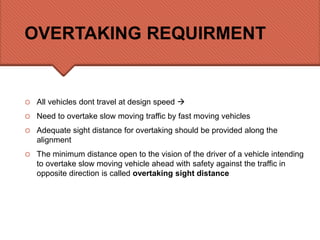
OVERTAKING REQUIRMENT
 All vehicles dont travel at design speed 
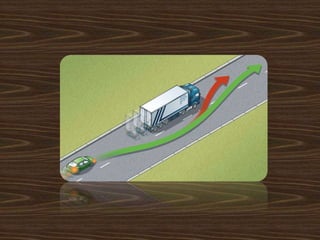
 Need to overtake slow moving traffic by fast moving vehicles
 Adequate sight distance for overtaking should be provided along the
alignment
 The minimum distance open to the vision of the driver of a vehicle intending
to overtake slow moving vehicle ahead with safety against the traffic in
opposite direction is called overtaking sight distance
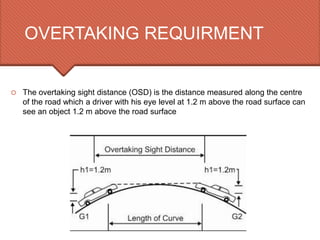
OVERTAKING REQUIRMENT
 The overtaking sight distance (OSD) is the distance measured along the centre
of the road which a driver with his eye level at 1.2 m above the road surface can
see an object 1.2 m above the road surface
FACTORS AFFECTING OSD
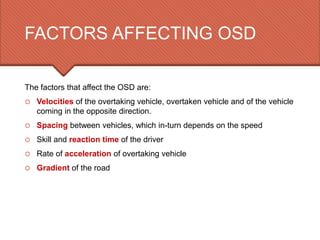
The factors that affect the OSD are:
 Velocities of the overtaking vehicle, overtaken vehicle and of the vehicle
coming in the opposite direction.
 Spacing between vehicles, which in-turn depends on the speed
 Skill and reaction time of the driver
 Rate of acceleration of overtaking vehicle
 Gradient of the road
ANALYSIS OF OSD (2 WAY ROAD)
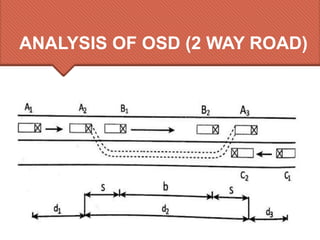
 A vehicle (A) travelling at design speed v  desires to
overtake a slow moving vehicle B travelling at vb
 The vehicle A has to wait till he get an opportunity to
overtake B  accelerate , shift to the opposite lane and
complete the overtaking
 Return to the left lane without colliding with opposite
coming vehicle C
 Fig is shown in next slide
ANALYSIS OF OSD (2 WAY ROAD)
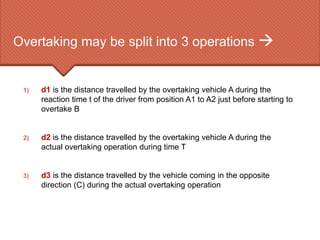
Overtaking may be split into 3 operations 
1) d1 is the distance travelled by the overtaking vehicle A during the
reaction time t of the driver from position A1 to A2 just before starting to
overtake B
2) d2 is the distance travelled by the overtaking vehicle A during the
actual overtaking operation during time T
3) d3 is the distance travelled by the vehicle coming in the opposite
direction (C) during the actual overtaking operation
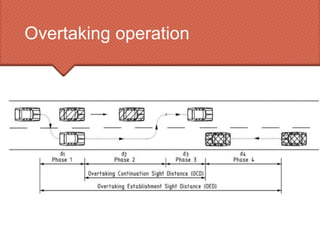
Overtaking operation
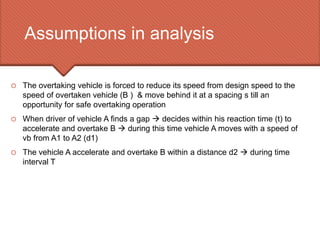
Assumptions in analysis
 The overtaking vehicle is forced to reduce its speed from design speed to the
speed of overtaken vehicle (B ) & move behind it at a spacing s till an
opportunity for safe overtaking operation
 When driver of vehicle A finds a gap  decides within his reaction time (t) to
accelerate and overtake B  during this time vehicle A moves with a speed of
vb from A1 to A2 (d1)
 The vehicle A accelerate and overtake B within a distance d2  during time
interval T
Assumptions in analysis
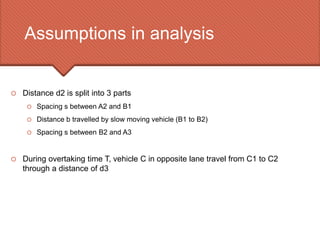
 Distance d2 is split into 3 parts
 Spacing s between A2 and B1
 Distance b travelled by slow moving vehicle (B1 to B2)
 Spacing s between B2 and A3
 During overtaking time T, vehicle C in opposite lane travel from C1 to C2
through a distance of d3
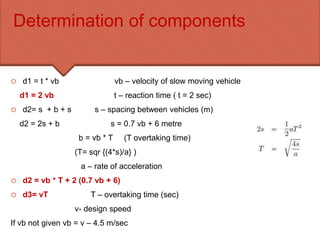
Determination of components
 d1 = t * vb vb – velocity of slow moving vehicle
d1 = 2 vb t – reaction time ( t = 2 sec)
 d2= s + b + s s – spacing between vehicles (m)
d2 = 2s + b s = 0.7 vb + 6 metre
b = vb * T (T overtaking time)
(T= sqr {(4*s)/a} )
a – rate of acceleration
 d2 = vb * T + 2 (0.7 vb + 6)
 d3= vT T – overtaking time (sec)
v- design speed
If vb not given vb = v – 4.5 m/sec
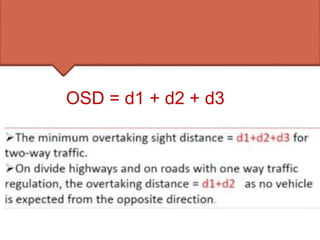
OSD = d1 + d2 + d3
Rate of acceleration Vs speed
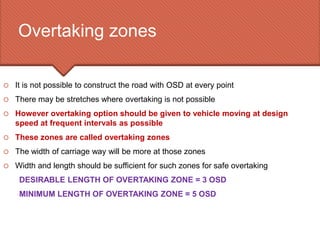
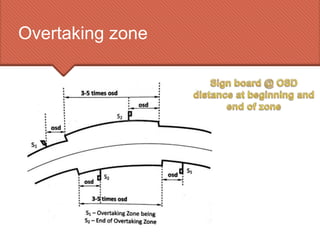
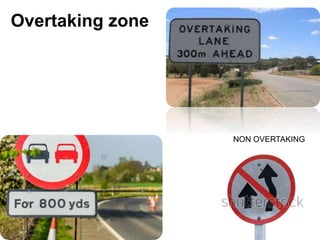
Overtaking zones
 It is not possible to construct the road with OSD at every point
 There may be stretches where overtaking is not possible
 However overtaking option should be given to vehicle moving at design
speed at frequent intervals as possible
 These zones are called overtaking zones
 The width of carriage way will be more at those zones
 Width and length should be sufficient for such zones for safe overtaking
DESIRABLE LENGTH OF OVERTAKING ZONE = 3 OSD
MINIMUM LENGTH OF OVERTAKING ZONE = 5 OSD
Overtaking zone
Overtaking zone
NON OVERTAKING
Intermediate sight distance
 If OSD cannot be provided  provide ISD
 ISD= 2 OSD
Head light sight distance
 The distance visible to a driver during night driving due to
head light
 HSD = SSD
Thank you
Lintels
For more…. Mail to aglaiaconnect2018@gmail.com

Overtaking sight distance

  • 1.
  • 2.
    OVERTAKING REQUIRMENT  Allvehicles dont travel at design speed   Need to overtake slow moving traffic by fast moving vehicles  Adequate sight distance for overtaking should be provided along the alignment  The minimum distance open to the vision of the driver of a vehicle intending to overtake slow moving vehicle ahead with safety against the traffic in opposite direction is called overtaking sight distance
  • 4.
    OVERTAKING REQUIRMENT  Theovertaking sight distance (OSD) is the distance measured along the centre of the road which a driver with his eye level at 1.2 m above the road surface can see an object 1.2 m above the road surface
  • 5.
    FACTORS AFFECTING OSD Thefactors that affect the OSD are:  Velocities of the overtaking vehicle, overtaken vehicle and of the vehicle coming in the opposite direction.  Spacing between vehicles, which in-turn depends on the speed  Skill and reaction time of the driver  Rate of acceleration of overtaking vehicle  Gradient of the road
  • 6.
    ANALYSIS OF OSD(2 WAY ROAD)  A vehicle (A) travelling at design speed v  desires to overtake a slow moving vehicle B travelling at vb  The vehicle A has to wait till he get an opportunity to overtake B  accelerate , shift to the opposite lane and complete the overtaking  Return to the left lane without colliding with opposite coming vehicle C  Fig is shown in next slide
  • 7.
    ANALYSIS OF OSD(2 WAY ROAD)
  • 8.
    Overtaking may besplit into 3 operations  1) d1 is the distance travelled by the overtaking vehicle A during the reaction time t of the driver from position A1 to A2 just before starting to overtake B 2) d2 is the distance travelled by the overtaking vehicle A during the actual overtaking operation during time T 3) d3 is the distance travelled by the vehicle coming in the opposite direction (C) during the actual overtaking operation
  • 9.
  • 10.
    Assumptions in analysis The overtaking vehicle is forced to reduce its speed from design speed to the speed of overtaken vehicle (B ) & move behind it at a spacing s till an opportunity for safe overtaking operation  When driver of vehicle A finds a gap  decides within his reaction time (t) to accelerate and overtake B  during this time vehicle A moves with a speed of vb from A1 to A2 (d1)  The vehicle A accelerate and overtake B within a distance d2  during time interval T
  • 11.
    Assumptions in analysis Distance d2 is split into 3 parts  Spacing s between A2 and B1  Distance b travelled by slow moving vehicle (B1 to B2)  Spacing s between B2 and A3  During overtaking time T, vehicle C in opposite lane travel from C1 to C2 through a distance of d3
  • 12.
    Determination of components d1 = t * vb vb – velocity of slow moving vehicle d1 = 2 vb t – reaction time ( t = 2 sec)  d2= s + b + s s – spacing between vehicles (m) d2 = 2s + b s = 0.7 vb + 6 metre b = vb * T (T overtaking time) (T= sqr {(4*s)/a} ) a – rate of acceleration  d2 = vb * T + 2 (0.7 vb + 6)  d3= vT T – overtaking time (sec) v- design speed If vb not given vb = v – 4.5 m/sec
  • 13.
    OSD = d1+ d2 + d3
  • 14.
  • 15.
    Overtaking zones  Itis not possible to construct the road with OSD at every point  There may be stretches where overtaking is not possible  However overtaking option should be given to vehicle moving at design speed at frequent intervals as possible  These zones are called overtaking zones  The width of carriage way will be more at those zones  Width and length should be sufficient for such zones for safe overtaking DESIRABLE LENGTH OF OVERTAKING ZONE = 3 OSD MINIMUM LENGTH OF OVERTAKING ZONE = 5 OSD
  • 16.
  • 18.
  • 19.
    Intermediate sight distance If OSD cannot be provided  provide ISD  ISD= 2 OSD Head light sight distance  The distance visible to a driver during night driving due to head light  HSD = SSD
  • 20.
    Thank you Lintels For more….Mail to aglaiaconnect2018@gmail.com