Learning Styles Freshman English Unit 2: Listening & Communication Mr. Hill
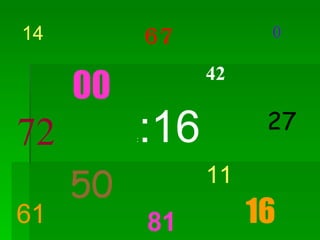
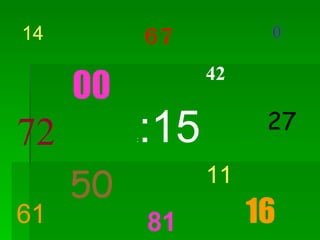
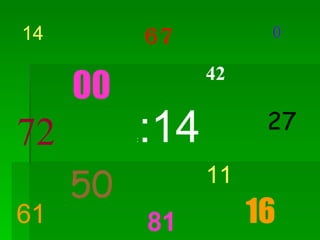
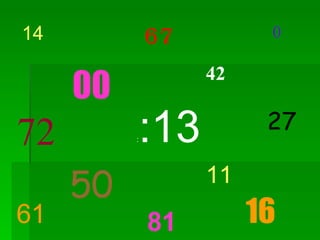
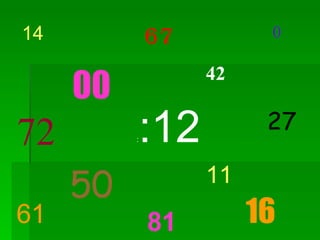
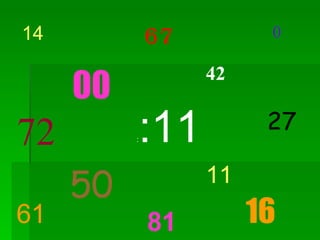
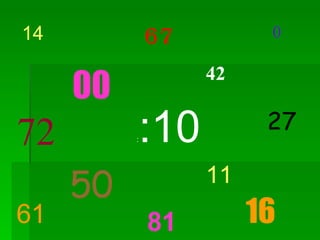
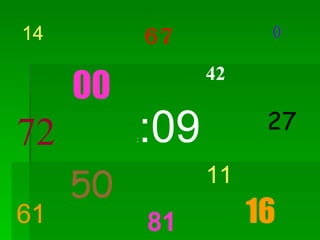
Activity #1 You will be shown a screen with many different numbers in many different colors. You will have 30 seconds to look at the screen. When the time is up, you will be asked a few questions about what you saw.
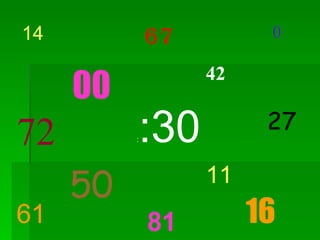
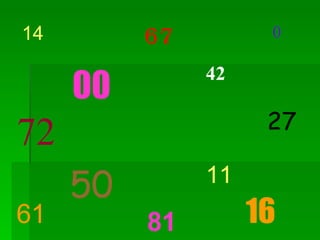
14 67 0 72 61 27 16 81 00 42 11 50 : :30
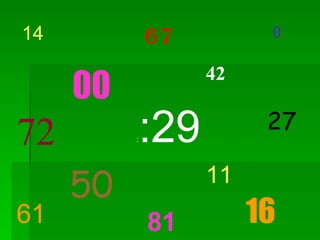
14 67 0 72 61 27 16 81 00 42 11 50 : :29
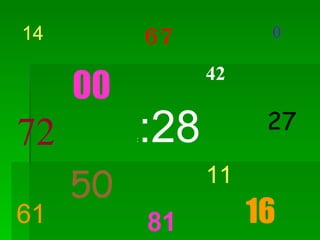
14 67 0 72 61 27 16 81 00 42 11 50 : :28
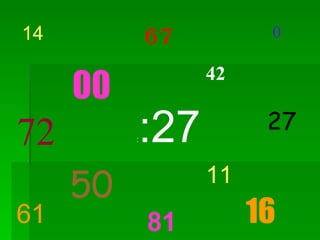
14 67 0 72 61 27 16 81 00 42 11 50 : :27
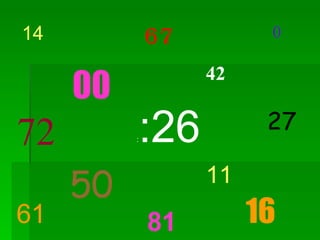
14 67 0 72 61 27 16 81 00 42 11 50 : :26
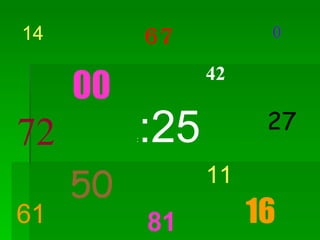
14 67 0 72 61 27 16 81 00 42 11 50 : :25
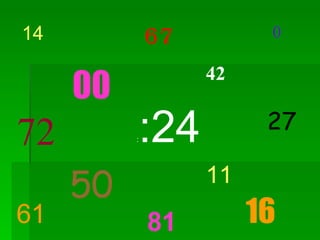
14 67 0 72 61 27 16 81 00 42 11 50 : :24
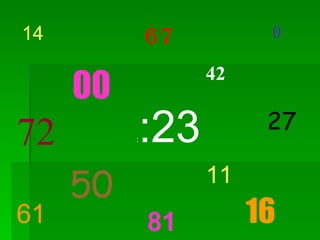
14 67 0 72 61 27 16 81 00 42 11 50 : :23
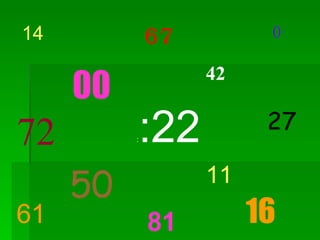
14 67 0 72 61 27 16 81 00 42 11 50 : :22
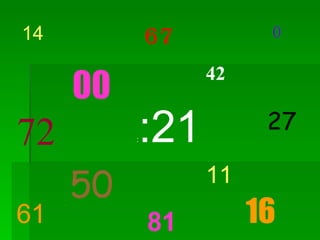
14 67 0 72 61 27 16 81 00 42 11 50 : :21
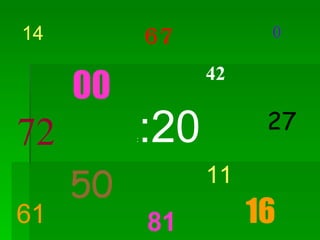
14 67 0 72 61 27 16 81 00 42 11 50 : :20
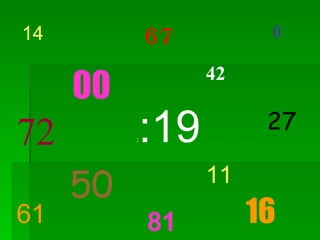
14 67 0 72 61 27 16 81 00 42 11 50 : :19
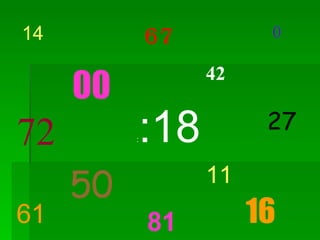
14 67 0 72 61 27 16 81 00 42 11 50 : :18
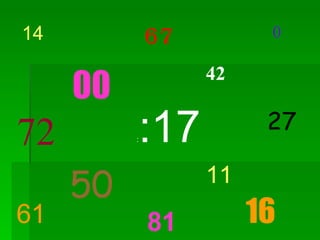
14 67 0 72 61 27 16 81 00 42 11 50 : :17
14 67 0 72 61 27 16 81 00 42 11 50 : :16
14 67 0 72 61 27 16 81 00 42 11 50 : :15
14 67 0 72 61 27 16 81 00 42 11 50 : :14
14 67 0 72 61 27 16 81 00 42 11 50 : :13
14 67 0 72 61 27 16 81 00 42 11 50 : :12
14 67 0 72 61 27 16 81 00 42 11 50 : :11
14 67 0 72 61 27 16 81 00 42 11 50 : :10
14 67 0 72 61 27 16 81 00 42 11 50 : :09
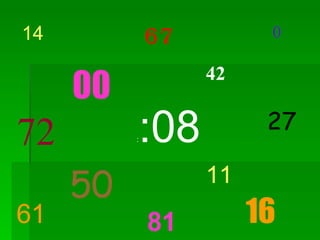
14 67 0 72 61 27 16 81 00 42 11 50 : :08
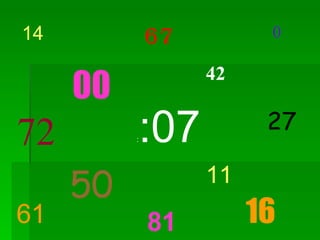
14 67 0 72 61 27 16 81 00 42 11 50 : :07
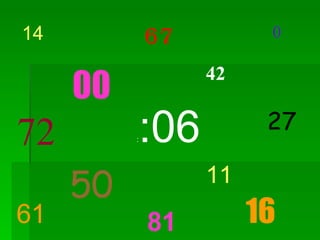
14 67 0 72 61 27 16 81 00 42 11 50 : :06
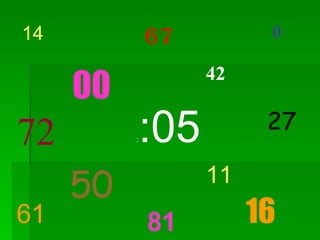
14 67 0 72 61 27 16 81 00 42 11 50 : :05
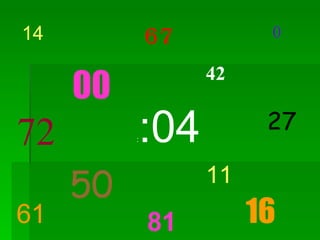
14 67 0 72 61 27 16 81 00 42 11 50 : :04
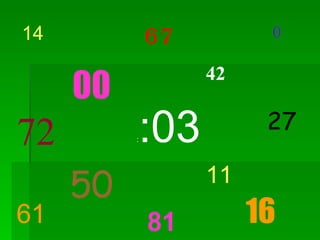
14 67 0 72 61 27 16 81 00 42 11 50 : :03
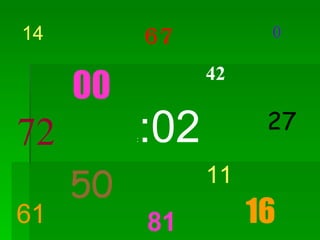
14 67 0 72 61 27 16 81 00 42 11 50 : :02
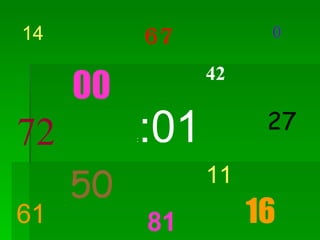
14 67 0 72 61 27 16 81 00 42 11 50 : :01
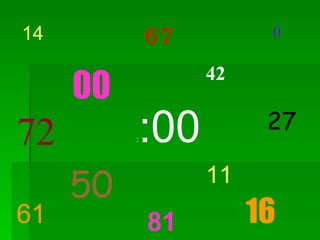
14 67 0 72 61 27 16 81 00 42 11 50 : :00
TIME’S UP
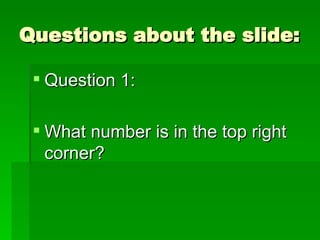
Questions about the slide: Question 1: What number is in the top right corner?
Questions about the slide: Question 2: What number is in the lower left corner?
Questions about the slide: Question 3: What number is in the left center?
Questions about the slide: Question 4: What number is in the bottom right corner?
Questions about the slide: Question 5: Besides the timer, what was the only white number?
Questions about the slide: Question 6: What was the highest number on the screen?
Questions about the slide: Question 7: What the largest sized number that was shown in orange?
Questions about the slide: Question 8: What were the two numbers that was shown in yellow?
Questions about the slide: Question 9: What number was in the top center of the screen?
Questions about the slide: Question 10: What was the only number shown in black?
14 67 0 72 61 27 16 81 00 42 11 50
What does it all mean? Your tendency toward being a visual learner can be VERY LOOSELY based upon the answers to your questions. Look at the following scale and see where your visual skills rank:
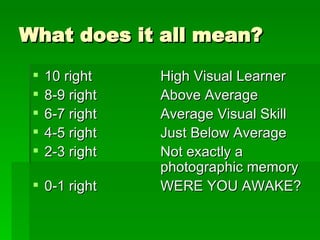
What does it all mean? 10 right High Visual Learner 8-9 right Above Average 6-7 right Average Visual Skill 4-5 right Just Below Average 2-3 right Not exactly a  photographic memory 0-1 right WERE YOU AWAKE?
Another Style of Learning For this activity, the results are a bit less exact. Often, the results completely backfire. However, when it works it is hard to explain. Listen to the directions and try not to work extra hard during the activity.
Activity #2: You will be numbered off from 1-3. All of the people who get a “1” will need to place their dominant hand on the corner of their desk and hold a pencil or pen in their mouth.
Activity #2: You will be numbered off from 1-3. All of the people who get a “2” will need to place their non-dominant hand on the corner of their desk and hold their dominant hand up in the air.
Activity #2: You will be numbered off from 1-3. All of the people who get a “3” will need to sit in their normal position and just be as comfortable as they can in their seats.
Activity #2: I will now read you a list of 15 names. When I finish the list, there will be five questions over the list. When the last name is read, everyone can resume a normal position in their seats.
Activity #2: HERE IS YOUR LIST OF NAMES
Activity #2 (continued) All of the “1” students here are questions for you.
“1” Student Questions: 1. What was the first name on the list? 2. What was the last name on the list? 3. What was the longest name on the list? 4. What were the only three girls names on the list? 5. What was the shortest name on the list?
“2” Student Questions: 1. What was the first boys name on the list? 2. What was the second name on the list? 3. What was the next to last name on the list? 4. What were the only two names on the list that started with “S”? 5. What was the only name on the list to start with a “V”?
“3” Student Questions: 1. What was the second boys name on the list? 2. What was the only name on the list with an “X” in the name? 3. What was the last girls name on the list? 4. What was the last boys name on the list? 5. How many names were on the list?
Looking at Learning Styles We will take a look at each of the three learning styles and see what the characteristics are for each. You will need to fill these in on the chart that you have been given. While this presentation will be on the web page, the chart will not be filled in.
VISUAL LEARNERS: We will take a look at each of the three learning styles and see what the characteristics are for each. You will need to fill these in on the chart that you have been given. While this presentation will be on the web page, the chart will not be filled in.
VISUAL LEARNERS: 1. Optical Enhancement is the key. 2. Posters & Charts are useful. These & photos are the top two methods. 85% retention rate (average) for use of charts. 75% retention rate (average) for use of posters or bulletin boards. Rates higher with explanations.
VISUAL LEARNERS: 3. There are more visual learners than other kinds. 4. It is based on the idea of the positioning of items. 5. Visual learners are often seen as “daydreamers” because they have to reconstruct pictures in their minds. 6. Often very intelligent people.
AUDITORY LEARNERS: 1. Based on learners who do better by hearing AND seeing new material. 2. Very likely to ask questions during a lecture. It offers them a second chance. 3. Find tape recording lectures useful. 4. Classical music can help retention.
AUDITORY LEARNERS: 4. Classical music can help (continued) 60% without music (average) 95% with music (average) 5. Are very good readers due to practice with reading things out loud. 6. Quiet times are very frustrating. 7. This is the 2 nd  most-found style.
AUDITORY LEARNERS: 8. It is the easiest style of learning to pick up if it is a weakness in someone.
KINESTHETIC LEARNERS: 1. Based upon the idea that motion is useful for learning. 2. Hand gestures and positioning of the body are important. 3. Find it easier to learn with large amounts of space available. They are often seen as “immature” or “pushy” because they want “their space.”
KINESTHETIC LEARNERS: 4. Copying or re-copying material is helpful due to the motion involved. 90% retention rate (average) for re-copying notes material. 5. Difficulty in learning in “traditional” educational set-up. They feel “confined.”
ACTIVITY TIME: You will be divided up into groups and given a task. Each group will have a different set of guidelines. Your job is to complete the task within 15 minutes. When you are finished, your final product will be “judged” according to how well it “stands the test of time.”

Learning Styles Presentation

  • 1.
    Learning Styles FreshmanEnglish Unit 2: Listening & Communication Mr. Hill
  • 2.
    Activity #1 Youwill be shown a screen with many different numbers in many different colors. You will have 30 seconds to look at the screen. When the time is up, you will be asked a few questions about what you saw.
  • 3.
    14 67 072 61 27 16 81 00 42 11 50 : :30
  • 4.
    14 67 072 61 27 16 81 00 42 11 50 : :29
  • 5.
    14 67 072 61 27 16 81 00 42 11 50 : :28
  • 6.
    14 67 072 61 27 16 81 00 42 11 50 : :27
  • 7.
    14 67 072 61 27 16 81 00 42 11 50 : :26
  • 8.
    14 67 072 61 27 16 81 00 42 11 50 : :25
  • 9.
    14 67 072 61 27 16 81 00 42 11 50 : :24
  • 10.
    14 67 072 61 27 16 81 00 42 11 50 : :23
  • 11.
    14 67 072 61 27 16 81 00 42 11 50 : :22
  • 12.
    14 67 072 61 27 16 81 00 42 11 50 : :21
  • 13.
    14 67 072 61 27 16 81 00 42 11 50 : :20
  • 14.
    14 67 072 61 27 16 81 00 42 11 50 : :19
  • 15.
    14 67 072 61 27 16 81 00 42 11 50 : :18
  • 16.
    14 67 072 61 27 16 81 00 42 11 50 : :17
  • 17.
    14 67 072 61 27 16 81 00 42 11 50 : :16
  • 18.
    14 67 072 61 27 16 81 00 42 11 50 : :15
  • 19.
    14 67 072 61 27 16 81 00 42 11 50 : :14
  • 20.
    14 67 072 61 27 16 81 00 42 11 50 : :13
  • 21.
    14 67 072 61 27 16 81 00 42 11 50 : :12
  • 22.
    14 67 072 61 27 16 81 00 42 11 50 : :11
  • 23.
    14 67 072 61 27 16 81 00 42 11 50 : :10
  • 24.
    14 67 072 61 27 16 81 00 42 11 50 : :09
  • 25.
    14 67 072 61 27 16 81 00 42 11 50 : :08
  • 26.
    14 67 072 61 27 16 81 00 42 11 50 : :07
  • 27.
    14 67 072 61 27 16 81 00 42 11 50 : :06
  • 28.
    14 67 072 61 27 16 81 00 42 11 50 : :05
  • 29.
    14 67 072 61 27 16 81 00 42 11 50 : :04
  • 30.
    14 67 072 61 27 16 81 00 42 11 50 : :03
  • 31.
    14 67 072 61 27 16 81 00 42 11 50 : :02
  • 32.
    14 67 072 61 27 16 81 00 42 11 50 : :01
  • 33.
    14 67 072 61 27 16 81 00 42 11 50 : :00
  • 34.
  • 35.
    Questions about theslide: Question 1: What number is in the top right corner?
  • 36.
    Questions about theslide: Question 2: What number is in the lower left corner?
  • 37.
    Questions about theslide: Question 3: What number is in the left center?
  • 38.
    Questions about theslide: Question 4: What number is in the bottom right corner?
  • 39.
    Questions about theslide: Question 5: Besides the timer, what was the only white number?
  • 40.
    Questions about theslide: Question 6: What was the highest number on the screen?
  • 41.
    Questions about theslide: Question 7: What the largest sized number that was shown in orange?
  • 42.
    Questions about theslide: Question 8: What were the two numbers that was shown in yellow?
  • 43.
    Questions about theslide: Question 9: What number was in the top center of the screen?
  • 44.
    Questions about theslide: Question 10: What was the only number shown in black?
  • 45.
    14 67 072 61 27 16 81 00 42 11 50
  • 46.
    What does itall mean? Your tendency toward being a visual learner can be VERY LOOSELY based upon the answers to your questions. Look at the following scale and see where your visual skills rank:
  • 47.
    What does itall mean? 10 right High Visual Learner 8-9 right Above Average 6-7 right Average Visual Skill 4-5 right Just Below Average 2-3 right Not exactly a photographic memory 0-1 right WERE YOU AWAKE?
  • 48.
    Another Style ofLearning For this activity, the results are a bit less exact. Often, the results completely backfire. However, when it works it is hard to explain. Listen to the directions and try not to work extra hard during the activity.
  • 49.
    Activity #2: Youwill be numbered off from 1-3. All of the people who get a “1” will need to place their dominant hand on the corner of their desk and hold a pencil or pen in their mouth.
  • 50.
    Activity #2: Youwill be numbered off from 1-3. All of the people who get a “2” will need to place their non-dominant hand on the corner of their desk and hold their dominant hand up in the air.
  • 51.
    Activity #2: Youwill be numbered off from 1-3. All of the people who get a “3” will need to sit in their normal position and just be as comfortable as they can in their seats.
  • 52.
    Activity #2: Iwill now read you a list of 15 names. When I finish the list, there will be five questions over the list. When the last name is read, everyone can resume a normal position in their seats.
  • 53.
    Activity #2: HEREIS YOUR LIST OF NAMES
  • 54.
    Activity #2 (continued)All of the “1” students here are questions for you.
  • 55.
    “1” Student Questions:1. What was the first name on the list? 2. What was the last name on the list? 3. What was the longest name on the list? 4. What were the only three girls names on the list? 5. What was the shortest name on the list?
  • 56.
    “2” Student Questions:1. What was the first boys name on the list? 2. What was the second name on the list? 3. What was the next to last name on the list? 4. What were the only two names on the list that started with “S”? 5. What was the only name on the list to start with a “V”?
  • 57.
    “3” Student Questions:1. What was the second boys name on the list? 2. What was the only name on the list with an “X” in the name? 3. What was the last girls name on the list? 4. What was the last boys name on the list? 5. How many names were on the list?
  • 58.
    Looking at LearningStyles We will take a look at each of the three learning styles and see what the characteristics are for each. You will need to fill these in on the chart that you have been given. While this presentation will be on the web page, the chart will not be filled in.
  • 59.
    VISUAL LEARNERS: Wewill take a look at each of the three learning styles and see what the characteristics are for each. You will need to fill these in on the chart that you have been given. While this presentation will be on the web page, the chart will not be filled in.
  • 60.
    VISUAL LEARNERS: 1.Optical Enhancement is the key. 2. Posters & Charts are useful. These & photos are the top two methods. 85% retention rate (average) for use of charts. 75% retention rate (average) for use of posters or bulletin boards. Rates higher with explanations.
  • 61.
    VISUAL LEARNERS: 3.There are more visual learners than other kinds. 4. It is based on the idea of the positioning of items. 5. Visual learners are often seen as “daydreamers” because they have to reconstruct pictures in their minds. 6. Often very intelligent people.
  • 62.
    AUDITORY LEARNERS: 1.Based on learners who do better by hearing AND seeing new material. 2. Very likely to ask questions during a lecture. It offers them a second chance. 3. Find tape recording lectures useful. 4. Classical music can help retention.
  • 63.
    AUDITORY LEARNERS: 4.Classical music can help (continued) 60% without music (average) 95% with music (average) 5. Are very good readers due to practice with reading things out loud. 6. Quiet times are very frustrating. 7. This is the 2 nd most-found style.
  • 64.
    AUDITORY LEARNERS: 8.It is the easiest style of learning to pick up if it is a weakness in someone.
  • 65.
    KINESTHETIC LEARNERS: 1.Based upon the idea that motion is useful for learning. 2. Hand gestures and positioning of the body are important. 3. Find it easier to learn with large amounts of space available. They are often seen as “immature” or “pushy” because they want “their space.”
  • 66.
    KINESTHETIC LEARNERS: 4.Copying or re-copying material is helpful due to the motion involved. 90% retention rate (average) for re-copying notes material. 5. Difficulty in learning in “traditional” educational set-up. They feel “confined.”
  • 67.
    ACTIVITY TIME: Youwill be divided up into groups and given a task. Each group will have a different set of guidelines. Your job is to complete the task within 15 minutes. When you are finished, your final product will be “judged” according to how well it “stands the test of time.”