Casey Emmerling and Maya Brown
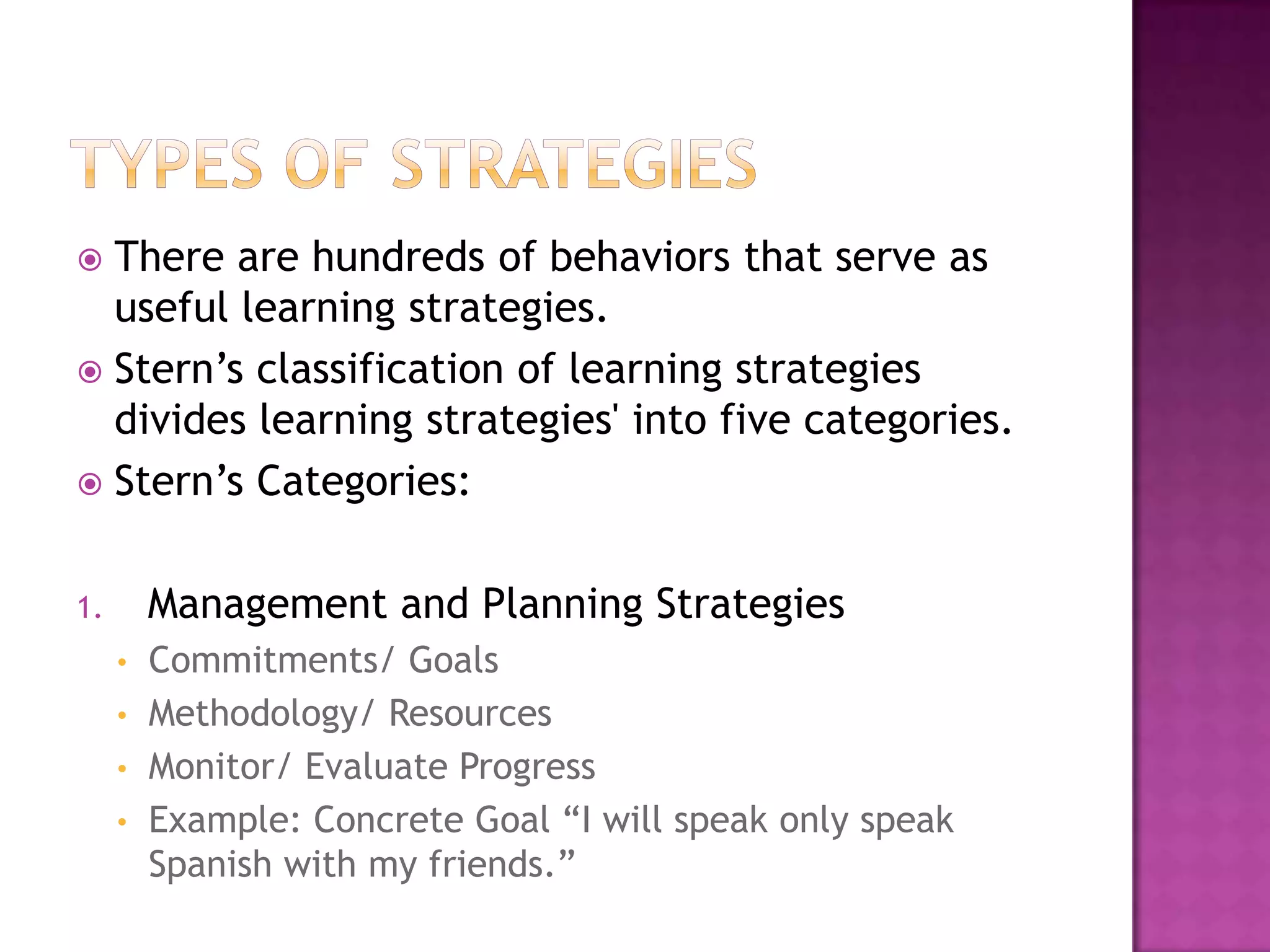
 There are hundreds of behaviors that serve as
  useful learning strategies.
 Stern’s classification of learning strategies
  divides learning strategies' into five categories.
 Stern’s Categories:


1.       Management and Planning Strategies
     • Commitments/ Goals
     • Methodology/ Resources
     • Monitor/ Evaluate Progress
     • Example: Concrete Goal “I will speak only speak
       Spanish with my friends.”
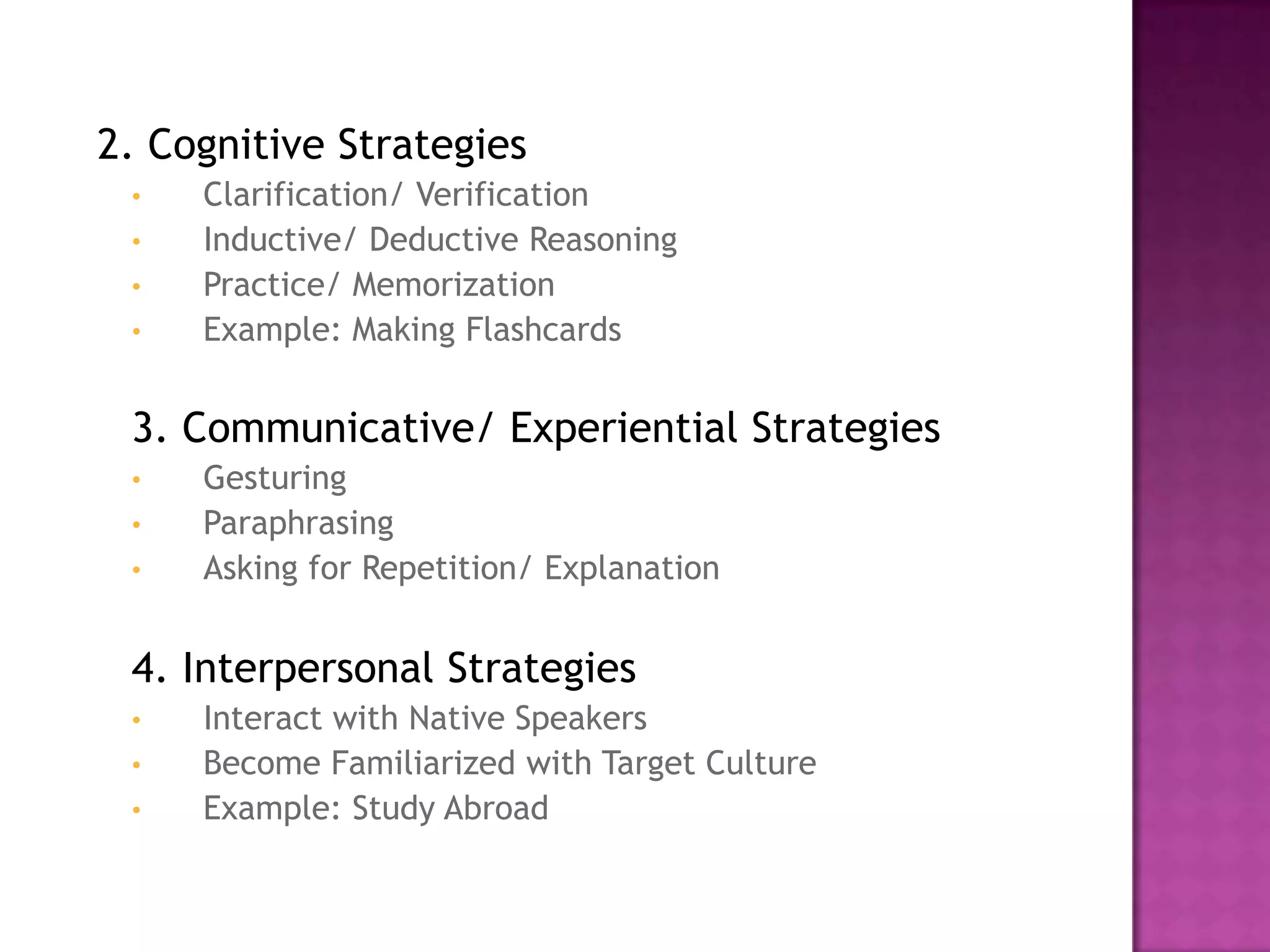
2. Cognitive Strategies
 •   Clarification/ Verification
 •   Inductive/ Deductive Reasoning
 •   Practice/ Memorization
 •   Example: Making Flashcards


 3. Communicative/ Experiential Strategies
 •   Gesturing
 •   Paraphrasing
 •   Asking for Repetition/ Explanation


 4. Interpersonal Strategies
 •   Interact with Native Speakers
 •   Become Familiarized with Target Culture
 •   Example: Study Abroad
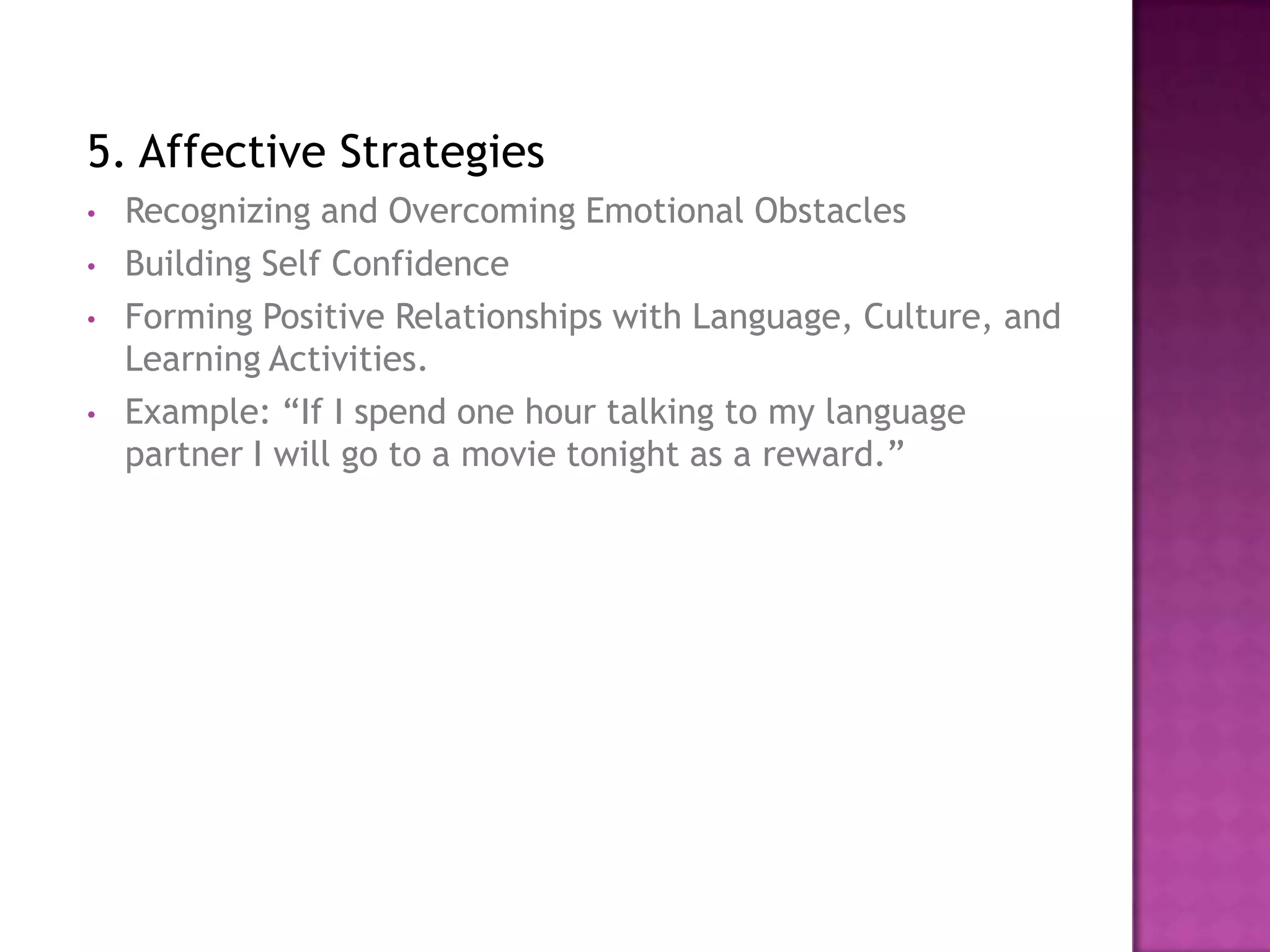
5. Affective Strategies
•   Recognizing and Overcoming Emotional Obstacles
•   Building Self Confidence
•   Forming Positive Relationships with Language, Culture, and
    Learning Activities.
•   Example: “If I spend one hour talking to my language
    partner I will go to a movie tonight as a reward.”
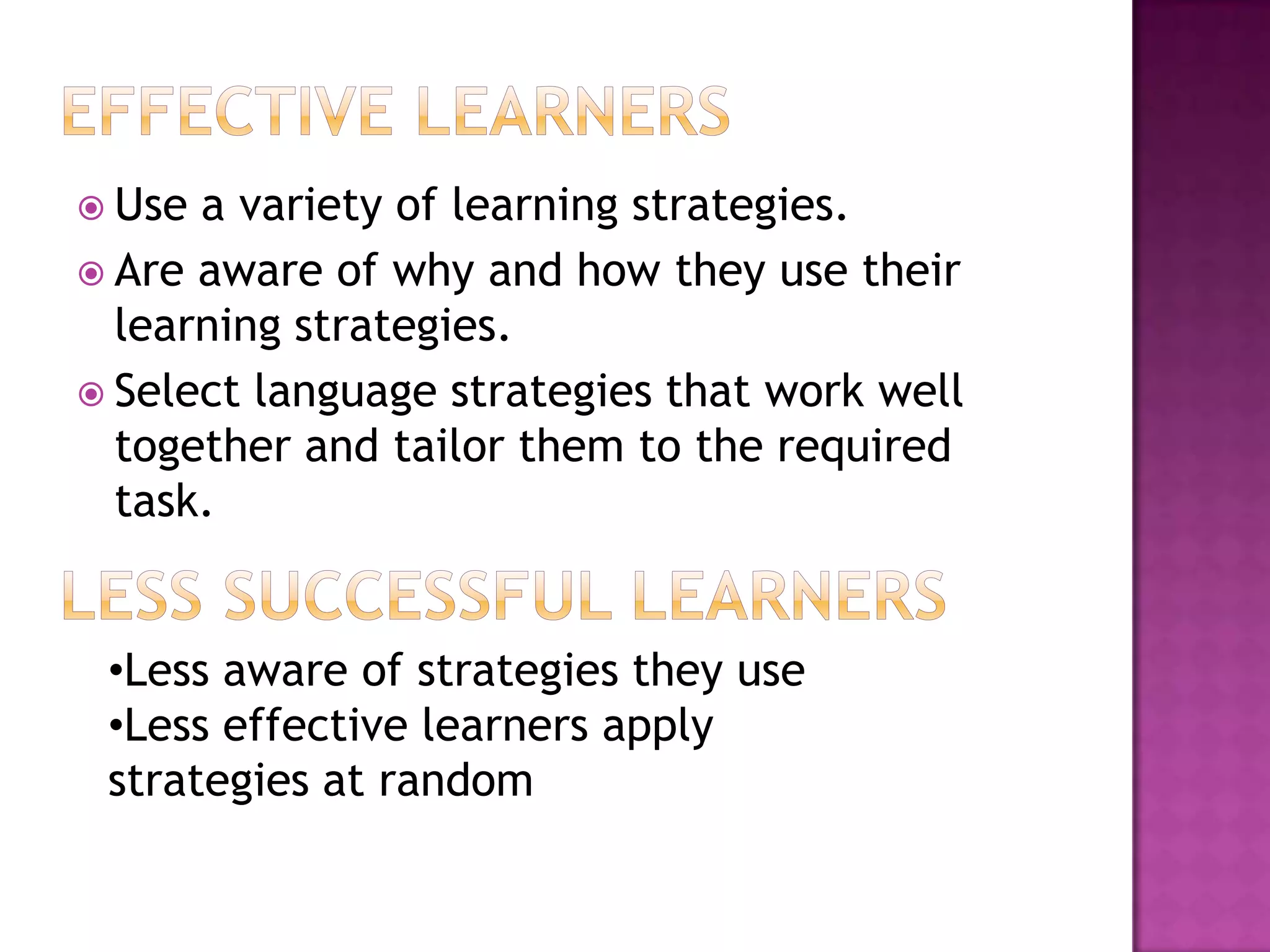
 Use a variety of learning strategies.
 Are aware of why and how they use their
  learning strategies.
 Select language strategies that work well
  together and tailor them to the required
  task.


 •Less aware of strategies they use
 •Less effective learners apply
 strategies at random
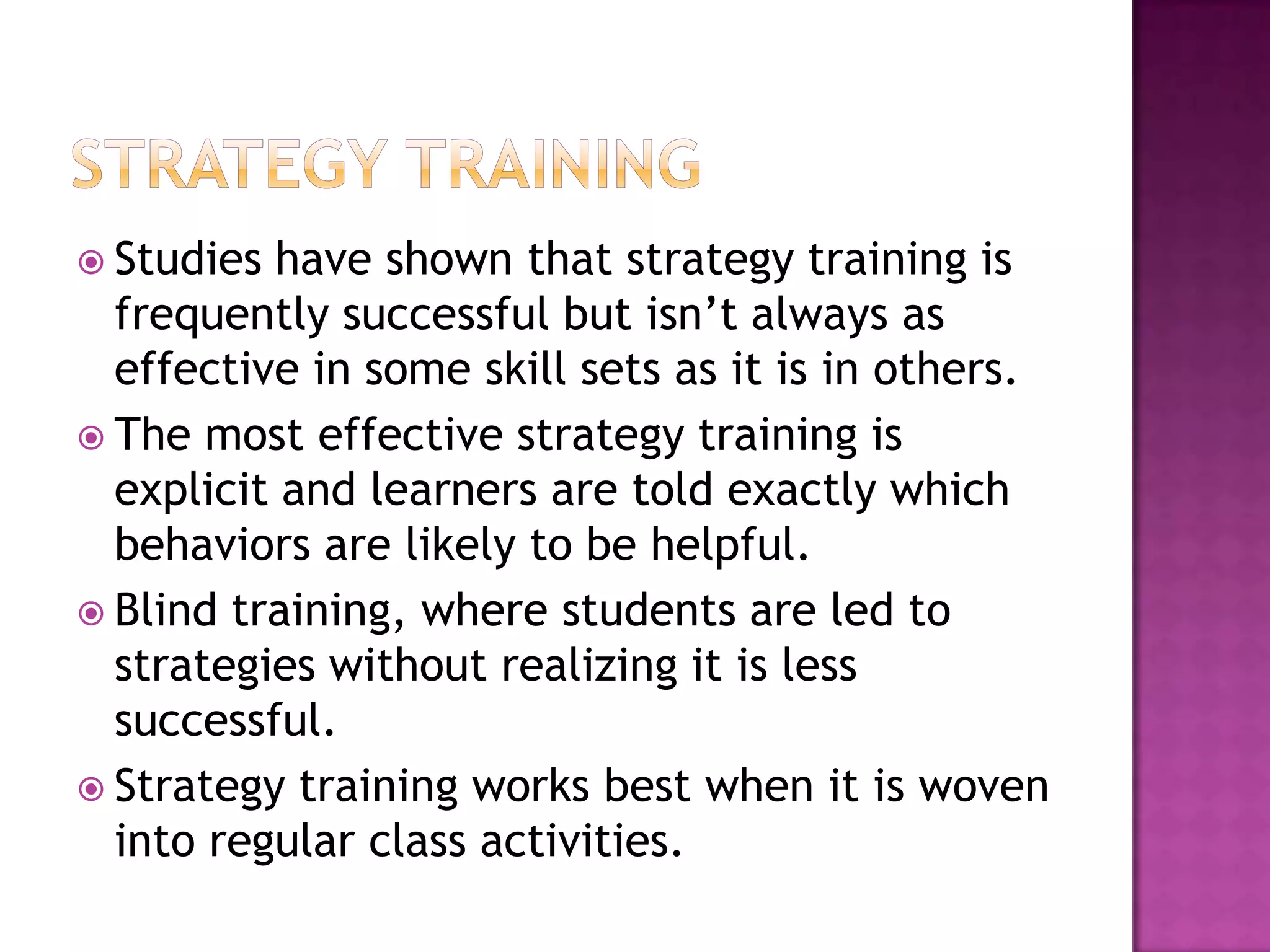
 Studies  have shown that strategy training is
  frequently successful but isn’t always as
  effective in some skill sets as it is in others.
 The most effective strategy training is
  explicit and learners are told exactly which
  behaviors are likely to be helpful.
 Blind training, where students are led to
  strategies without realizing it is less
  successful.
 Strategy training works best when it is woven
  into regular class activities.
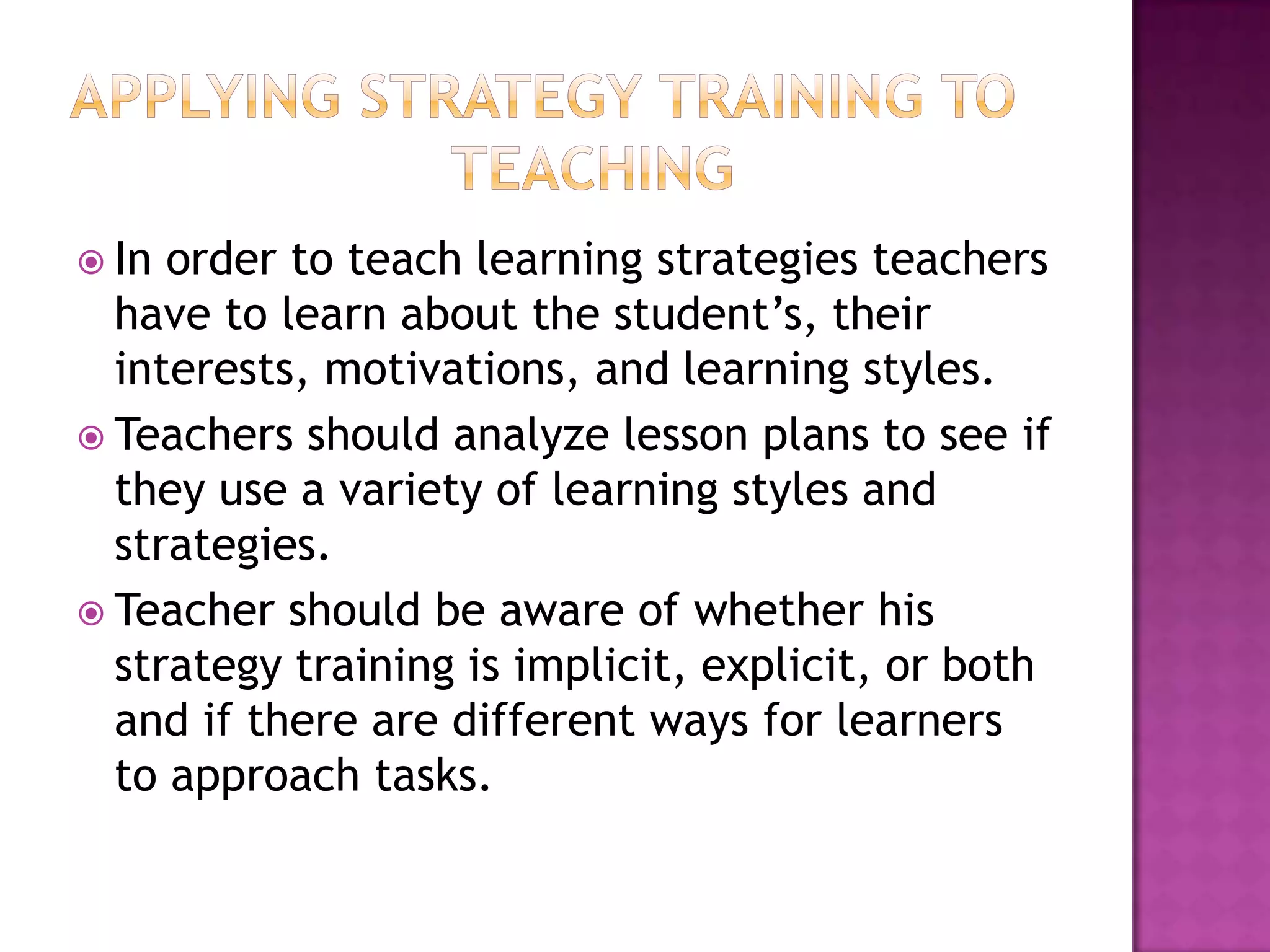
 In order to teach learning strategies teachers
  have to learn about the student’s, their
  interests, motivations, and learning styles.
 Teachers should analyze lesson plans to see if
  they use a variety of learning styles and
  strategies.
 Teacher should be aware of whether his
  strategy training is implicit, explicit, or both
  and if there are different ways for learners
  to approach tasks.
 Learning Strategies-
  http://www2.elc.polyu.edu.hk/CILL/strategy
  .htm
 Language Learning Strategies in Foreign
  Language Learning and Teaching-
  http://iteslj.org/Articles/Hismanoglu-
  Strategies.html

Learning strategies

  • 1.
  • 2.
     There arehundreds of behaviors that serve as useful learning strategies.  Stern’s classification of learning strategies divides learning strategies' into five categories.  Stern’s Categories: 1. Management and Planning Strategies • Commitments/ Goals • Methodology/ Resources • Monitor/ Evaluate Progress • Example: Concrete Goal “I will speak only speak Spanish with my friends.”
  • 3.
    2. Cognitive Strategies • Clarification/ Verification • Inductive/ Deductive Reasoning • Practice/ Memorization • Example: Making Flashcards 3. Communicative/ Experiential Strategies • Gesturing • Paraphrasing • Asking for Repetition/ Explanation 4. Interpersonal Strategies • Interact with Native Speakers • Become Familiarized with Target Culture • Example: Study Abroad
  • 4.
    5. Affective Strategies • Recognizing and Overcoming Emotional Obstacles • Building Self Confidence • Forming Positive Relationships with Language, Culture, and Learning Activities. • Example: “If I spend one hour talking to my language partner I will go to a movie tonight as a reward.”
  • 5.
     Use avariety of learning strategies.  Are aware of why and how they use their learning strategies.  Select language strategies that work well together and tailor them to the required task. •Less aware of strategies they use •Less effective learners apply strategies at random
  • 6.
     Studies have shown that strategy training is frequently successful but isn’t always as effective in some skill sets as it is in others.  The most effective strategy training is explicit and learners are told exactly which behaviors are likely to be helpful.  Blind training, where students are led to strategies without realizing it is less successful.  Strategy training works best when it is woven into regular class activities.
  • 7.
     In orderto teach learning strategies teachers have to learn about the student’s, their interests, motivations, and learning styles.  Teachers should analyze lesson plans to see if they use a variety of learning styles and strategies.  Teacher should be aware of whether his strategy training is implicit, explicit, or both and if there are different ways for learners to approach tasks.
  • 8.
     Learning Strategies- http://www2.elc.polyu.edu.hk/CILL/strategy .htm  Language Learning Strategies in Foreign Language Learning and Teaching- http://iteslj.org/Articles/Hismanoglu- Strategies.html