Learning Styles
ATU PhD
Course: SLA theories
Professor: Dr. Khatib
Prepared by: M.Soleimani Aghchay
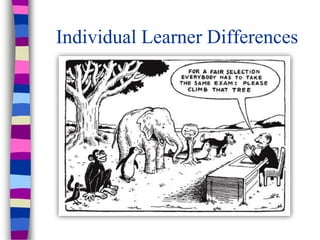
Individual Learner Differences
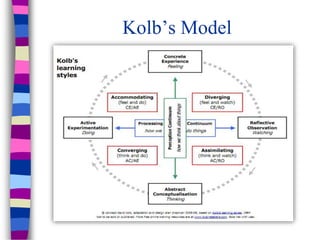
Kolb’s Model
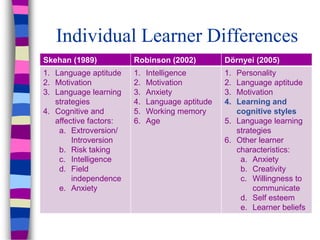
Individual Learner Differences
Skehan (1989) Robinson (2002) Dörnyei (2005)
1. Language aptitude
2. Motivation
3. Language learning
strategies
4. Cognitive and
affective factors:
a. Extroversion/
Introversion
b. Risk taking
c. Intelligence
d. Field
independence
e. Anxiety
1. Intelligence
2. Motivation
3. Anxiety
4. Language aptitude
5. Working memory
6. Age
1. Personality
2. Language aptitude
3. Motivation
4. Learning and
cognitive styles
5. Language learning
strategies
6. Other learner
characteristics:
a. Anxiety
b. Creativity
c. Willingness to
communicate
d. Self esteem
e. Learner beliefs
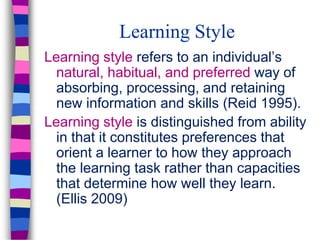
Learning Style
Learning style refers to an individual’s
natural, habitual, and preferred way of
absorbing, processing, and retaining
new information and skills (Reid 1995).
Learning style is distinguished from ability
in that it constitutes preferences that
orient a learner to how they approach
the learning task rather than capacities
that determine how well they learn.
(Ellis 2009)
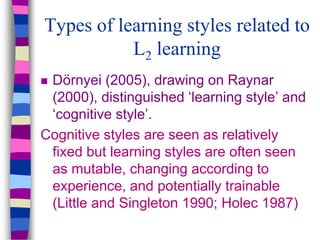
Types of learning styles related to
L2 learning
 Dörnyei (2005), drawing on Raynar
(2000), distinguished ‘learning style’ and
‘cognitive style’.
Cognitive styles are seen as relatively
fixed but learning styles are often seen
as mutable, changing according to
experience, and potentially trainable
(Little and Singleton 1990; Holec 1987)
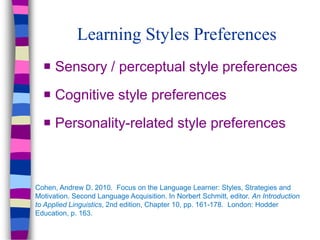
Learning Styles Preferences
 Sensory / perceptual style preferences
 Cognitive style preferences
 Personality-related style preferences
Cohen, Andrew D. 2010. Focus on the Language Learner: Styles, Strategies and
Motivation. Second Language Acquisition. In Norbert Schmitt, editor. An Introduction
to Applied Linguistics, 2nd edition, Chapter 10, pp. 161-178. London: Hodder
Education, p. 163.
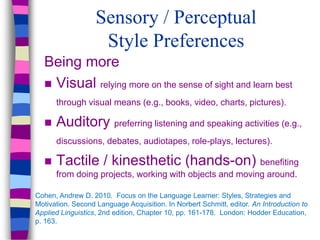
Sensory / Perceptual
Style Preferences
Being more
 Visual relying more on the sense of sight and learn best
through visual means (e.g., books, video, charts, pictures).
 Auditory preferring listening and speaking activities (e.g.,
discussions, debates, audiotapes, role-plays, lectures).
 Tactile / kinesthetic (hands-on) benefiting
from doing projects, working with objects and moving around.
Cohen, Andrew D. 2010. Focus on the Language Learner: Styles, Strategies and
Motivation. Second Language Acquisition. In Norbert Schmitt, editor. An Introduction to
Applied Linguistics, 2nd edition, Chapter 10, pp. 161-178. London: Hodder Education,
p. 163.
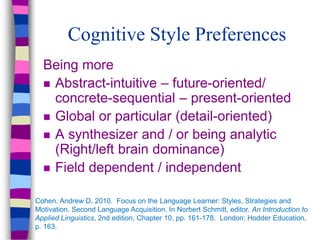
Cognitive Style Preferences
Being more
 Abstract-intuitive – future-oriented/
concrete-sequential – present-oriented
 Global or particular (detail-oriented)
 A synthesizer and / or being analytic
(Right/left brain dominance)
 Field dependent / independent
Cohen, Andrew D. 2010. Focus on the Language Learner: Styles, Strategies and
Motivation. Second Language Acquisition. In Norbert Schmitt, editor. An Introduction to
Applied Linguistics, 2nd edition, Chapter 10, pp. 161-178. London: Hodder Education,
p. 163.
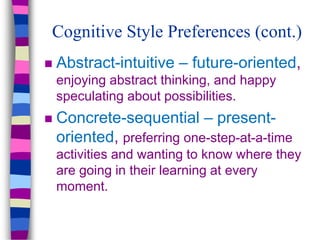
Cognitive Style Preferences (cont.)
 Abstract-intuitive – future-oriented,
enjoying abstract thinking, and happy
speculating about possibilities.
 Concrete-sequential – present-
oriented, preferring one-step-at-a-time
activities and wanting to know where they
are going in their learning at every
moment.
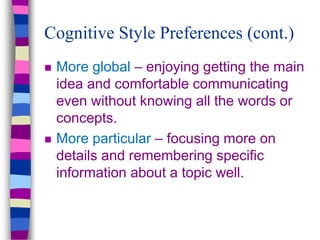
Cognitive Style Preferences (cont.)
 More global – enjoying getting the main
idea and comfortable communicating
even without knowing all the words or
concepts.
 More particular – focusing more on
details and remembering specific
information about a topic well.
 More synthesizing – summarizing
material well and noticing similarities
quickly.
 More analytic – pulling ideas apart,
doing well on logical analysis and contrast
tasks, and tending to focus on grammar
rules.
Cognitive Style Preferences (cont.)
 More field-dependent – needs context
in order to focus and understand
something; takes each language part one
at a time and may have difficulty handling
all of the parts at one time.
 More field-independent – able to
keep a sense of the whole while handling
all the individual parts as well without
being distracted
Cognitive Style Preferences (cont.)
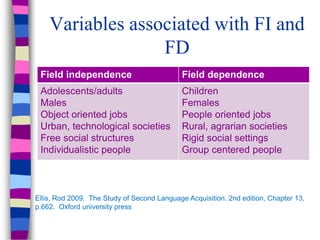
Variables associated with FI and
FD
Field independence Field dependence
Adolescents/adults
Males
Object oriented jobs
Urban, technological societies
Free social structures
Individualistic people
Children
Females
People oriented jobs
Rural, agrarian societies
Rigid social settings
Group centered people
Ellis, Rod 2009. The Study of Second Language Acquisition. 2nd edition, Chapter 13,
p.662. Oxford university press
Personality-Related
Style Preferences
Being more
 Extroverted or Introverted
 Reflective or Impulsive
 Open or Closure-oriented
Cohen, Andrew D. 2010. Focus on the Language Learner: Styles, Strategies and
Motivation. Second Language Acquisition. In Norbert Schmitt, editor. An Introduction to
Applied Linguistics, 2nd edition, Chapter 10, pp. 161-178. London: Hodder Education,
p. 163.
Extroverted or Introverted
 Extroverted – enjoying a wide range of
social, interactive learning tasks (e.g.,
games, conversations, debates, role-
plays, simulations).
 Introverted – preferring more
independent work (e.g., studying or
reading by oneself or learning with the
computer) or enjoying working with, say,
one other person.
Reflective or Impulsive
 More reflective – processes
material at a low speed with high
accuracy; avoids risks and
guessing
 More impulsive – processes
material at a high speed with low
accuracy; often takes risks and
guesses
Open or Closure-oriented
 Keeping all options open – enjoying
discovery learning where information is
picked up naturally and where learning
doesn’t involve a concern for deadlines or
rules.
 Closure-oriented – focusing carefully on all
learning tasks and seek clarity, meeting
deadlines, planning ahead for assignments
and staying organized, and wanting
explicit directions and decisions.
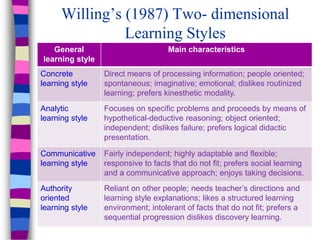
Willing’s (1987) Two- dimensional
Learning Styles
General
learning style
Main characteristics
Concrete
learning style
Direct means of processing information; people oriented;
spontaneous; imaginative; emotional; dislikes routinized
learning; prefers kinesthetic modality.
Analytic
learning style
Focuses on specific problems and proceeds by means of
hypothetical-deductive reasoning; object oriented;
independent; dislikes failure; prefers logical didactic
presentation.
Communicative
learning style
Fairly independent; highly adaptable and flexible;
responsive to facts that do not fit; prefers social learning
and a communicative approach; enjoys taking decisions.
Authority
oriented
learning style
Reliant on other people; needs teacher’s directions and
learning style explanations; likes a structured learning
environment; intolerant of facts that do not fit; prefers a
sequential progression dislikes discovery learning.
Reid’s (1987) Perceptual & Social
Learning Styles
1. Visual learning e.g. reading & studying
charts
2. Auditory learning e.g. listening to lectures/
audio tapes
3. Kinesthetic learning e.g. physical responses
4. Tactile learning e.g. hands on learning, as in
building models.
5. Group preference (learning with other
learners)
6. Individual preference (learning by oneself)
How can we assess an individual’s
stylistic preferences?
 There are different models (theories) of
cognitive/learning style
 Accordingly, there are many different
measures:
– Tests and questionnaires
– Riding’s model of cognitive style and the
CSA-test
– Ehrman & Leaver’s model of learning style
and the E&L Questionnaire
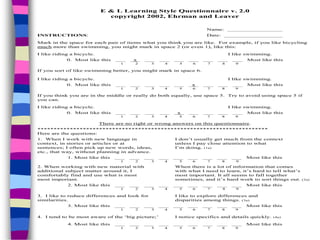
E & L Learning Style Questionnaire v. 2.0
copyright 2002, Ehrman and Leaver
Name: _________________
INSTRUCTIONS: Date: __________________
Mark in the space for each pair of items what you think you are like. For example, if you like bicycling
much more than swimming, you might mark in space 2 (or even 1), like this:
I like riding a bicycle. I like swimming.
0. Most like this ___ _x_ ___ ___ ___ ___ ___ ___ ___ Most like this
1 2 3 4 5 6 7 8 9
If you sort of like swimming better, you might mark in space 6.
I like riding a bicycle. I like swimming.
0. Most like this ___ ___ ___ ___ ___ _x_ ___ ___ ___ Most like this
1 2 3 4 5 6 7 8 9
If you think you are in the middle or really do both equally, use space 5. Try to avoid using space 5 if
you can.
I like riding a bicycle. I like swimming.
0. Most like this ___ ___ ___ ___ _x_ ___ ___ ___ ___ Most like this
1 2 3 4 5 6 7 8 9
There are no right or wrong answers on this questionnaire.
***********************************************************************
Here are the questions:
1. When I work with new language in I don’t usually get much from the context
context, in stories or articles or at unless I pay close attention to what
sentences; I often pick up new words, ideas, I’m doing. (1a)
etc., that way, without planning in advance.
1. Most like this ___ ___ ___ ___ ___ ___ ___ ___ ___ Most like this
1 2 3 4 5 6 7 8 9
2. When working with new material with When there is a lot of information that comes
additional subject matter around it, I with what I need to learn, it’s hard to tell what’s
comfortably find and use what is most most important. It all seems to fall together
most important. sometimes, and it’s hard work to sort things out. (2a)
2. Most like this ___ ___ ___ ___ ___ ___ ___ ___ ___ Most like this
1 2 3 4 5 6 7 8 9
3. I like to reduce differences and look for I like to explore differences and
similarities. disparities among things. (3a)
3. Most like this ___ ___ ___ ___ ___ ___ ___ ___ ___ Most like this
1 2 3 4 5 6 7 8 9
4. I tend to be most aware of the ‘big picture;’ I notice specifics and details quickly. (4a)
4. Most like this ___ ___ ___ ___ ___ ___ ___ ___ ___ Most like this
1 2 3 4 5 6 7 8 9
Ehrman & Leaver’s model of
cognitive/learning style
 One superordinate style dimension: Synopsis
vs. ectasis (Ehrman & Leaver, 2003)
 Synoptic individuals ‘trust their guts’, while
ectenic individuals tend not to
 Ectenic individuals want and need more
conscious control over the learning situation
than synoptic individuals
– 10 subordinate style dimensions, e.g.:
• Field dependent/field independent
• Random/sequential
• Inductive/deductive
• Concrete/abstract
A Learning Style Survey: Assessing
Your Own Learning Styles by Andrew
D. Cohen, Rebecca L. Oxford, & Julie C.
Chi (2001) – downloadable from the
CARLA website at:
http://www.carla.umn.edu/about/profiles/Cohen
This measure was informed by earlier
work conducted by Rebecca Oxford,
Madeline Ehrman, and Betty Lou Leaver
Teacher-Learner Style Conflicts
in the Classroom
 The teacher is more analytic, reflective,
and auditory, while the learner is more
global, impulsive, and visual,
 The teacher is more open-oriented,
while the learner is more closure-
oriented,
 The teacher is more concrete-
sequential, while the learner is more
random-intuitive,
 The teacher is more concrete-
sequential, visual, and reflective, while
the learner is more random-intuitive,
auditory, and impulsive,
 The teacher is more extroverted and
hands-on, while the learner is more
introverted and visual.
[From Oxford, R. L. & Lavine, R. Z. (1992). Teacher-student style
wars in the language classroom: Research insights and
suggestions. ADFL Bulletin, 23 (2), 38-45.]
To avoid or resolve such conflicts:
 Assessment of students' and teachers'
styles and use of this information in
understanding classroom dynamics,
 Changes in the teacher's instructional
style,
 Style-stretching by students,
 Changes in the way group work is done in
the classroom,
 Changes in the curriculum,
 Changes in the way style conflicts are
viewed.
 Oxford, R. L. (1993). Style Analysis Survey. In J. Reid
(Ed.) (1995). Learning styles in the ESL/EFL
classroom (pp. 208-215). Boston: Heinle & Heinle.
 Ehrman, M. E. & Leaver, B. L. (1997). Sorting our
global and analytic functions in second language
learning. Paper presented at the American
Association for Applied Linguistics annual meeting,
Orlando, FL, March 8-11, 1997.
 Ehrman, M. E. & Leaver, B. L. (2001). E&L
Questionnaire.
 Ehrman, M. & Leaver, B. L. (2003). Cognitive styles in
the service of language learning. System, 31(3), 313-
330.
 Dörnyei, Z. (2005). The psychology of the language
learner. Mahwah, NJ: Lawrence Erlbaum.
Thank you!

Learning styles

  • 1.
    Learning Styles ATU PhD Course:SLA theories Professor: Dr. Khatib Prepared by: M.Soleimani Aghchay
  • 2.
  • 3.
  • 4.
    Individual Learner Differences Skehan(1989) Robinson (2002) Dörnyei (2005) 1. Language aptitude 2. Motivation 3. Language learning strategies 4. Cognitive and affective factors: a. Extroversion/ Introversion b. Risk taking c. Intelligence d. Field independence e. Anxiety 1. Intelligence 2. Motivation 3. Anxiety 4. Language aptitude 5. Working memory 6. Age 1. Personality 2. Language aptitude 3. Motivation 4. Learning and cognitive styles 5. Language learning strategies 6. Other learner characteristics: a. Anxiety b. Creativity c. Willingness to communicate d. Self esteem e. Learner beliefs
  • 5.
    Learning Style Learning stylerefers to an individual’s natural, habitual, and preferred way of absorbing, processing, and retaining new information and skills (Reid 1995). Learning style is distinguished from ability in that it constitutes preferences that orient a learner to how they approach the learning task rather than capacities that determine how well they learn. (Ellis 2009)
  • 6.
    Types of learningstyles related to L2 learning  Dörnyei (2005), drawing on Raynar (2000), distinguished ‘learning style’ and ‘cognitive style’. Cognitive styles are seen as relatively fixed but learning styles are often seen as mutable, changing according to experience, and potentially trainable (Little and Singleton 1990; Holec 1987)
  • 7.
    Learning Styles Preferences Sensory / perceptual style preferences  Cognitive style preferences  Personality-related style preferences Cohen, Andrew D. 2010. Focus on the Language Learner: Styles, Strategies and Motivation. Second Language Acquisition. In Norbert Schmitt, editor. An Introduction to Applied Linguistics, 2nd edition, Chapter 10, pp. 161-178. London: Hodder Education, p. 163.
  • 8.
    Sensory / Perceptual StylePreferences Being more  Visual relying more on the sense of sight and learn best through visual means (e.g., books, video, charts, pictures).  Auditory preferring listening and speaking activities (e.g., discussions, debates, audiotapes, role-plays, lectures).  Tactile / kinesthetic (hands-on) benefiting from doing projects, working with objects and moving around. Cohen, Andrew D. 2010. Focus on the Language Learner: Styles, Strategies and Motivation. Second Language Acquisition. In Norbert Schmitt, editor. An Introduction to Applied Linguistics, 2nd edition, Chapter 10, pp. 161-178. London: Hodder Education, p. 163.
  • 9.
    Cognitive Style Preferences Beingmore  Abstract-intuitive – future-oriented/ concrete-sequential – present-oriented  Global or particular (detail-oriented)  A synthesizer and / or being analytic (Right/left brain dominance)  Field dependent / independent Cohen, Andrew D. 2010. Focus on the Language Learner: Styles, Strategies and Motivation. Second Language Acquisition. In Norbert Schmitt, editor. An Introduction to Applied Linguistics, 2nd edition, Chapter 10, pp. 161-178. London: Hodder Education, p. 163.
  • 10.
    Cognitive Style Preferences(cont.)  Abstract-intuitive – future-oriented, enjoying abstract thinking, and happy speculating about possibilities.  Concrete-sequential – present- oriented, preferring one-step-at-a-time activities and wanting to know where they are going in their learning at every moment.
  • 11.
    Cognitive Style Preferences(cont.)  More global – enjoying getting the main idea and comfortable communicating even without knowing all the words or concepts.  More particular – focusing more on details and remembering specific information about a topic well.
  • 12.
     More synthesizing– summarizing material well and noticing similarities quickly.  More analytic – pulling ideas apart, doing well on logical analysis and contrast tasks, and tending to focus on grammar rules. Cognitive Style Preferences (cont.)
  • 13.
     More field-dependent– needs context in order to focus and understand something; takes each language part one at a time and may have difficulty handling all of the parts at one time.  More field-independent – able to keep a sense of the whole while handling all the individual parts as well without being distracted Cognitive Style Preferences (cont.)
  • 14.
    Variables associated withFI and FD Field independence Field dependence Adolescents/adults Males Object oriented jobs Urban, technological societies Free social structures Individualistic people Children Females People oriented jobs Rural, agrarian societies Rigid social settings Group centered people Ellis, Rod 2009. The Study of Second Language Acquisition. 2nd edition, Chapter 13, p.662. Oxford university press
  • 15.
    Personality-Related Style Preferences Being more Extroverted or Introverted  Reflective or Impulsive  Open or Closure-oriented Cohen, Andrew D. 2010. Focus on the Language Learner: Styles, Strategies and Motivation. Second Language Acquisition. In Norbert Schmitt, editor. An Introduction to Applied Linguistics, 2nd edition, Chapter 10, pp. 161-178. London: Hodder Education, p. 163.
  • 16.
    Extroverted or Introverted Extroverted – enjoying a wide range of social, interactive learning tasks (e.g., games, conversations, debates, role- plays, simulations).  Introverted – preferring more independent work (e.g., studying or reading by oneself or learning with the computer) or enjoying working with, say, one other person.
  • 17.
    Reflective or Impulsive More reflective – processes material at a low speed with high accuracy; avoids risks and guessing  More impulsive – processes material at a high speed with low accuracy; often takes risks and guesses
  • 18.
    Open or Closure-oriented Keeping all options open – enjoying discovery learning where information is picked up naturally and where learning doesn’t involve a concern for deadlines or rules.  Closure-oriented – focusing carefully on all learning tasks and seek clarity, meeting deadlines, planning ahead for assignments and staying organized, and wanting explicit directions and decisions.
  • 19.
    Willing’s (1987) Two-dimensional Learning Styles General learning style Main characteristics Concrete learning style Direct means of processing information; people oriented; spontaneous; imaginative; emotional; dislikes routinized learning; prefers kinesthetic modality. Analytic learning style Focuses on specific problems and proceeds by means of hypothetical-deductive reasoning; object oriented; independent; dislikes failure; prefers logical didactic presentation. Communicative learning style Fairly independent; highly adaptable and flexible; responsive to facts that do not fit; prefers social learning and a communicative approach; enjoys taking decisions. Authority oriented learning style Reliant on other people; needs teacher’s directions and learning style explanations; likes a structured learning environment; intolerant of facts that do not fit; prefers a sequential progression dislikes discovery learning.
  • 20.
    Reid’s (1987) Perceptual& Social Learning Styles 1. Visual learning e.g. reading & studying charts 2. Auditory learning e.g. listening to lectures/ audio tapes 3. Kinesthetic learning e.g. physical responses 4. Tactile learning e.g. hands on learning, as in building models. 5. Group preference (learning with other learners) 6. Individual preference (learning by oneself)
  • 21.
    How can weassess an individual’s stylistic preferences?  There are different models (theories) of cognitive/learning style  Accordingly, there are many different measures: – Tests and questionnaires – Riding’s model of cognitive style and the CSA-test – Ehrman & Leaver’s model of learning style and the E&L Questionnaire
  • 22.
    E & LLearning Style Questionnaire v. 2.0 copyright 2002, Ehrman and Leaver Name: _________________ INSTRUCTIONS: Date: __________________ Mark in the space for each pair of items what you think you are like. For example, if you like bicycling much more than swimming, you might mark in space 2 (or even 1), like this: I like riding a bicycle. I like swimming. 0. Most like this ___ _x_ ___ ___ ___ ___ ___ ___ ___ Most like this 1 2 3 4 5 6 7 8 9 If you sort of like swimming better, you might mark in space 6. I like riding a bicycle. I like swimming. 0. Most like this ___ ___ ___ ___ ___ _x_ ___ ___ ___ Most like this 1 2 3 4 5 6 7 8 9 If you think you are in the middle or really do both equally, use space 5. Try to avoid using space 5 if you can. I like riding a bicycle. I like swimming. 0. Most like this ___ ___ ___ ___ _x_ ___ ___ ___ ___ Most like this 1 2 3 4 5 6 7 8 9 There are no right or wrong answers on this questionnaire. *********************************************************************** Here are the questions: 1. When I work with new language in I don’t usually get much from the context context, in stories or articles or at unless I pay close attention to what sentences; I often pick up new words, ideas, I’m doing. (1a) etc., that way, without planning in advance. 1. Most like this ___ ___ ___ ___ ___ ___ ___ ___ ___ Most like this 1 2 3 4 5 6 7 8 9 2. When working with new material with When there is a lot of information that comes additional subject matter around it, I with what I need to learn, it’s hard to tell what’s comfortably find and use what is most most important. It all seems to fall together most important. sometimes, and it’s hard work to sort things out. (2a) 2. Most like this ___ ___ ___ ___ ___ ___ ___ ___ ___ Most like this 1 2 3 4 5 6 7 8 9 3. I like to reduce differences and look for I like to explore differences and similarities. disparities among things. (3a) 3. Most like this ___ ___ ___ ___ ___ ___ ___ ___ ___ Most like this 1 2 3 4 5 6 7 8 9 4. I tend to be most aware of the ‘big picture;’ I notice specifics and details quickly. (4a) 4. Most like this ___ ___ ___ ___ ___ ___ ___ ___ ___ Most like this 1 2 3 4 5 6 7 8 9
  • 23.
    Ehrman & Leaver’smodel of cognitive/learning style  One superordinate style dimension: Synopsis vs. ectasis (Ehrman & Leaver, 2003)  Synoptic individuals ‘trust their guts’, while ectenic individuals tend not to  Ectenic individuals want and need more conscious control over the learning situation than synoptic individuals – 10 subordinate style dimensions, e.g.: • Field dependent/field independent • Random/sequential • Inductive/deductive • Concrete/abstract
  • 24.
    A Learning StyleSurvey: Assessing Your Own Learning Styles by Andrew D. Cohen, Rebecca L. Oxford, & Julie C. Chi (2001) – downloadable from the CARLA website at: http://www.carla.umn.edu/about/profiles/Cohen This measure was informed by earlier work conducted by Rebecca Oxford, Madeline Ehrman, and Betty Lou Leaver
  • 25.
    Teacher-Learner Style Conflicts inthe Classroom  The teacher is more analytic, reflective, and auditory, while the learner is more global, impulsive, and visual,  The teacher is more open-oriented, while the learner is more closure- oriented,  The teacher is more concrete- sequential, while the learner is more random-intuitive,
  • 26.
     The teacheris more concrete- sequential, visual, and reflective, while the learner is more random-intuitive, auditory, and impulsive,  The teacher is more extroverted and hands-on, while the learner is more introverted and visual. [From Oxford, R. L. & Lavine, R. Z. (1992). Teacher-student style wars in the language classroom: Research insights and suggestions. ADFL Bulletin, 23 (2), 38-45.]
  • 27.
    To avoid orresolve such conflicts:  Assessment of students' and teachers' styles and use of this information in understanding classroom dynamics,  Changes in the teacher's instructional style,  Style-stretching by students,  Changes in the way group work is done in the classroom,  Changes in the curriculum,  Changes in the way style conflicts are viewed.
  • 28.
     Oxford, R.L. (1993). Style Analysis Survey. In J. Reid (Ed.) (1995). Learning styles in the ESL/EFL classroom (pp. 208-215). Boston: Heinle & Heinle.  Ehrman, M. E. & Leaver, B. L. (1997). Sorting our global and analytic functions in second language learning. Paper presented at the American Association for Applied Linguistics annual meeting, Orlando, FL, March 8-11, 1997.  Ehrman, M. E. & Leaver, B. L. (2001). E&L Questionnaire.  Ehrman, M. & Leaver, B. L. (2003). Cognitive styles in the service of language learning. System, 31(3), 313- 330.  Dörnyei, Z. (2005). The psychology of the language learner. Mahwah, NJ: Lawrence Erlbaum.
  • 29.