PRE-WRITING TASKS
FOR VISUAL, AUDITORY, AND
  KINESTHETIC LEARNERS

                   Isabela Villas Boas - CTJ
                       Claudio Fleury – CTJ
     8th CTJ Seminar – In Charge of Change
OUTLINE


•   ACTIVITIES
•   WRITING
•   LEARNING STYLES
•   EXAMPLE TASKS
ACTIVITY 1
      ORGANIZING INFORMATION
• Stand up, discuss and organize yourselves in
  three groups, according to the activity in your
  cards.
• Explain the rationale for the organization.
ACTIVITY 2
            GENERATING IDEAS
• In pairs, take turns speaking non-stop for
  three minutes each.
• Partner A: “What do you know about
  perceptual learning styles?”
• Partner B: “How can teachers apply
  knowledge about different learning styles to
  their teaching?”
ACTIVITY 3
      ORGANIZING INFORMATION
• Fill in the mind map with information
  generated in the previous activities.
• Share your mind map with a partner and
  complete the information about learning
  styles
WRITING ACTIVITY
• Write an article for your school bulletin board
  about how important it is that students’
  different learning styles be catered to in class.
PRE-WRITING ACTIVITIES
           AND LEARNING STYLES
•   what is the connection?
•   pre-writing – why is it important?
•   the writing process
•   generating ideas and planning are the most
    neglected
LEARNING STYLES

• “… an individual’s natural, habitual, and
  preferred ways of absorbing, processing,
  and retaining new information and skills.”
                      (Kinsella, 1995, p. 171,
                          in Christison, 2003)
LEARNING STYLES


• “How a person is likely to perceive and
  process information and experiences.”
                         (Mc Carthy, 1980)
LEARNING STYLES

• “Cognitive, affective, and physiological
  traits that are relatively stable indicators
  of how learners perceive, interact with,
  and respond to the learning
  environment.”
                             (Keefe, 1979, p. 4)
KEY RESEARCH FINDINGS


• ESL / EFL teachers’ teaching styles often
  reflect their own learning style


• As cited in Leopold, 2010
KEY RESEARCH FINDINGS


• Higher student achievement relates to a
  match between student learning styles
  and teacher teaching styles


• As cited in Leopold, 2010
KEY RESEARCH FINDINGS


• Although culture is not the sole
  determinant, it is one of the principal
  factors influencing learning styles

• As cited in Leopold, 2010
KEY RESEARCH FINDINGS


• More than 90% of the traditional college
  classroom is auditory


• As cited in Leopold, 2010
KEY RESEARCH FINDINGS


• Most ESL students strongly prefer kinesthetic
  learning


• As cited in Leopold, 2010
PERCEPTUAL LEARNING STYLES
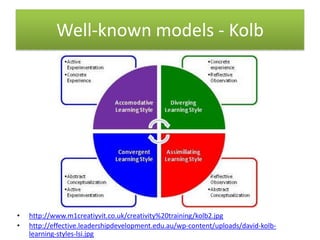
Well-known models - Kolb


•   http://www.m1creatiyvit.co.uk/creativity%20training/kolb2.jpg
•   http://effective.leadershipdevelopment.edu.au/wp-content/uploads/david-kolb-
    learning-styles-lsi.jpg
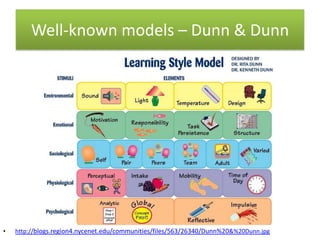
Well-known models – Dunn & Dunn


•   http://blogs.region4.nycenet.edu/communities/files/563/26340/Dunn%20&%20Dunn.jpg
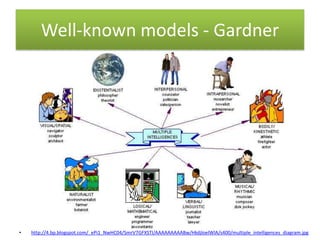
Well-known models - Gardner


•   http://4.bp.blogspot.com/_ePi1_NwHC04/SmrV7GFXSTI/AAAAAAAAABw/HkdjloelWlA/s400/multiple_intelligences_diagram.jpg
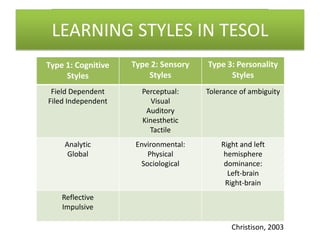
LEARNINGstyles in TESOL
 Learning STYLES IN TESOL
Type 1: Cognitive   Type 2: Sensory   Type 3: Personality
     Styles             Styles              Styles
 Field Dependent      Perceptual:     Tolerance of ambiguity
Filed Independent        Visual
                       Auditory
                      Kinesthetic
                        Tactile
    Analytic         Environmental:       Right and left
     Global             Physical           hemisphere
                      Sociological         dominance:
                                            Left-brain
                                           Right-brain
    Reflective
    Impulsive

                                             Christison, 2003
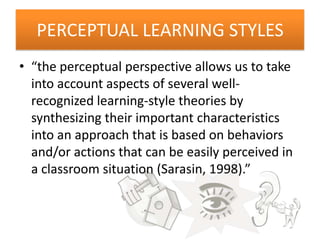
PERCEPTUAL LEARNING STYLES
• “the perceptual perspective allows us to take
  into account aspects of several well-
  recognized learning-style theories by
  synthesizing their important characteristics
  into an approach that is based on behaviors
  and/or actions that can be easily perceived in
  a classroom situation (Sarasin, 1998).”
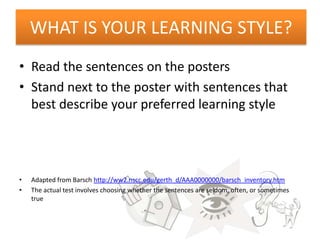
WHAT IS YOUR LEARNING STYLE?
• Read the sentences on the posters
• Stand next to the poster with sentences that
  best describe your preferred learning style


•   Adapted from Barsch http://ww2.nscc.edu/gerth_d/AAA0000000/barsch_inventory.htm
•   The actual test involves choosing whether the sentences are seldom, often, or sometimes
    true
VISUAL LEARNERS

Visual learners have two sub-channels

• Linguistic
• Spatial
VISUAL LEARNERS
visual-linguistic learners
• learn through written language, such as
  reading and writing tasks
• remember what has been written down, even
  if they do not read it more than once
• like to write down directions
• pay better attention to lectures if they watch
  them
VISUAL LEARNERS
visual-spatial learners
• usually have difficulty with the written
  language
• do better with charts, demonstrations, videos,
  and other visual materials
• visualize faces and places by using their
  imagination and seldom get lost in new
  surroundings.
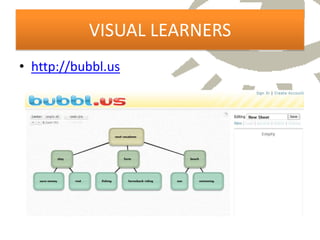
VISUAL LEARNERS
Pre-writing activities

•    mind-mapping for brainstorming
•   http://bubbl.us
•   graphic organizers (tree)
•   videos
•   slides / illustrations
•   demonstrations
KINESTHETIC LEARNERS

Kinesthetic learners two sub-channels:

• kinesthetic (movement) and
• tactile (touch)

• tend to lose concentration if there is little or
  no external stimulation or movement
KINESTHETIC LEARNERS

• When listening to lectures, they may want to
  take notes for the sake of moving their hands.
• When reading, they like to scan the material
  first, and then focus in on the details (get the
  big picture first).
• They typically use color highlighters and take
  notes by drawing pictures, diagrams, or
  doodling.
KINESTHETIC LEARNERS
Pre-writing activities

•   forming groups - organizing
•   tossing objects
•   computers and the internet
•   acting out
•   changing places / moving around
AUDITORY LEARNERS

• often talk to themselves
• may move their lips and read out loud.
• may have difficulty with reading and writing
  tasks.
• often do better talking to a colleague or a
  voice recorder and hearing what was said.
AUDITORY LEARNERS

Pre-writing activities

•   voice recorders – mp3 players
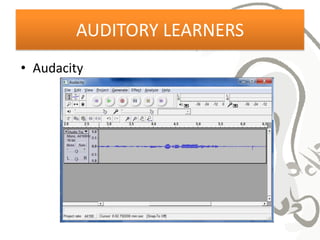
•   Audacity
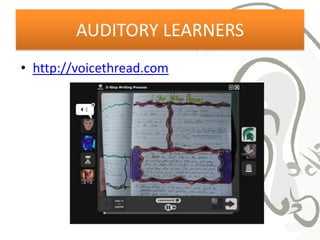
•   http://voicethread.com
•   paraphrasing
•   debates
SAMPLE ACTIVITIES
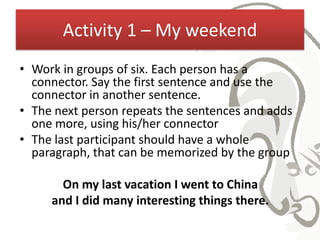
Activity 1 – My weekend
• Work in groups of six. Each person has a
  connector. Say the first sentence and use the
  connector in another sentence.
• The next person repeats the sentences and adds
  one more, using his/her connector
• The last participant should have a whole
  paragraph, that can be memorized by the group

       On my last vacation I went to China
     and I did many interesting things there.
Activity 2 – Hosting a world cup
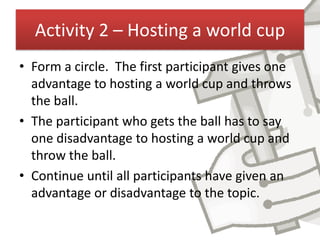
• Form a circle. The first participant gives one
  advantage to hosting a world cup and throws
  the ball.
• The participant who gets the ball has to say
  one disadvantage to hosting a world cup and
  throw the ball.
• Continue until all participants have given an
  advantage or disadvantage to the topic.
Activity 3 – Global Warming
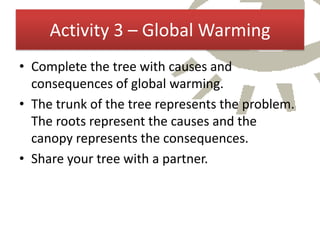
• Complete the tree with causes and
  consequences of global warming.
• The trunk of the tree represents the problem.
  The roots represent the causes and the
  canopy represents the consequences.
• Share your tree with a partner.
SAMPLE ACTIVITIES


• Activity 1 – auditory – beginners
• Activity 2 – kinesthetic - advanced
• Activity 3 – visual - intermediate
Thank you

• isabela.villasboas@thomas.org.br
• claudios@thomas.org.br

• http://prewriting.pbworks.com
Bibliography

•   BROWN, H. Douglas Teaching by Principles: An Interactive Approach to Language
    Pedagogy, 2nd ed.New York: Longman, 2001.
•   CHRISTISON, M. A. Learning styles and strategies. In D. Nunan (Ed.). Practical
    English Language Teaching. New York: McGraw Hill, 2003.
•   DUNN, R., K DUNN AND G. E. PRICE. The learning style inventory. Lawrence, KS:
    Price Systems, 1975.
•   KEEFE, J. W. Student learning styles: Diagnosing and prescribing
    programs. Reston, VA: National Association of Secondary School Principals, 1979.
•   KINSELLA, K. Understanding and empowering diverse learners. In J.M. Reid
    (ed.) Learning Styles in the ESL/EFL Classroom. Boston: Heinle & Heinle, 1995.
•   LIGHTBOWN, Patsy and SPADA, Nina. How Languages are Learned, 3rd ed. China:
    Oxford, 2006.
•   WOOLFOLK, Anita Educational Psychology - 10th ed. New York: Pearson, 2007.
Available online

•    http://www.bhsu.edu/Academics/TheColleges/CollegeofArtsandSciences/D
    epartmentsandPrograms/Humanities/English/WritingResources/LearningSt
    yles/tabid/953/Default.aspx
•   http://eca.state.gov/forum/vols/vol37/no4/p6.htm#top
•   http://iteslj.org/Techniques/Zhenhui-TeachingStyles.html
•   http://www.slideshare.net/51625678/teaching-and-learning-styles-
    research
•   test http://www.vark-learn.com/english/index.asp
•   http://www.cloudnet.com/~edrbsass/learningstylesjigsaw.html
•   test http://www.open.ac.uk/skillsforstudy/learning-style-activity.php
•   http://www.everythingesl.net/inservices/learningstyle.php
•   links http://www.shambles.net/pages/staff/lstyles/
•    http://ww2.nscc.edu/gerth_d/AAA0000000/barsch_inventory.htm
•    http://www.ldpride.net/learningstyles.MI.htm
VISUAL LEARNERS
• http://bubbl.us
AUDITORY LEARNERS
• Audacity
AUDITORY LEARNERS
• http://voicethread.com

Pre-writing and learning styles

  • 1.
    PRE-WRITING TASKS FOR VISUAL,AUDITORY, AND KINESTHETIC LEARNERS Isabela Villas Boas - CTJ Claudio Fleury – CTJ 8th CTJ Seminar – In Charge of Change
  • 2.
    OUTLINE • ACTIVITIES • WRITING • LEARNING STYLES • EXAMPLE TASKS
  • 3.
    ACTIVITY 1 ORGANIZING INFORMATION • Stand up, discuss and organize yourselves in three groups, according to the activity in your cards. • Explain the rationale for the organization.
  • 4.
    ACTIVITY 2 GENERATING IDEAS • In pairs, take turns speaking non-stop for three minutes each. • Partner A: “What do you know about perceptual learning styles?” • Partner B: “How can teachers apply knowledge about different learning styles to their teaching?”
  • 5.
    ACTIVITY 3 ORGANIZING INFORMATION • Fill in the mind map with information generated in the previous activities. • Share your mind map with a partner and complete the information about learning styles
  • 6.
    WRITING ACTIVITY • Writean article for your school bulletin board about how important it is that students’ different learning styles be catered to in class.
  • 7.
    PRE-WRITING ACTIVITIES AND LEARNING STYLES • what is the connection? • pre-writing – why is it important? • the writing process • generating ideas and planning are the most neglected
  • 8.
    LEARNING STYLES • “…an individual’s natural, habitual, and preferred ways of absorbing, processing, and retaining new information and skills.” (Kinsella, 1995, p. 171, in Christison, 2003)
  • 9.
    LEARNING STYLES • “Howa person is likely to perceive and process information and experiences.” (Mc Carthy, 1980)
  • 10.
    LEARNING STYLES • “Cognitive,affective, and physiological traits that are relatively stable indicators of how learners perceive, interact with, and respond to the learning environment.” (Keefe, 1979, p. 4)
  • 11.
    KEY RESEARCH FINDINGS •ESL / EFL teachers’ teaching styles often reflect their own learning style • As cited in Leopold, 2010
  • 12.
    KEY RESEARCH FINDINGS •Higher student achievement relates to a match between student learning styles and teacher teaching styles • As cited in Leopold, 2010
  • 13.
    KEY RESEARCH FINDINGS •Although culture is not the sole determinant, it is one of the principal factors influencing learning styles • As cited in Leopold, 2010
  • 14.
    KEY RESEARCH FINDINGS •More than 90% of the traditional college classroom is auditory • As cited in Leopold, 2010
  • 15.
    KEY RESEARCH FINDINGS •Most ESL students strongly prefer kinesthetic learning • As cited in Leopold, 2010
  • 16.
  • 17.
    Well-known models -Kolb • http://www.m1creatiyvit.co.uk/creativity%20training/kolb2.jpg • http://effective.leadershipdevelopment.edu.au/wp-content/uploads/david-kolb- learning-styles-lsi.jpg
  • 18.
    Well-known models –Dunn & Dunn • http://blogs.region4.nycenet.edu/communities/files/563/26340/Dunn%20&%20Dunn.jpg
  • 19.
    Well-known models -Gardner • http://4.bp.blogspot.com/_ePi1_NwHC04/SmrV7GFXSTI/AAAAAAAAABw/HkdjloelWlA/s400/multiple_intelligences_diagram.jpg
  • 20.
    LEARNINGstyles in TESOL Learning STYLES IN TESOL Type 1: Cognitive Type 2: Sensory Type 3: Personality Styles Styles Styles Field Dependent Perceptual: Tolerance of ambiguity Filed Independent Visual Auditory Kinesthetic Tactile Analytic Environmental: Right and left Global Physical hemisphere Sociological dominance: Left-brain Right-brain Reflective Impulsive Christison, 2003
  • 21.
    PERCEPTUAL LEARNING STYLES •“the perceptual perspective allows us to take into account aspects of several well- recognized learning-style theories by synthesizing their important characteristics into an approach that is based on behaviors and/or actions that can be easily perceived in a classroom situation (Sarasin, 1998).”
  • 22.
    WHAT IS YOURLEARNING STYLE? • Read the sentences on the posters • Stand next to the poster with sentences that best describe your preferred learning style • Adapted from Barsch http://ww2.nscc.edu/gerth_d/AAA0000000/barsch_inventory.htm • The actual test involves choosing whether the sentences are seldom, often, or sometimes true
  • 23.
    VISUAL LEARNERS Visual learnershave two sub-channels • Linguistic • Spatial
  • 24.
    VISUAL LEARNERS visual-linguistic learners •learn through written language, such as reading and writing tasks • remember what has been written down, even if they do not read it more than once • like to write down directions • pay better attention to lectures if they watch them
  • 25.
    VISUAL LEARNERS visual-spatial learners •usually have difficulty with the written language • do better with charts, demonstrations, videos, and other visual materials • visualize faces and places by using their imagination and seldom get lost in new surroundings.
  • 26.
    VISUAL LEARNERS Pre-writing activities • mind-mapping for brainstorming • http://bubbl.us • graphic organizers (tree) • videos • slides / illustrations • demonstrations
  • 27.
    KINESTHETIC LEARNERS Kinesthetic learnerstwo sub-channels: • kinesthetic (movement) and • tactile (touch) • tend to lose concentration if there is little or no external stimulation or movement
  • 28.
    KINESTHETIC LEARNERS • Whenlistening to lectures, they may want to take notes for the sake of moving their hands. • When reading, they like to scan the material first, and then focus in on the details (get the big picture first). • They typically use color highlighters and take notes by drawing pictures, diagrams, or doodling.
  • 29.
    KINESTHETIC LEARNERS Pre-writing activities • forming groups - organizing • tossing objects • computers and the internet • acting out • changing places / moving around
  • 30.
    AUDITORY LEARNERS • oftentalk to themselves • may move their lips and read out loud. • may have difficulty with reading and writing tasks. • often do better talking to a colleague or a voice recorder and hearing what was said.
  • 31.
    AUDITORY LEARNERS Pre-writing activities • voice recorders – mp3 players • Audacity • http://voicethread.com • paraphrasing • debates
  • 32.
  • 33.
    Activity 1 –My weekend • Work in groups of six. Each person has a connector. Say the first sentence and use the connector in another sentence. • The next person repeats the sentences and adds one more, using his/her connector • The last participant should have a whole paragraph, that can be memorized by the group On my last vacation I went to China and I did many interesting things there.
  • 34.
    Activity 2 –Hosting a world cup • Form a circle. The first participant gives one advantage to hosting a world cup and throws the ball. • The participant who gets the ball has to say one disadvantage to hosting a world cup and throw the ball. • Continue until all participants have given an advantage or disadvantage to the topic.
  • 35.
    Activity 3 –Global Warming • Complete the tree with causes and consequences of global warming. • The trunk of the tree represents the problem. The roots represent the causes and the canopy represents the consequences. • Share your tree with a partner.
  • 36.
    SAMPLE ACTIVITIES • Activity1 – auditory – beginners • Activity 2 – kinesthetic - advanced • Activity 3 – visual - intermediate
  • 37.
    Thank you • isabela.villasboas@thomas.org.br •claudios@thomas.org.br • http://prewriting.pbworks.com
  • 38.
    Bibliography • BROWN, H. Douglas Teaching by Principles: An Interactive Approach to Language Pedagogy, 2nd ed.New York: Longman, 2001. • CHRISTISON, M. A. Learning styles and strategies. In D. Nunan (Ed.). Practical English Language Teaching. New York: McGraw Hill, 2003. • DUNN, R., K DUNN AND G. E. PRICE. The learning style inventory. Lawrence, KS: Price Systems, 1975. • KEEFE, J. W. Student learning styles: Diagnosing and prescribing programs. Reston, VA: National Association of Secondary School Principals, 1979. • KINSELLA, K. Understanding and empowering diverse learners. In J.M. Reid (ed.) Learning Styles in the ESL/EFL Classroom. Boston: Heinle & Heinle, 1995. • LIGHTBOWN, Patsy and SPADA, Nina. How Languages are Learned, 3rd ed. China: Oxford, 2006. • WOOLFOLK, Anita Educational Psychology - 10th ed. New York: Pearson, 2007.
  • 39.
    Available online • http://www.bhsu.edu/Academics/TheColleges/CollegeofArtsandSciences/D epartmentsandPrograms/Humanities/English/WritingResources/LearningSt yles/tabid/953/Default.aspx • http://eca.state.gov/forum/vols/vol37/no4/p6.htm#top • http://iteslj.org/Techniques/Zhenhui-TeachingStyles.html • http://www.slideshare.net/51625678/teaching-and-learning-styles- research • test http://www.vark-learn.com/english/index.asp • http://www.cloudnet.com/~edrbsass/learningstylesjigsaw.html • test http://www.open.ac.uk/skillsforstudy/learning-style-activity.php • http://www.everythingesl.net/inservices/learningstyle.php • links http://www.shambles.net/pages/staff/lstyles/ • http://ww2.nscc.edu/gerth_d/AAA0000000/barsch_inventory.htm • http://www.ldpride.net/learningstyles.MI.htm
  • 40.
  • 41.
  • 42.

Editor's Notes

  • #4 Claudio – levar duas bolas
  • #5 Isabela
  • #6 claudio
  • #8 CONNECTION between learning styles and prewriting activities.In this presentation we focus on prewriting, but all steps are important – generating ideas and planning
  • #17 The most well-known types of learning styles are the perceptual ones – visual, auditory, kinesthetic, (and tactile), known as the VAK(T ) model.  However, they are not the only ones.
  • #18 EACH IS A DIFFERENT SLIDE WITH ILLUSTRATIONS
  • #19 EACH IS A DIFFERENT SLIDE WITH ILLUSTRATIONS
  • #20 EACH IS A DIFFERENT SLIDE WITH ILLUSTRATIONS
  • #21 PERCEPTUAL LEARNING STYLE
  • #22 claudio
  • #23 There are many learning style inventories that have been used, some available online. Criticism. Not validated. Just mention criticism.
  • #34 Ask how other styles can be met
  • #35 Model – take two balls – advantages and disadvantages