Student Learning Styles January 13, 2002
What is a “learning style”?   “ The way that he or she concentrates on, processes, internalizes, and remembers new and difficult information or skills”. Dr. Rita Dunn, St. John’s University  “ Characteristic cognitive, affective, and physiological behaviors that serve as relatively stable indicators of how learners perceive, interact with, and respond to the learning environment”. James W. Keefe
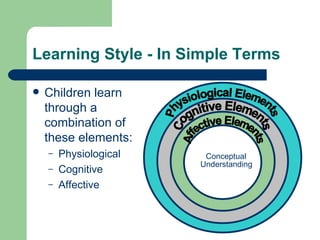
Learning Style - In Simple Terms Children learn through a  combination of these elements:  Physiological Cognitive Affective Physiological Elements Cognitive Elements Affective Elements Conceptual Understanding
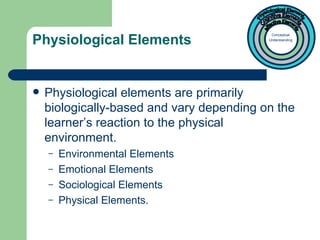
Physiological Elements Physiological elements are primarily biologically-based and vary depending on the learner’s reaction to the physical environment.  Environmental Elements Emotional Elements Sociological Elements Physical Elements. Physiological Elements Cognitive Elements Affective Elements Conceptual Understanding
Environmental Elements Sound Light Temperature Design
Environmental Elements Sound Children vary greatly in their ability to concentrate in varied sound environments.  Some children require that it be completely silent in order to concentrate.  Others have the ability to block out surrounding noise and can become engrossed in their own thoughts.
Environmental Elements – cont. Light It has been found that florescent bulbs emit rays that stimulate analytic children.  Thus, analytic children find it hard to concentrate in a dim room.  However, these same rays can overstimulate global children, causing them to loose the ability to concentrate.
Environmental Elements – cont. Temperature Every child is different when it comes to temperature preferences.  And, although the temperature of a room does not have any direct bearing cognitively on a child, as a biological response it can affect a child’s attention span.
Environmental Elements – cont. Design Design in a classroom refers to the layout of the room in comparison to the physical needs of the children.  Some children can be seated at a desk or table for an extended period of time while others prefer standing or sitting on the floor.
Emotional Elements Motivation Persistence Responsibility Structure
Emotional Elements Motivation Motivation and achievement are closely related.  If children are not able to learn either because of their ability or the teachers they tend to withdraw from what is happening in the classroom and become either negative or apathetic.
Emotional Elements – cont. Persistance The element of persistence is both emotional and cognitive in nature.  When certain students begin a task, they have a strong emotional need to complete the task, thus demonstrating an emotional bond to complete.  This emotional desire to finish the assignment is distinctly different from the cognitive ability to remain focused on the task for the duration of involvement.
Emotional Elements – cont. Responsibility These children are follow through on assignments, finish them to the best of their ability, and do so many times without ongoing supervision.  However, many times children appear to be less responsible than they truly are.  Sometimes this is due to the child’s short attention span and desire to move on to something else.
Emotional Elements – cont. Structure Some children need to know exactly what is expected of them before commencing on an activity.  Others want only the objective or goal and prefer to create their own way of accomplishing the assignment.  These differences are referred to as structural differences.
Sociological Elements Individual sociological patterns vary greatly depending on a child’s age and social experience.  Some children learn better consistently in one way.  Others learn better by varying the social contexts in which they learn.  Knowing the social setting in which children can learn is extremely important in forming their learning setting.
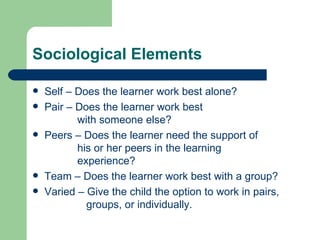
Sociological Elements Self – Does the learner work best alone? Pair – Does the learner work best    with someone else? Peers – Does the learner need the support of    his or her peers in the learning    experience? Team – Does the learner work best with a group? Varied – Give the child the option to work in pairs,    groups, or individually.
Physical Elements Perceptual Intake Time Mobility
Physical Elements Perceptual This area has to do with the learner's ability to understand and perceive the concept.  Some learners need much more contact with an idea or concept than others.
Physical Elements – cont. Intake Through eating, drinking, or smelling, the senses can be actively engaged in the learning experience.  By involving as many of the senses as possible the child is more likely to retain the information presented.
Physical Elements – cont. Time Time rhythms refer to the individual’s optimum learning patterns based on the time of the day.  Some learners retain much more in the evening, and others are at their peak in the morning.
Physical Elements – cont. Mobility Mobility has to do with a child’s need to change physical position during the learning process.
Cognitive Elements Brain Dominance Conceptual Tempo Mindstyles Psychological Differentiation Modality Multiple Intelligences Physiological Elements Cognitive Elements Affective Elements Conceptual Understanding
Brain Dominance What is the way in which the brain analyzes information? Analytical Analytical children patch details together in the exact opposite way globals do.  Once a strongly analytic student begins a task, that student has a strong emotional compulsion to complete it.
Brain Dominance – cont. Global Globals need an overall comprehension of what’s being covered first, and then they can look at the details.  Globals tend to concentrate on difficult academic studies for a relatively short amount of time.
Brain Dominance – cont. Integrated Try to vary the types of activities offered to engage both types of learners.
Conceptual Tempo Impulsive Impulsive children are those who blurt out answers, behave impetuously, and speak before they think. Reflexive Reflexive children are many times perceived as more intelligent because they act more thoughtful.
Mindstyles Concrete Sequential Emphasis on the concrete world of the physical senses; sequential step-by-step linear progression of thought; instinctive, methodical, deliberate; ordered, practical, quiet, stable. Abstrate Random Random web-like and multi-dimensional; emotional, perceptive, critical; metaphoric, uses gestures and body language, colorful.
Mindstyles – cont. Abstract Sequential Abstract world of the intellect based upon concrete world; focuses attention on facts, documentation, concepts, and ideas; uses precise rational and is highly verbal. Concrete Random Intuitive, instinctive, impulsive, and independent thinking processes; uses practical demonstration to validate or to prove.
Psychological Differentiation Field Dependence The field independent learner “tends to articulate figures as discrete from their backgrounds”.  These learners can differentiate objects from their backgrounds.  They have more of an ability to handle tasks the require analysis or comparison. Field Independence The field dependent learner tends to experience events in consonant fashion.  They tend to identify with a group.
Modality Young children first begin learning kinesthetically.  They experience everything they learn.  As they develop, children next develop tactual preferences.  A young child will try touching everything he or she comes near.  Then, finally visual and auditory abilities develop as the child develops.
Modality – cont. Visual Visual learners remember what they see and can recall details through picturing what they have seen.  Allow these children to view the material in advance to class, so that they can visualize what they will be taught. Auditory An auditory learner is defined as “one who recalls at least seventy-five percent of what is discussed or heard in a normal forty to forty-five minute period”.  These learners remember what they hear and can recreate what they hear by focusing on what was said in the lesson.
Modality – cont. Tactile Tactile learners use their fingers and hands while concentrating.  These children remember more easily if they are drawing, doodling, writing, or somehow using their fingers.  Hand motions for songs.  Flipcharts, flashcards, puzzles Kinesthetic Most children who have problems in tradition classroom settings are kinesthetic learners.  They often can not remember too much of what they are shown or many specifics.  They learn best be a combination of tactile and kinesthetic experiences
Modality – cont. Integrated Allow children to develop their own visual aids to help them learn.  Give them the option to create for themselves the kinesthetic resources which would best benefit them in their learning experience.
Multiple Intelligences Howard Gardner's theory holds that all learners are intelligent, based on these six different areas.  The level of intelligence in each area varies, and these different self-explanatory levels help describe each individual learner.
Multiple Intelligences – cont. Bodily Kinesthetic The body is used in skilled ways, with or without objects, involving fine and gross motor movement. Linguistic These are gifted communicators, poets, and journalists.  The have knowledge or word meaning or semantics.
Multiple Intelligences – cont. Musical Needs to have musical activities planned in order to bloom as much as the child gifted in language. Spatial These learners are more visual or think in pictures and images.
Multiple Intelligences – cont. Intrapersonal These learners are self-reliant, self-confident, and retrospective.  They need time to daydream and space to be alone. Interpersonal These learners have many friends and learn best in a social context.
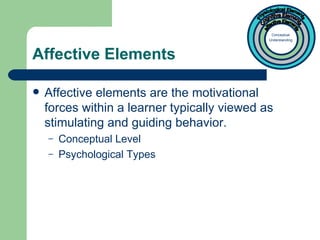
Affective Elements Affective elements are the motivational forces within a learner typically viewed as stimulating and guiding behavior. Conceptual Level Psychological Types Physiological Elements Cognitive Elements Affective Elements Conceptual Understanding
Conceptual Level High These students are more independent.  They enjoy individual projects, problem solving, and a choice of assignments. Low These see environment as fixed and rigid.  They are not able to look at alternative solutions to problems.
Psychological Types Thinker These learners are more objective and reason logically their decisions. Sensor These learners relate best to the real world and concrete experiences. Feeler These learners make decisions based more on their emotions and insight than reason. Intuitor These learners relate to the world through intuition.  They are more global and more apt to dislike detailed work.
Application in the Classroom Understand that your students don’t all learn the same way you do Child involvement is key Utilize as many senses as possible Be flexible Try new things Pray for God’s direction – ALWAYS!

Learning Styles

  • 1.
    Student Learning StylesJanuary 13, 2002
  • 2.
    What is a“learning style”? “ The way that he or she concentrates on, processes, internalizes, and remembers new and difficult information or skills”. Dr. Rita Dunn, St. John’s University “ Characteristic cognitive, affective, and physiological behaviors that serve as relatively stable indicators of how learners perceive, interact with, and respond to the learning environment”. James W. Keefe
  • 3.
    Learning Style -In Simple Terms Children learn through a combination of these elements: Physiological Cognitive Affective Physiological Elements Cognitive Elements Affective Elements Conceptual Understanding
  • 4.
    Physiological Elements Physiologicalelements are primarily biologically-based and vary depending on the learner’s reaction to the physical environment. Environmental Elements Emotional Elements Sociological Elements Physical Elements. Physiological Elements Cognitive Elements Affective Elements Conceptual Understanding
  • 5.
    Environmental Elements SoundLight Temperature Design
  • 6.
    Environmental Elements SoundChildren vary greatly in their ability to concentrate in varied sound environments. Some children require that it be completely silent in order to concentrate. Others have the ability to block out surrounding noise and can become engrossed in their own thoughts.
  • 7.
    Environmental Elements –cont. Light It has been found that florescent bulbs emit rays that stimulate analytic children. Thus, analytic children find it hard to concentrate in a dim room. However, these same rays can overstimulate global children, causing them to loose the ability to concentrate.
  • 8.
    Environmental Elements –cont. Temperature Every child is different when it comes to temperature preferences. And, although the temperature of a room does not have any direct bearing cognitively on a child, as a biological response it can affect a child’s attention span.
  • 9.
    Environmental Elements –cont. Design Design in a classroom refers to the layout of the room in comparison to the physical needs of the children. Some children can be seated at a desk or table for an extended period of time while others prefer standing or sitting on the floor.
  • 10.
    Emotional Elements MotivationPersistence Responsibility Structure
  • 11.
    Emotional Elements MotivationMotivation and achievement are closely related. If children are not able to learn either because of their ability or the teachers they tend to withdraw from what is happening in the classroom and become either negative or apathetic.
  • 12.
    Emotional Elements –cont. Persistance The element of persistence is both emotional and cognitive in nature. When certain students begin a task, they have a strong emotional need to complete the task, thus demonstrating an emotional bond to complete. This emotional desire to finish the assignment is distinctly different from the cognitive ability to remain focused on the task for the duration of involvement.
  • 13.
    Emotional Elements –cont. Responsibility These children are follow through on assignments, finish them to the best of their ability, and do so many times without ongoing supervision. However, many times children appear to be less responsible than they truly are. Sometimes this is due to the child’s short attention span and desire to move on to something else.
  • 14.
    Emotional Elements –cont. Structure Some children need to know exactly what is expected of them before commencing on an activity. Others want only the objective or goal and prefer to create their own way of accomplishing the assignment. These differences are referred to as structural differences.
  • 15.
    Sociological Elements Individualsociological patterns vary greatly depending on a child’s age and social experience. Some children learn better consistently in one way. Others learn better by varying the social contexts in which they learn. Knowing the social setting in which children can learn is extremely important in forming their learning setting.
  • 16.
    Sociological Elements Self– Does the learner work best alone? Pair – Does the learner work best with someone else? Peers – Does the learner need the support of his or her peers in the learning experience? Team – Does the learner work best with a group? Varied – Give the child the option to work in pairs, groups, or individually.
  • 17.
    Physical Elements PerceptualIntake Time Mobility
  • 18.
    Physical Elements PerceptualThis area has to do with the learner's ability to understand and perceive the concept. Some learners need much more contact with an idea or concept than others.
  • 19.
    Physical Elements –cont. Intake Through eating, drinking, or smelling, the senses can be actively engaged in the learning experience. By involving as many of the senses as possible the child is more likely to retain the information presented.
  • 20.
    Physical Elements –cont. Time Time rhythms refer to the individual’s optimum learning patterns based on the time of the day. Some learners retain much more in the evening, and others are at their peak in the morning.
  • 21.
    Physical Elements –cont. Mobility Mobility has to do with a child’s need to change physical position during the learning process.
  • 22.
    Cognitive Elements BrainDominance Conceptual Tempo Mindstyles Psychological Differentiation Modality Multiple Intelligences Physiological Elements Cognitive Elements Affective Elements Conceptual Understanding
  • 23.
    Brain Dominance Whatis the way in which the brain analyzes information? Analytical Analytical children patch details together in the exact opposite way globals do. Once a strongly analytic student begins a task, that student has a strong emotional compulsion to complete it.
  • 24.
    Brain Dominance –cont. Global Globals need an overall comprehension of what’s being covered first, and then they can look at the details. Globals tend to concentrate on difficult academic studies for a relatively short amount of time.
  • 25.
    Brain Dominance –cont. Integrated Try to vary the types of activities offered to engage both types of learners.
  • 26.
    Conceptual Tempo ImpulsiveImpulsive children are those who blurt out answers, behave impetuously, and speak before they think. Reflexive Reflexive children are many times perceived as more intelligent because they act more thoughtful.
  • 27.
    Mindstyles Concrete SequentialEmphasis on the concrete world of the physical senses; sequential step-by-step linear progression of thought; instinctive, methodical, deliberate; ordered, practical, quiet, stable. Abstrate Random Random web-like and multi-dimensional; emotional, perceptive, critical; metaphoric, uses gestures and body language, colorful.
  • 28.
    Mindstyles – cont.Abstract Sequential Abstract world of the intellect based upon concrete world; focuses attention on facts, documentation, concepts, and ideas; uses precise rational and is highly verbal. Concrete Random Intuitive, instinctive, impulsive, and independent thinking processes; uses practical demonstration to validate or to prove.
  • 29.
    Psychological Differentiation FieldDependence The field independent learner “tends to articulate figures as discrete from their backgrounds”. These learners can differentiate objects from their backgrounds. They have more of an ability to handle tasks the require analysis or comparison. Field Independence The field dependent learner tends to experience events in consonant fashion. They tend to identify with a group.
  • 30.
    Modality Young childrenfirst begin learning kinesthetically. They experience everything they learn. As they develop, children next develop tactual preferences. A young child will try touching everything he or she comes near. Then, finally visual and auditory abilities develop as the child develops.
  • 31.
    Modality – cont.Visual Visual learners remember what they see and can recall details through picturing what they have seen. Allow these children to view the material in advance to class, so that they can visualize what they will be taught. Auditory An auditory learner is defined as “one who recalls at least seventy-five percent of what is discussed or heard in a normal forty to forty-five minute period”. These learners remember what they hear and can recreate what they hear by focusing on what was said in the lesson.
  • 32.
    Modality – cont.Tactile Tactile learners use their fingers and hands while concentrating. These children remember more easily if they are drawing, doodling, writing, or somehow using their fingers. Hand motions for songs. Flipcharts, flashcards, puzzles Kinesthetic Most children who have problems in tradition classroom settings are kinesthetic learners. They often can not remember too much of what they are shown or many specifics. They learn best be a combination of tactile and kinesthetic experiences
  • 33.
    Modality – cont.Integrated Allow children to develop their own visual aids to help them learn. Give them the option to create for themselves the kinesthetic resources which would best benefit them in their learning experience.
  • 34.
    Multiple Intelligences HowardGardner's theory holds that all learners are intelligent, based on these six different areas. The level of intelligence in each area varies, and these different self-explanatory levels help describe each individual learner.
  • 35.
    Multiple Intelligences –cont. Bodily Kinesthetic The body is used in skilled ways, with or without objects, involving fine and gross motor movement. Linguistic These are gifted communicators, poets, and journalists. The have knowledge or word meaning or semantics.
  • 36.
    Multiple Intelligences –cont. Musical Needs to have musical activities planned in order to bloom as much as the child gifted in language. Spatial These learners are more visual or think in pictures and images.
  • 37.
    Multiple Intelligences –cont. Intrapersonal These learners are self-reliant, self-confident, and retrospective. They need time to daydream and space to be alone. Interpersonal These learners have many friends and learn best in a social context.
  • 38.
    Affective Elements Affectiveelements are the motivational forces within a learner typically viewed as stimulating and guiding behavior. Conceptual Level Psychological Types Physiological Elements Cognitive Elements Affective Elements Conceptual Understanding
  • 39.
    Conceptual Level HighThese students are more independent. They enjoy individual projects, problem solving, and a choice of assignments. Low These see environment as fixed and rigid. They are not able to look at alternative solutions to problems.
  • 40.
    Psychological Types ThinkerThese learners are more objective and reason logically their decisions. Sensor These learners relate best to the real world and concrete experiences. Feeler These learners make decisions based more on their emotions and insight than reason. Intuitor These learners relate to the world through intuition. They are more global and more apt to dislike detailed work.
  • 41.
    Application in theClassroom Understand that your students don’t all learn the same way you do Child involvement is key Utilize as many senses as possible Be flexible Try new things Pray for God’s direction – ALWAYS!