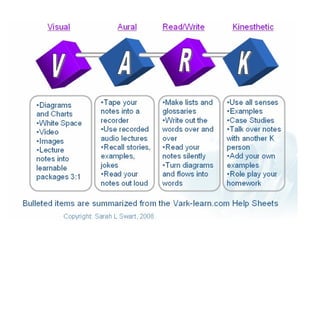
SMART Ideas for Increasing Student Success Ways to Address Multiple Learning Styles in Our Lessons VARK -- A Guide to Learning Styles
Why? Learners use different modalities to receive and understand new information.  For many people, one or two dominant styles are more effective when learning new information. For this reason, it is important to include a  variety  of modalities in our lessons, so we can give all students equal opportunity to understand the content we teach. Why?
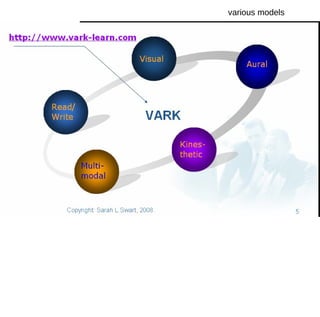
various models
 
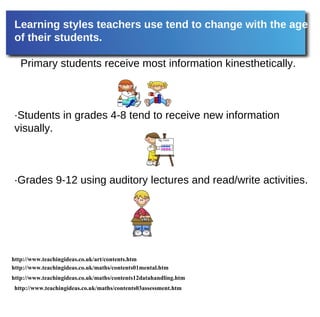
Learning styles teachers use tend to change with the age of their students.   ·  Primary students receive most information kinesthetically. ·Students in grades 4-8 tend to receive new information visually. ·Grades 9-12 using auditory lectures and read/write activities. http://www.teachingideas.co.uk/art/contents.htm http://www.teachingideas.co.uk/maths/contents01mental.htm http://www.teachingideas.co.uk/maths/contents12datahandling.htm http://www.teachingideas.co.uk/maths/contents03assessment.htm
Ideas for Incorporating Multiple Learning Modalities into our SMART Lessons.
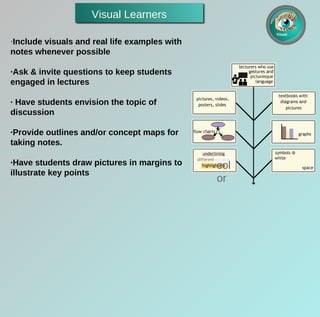
Visual Learners · Include visuals and real life examples with notes whenever possible ·Ask & invite questions to keep students engaged in lectures · Have students envision the topic of discussion  ·Provide outlines and/or concept maps for taking notes.  ·Have students draw pictures in margins to illustrate key points color Visual
Auditory Learners  Auditory · Provide opportunities for presentations, debates and  small/whole group discussions · Have students explain new ideas to classmates Provide recordings of lessons online to help students remember  ·Ask students to describe the lesson and diagrams to someone else or role play ·Have students leave spaces notes for later recall and filling in more information after comparing with a partner
Read/Write Learners  Read/Write · Provide practice quizzes and tests ·Provide opportunities for written assignments and reflections. · Provide opportunities for students to create lists ·Provide supplemental readings
Kinesthetic Learners  · Provide opportunities for students to touch and manipulate information ·Provide colored highlighters to interact with text and highlight notes · Allow opportunities for students act out or role play content · Provide hands on approaches and models for interacting with content Kinesthetic
How might we incorporate  multiple  learning styles into our lessons? Here are a few ideas...
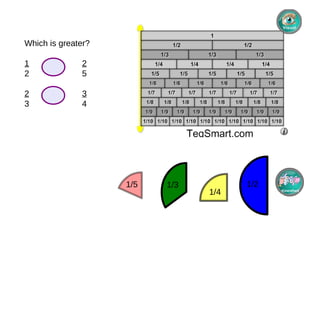
1/2  Which is greater? 1 2 2 5 2 3 3 4 1/3 1/4 1/5 Kinesthetic
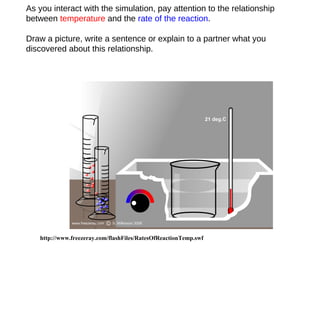
http://www.freezeray.com/flashFiles/RatesOfReactionTemp.swf As you interact with the simulation, pay attention to the relationship between  temperature  and the  rate of the reaction . Draw a picture, write a sentence or explain to a partner what you discovered about this relationship.
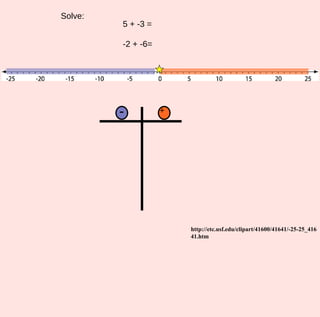
-2 + -6= 5 + -3 =  http://etc.usf.edu/clipart/41600/41641/-25-25_41641.htm Solve: - +
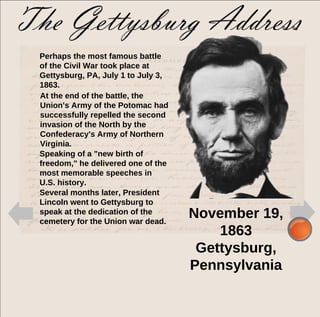
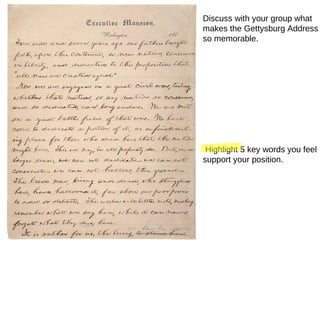
Perhaps the most famous battle of the Civil War took place at Gettysburg, PA, July 1 to July 3, 1863.  Speaking of a "new birth of freedom," he delivered one of the most memorable speeches in U.S. history. At the end of the battle, the Union's Army of the Potomac had successfully repelled the second invasion of the North by the Confederacy's Army of Northern Virginia.  Several months later, President Lincoln went to Gettysburg to speak at the dedication of the cemetery for the Union war dead.  November 19, 1863 Gettysburg, Pennsylvania
Discuss with your group what makes the Gettysburg Address so memorable. Highlight 5 key words you feel support your position.
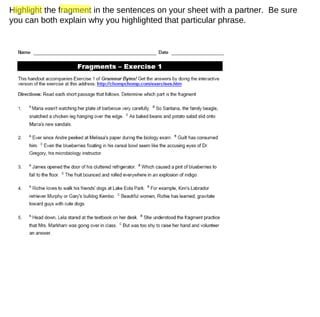
Highlight the fragment in the sentences on your sheet with a partner.  Be sure you can both explain why you highlighted that particular phrase.
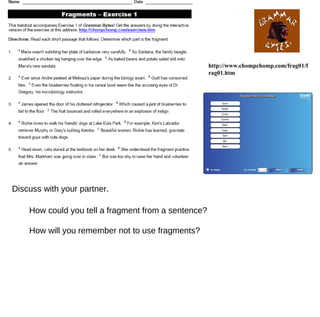
http://www.chompchomp.com/frag01/frag01.htm How could you tell a fragment from a sentence? How will you remember not to use fragments? Discuss with your partner.
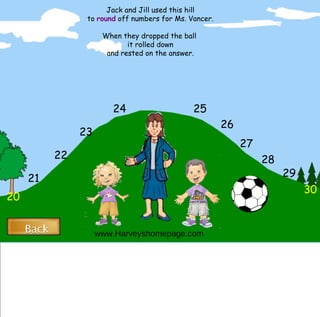
20 30 29 28 27 26 25 21 22 23 24 Jack and Jill used this hill to  round  off numbers for Ms. Vancer. When they dropped the ball  it rolled down and rested on the answer. www.Harveyshomepage.com Back Back
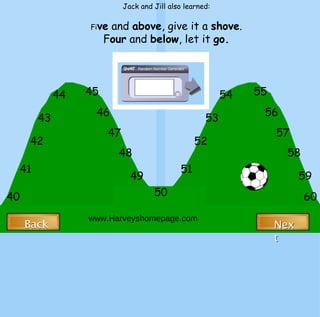
40 50 60 41 42 43 44 45 46 47 48 49 51 52 53 54 55 56 57 58 59 Jack and Jill also learned: Fi ve  and  above , give it a  shove . F our  and  below , let it  go. www.Harveyshomepage.com Back Back Next Next
www.vark-learn.com  VARK -- A Guide to Learning Styles If you would like more information or would like to take the LEARNING STYLE preference quiz, visit
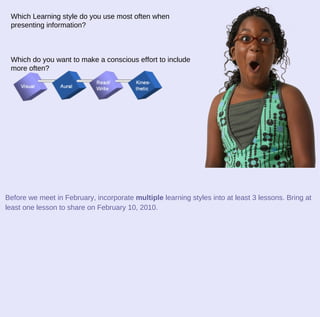
Before we meet in February, incorporate  multiple  learning styles into at least 3 lessons. Bring at least one lesson to share on February 10, 2010. Which Learning style do you use most often when presenting information? Which do you want to make a conscious effort to include more often?
· Search for resources on the Mahtomedi_Online_Resources delicious site. ·Take the VARK quiz at www.vark-learn.com ·Practice using any of the Tips and Tricks from today. ·Network and share ideas with someone who teaches a similar discipline or grade. For the remainder of our time together, you may choose to...
Attachments gettysburgaddress.notebook

VARK Learning Styles

  • 1.
    SMART Ideas forIncreasing Student Success Ways to Address Multiple Learning Styles in Our Lessons VARK -- A Guide to Learning Styles
  • 2.
    Why? Learners usedifferent modalities to receive and understand new information. For many people, one or two dominant styles are more effective when learning new information. For this reason, it is important to include a variety of modalities in our lessons, so we can give all students equal opportunity to understand the content we teach. Why?
  • 3.
  • 4.
  • 5.
    Learning styles teachersuse tend to change with the age of their students. · Primary students receive most information kinesthetically. ·Students in grades 4-8 tend to receive new information visually. ·Grades 9-12 using auditory lectures and read/write activities. http://www.teachingideas.co.uk/art/contents.htm http://www.teachingideas.co.uk/maths/contents01mental.htm http://www.teachingideas.co.uk/maths/contents12datahandling.htm http://www.teachingideas.co.uk/maths/contents03assessment.htm
  • 6.
    Ideas for IncorporatingMultiple Learning Modalities into our SMART Lessons.
  • 7.
    Visual Learners ·Include visuals and real life examples with notes whenever possible ·Ask & invite questions to keep students engaged in lectures · Have students envision the topic of discussion ·Provide outlines and/or concept maps for taking notes. ·Have students draw pictures in margins to illustrate key points color Visual
  • 8.
    Auditory Learners Auditory · Provide opportunities for presentations, debates and small/whole group discussions · Have students explain new ideas to classmates Provide recordings of lessons online to help students remember ·Ask students to describe the lesson and diagrams to someone else or role play ·Have students leave spaces notes for later recall and filling in more information after comparing with a partner
  • 9.
    Read/Write Learners Read/Write · Provide practice quizzes and tests ·Provide opportunities for written assignments and reflections. · Provide opportunities for students to create lists ·Provide supplemental readings
  • 10.
    Kinesthetic Learners · Provide opportunities for students to touch and manipulate information ·Provide colored highlighters to interact with text and highlight notes · Allow opportunities for students act out or role play content · Provide hands on approaches and models for interacting with content Kinesthetic
  • 11.
    How might weincorporate multiple learning styles into our lessons? Here are a few ideas...
  • 12.
    1/2 Whichis greater? 1 2 2 5 2 3 3 4 1/3 1/4 1/5 Kinesthetic
  • 13.
    http://www.freezeray.com/flashFiles/RatesOfReactionTemp.swf As youinteract with the simulation, pay attention to the relationship between temperature and the rate of the reaction . Draw a picture, write a sentence or explain to a partner what you discovered about this relationship.
  • 14.
    -2 + -6=5 + -3 = http://etc.usf.edu/clipart/41600/41641/-25-25_41641.htm Solve: - +
  • 15.
    Perhaps the mostfamous battle of the Civil War took place at Gettysburg, PA, July 1 to July 3, 1863. Speaking of a "new birth of freedom," he delivered one of the most memorable speeches in U.S. history. At the end of the battle, the Union's Army of the Potomac had successfully repelled the second invasion of the North by the Confederacy's Army of Northern Virginia. Several months later, President Lincoln went to Gettysburg to speak at the dedication of the cemetery for the Union war dead. November 19, 1863 Gettysburg, Pennsylvania
  • 16.
    Discuss with yourgroup what makes the Gettysburg Address so memorable. Highlight 5 key words you feel support your position.
  • 17.
    Highlight the fragmentin the sentences on your sheet with a partner. Be sure you can both explain why you highlighted that particular phrase.
  • 18.
    http://www.chompchomp.com/frag01/frag01.htm How couldyou tell a fragment from a sentence? How will you remember not to use fragments? Discuss with your partner.
  • 19.
    20 30 2928 27 26 25 21 22 23 24 Jack and Jill used this hill to round off numbers for Ms. Vancer. When they dropped the ball it rolled down and rested on the answer. www.Harveyshomepage.com Back Back
  • 20.
    40 50 6041 42 43 44 45 46 47 48 49 51 52 53 54 55 56 57 58 59 Jack and Jill also learned: Fi ve and above , give it a shove . F our and below , let it go. www.Harveyshomepage.com Back Back Next Next
  • 21.
    www.vark-learn.com VARK-- A Guide to Learning Styles If you would like more information or would like to take the LEARNING STYLE preference quiz, visit
  • 22.
    Before we meetin February, incorporate multiple learning styles into at least 3 lessons. Bring at least one lesson to share on February 10, 2010. Which Learning style do you use most often when presenting information? Which do you want to make a conscious effort to include more often?
  • 23.
    · Search forresources on the Mahtomedi_Online_Resources delicious site. ·Take the VARK quiz at www.vark-learn.com ·Practice using any of the Tips and Tricks from today. ·Network and share ideas with someone who teaches a similar discipline or grade. For the remainder of our time together, you may choose to...
  • 24.