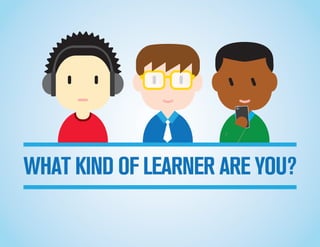
WHAT KIND OF LEARNER ARE YOU?
Cloud computing, which is
usually associated with businesses and
leveraging efficiency, has slowly been
breaking into the education system and
providing more opportunities to students
and faculty at lower cost.
			 Today’s students and teachers
		 are always seeking the latest
	 technologies available both for personal and 		
	 school use. Technology can assist them in 	 	 	
attaining the knowledge they desire and help make 	
learning more interactive and tailored to different 		
	 learning styles.
To learn, we depend on our senses to
process the information around us. At
a basic level, people learn by hearing,
seeing or doing, and most people use
one of their senses more than others.
The three most common learning styles are
Visual | Auditory | Kinesthetic
Some people listen more attentively to a
lecture while others are more alert during
a visual presentation. Meanwhile, others
are busy taking notes or practicing the
skill. Knowing your learning style can be
helpful for finding the right way to interact
with colleagues and get the most out of
meetings.
WHAT KIND OF LEARNER ARE YOU?
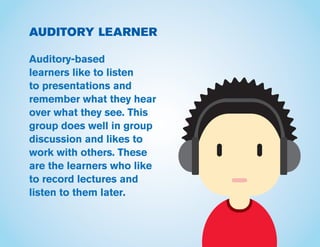
AUDITORY LEARNER
Auditory-based
learners like to listen
to presentations and
remember what they hear
over what they see. This
group does well in group
discussion and likes to
work with others. These
are the learners who like
to record lectures and
listen to them later.
AUDITORY
COMMUNICATION TOOL
Audio conferencing is a
collaborative tool that connects
customers and remote team
members. Auditory learners will
flourish in an office where they
can discuss, engage and hold
virtual meetings with audio-
only communication. And with
call recording setting, auditory
learners can go back and download
meetings to relisten later.
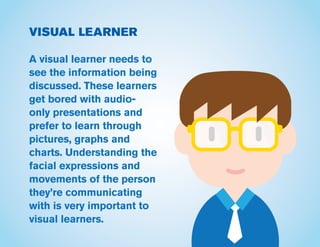
VISUAL LEARNER
A visual learner needs to
see the information being
discussed. These learners
get bored with audio-
only presentations and
prefer to learn through
pictures, graphs and
charts. Understanding the
facial expressions and
movements of the person
they’re communicating
with is very important to
visual learners.
VISUAL COMMUNICATION TOOL
Visual learners will flourish in an environment where they can
see and interact with colleagues through video conferencing
technology. A face-to-face solution makes it easier to interact
with business partners, take webinars and training courses,
and remember information.
KINESTHETIC
LEARNER
Kinesthetic or tactile
learners are always
touching things and learn
best by doing. Kinesthetic
learners are constantly
moving about and want
to be touching the object
they are learning from.
In meeting settings,
kinesthetic learners may
stand out because of their
need to move.
KINESTHETIC COMMUNICATION TOOL
Because the sense of touch is so important to tactile
learners, they need a communication tool they can have in
their hands. Mobility apps with a unified communications
platform can give kinesthetic learners the freedom to move
around and maintain professionalism while they connect
with colleagues and clients. With features like screen share
andwhiteboarding,webconferencingcanalsobeavaluable
tool for tactile learners as they can interact in real-time.
Learn more about how communications tools
affect learning by visiting the Momentum blog
BLOG.GOMOMENTUM.COM

What Kind of Learner Are You?

  • 1.
    WHAT KIND OFLEARNER ARE YOU?
  • 2.
    Cloud computing, whichis usually associated with businesses and leveraging efficiency, has slowly been breaking into the education system and providing more opportunities to students and faculty at lower cost. Today’s students and teachers are always seeking the latest technologies available both for personal and school use. Technology can assist them in attaining the knowledge they desire and help make learning more interactive and tailored to different learning styles.
  • 3.
    To learn, wedepend on our senses to process the information around us. At a basic level, people learn by hearing, seeing or doing, and most people use one of their senses more than others.
  • 4.
    The three mostcommon learning styles are Visual | Auditory | Kinesthetic Some people listen more attentively to a lecture while others are more alert during a visual presentation. Meanwhile, others are busy taking notes or practicing the skill. Knowing your learning style can be helpful for finding the right way to interact with colleagues and get the most out of meetings.
  • 5.
    WHAT KIND OFLEARNER ARE YOU?
  • 6.
    AUDITORY LEARNER Auditory-based learners liketo listen to presentations and remember what they hear over what they see. This group does well in group discussion and likes to work with others. These are the learners who like to record lectures and listen to them later.
  • 7.
    AUDITORY COMMUNICATION TOOL Audio conferencingis a collaborative tool that connects customers and remote team members. Auditory learners will flourish in an office where they can discuss, engage and hold virtual meetings with audio- only communication. And with call recording setting, auditory learners can go back and download meetings to relisten later.
  • 8.
    VISUAL LEARNER A visuallearner needs to see the information being discussed. These learners get bored with audio- only presentations and prefer to learn through pictures, graphs and charts. Understanding the facial expressions and movements of the person they’re communicating with is very important to visual learners.
  • 9.
    VISUAL COMMUNICATION TOOL Visuallearners will flourish in an environment where they can see and interact with colleagues through video conferencing technology. A face-to-face solution makes it easier to interact with business partners, take webinars and training courses, and remember information.
  • 10.
    KINESTHETIC LEARNER Kinesthetic or tactile learnersare always touching things and learn best by doing. Kinesthetic learners are constantly moving about and want to be touching the object they are learning from. In meeting settings, kinesthetic learners may stand out because of their need to move.
  • 11.
    KINESTHETIC COMMUNICATION TOOL Becausethe sense of touch is so important to tactile learners, they need a communication tool they can have in their hands. Mobility apps with a unified communications platform can give kinesthetic learners the freedom to move around and maintain professionalism while they connect with colleagues and clients. With features like screen share andwhiteboarding,webconferencingcanalsobeavaluable tool for tactile learners as they can interact in real-time.
  • 12.
    Learn more abouthow communications tools affect learning by visiting the Momentum blog BLOG.GOMOMENTUM.COM