DAV PUBLIC SCOOL
RIHANDNAGAR
Seminar
On
Effective
Classroom
Management
CONTENT
Introduction
What is Classroom Management?
Objectives
Why is it Important?
Strategies
Classroom Rules
Classroom Management Issues
Tips for Minimizing Problems
Introduction
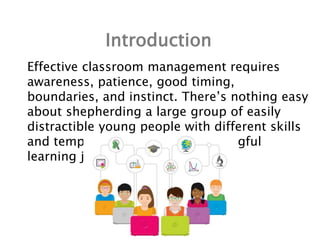
Effective classroom management requires
awareness, patience, good timing,
boundaries, and instinct. There’s nothing easy
about shepherding a large group of easily
distractible young people with different skills
and temperaments along a meaningful
learning journey.
WHAT IS CLASSROOM
MANAGEMENT?
 It’s effective discipline
 It’s being prepared for class
 It’s motivating your students
 It’s providing a safe, comfortable learning
environment
 It’s building your students’ self esteem
 It’s being creative and imaginative in daily
lessons
OBJECTIVES
Understand proven research and sound theories that provide a
foundation for quality classroom management and prepare a
lesson plan.
Share effective classroom management strategies
Understand how to manage rules and procedures.
Understand how to handle discipline problems.
Building a good relationship between teacher and student.
WHY IS CLASSROOM MANAGEMENT
IMPORTANT?
Satisfaction and enjoyment in teaching are
dependent upon leading students to cooperate
Classroom management issues are of highest
concern for beginning teachers
Classroom management and effective instruction are
key in ensuring student success and learning
THE CRITICAL ROLE OF THE
TEACHER AS CLASSROOM
MANAGER
Classroom management is one of the most important
roles played by teachers because it determines teaching
success.
Effective teachers appear to be effective with students of
all achievement levels regardless of the levels of
heterogeneity in their classes.
Effective classroom managers are those who understand
and use specific techniques.
Even if the school they work in is highly ineffective,
individual teachers can produce powerful gains in
student learning
FUNCTIONS PERFORMED BY
AN EFFECTIVE TEACHER
Chooses, makes and uses the most effective instructional
strategies.
Designs classroom curriculum that facilitates student
learning.
Also considers, when designing a curriculum, the needs
of the students collectively and individually and not just
relying on the textbook provided by the district .
Implements rules and regulations and imposed
disciplinary actions.
WHAT ARE THE FOUR
COMPONENTS OF CLASSROOM
MANAGEMENT?
1. Classroom Design
Arrange your classroom furniture, accessories, and
learning aids thoughtfully. Think students' desks, learning
stations, and device placement.
2. Instructional Technique
Switch between learning styles with different classes. For
example, you can engage your 3rd class students with
digital gamification elements. generate the curiosity of
your 8th graders with small group discussions on their
favorite topics.
WHAT ARE THE FOUR
COMPONENTS OF CLASSROOM
MANAGEMENT?......
3. Classroom Rules
Lead your class with a firm hand but make sure that
students get the message. If you do well in the other
departments, they’ll understand the rules are in
everyone’s best interests.
4. Organization
Keep your lessons organized and show up on time.
Investing time in teaching discipline and procedures will be repaid multifold
in the effective use of class time.
Here are a few things to keep in mind as you are establishing rules:
 Rules are expectations of appropriate behavior. You can state your
expectations as rules
 Rules immediately create a work-oriented atmosphere
 Rules create a strong expectation about the things that are
important to you.
 Include consequences – What the student chooses to accept if a
rule is broken.
 Include rewards – What the student receives for appropriate
behavior
Establishing a Discipline Plan
Take some time to discuss with your colleagues things that you have
done that worked and things that didn’t work.
What are the areas are the strongest? Weakest?
How can you help another colleague in the area where you are
strongest?
What do you need to improve the areas you thought were weak?
What materials and/or resources are needed in order to improve your
classroom management skills this year?
Teamwork – Implementing Classroom Management
Classroom Rules
a. Bring all needed materials to class
b. Be in your seat ready to work when bell rings
c. Respect and be polite to everyone
d. Listen and stay seated when someone else is
talking
e. Respect other people’s property
f. Obey all school rules
1. Student ownership of rules if they help establish them
2. It will take a few weeks for students to adjust
3. If a rule doesn’t work, make it more realistic and enforceable
4. May want to post rules or send a copy home with parents
CLASSROOM MANAGEMENT
ISSUES
Academic Misconduct
Aggressive Students
Attendance
Discussing Controversial Topics
Disrespectful genders colour ,castes and religion.
Dominant Students & Quiet Students
Emotional & Psychological Problems
Inattentive Students
Unprepared Students
TIPS FOR MINIMIZING PROBLEMS
1. Publish expectations in the syllabus and review in
class.
2. Address issues when they come up.
3. Be consistent in application of course policies.
TIPS FOR BETTER
CLASSROOM MANAGEMENT
Always love the students
The teacher should always love their students and stand
against their behavior, which doesn’t meet their
expectations. The students can remind of their true worth
if their teachers love them unconditionally.
Praise their efforts
The teacher should always praise the work of their
students if they meet their expectations. It helps in
creating positivity in the class.
TIPS FOR BETTER
CLASSROOM
MANAGEMENT…….
Identify yourself
The teachers should tell their students regarding who
they are and why they are here. A class where all the
students have a great confidence in their teacher often
has the power to create a wonderful environment for
learning.
Having a plan
The lesson plans of the teacher should be concise and
clear and they required starting each day with a clear
vision. In addition to that, the teacher should have a keen
sense of the behavior they expect at every point in the
class.
THANKS

Classroom-Management-PPT (1) (1).pptx

  • 1.
  • 2.
    CONTENT Introduction What is ClassroomManagement? Objectives Why is it Important? Strategies Classroom Rules Classroom Management Issues Tips for Minimizing Problems
  • 3.
    Introduction Effective classroom managementrequires awareness, patience, good timing, boundaries, and instinct. There’s nothing easy about shepherding a large group of easily distractible young people with different skills and temperaments along a meaningful learning journey.
  • 4.
    WHAT IS CLASSROOM MANAGEMENT? It’s effective discipline  It’s being prepared for class  It’s motivating your students  It’s providing a safe, comfortable learning environment  It’s building your students’ self esteem  It’s being creative and imaginative in daily lessons
  • 5.
    OBJECTIVES Understand proven researchand sound theories that provide a foundation for quality classroom management and prepare a lesson plan. Share effective classroom management strategies Understand how to manage rules and procedures. Understand how to handle discipline problems. Building a good relationship between teacher and student.
  • 6.
    WHY IS CLASSROOMMANAGEMENT IMPORTANT? Satisfaction and enjoyment in teaching are dependent upon leading students to cooperate Classroom management issues are of highest concern for beginning teachers Classroom management and effective instruction are key in ensuring student success and learning
  • 7.
    THE CRITICAL ROLEOF THE TEACHER AS CLASSROOM MANAGER Classroom management is one of the most important roles played by teachers because it determines teaching success. Effective teachers appear to be effective with students of all achievement levels regardless of the levels of heterogeneity in their classes. Effective classroom managers are those who understand and use specific techniques. Even if the school they work in is highly ineffective, individual teachers can produce powerful gains in student learning
  • 8.
    FUNCTIONS PERFORMED BY ANEFFECTIVE TEACHER Chooses, makes and uses the most effective instructional strategies. Designs classroom curriculum that facilitates student learning. Also considers, when designing a curriculum, the needs of the students collectively and individually and not just relying on the textbook provided by the district . Implements rules and regulations and imposed disciplinary actions.
  • 9.
    WHAT ARE THEFOUR COMPONENTS OF CLASSROOM MANAGEMENT? 1. Classroom Design Arrange your classroom furniture, accessories, and learning aids thoughtfully. Think students' desks, learning stations, and device placement. 2. Instructional Technique Switch between learning styles with different classes. For example, you can engage your 3rd class students with digital gamification elements. generate the curiosity of your 8th graders with small group discussions on their favorite topics.
  • 10.
    WHAT ARE THEFOUR COMPONENTS OF CLASSROOM MANAGEMENT?...... 3. Classroom Rules Lead your class with a firm hand but make sure that students get the message. If you do well in the other departments, they’ll understand the rules are in everyone’s best interests. 4. Organization Keep your lessons organized and show up on time.
  • 11.
    Investing time inteaching discipline and procedures will be repaid multifold in the effective use of class time. Here are a few things to keep in mind as you are establishing rules:  Rules are expectations of appropriate behavior. You can state your expectations as rules  Rules immediately create a work-oriented atmosphere  Rules create a strong expectation about the things that are important to you.  Include consequences – What the student chooses to accept if a rule is broken.  Include rewards – What the student receives for appropriate behavior Establishing a Discipline Plan
  • 12.
    Take some timeto discuss with your colleagues things that you have done that worked and things that didn’t work. What are the areas are the strongest? Weakest? How can you help another colleague in the area where you are strongest? What do you need to improve the areas you thought were weak? What materials and/or resources are needed in order to improve your classroom management skills this year? Teamwork – Implementing Classroom Management
  • 13.
    Classroom Rules a. Bringall needed materials to class b. Be in your seat ready to work when bell rings c. Respect and be polite to everyone d. Listen and stay seated when someone else is talking e. Respect other people’s property f. Obey all school rules 1. Student ownership of rules if they help establish them 2. It will take a few weeks for students to adjust 3. If a rule doesn’t work, make it more realistic and enforceable 4. May want to post rules or send a copy home with parents
  • 14.
    CLASSROOM MANAGEMENT ISSUES Academic Misconduct AggressiveStudents Attendance Discussing Controversial Topics Disrespectful genders colour ,castes and religion. Dominant Students & Quiet Students Emotional & Psychological Problems Inattentive Students Unprepared Students
  • 15.
    TIPS FOR MINIMIZINGPROBLEMS 1. Publish expectations in the syllabus and review in class. 2. Address issues when they come up. 3. Be consistent in application of course policies.
  • 16.
    TIPS FOR BETTER CLASSROOMMANAGEMENT Always love the students The teacher should always love their students and stand against their behavior, which doesn’t meet their expectations. The students can remind of their true worth if their teachers love them unconditionally. Praise their efforts The teacher should always praise the work of their students if they meet their expectations. It helps in creating positivity in the class.
  • 17.
    TIPS FOR BETTER CLASSROOM MANAGEMENT……. Identifyyourself The teachers should tell their students regarding who they are and why they are here. A class where all the students have a great confidence in their teacher often has the power to create a wonderful environment for learning. Having a plan The lesson plans of the teacher should be concise and clear and they required starting each day with a clear vision. In addition to that, the teacher should have a keen sense of the behavior they expect at every point in the class.
  • 18.