What are Learning Styles?What are Learning Styles?
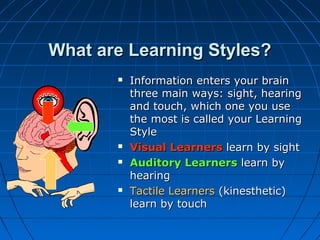
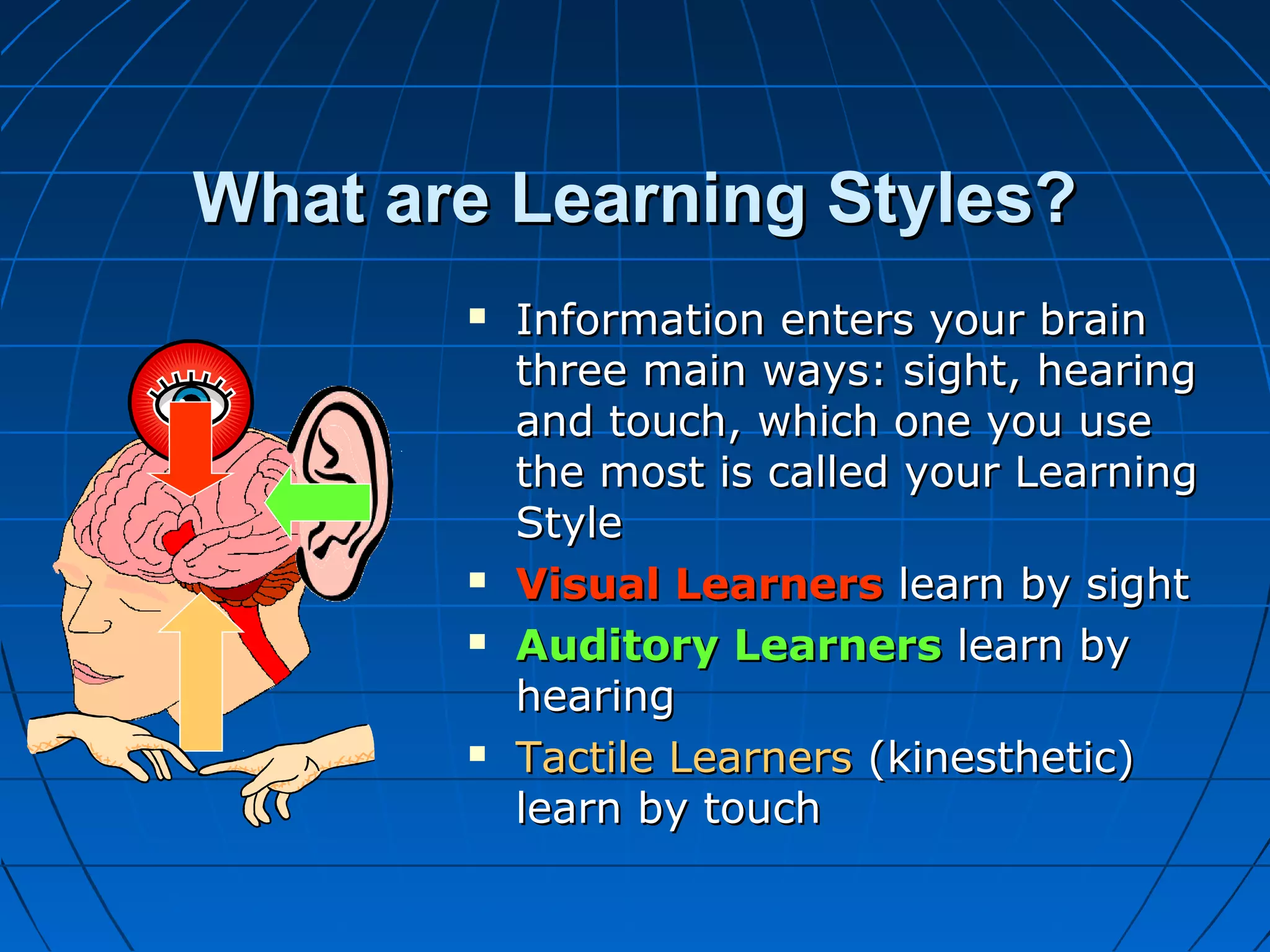
 Information enters your brainInformation enters your brain
three main ways: sight, hearingthree main ways: sight, hearing
and touch, which one you useand touch, which one you use
the most is called your Learningthe most is called your Learning
StyleStyle
 Visual LearnersVisual Learners learn by sightlearn by sight
 Auditory LearnersAuditory Learners learn bylearn by
hearinghearing
 Tactile LearnersTactile Learners (kinesthetic)(kinesthetic)
learn by touchlearn by touch
Visual LearnersVisual Learners
 Prefer to see information such as pictures,Prefer to see information such as pictures,
diagrams, cartoons, demonstrationsdiagrams, cartoons, demonstrations
 Picture words and concepts they hear asPicture words and concepts they hear as
imagesimages
 Easily distracted in lecture with no visualEasily distracted in lecture with no visual
aidsaids
 Overwhelmed with intense visualsOverwhelmed with intense visuals
accompanied by lectureaccompanied by lecture
 Benefit from using charts, maps, notes,Benefit from using charts, maps, notes,
and flash cards when studyingand flash cards when studying
Auditory LearnersAuditory Learners
 Prefer to hear information spokenPrefer to hear information spoken
 Can absorb a lecture with little effortCan absorb a lecture with little effort
 May not need careful notes to learn.May not need careful notes to learn.
 Often avoid eye contact in order toOften avoid eye contact in order to
concentrateconcentrate
 May read aloud to themselvesMay read aloud to themselves
 Like background music when they studyLike background music when they study
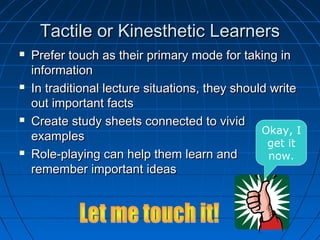
Tactile or Kinesthetic LearnersTactile or Kinesthetic Learners
 Prefer touch as their primary mode for taking inPrefer touch as their primary mode for taking in
informationinformation
 In traditional lecture situations, they should writeIn traditional lecture situations, they should write
out important factsout important facts
 Create study sheets connected to vividCreate study sheets connected to vivid
examplesexamples
 Role-playing can help them learn andRole-playing can help them learn and
remember important ideasremember important ideas
Okay, I
get it
now.
Discovering Your Own Learning StyleDiscovering Your Own Learning Style
 Take a Learning Styles testTake a Learning Styles test
 Think about your favorite classes in highThink about your favorite classes in high
school or college so far. What do they haveschool or college so far. What do they have
in common? Did you like…in common? Did you like…
• mastering facts?mastering facts?
• discussion? or working on your own?discussion? or working on your own?
• lecture? or pairing or grouping?lecture? or pairing or grouping?
• hands-on activities?hands-on activities?
 Do some self-analysis (calledDo some self-analysis (called
metacognition) How do youmetacognition) How do you
think you learn?think you learn?
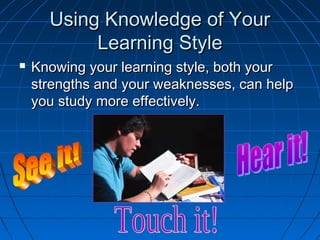
Using Knowledge of YourUsing Knowledge of Your
Learning StyleLearning Style
 Knowing your learning style, both yourKnowing your learning style, both your
strengths and your weaknesses, can helpstrengths and your weaknesses, can help
you study more effectively.you study more effectively.
Different Teaching StylesDifferent Teaching Styles
LectureLecture –– teacher talks all periodteacher talks all period
Group discussionGroup discussion –– teacher talks butteacher talks but
encourages discussionencourages discussion
Small groupsSmall groups –– teacher aids (facilitates) groupteacher aids (facilitates) group
interactioninteraction
Visual focusVisual focus – teacher uses lots of visual aids– teacher uses lots of visual aids
Verbal focusVerbal focus – words, words & more words– words, words & more words
Logical sequenceLogical sequence – teacher presents material in– teacher presents material in
a step-by-step, reasonable formata step-by-step, reasonable format
Random sequenceRandom sequence – teacher jumps all over the– teacher jumps all over the
placeplace
Teaching stylesTeaching styles
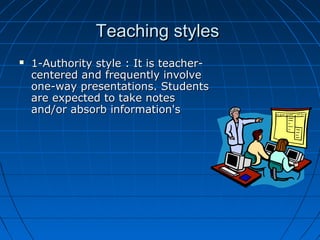
 1-Authority style : It is teacher-1-Authority style : It is teacher-
centered and frequently involvecentered and frequently involve
one-way presentations. Studentsone-way presentations. Students
are expected to take notesare expected to take notes
and/or absorb information'sand/or absorb information's
Teaching stylesTeaching styles
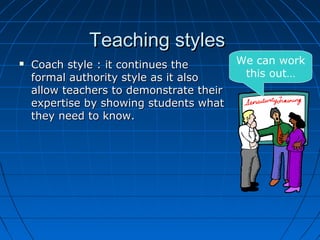
 Coach style : it continues theCoach style : it continues the
formal authority style as it alsoformal authority style as it also
allow teachers to demonstrate theirallow teachers to demonstrate their
expertise by showing students whatexpertise by showing students what
they need to know.they need to know.
We can work
this out…
Teaching stylesTeaching styles
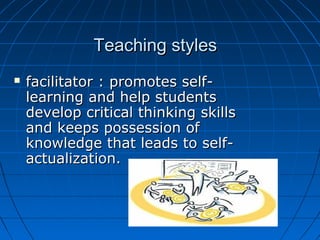
 facilitator : promotes self-facilitator : promotes self-
learning and help studentslearning and help students
develop critical thinking skillsdevelop critical thinking skills
and keeps possession ofand keeps possession of
knowledge that leads to self-knowledge that leads to self-
actualization.actualization.
Teaching stylesTeaching styles
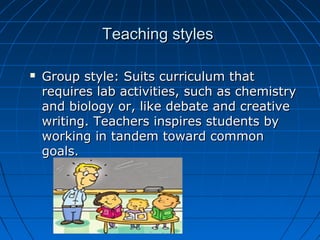
 Group style: Suits curriculum thatGroup style: Suits curriculum that
requires lab activities, such as chemistryrequires lab activities, such as chemistry
and biology or, like debate and creativeand biology or, like debate and creative
writing. Teachers inspires students bywriting. Teachers inspires students by
working in tandem toward commonworking in tandem toward common
goals.goals.
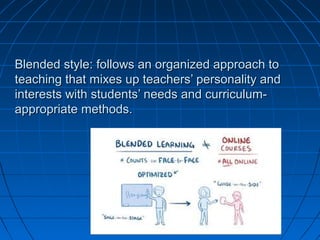
Blended style: follows an organized approach toBlended style: follows an organized approach to
teaching that mixes up teachers’ personality andteaching that mixes up teachers’ personality and
interests with students’ needs and curriculum-interests with students’ needs and curriculum-
appropriate methods.appropriate methods.
teaching and learning style

teaching and learning style

  • 1.
    What are LearningStyles?What are Learning Styles?  Information enters your brainInformation enters your brain three main ways: sight, hearingthree main ways: sight, hearing and touch, which one you useand touch, which one you use the most is called your Learningthe most is called your Learning StyleStyle  Visual LearnersVisual Learners learn by sightlearn by sight  Auditory LearnersAuditory Learners learn bylearn by hearinghearing  Tactile LearnersTactile Learners (kinesthetic)(kinesthetic) learn by touchlearn by touch
  • 2.
    Visual LearnersVisual Learners Prefer to see information such as pictures,Prefer to see information such as pictures, diagrams, cartoons, demonstrationsdiagrams, cartoons, demonstrations  Picture words and concepts they hear asPicture words and concepts they hear as imagesimages  Easily distracted in lecture with no visualEasily distracted in lecture with no visual aidsaids  Overwhelmed with intense visualsOverwhelmed with intense visuals accompanied by lectureaccompanied by lecture  Benefit from using charts, maps, notes,Benefit from using charts, maps, notes, and flash cards when studyingand flash cards when studying
  • 3.
    Auditory LearnersAuditory Learners Prefer to hear information spokenPrefer to hear information spoken  Can absorb a lecture with little effortCan absorb a lecture with little effort  May not need careful notes to learn.May not need careful notes to learn.  Often avoid eye contact in order toOften avoid eye contact in order to concentrateconcentrate  May read aloud to themselvesMay read aloud to themselves  Like background music when they studyLike background music when they study
  • 4.
    Tactile or KinestheticLearnersTactile or Kinesthetic Learners  Prefer touch as their primary mode for taking inPrefer touch as their primary mode for taking in informationinformation  In traditional lecture situations, they should writeIn traditional lecture situations, they should write out important factsout important facts  Create study sheets connected to vividCreate study sheets connected to vivid examplesexamples  Role-playing can help them learn andRole-playing can help them learn and remember important ideasremember important ideas Okay, I get it now.
  • 5.
    Discovering Your OwnLearning StyleDiscovering Your Own Learning Style  Take a Learning Styles testTake a Learning Styles test  Think about your favorite classes in highThink about your favorite classes in high school or college so far. What do they haveschool or college so far. What do they have in common? Did you like…in common? Did you like… • mastering facts?mastering facts? • discussion? or working on your own?discussion? or working on your own? • lecture? or pairing or grouping?lecture? or pairing or grouping? • hands-on activities?hands-on activities?  Do some self-analysis (calledDo some self-analysis (called metacognition) How do youmetacognition) How do you think you learn?think you learn?
  • 6.
    Using Knowledge ofYourUsing Knowledge of Your Learning StyleLearning Style  Knowing your learning style, both yourKnowing your learning style, both your strengths and your weaknesses, can helpstrengths and your weaknesses, can help you study more effectively.you study more effectively.
  • 7.
    Different Teaching StylesDifferentTeaching Styles LectureLecture –– teacher talks all periodteacher talks all period Group discussionGroup discussion –– teacher talks butteacher talks but encourages discussionencourages discussion Small groupsSmall groups –– teacher aids (facilitates) groupteacher aids (facilitates) group interactioninteraction Visual focusVisual focus – teacher uses lots of visual aids– teacher uses lots of visual aids Verbal focusVerbal focus – words, words & more words– words, words & more words Logical sequenceLogical sequence – teacher presents material in– teacher presents material in a step-by-step, reasonable formata step-by-step, reasonable format Random sequenceRandom sequence – teacher jumps all over the– teacher jumps all over the placeplace
  • 8.
    Teaching stylesTeaching styles 1-Authority style : It is teacher-1-Authority style : It is teacher- centered and frequently involvecentered and frequently involve one-way presentations. Studentsone-way presentations. Students are expected to take notesare expected to take notes and/or absorb information'sand/or absorb information's
  • 9.
    Teaching stylesTeaching styles Coach style : it continues theCoach style : it continues the formal authority style as it alsoformal authority style as it also allow teachers to demonstrate theirallow teachers to demonstrate their expertise by showing students whatexpertise by showing students what they need to know.they need to know. We can work this out…
  • 10.
    Teaching stylesTeaching styles facilitator : promotes self-facilitator : promotes self- learning and help studentslearning and help students develop critical thinking skillsdevelop critical thinking skills and keeps possession ofand keeps possession of knowledge that leads to self-knowledge that leads to self- actualization.actualization.
  • 11.
    Teaching stylesTeaching styles Group style: Suits curriculum thatGroup style: Suits curriculum that requires lab activities, such as chemistryrequires lab activities, such as chemistry and biology or, like debate and creativeand biology or, like debate and creative writing. Teachers inspires students bywriting. Teachers inspires students by working in tandem toward commonworking in tandem toward common goals.goals.
  • 12.
    Blended style: followsan organized approach toBlended style: follows an organized approach to teaching that mixes up teachers’ personality andteaching that mixes up teachers’ personality and interests with students’ needs and curriculum-interests with students’ needs and curriculum- appropriate methods.appropriate methods.

Editor's Notes

  • #12 Different instructors have different goals regarding student participation. Some expect students to concentrate on listening, thinking, and taking notes. Others want you to be actively involved in other ways as well. Participating in various ways will develop your academic skills. Asking or responding to questions can make a class more worthwhile for you and your classmates.