An Introduction and OverviewMultiple IntelligencesLanguage Learning Strategiesand Lexis©Developed by William M. Tweedie
ObjectivesYou will learn:What language learning strategies areWhat learning styles areThat language learning strategies are linked to  learning stylesCategories and groups of language learning strategiesSome activities to apply strategy instruction in your classrooms
What are Language LearningStrategies?Human Language is a means of Communicating our thoughts and feelings to others.Learning is “the process by which information is obtained, stored, retrieved, and used”. *Language Learning Strategies are any activities, steps, plans, or routines used by the learner which affect this process with the goal to improve the learningof language for the use of it.* J. Rubin. Learner strategies: Theoretical assumptions, research history and typology. In A. Wenden and J. Rubin, editors, Learner Strategies in Language Learning, page 29. Prentice Hall, New York, 1987.
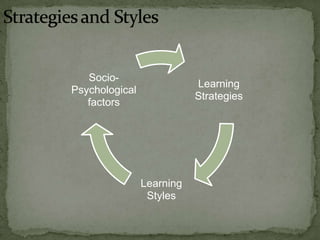
Learning Style is a reflection of the development of one’s Multiple Intelligences at any given moment in time.The development of the various intelligences dictates preferred or successful ways of learning.Being conscious of your Learning Style will help you choose successful learning Strategies.All the Intelligences and all Learning Strategies can be developed.Strategies and Styles
Knowledge Check-upWhat are the Intelligences that have been identified so far in the theory put forth by Howard Gardiner?Hint: There are eight or nine (depending on the proponent of the Theory you read)Another hint: think of the most famous people you know in history or today. What gift do they have.Brainstorm!!
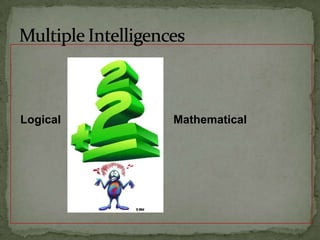
  Logical                                   MathematicalMultiple Intelligences
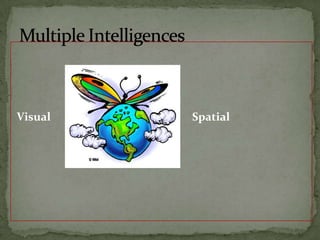
Visual                                                   SpatialMultiple Intelligences
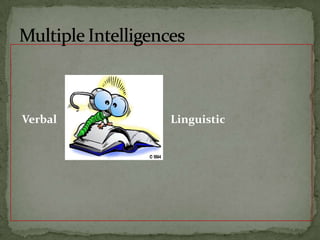
   Verbal                                         LinguisticMultiple Intelligences
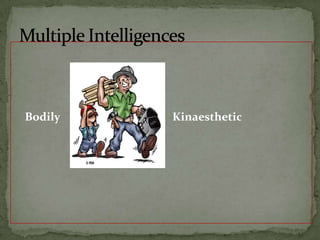
    Bodily  			           KinaestheticMultiple Intelligences
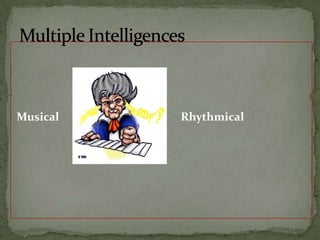
 Musical   			              RhythmicalMultiple Intelligences
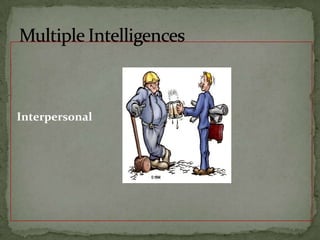
InterpersonalMultiple Intelligences
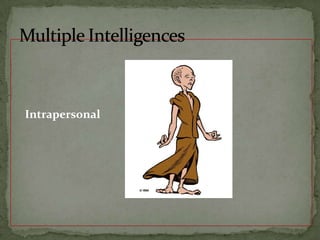
    IntrapersonalMultiple Intelligences
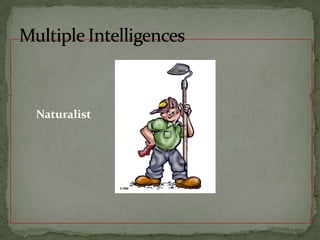
        Naturalist		Multiple Intelligences
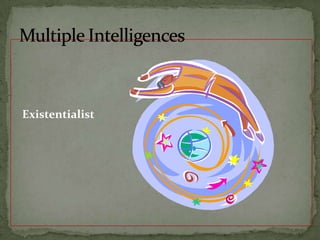
   ExistentialistMultiple Intelligences
Strategies and Styles
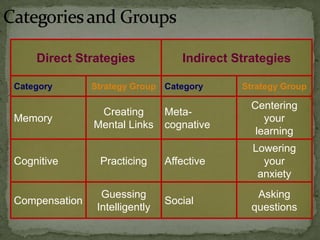
Categories and Groups
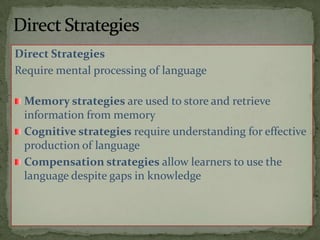
Direct StrategiesDirect StrategiesRequire mental processing of languageMemory strategies are used to store and retrieve information from memoryCognitive strategies require understanding for effective production of languageCompensation strategies allow learners to use the language despite gaps in knowledge
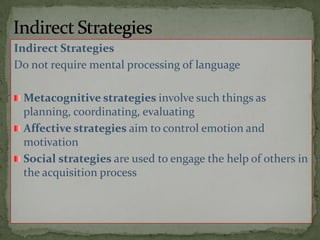
Indirect StrategiesIndirect StrategiesDo not require mental processing of languageMetacognitive strategies involve such things as planning, coordinating, evaluatingAffective strategies aim to control emotion and motivationSocial strategies are used to engage thehelp of others in the acquisition process
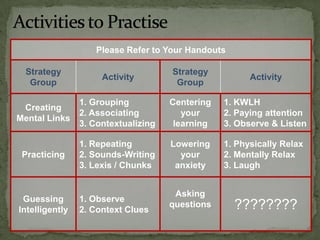
Activities to Practise
Language Learning Strategies and Lexis © 2002 Kenmac Educan International and William M. Tweediea course book in progress for beginner to lowintermediate level Young Adult and Adult learners of English as a Foreign Language.It is based on the framework laid out in the highly recommended Language learning Strategies: What Every Teacher Should Know by Rebecca L. Oxford (1990) Boston, Heinle &HeinleThank you for contributing to it’s development!Course Note

Language Learning Strategies

  • 1.
    An Introduction andOverviewMultiple IntelligencesLanguage Learning Strategiesand Lexis©Developed by William M. Tweedie
  • 2.
    ObjectivesYou will learn:Whatlanguage learning strategies areWhat learning styles areThat language learning strategies are linked to learning stylesCategories and groups of language learning strategiesSome activities to apply strategy instruction in your classrooms
  • 3.
    What are LanguageLearningStrategies?Human Language is a means of Communicating our thoughts and feelings to others.Learning is “the process by which information is obtained, stored, retrieved, and used”. *Language Learning Strategies are any activities, steps, plans, or routines used by the learner which affect this process with the goal to improve the learningof language for the use of it.* J. Rubin. Learner strategies: Theoretical assumptions, research history and typology. In A. Wenden and J. Rubin, editors, Learner Strategies in Language Learning, page 29. Prentice Hall, New York, 1987.
  • 4.
    Learning Style isa reflection of the development of one’s Multiple Intelligences at any given moment in time.The development of the various intelligences dictates preferred or successful ways of learning.Being conscious of your Learning Style will help you choose successful learning Strategies.All the Intelligences and all Learning Strategies can be developed.Strategies and Styles
  • 5.
    Knowledge Check-upWhat arethe Intelligences that have been identified so far in the theory put forth by Howard Gardiner?Hint: There are eight or nine (depending on the proponent of the Theory you read)Another hint: think of the most famous people you know in history or today. What gift do they have.Brainstorm!!
  • 6.
    Logical MathematicalMultiple Intelligences
  • 7.
    Visual SpatialMultiple Intelligences
  • 8.
    Verbal LinguisticMultiple Intelligences
  • 9.
    Bodily KinaestheticMultiple Intelligences
  • 10.
    Musical RhythmicalMultiple Intelligences
  • 11.
  • 12.
    IntrapersonalMultiple Intelligences
  • 13.
    Naturalist Multiple Intelligences
  • 14.
    ExistentialistMultiple Intelligences
  • 15.
  • 16.
  • 17.
    Direct StrategiesDirect StrategiesRequiremental processing of languageMemory strategies are used to store and retrieve information from memoryCognitive strategies require understanding for effective production of languageCompensation strategies allow learners to use the language despite gaps in knowledge
  • 18.
    Indirect StrategiesIndirect StrategiesDonot require mental processing of languageMetacognitive strategies involve such things as planning, coordinating, evaluatingAffective strategies aim to control emotion and motivationSocial strategies are used to engage thehelp of others in the acquisition process
  • 19.
  • 20.
    Language Learning Strategiesand Lexis © 2002 Kenmac Educan International and William M. Tweediea course book in progress for beginner to lowintermediate level Young Adult and Adult learners of English as a Foreign Language.It is based on the framework laid out in the highly recommended Language learning Strategies: What Every Teacher Should Know by Rebecca L. Oxford (1990) Boston, Heinle &HeinleThank you for contributing to it’s development!Course Note