Chapter 11
Leadership
“The ability to influence people
toward the attainment of
goals.”
Types of Leadership Theories
Universal
– Traits (I)
– Behaviors (II)
» e.g., Ohio State, Leadership Grid (Blake & Mouton),
Michigan
Contingency
– Traits (III)
» e.g., Fiedler
– Behaviors (IV)
» e.g., Hersey & Blanchard,
Type I Theories: Traits that
Generally Differentiate Leaders
from Nonleaders
Drive
Desire to Lead
Honesty and Integrity
Self-Confidence
Intelligence
Job-Relevant Knowledge
(Traits only provide the potential for leadership.
They don’t guarantee it will happen.)
2 Basic Leadership Styles
(Types II, III, and IV Theories)
Category 1
Initiating Structure--
Job-Centered---------
Conc. for Production
Task-Oriented--------
Directive---------------
Category 2
Consideration
Employee-Centered
Concern for People
Relationship-
Oriented
Supportive
Ohio State Studies (Type II)
Consideration
Initiating Structure
(Leaders are supposedly Both, One,
or Neither - Viewed as two
different dimensions)
The Leadership Grid (Type II)
Concern for production measured on a
scale of 1 to 9
Concern for people measured on a scale
of 1 to 9
Team management (9,9) is often
considered the most effective style for all
managers.
Blake & Mouton’s
Leadership Grid
HighHigh
HighHigh
LowLow
LowLow Concern for ProductionConcern for Production
ConcernforPeopleConcernforPeople
Country ClubCountry Club
ManagementManagement
ImpoverishedImpoverished
ManagementManagement
TeamTeam
ManagementManagement
Authority-Authority-
ComplianceCompliance
ManagementManagement
Middle-of-Middle-of-
the-Roadthe-Road
ManagementManagement
Michigan Studies (Type II)
Employee-Centered Leaders
Job-Centered Leaders
(Leaders are supposedly
Either/OR, but NOT Both -
These were viewed as opposite
extremes of the same continuum -
c.f., Fiedler)
Contingency Approaches
Identify relevant Situational
Variables and what Leader
Traits or Styles are appropriate
for each.
Hersey and Blanchard'sHersey and Blanchard's
Situational TheorySituational Theory
Situational VariablesSituational Variables
Followers’Followers’ Readiness /Readiness /
Maturity is due to :Maturity is due to :
AbilityAbility
WillingnessWillingness
Leader BehaviorsLeader Behaviors
Task Behavior (High orTask Behavior (High or
Low)Low)
Relationship BehaviorRelationship Behavior
(High or Low)(High or Low)
4 Combinations:4 Combinations:
Telling (H-L)Telling (H-L)
Selling (H-H)Selling (H-H)
Participating (L-H)Participating (L-H)
Delegating (L-L)Delegating (L-L)
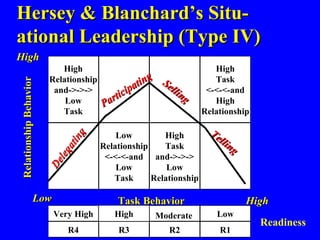
Hersey & Blanchard’s Situ-Hersey & Blanchard’s Situ-
ational Leadership (Type IV)ational Leadership (Type IV)
High
Relationship
and->->->
Low
Task
High
Task
<-<-<-and
High
Relationship
Low
Relationship
<-<-<-and
Low
Task
High
Task
and->->->
Low
Relationship
Very High Low
R4 R3 R2 R1
Moderate
Task BehaviorTask Behavior HighHigh
HighHigh
LowLow
RelationshipBehaviorRelationshipBehavior
Delegating
Delegating
Participating
Participating Selling
Selling
Telling
Telling
Readiness
High
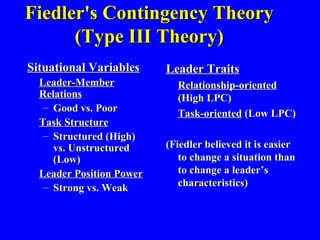
Fiedler's Contingency TheoryFiedler's Contingency Theory
(Type III Theory)(Type III Theory)
Leader TraitsLeader Traits
Relationship-orientedRelationship-oriented
(High LPC)(High LPC)
Task-orientedTask-oriented (Low LPC)(Low LPC)
(Fiedler believed it is easier(Fiedler believed it is easier
to change a situation thanto change a situation than
to change a leader’sto change a leader’s
characteristics)characteristics)
Situational VariablesSituational Variables
Leader-MemberLeader-Member
RelationsRelations
– Good vs. PoorGood vs. Poor
Task StructureTask Structure
– Structured (High)Structured (High)
vs. Unstructuredvs. Unstructured
(Low)(Low)
Leader Position PowerLeader Position Power
– Strong vs. WeakStrong vs. Weak
Fiedler’s RecommendationsFiedler’s Recommendations
Task-oriented managers more
effective in very favorable or
very unfavorable situations.
Relationship-oriented managers
more effective in moderately
favorable situations.
Fiedler’s Contingency ModelFiedler’s Contingency Model
GOODGOOD POORPOOR
HIGH LO W HIGH LOWHIGH LO W HIGH LOW
SS WW SS WW SS WW SS WW
Leader-
Member
Relations
Task
Structure
Position
Power
Kinds of
Leadership
Situations
Very
Favorable
Very
Unfavorable
I II III IV V VI VII VIII1
Relationship-oriented managers most effective in IV, V, VI, VII.
Task-oriented managers most effective in I, II, III or VIII.
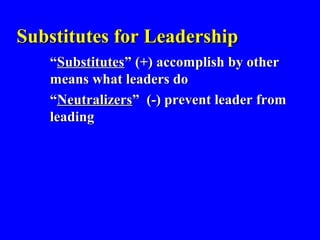
Substitutes for LeadershipSubstitutes for Leadership
““SubstitutesSubstitutes” (+) accomplish by other” (+) accomplish by other
means what leaders domeans what leaders do
““NeutralizersNeutralizers” (-) prevent leader from” (-) prevent leader from
leadingleading
Substitutes for LeadershipSubstitutes for Leadership
OrganizationalOrganizational VariablesVariables
Formalization Rules (+)Formalization Rules (+)
Physical separation (-)Physical separation (-)
TaskTask characteristicscharacteristics
Highly structured task (+)Highly structured task (+)
Automatic feedback (+)Automatic feedback (+)
GroupGroup characteristicscharacteristics
Training/experience (+)Training/experience (+)
Group doesn’t value the rewards given (-)Group doesn’t value the rewards given (-)
Newer Leadership Approaches
These are outside the bounds of
most of the highly developed
leadership theories.
A leader may well fit into more
than one of the categories.
Transactional Leader
This is the traditional view of leadership
that the new approaches are contrasted
with.
A leader who clarifies subordinates’ role
and task requirements, initiates
structure, provides rewards, and
displays consideration for subordinates.
Charismatic Leader
A leader whose personality motivates
subordinates to transcend their expected
performance.
Visionary Leader
A leader who is able to imagine how the
future could be and inspire followers to
work toward creating that future.
Transformational Leader
A leader distinguished by a special ability to
bring about innovation and change – by
inspiring people, not by coercion.
Servant Leader
A leader who works to fulfill subordinates’
needs and goals - as a means to achieve the
organization’s larger mission.
Level 5 Leader
A leader with a combination of personal
humility and resolve
More ambitious for their companies than for
themselves
Interactive Leader
A leader who is concerned with consensus
building, is open and inclusive, and encourages
participation
Seems to be more prevalent among females
Authentic Leader
A leader who is ethical, people-
oriented, committed to the
organization mission, and exhibits
emotional intelligence.
Bases of Social Power
Positional - Likely Response
Legitimate - Compliance
Reward - Compliance
Coercive - Resistance
Personal
Referent - Commitment
Expert - Commitment
----------------------------------------------------
More Types of Power?
Information?
Association?
Fundamentals of Gaining PowerFundamentals of Gaining Power
Gain power by making othersGain power by making others dependentdependent
on youon you for:for:
Scarce ResourcesScarce Resources
InformationInformation
Solution of Important ProblemsSolution of Important Problems
Reducing UncertaintyReducing Uncertainty
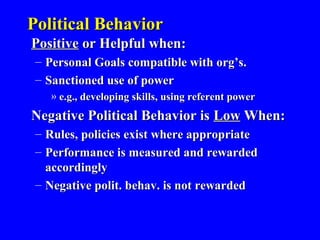
Political BehaviorPolitical Behavior
PositivePositive or Helpful when:or Helpful when:
– Personal Goals compatible with org’s.Personal Goals compatible with org’s.
– Sanctioned use of powerSanctioned use of power
» e.g., developing skills, using referent powere.g., developing skills, using referent power
Negative Political Behavior isNegative Political Behavior is LowLow When:When:
– Rules, policies exist where appropriateRules, policies exist where appropriate
– Performance is measured and rewardedPerformance is measured and rewarded
accordinglyaccordingly
– Negative polit. behav. is not rewardedNegative polit. behav. is not rewarded
Implications of Leadership
Theories
Know your preferred Style.
Know and care about your Followers.
Know and care about the Task.
Understand the Environment affecting
you and your followers.
Implications of Leadership
Theories
Fit your Style to your Followers, the
Task, and the Environment. (This may
include making changes in S, F, T, or E.)
Enhance your Referent and Expert
Power
Visualize the Future and prepare your
Followers for it

Leader ship thiory

  • 1.
    Chapter 11 Leadership “The abilityto influence people toward the attainment of goals.”
  • 2.
    Types of LeadershipTheories Universal – Traits (I) – Behaviors (II) » e.g., Ohio State, Leadership Grid (Blake & Mouton), Michigan Contingency – Traits (III) » e.g., Fiedler – Behaviors (IV) » e.g., Hersey & Blanchard,
  • 3.
    Type I Theories:Traits that Generally Differentiate Leaders from Nonleaders Drive Desire to Lead Honesty and Integrity Self-Confidence Intelligence Job-Relevant Knowledge (Traits only provide the potential for leadership. They don’t guarantee it will happen.)
  • 4.
    2 Basic LeadershipStyles (Types II, III, and IV Theories) Category 1 Initiating Structure-- Job-Centered--------- Conc. for Production Task-Oriented-------- Directive--------------- Category 2 Consideration Employee-Centered Concern for People Relationship- Oriented Supportive
  • 5.
    Ohio State Studies(Type II) Consideration Initiating Structure (Leaders are supposedly Both, One, or Neither - Viewed as two different dimensions)
  • 6.
    The Leadership Grid(Type II) Concern for production measured on a scale of 1 to 9 Concern for people measured on a scale of 1 to 9 Team management (9,9) is often considered the most effective style for all managers.
  • 7.
    Blake & Mouton’s LeadershipGrid HighHigh HighHigh LowLow LowLow Concern for ProductionConcern for Production ConcernforPeopleConcernforPeople Country ClubCountry Club ManagementManagement ImpoverishedImpoverished ManagementManagement TeamTeam ManagementManagement Authority-Authority- ComplianceCompliance ManagementManagement Middle-of-Middle-of- the-Roadthe-Road ManagementManagement
  • 8.
    Michigan Studies (TypeII) Employee-Centered Leaders Job-Centered Leaders (Leaders are supposedly Either/OR, but NOT Both - These were viewed as opposite extremes of the same continuum - c.f., Fiedler)
  • 9.
    Contingency Approaches Identify relevantSituational Variables and what Leader Traits or Styles are appropriate for each.
  • 10.
    Hersey and Blanchard'sHerseyand Blanchard's Situational TheorySituational Theory Situational VariablesSituational Variables Followers’Followers’ Readiness /Readiness / Maturity is due to :Maturity is due to : AbilityAbility WillingnessWillingness Leader BehaviorsLeader Behaviors Task Behavior (High orTask Behavior (High or Low)Low) Relationship BehaviorRelationship Behavior (High or Low)(High or Low) 4 Combinations:4 Combinations: Telling (H-L)Telling (H-L) Selling (H-H)Selling (H-H) Participating (L-H)Participating (L-H) Delegating (L-L)Delegating (L-L)
  • 11.
    Hersey & Blanchard’sSitu-Hersey & Blanchard’s Situ- ational Leadership (Type IV)ational Leadership (Type IV) High Relationship and->->-> Low Task High Task <-<-<-and High Relationship Low Relationship <-<-<-and Low Task High Task and->->-> Low Relationship Very High Low R4 R3 R2 R1 Moderate Task BehaviorTask Behavior HighHigh HighHigh LowLow RelationshipBehaviorRelationshipBehavior Delegating Delegating Participating Participating Selling Selling Telling Telling Readiness High
  • 12.
    Fiedler's Contingency TheoryFiedler'sContingency Theory (Type III Theory)(Type III Theory) Leader TraitsLeader Traits Relationship-orientedRelationship-oriented (High LPC)(High LPC) Task-orientedTask-oriented (Low LPC)(Low LPC) (Fiedler believed it is easier(Fiedler believed it is easier to change a situation thanto change a situation than to change a leader’sto change a leader’s characteristics)characteristics) Situational VariablesSituational Variables Leader-MemberLeader-Member RelationsRelations – Good vs. PoorGood vs. Poor Task StructureTask Structure – Structured (High)Structured (High) vs. Unstructuredvs. Unstructured (Low)(Low) Leader Position PowerLeader Position Power – Strong vs. WeakStrong vs. Weak
  • 13.
    Fiedler’s RecommendationsFiedler’s Recommendations Task-orientedmanagers more effective in very favorable or very unfavorable situations. Relationship-oriented managers more effective in moderately favorable situations.
  • 14.
    Fiedler’s Contingency ModelFiedler’sContingency Model GOODGOOD POORPOOR HIGH LO W HIGH LOWHIGH LO W HIGH LOW SS WW SS WW SS WW SS WW Leader- Member Relations Task Structure Position Power Kinds of Leadership Situations Very Favorable Very Unfavorable I II III IV V VI VII VIII1 Relationship-oriented managers most effective in IV, V, VI, VII. Task-oriented managers most effective in I, II, III or VIII.
  • 15.
    Substitutes for LeadershipSubstitutesfor Leadership ““SubstitutesSubstitutes” (+) accomplish by other” (+) accomplish by other means what leaders domeans what leaders do ““NeutralizersNeutralizers” (-) prevent leader from” (-) prevent leader from leadingleading
  • 16.
    Substitutes for LeadershipSubstitutesfor Leadership OrganizationalOrganizational VariablesVariables Formalization Rules (+)Formalization Rules (+) Physical separation (-)Physical separation (-) TaskTask characteristicscharacteristics Highly structured task (+)Highly structured task (+) Automatic feedback (+)Automatic feedback (+) GroupGroup characteristicscharacteristics Training/experience (+)Training/experience (+) Group doesn’t value the rewards given (-)Group doesn’t value the rewards given (-)
  • 17.
    Newer Leadership Approaches Theseare outside the bounds of most of the highly developed leadership theories. A leader may well fit into more than one of the categories.
  • 18.
    Transactional Leader This isthe traditional view of leadership that the new approaches are contrasted with. A leader who clarifies subordinates’ role and task requirements, initiates structure, provides rewards, and displays consideration for subordinates.
  • 19.
    Charismatic Leader A leaderwhose personality motivates subordinates to transcend their expected performance. Visionary Leader A leader who is able to imagine how the future could be and inspire followers to work toward creating that future.
  • 20.
    Transformational Leader A leaderdistinguished by a special ability to bring about innovation and change – by inspiring people, not by coercion. Servant Leader A leader who works to fulfill subordinates’ needs and goals - as a means to achieve the organization’s larger mission.
  • 21.
    Level 5 Leader Aleader with a combination of personal humility and resolve More ambitious for their companies than for themselves Interactive Leader A leader who is concerned with consensus building, is open and inclusive, and encourages participation Seems to be more prevalent among females
  • 22.
    Authentic Leader A leaderwho is ethical, people- oriented, committed to the organization mission, and exhibits emotional intelligence.
  • 23.
    Bases of SocialPower Positional - Likely Response Legitimate - Compliance Reward - Compliance Coercive - Resistance Personal Referent - Commitment Expert - Commitment ---------------------------------------------------- More Types of Power? Information? Association?
  • 24.
    Fundamentals of GainingPowerFundamentals of Gaining Power Gain power by making othersGain power by making others dependentdependent on youon you for:for: Scarce ResourcesScarce Resources InformationInformation Solution of Important ProblemsSolution of Important Problems Reducing UncertaintyReducing Uncertainty
  • 25.
    Political BehaviorPolitical Behavior PositivePositiveor Helpful when:or Helpful when: – Personal Goals compatible with org’s.Personal Goals compatible with org’s. – Sanctioned use of powerSanctioned use of power » e.g., developing skills, using referent powere.g., developing skills, using referent power Negative Political Behavior isNegative Political Behavior is LowLow When:When: – Rules, policies exist where appropriateRules, policies exist where appropriate – Performance is measured and rewardedPerformance is measured and rewarded accordinglyaccordingly – Negative polit. behav. is not rewardedNegative polit. behav. is not rewarded
  • 26.
    Implications of Leadership Theories Knowyour preferred Style. Know and care about your Followers. Know and care about the Task. Understand the Environment affecting you and your followers.
  • 27.
    Implications of Leadership Theories Fityour Style to your Followers, the Task, and the Environment. (This may include making changes in S, F, T, or E.) Enhance your Referent and Expert Power Visualize the Future and prepare your Followers for it