• ZEENAT RIDA 2016-1908
• ADEEL AZIZ 2016-1904
• MUHAMMAD MUNEEB 2016-1919
• TANVEER AHMAD 2016-1923
Presented By:
Leadership is the process of social influence in which one
person can enlist the aid and support of others in the
accomplishment of a common task. M. Chemers
Leadership is ultimately about creating the way for people
to contribute to making something extraordinary happen.
Alan Keith
Leadership is the ability of superior to influence the
behavior of subordinates or group and persuade them to
follow to particular course of action
Chester Bernard
Importance of Leadership
1. Employees perform 60% of their total capabilities because of
the following reasons:
• Social pressure
• Need for a job
• Authority of superior
2. Rest of the 40% is done with the help of the leadership, because
leadership is:
• Source of motivation
• Basis of cooperation
• Directing group activities
• Promoting the spirit of coordination among the employees
• Fulfilling the social responsibility
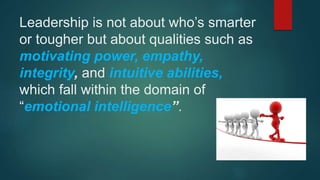
Leadership is not about who’s smarter
or tougher but about qualities such as
motivating power, empathy,
integrity, and intuitive abilities,
which fall within the domain of
“emotional intelligence”.
Categories of Leadership
1. Instructional leadership
2. Transformational Leadership
3. Moral Leadership
4. Participative Leadership
5. Contingency Leadership
6. Managerial Leadership
Instructional leadership:
1. Focuses on “the behaviors of teachers as they
engage in activities directly affecting the growth of
students.
2. Allocate authority and influence to formal
administrative roles.
3. It concern about the behaviors on student
achievement and other important school outcomes.
Transformational Leadership
1. Transformational leadership focuses on “the
commitments and capacities of organizational
members”
2. Transformational leadership raise
organizational member’s levels of personal
commitment to achieve organizational goals
resulting in greater productivity.
Moral Leadership
1. The focus of moral leadership is on the
values and ethics of leadership.
2. It promotes equity, democratic community
and social justice.
Participative Leadership
1. It also called “group”, “shared” or “teacher
leadership”.
2. It stresses the “decision making process of
the group”.
3. It increase the organizational effectiveness.
Contingency Leadership
1. It’s focus on “how leaders respond to the
unique organizational circumstances or
problems that they face”.
2. Contingency leaders typically in formal
administrative roles are capable of mastering
a wide range of leadership styles.
Managerial Leadership
1. Focuses on the “functions, tasks, or behaviors of
leader”.
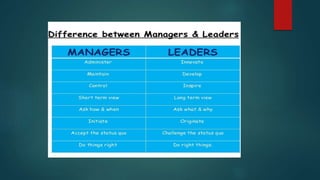
Leadership versus Management
 Management power comes from organizational
structure.
 Leadership power comes from Personal source.
 Leader empowers the employees while manager
command the employees
Trait theory
 Focuses on individual characteristics of successful leaders.
 Leaders possess a set of traits which make them distinct from
followers.
 A strong desire for accomplishment.
 Creativity and intelligence.
 Initiative.
 High tolerence.
 Ability to influence others.
 According to this theory leaders are born not made.
Traits of Leaders
 Stogdill, 1948 survey: Analyzed 124 traits. An individual does NOT
become a leader solely based on possessing these traits. The traits
must be relevant to the situation in which the leader is functioning.
The survey argued that leadership was determined by the situational
factor
 Intelligence
 Physical Features
 Inner Motivation
 Maturity
 Vision & Foresight
 Acceptance of Responsibility
 Open-Minded and adaptability
 Self-confidence
 Human Relations Attitude
 Fairness and Objectivity
Behavioural Theory
 Main focus on behaviours of actual leaders.
 Determines how various kinds of specific leaders behaviour
affect the performance and satisfaction of followers.
Pattern of actions used by different individuals
determines leadership potential.
A leader’s behavior is the best predictor of his leadership
influences and as a result, is the best determinant of his or
her leadership success.
Contingency theory
 Behaviour of leader depends upon
characteristic of situation in which leader
is in.
 Implies under what conditions will employee
oriented leadership will be effective and
under what type of conditions production
oriented leadership be more effective.
While trait and behavior theories do
help us understand leadership, an
important component is missing: the
environment in which the leader exists.
Contingency Theory deals with this
additional aspect of leadership
effectiveness studies.
Most popular theories –
1. Fiedler’s contingency
model.
2. The path-goal theory.
3. Situational leadership
theory.
Fiedler’s theory
 The theory that effective groups depend upon a proper
match between a leader's style of interacting with
subordinates and the degree to which the situation gives
control and influence to the leader.
 There are basically three steps in the model
Identifying Leadership Style
Defining the Situation
Matching leaders and situations
Path – goal theory
. The Path-Goal is a theory based on specifying a
leader's style or behavior that best fits the employee
and work environment in order to achieve
a goal (House, Mitchell, 1974).
The goal is to increase your employees' motivation,
empowerment, and satisfaction so they become
productive members of the organization.
Leader’s job is to use structure,support and rewards to
create a work environvent that helps employees
reach the organisation’s goals
Situational leadership theory
Paul hershey and Kenneth blanchard :
 Maturity of followers as a contingency variable.
 Situational leadership requires leader’s emphasis
on task behaviours and relationship behaviour
according to maturity of followers in performing
their tasks.
Leadership
Styles
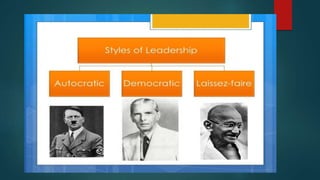
Different Leadership
Styles
 Autocratic or Authoritative
 Democratic or Participative
 Laissez Fair or Free rein
Autocratic or authoritarian style
 Under the autocratic leadership style, all decision-making
powers are centralized in the leader, as with dictator leaders.
 They do not entertain any suggestions or initiatives from
subordinates. The autocratic leadership has been successful as
it provides strong motivation to the leader.
 It permits quick decision-making, as only one person decides
for the whole group and keeps each decision to himself until he
feels it is needed to be shared with the rest of the group.
 High degree of dependency on the leader
 May be valuable in some types of business where decisions
need to be made quickly and decisively
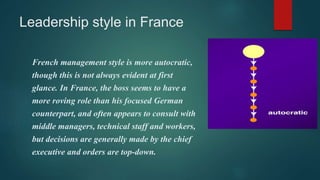
Leadership style in France
French management style is more autocratic,
though this is not always evident at first
glance. In France, the boss seems to have a
more roving role than his focused German
counterpart, and often appears to consult with
middle managers, technical staff and workers,
but decisions are generally made by the chief
executive and orders are top-down.
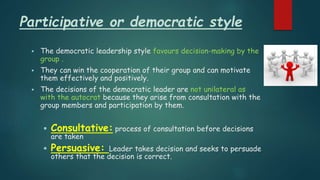
Participative or democratic style
 The democratic leadership style favours decision-making by the
group .
 They can win the cooperation of their group and can motivate
them effectively and positively.
 The decisions of the democratic leader are not unilateral as
with the autocrat because they arise from consultation with the
group members and participation by them.
 Consultative: process of consultation before decisions
are taken
 Persuasive: Leader takes decision and seeks to persuade
others that the decision is correct.
TEAMWORKMAKES
THEDREAMWORK
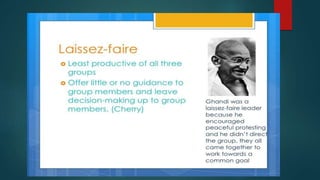
Laissez –Faire or free rein style
 A free rein leader does not lead, but leaves the group entirely
to itself such a leader allows maximum freedom to
subordinates, i.e. they are given a free hand in deciding their
own policies and methods.
1. Can be very useful in businesses where creative ideas are
important
2. Can be highly motivational, as people have control over their
working life
3. Can make coordination and decision making time-consuming
and lacking in overall direction
4. Relies on good team work.
5. Relies on good interpersonal relations
Summary
 The literature reviewed over the past decade revealed six major
categories of leadership. Instructional, Transformational, moral,
participative, contingency and managerial leadership. Leadership
theories can be classified as trait, behavioral, contingency, pat-goal
and stiuational leadership theory. Trait theory campares the leader
from non leaders. Behavior theory has no conclusive results so it has
been incorporated into contingency theory of leadership. The
contingency theory is based on two different assumptions about leader
adaptability. One assumes that leaders must change their behavior to
fit the situation. And other approach assumes that the leader must
change the situation to fit the leader's behavior, which is assumed to
be immutable. Three major styles of leadership are authoritative,
Democratic, and laissez fair. Most important conclusion from
leadership theory is that the traits or skills of a leader, leader’s
behaviors, and various situational factors interacting together may
ultimately determine a leader’s effectiveness.
References:
 Educational Administration: Concepts and Practices
by Fred C. Lunenburg
 Hemphill, John K. (1949). Situational Factors in
Leadership. Columbus: Ohio State University Bureau of
Educational Research.
 Fiedler, Fred E. (1967). A theory of leadership
effectiveness. McGraw-Hill:
 Tittemore, James A. (2003). Leadership at all Levels.
Canada:
“Together we will make it
happen”
COMPOSED BY FUTURE
LEADERS
Thank You !!

Leadreship Categories, theories, and styles

  • 2.
    • ZEENAT RIDA2016-1908 • ADEEL AZIZ 2016-1904 • MUHAMMAD MUNEEB 2016-1919 • TANVEER AHMAD 2016-1923 Presented By:
  • 3.
    Leadership is theprocess of social influence in which one person can enlist the aid and support of others in the accomplishment of a common task. M. Chemers Leadership is ultimately about creating the way for people to contribute to making something extraordinary happen. Alan Keith Leadership is the ability of superior to influence the behavior of subordinates or group and persuade them to follow to particular course of action Chester Bernard
  • 4.
    Importance of Leadership 1.Employees perform 60% of their total capabilities because of the following reasons: • Social pressure • Need for a job • Authority of superior 2. Rest of the 40% is done with the help of the leadership, because leadership is: • Source of motivation • Basis of cooperation • Directing group activities • Promoting the spirit of coordination among the employees • Fulfilling the social responsibility
  • 5.
    Leadership is notabout who’s smarter or tougher but about qualities such as motivating power, empathy, integrity, and intuitive abilities, which fall within the domain of “emotional intelligence”.
  • 6.
    Categories of Leadership 1.Instructional leadership 2. Transformational Leadership 3. Moral Leadership 4. Participative Leadership 5. Contingency Leadership 6. Managerial Leadership
  • 7.
    Instructional leadership: 1. Focuseson “the behaviors of teachers as they engage in activities directly affecting the growth of students. 2. Allocate authority and influence to formal administrative roles. 3. It concern about the behaviors on student achievement and other important school outcomes.
  • 8.
    Transformational Leadership 1. Transformationalleadership focuses on “the commitments and capacities of organizational members” 2. Transformational leadership raise organizational member’s levels of personal commitment to achieve organizational goals resulting in greater productivity.
  • 9.
    Moral Leadership 1. Thefocus of moral leadership is on the values and ethics of leadership. 2. It promotes equity, democratic community and social justice.
  • 10.
    Participative Leadership 1. Italso called “group”, “shared” or “teacher leadership”. 2. It stresses the “decision making process of the group”. 3. It increase the organizational effectiveness.
  • 11.
    Contingency Leadership 1. It’sfocus on “how leaders respond to the unique organizational circumstances or problems that they face”. 2. Contingency leaders typically in formal administrative roles are capable of mastering a wide range of leadership styles.
  • 12.
    Managerial Leadership 1. Focuseson the “functions, tasks, or behaviors of leader”. Leadership versus Management  Management power comes from organizational structure.  Leadership power comes from Personal source.  Leader empowers the employees while manager command the employees
  • 15.
    Trait theory  Focuseson individual characteristics of successful leaders.  Leaders possess a set of traits which make them distinct from followers.  A strong desire for accomplishment.  Creativity and intelligence.  Initiative.  High tolerence.  Ability to influence others.  According to this theory leaders are born not made.
  • 16.
    Traits of Leaders Stogdill, 1948 survey: Analyzed 124 traits. An individual does NOT become a leader solely based on possessing these traits. The traits must be relevant to the situation in which the leader is functioning. The survey argued that leadership was determined by the situational factor  Intelligence  Physical Features  Inner Motivation  Maturity  Vision & Foresight  Acceptance of Responsibility  Open-Minded and adaptability  Self-confidence  Human Relations Attitude  Fairness and Objectivity
  • 17.
    Behavioural Theory  Mainfocus on behaviours of actual leaders.  Determines how various kinds of specific leaders behaviour affect the performance and satisfaction of followers. Pattern of actions used by different individuals determines leadership potential. A leader’s behavior is the best predictor of his leadership influences and as a result, is the best determinant of his or her leadership success.
  • 18.
    Contingency theory  Behaviourof leader depends upon characteristic of situation in which leader is in.  Implies under what conditions will employee oriented leadership will be effective and under what type of conditions production oriented leadership be more effective.
  • 19.
    While trait andbehavior theories do help us understand leadership, an important component is missing: the environment in which the leader exists. Contingency Theory deals with this additional aspect of leadership effectiveness studies.
  • 20.
    Most popular theories– 1. Fiedler’s contingency model. 2. The path-goal theory. 3. Situational leadership theory.
  • 21.
    Fiedler’s theory  Thetheory that effective groups depend upon a proper match between a leader's style of interacting with subordinates and the degree to which the situation gives control and influence to the leader.  There are basically three steps in the model Identifying Leadership Style Defining the Situation Matching leaders and situations
  • 22.
    Path – goaltheory . The Path-Goal is a theory based on specifying a leader's style or behavior that best fits the employee and work environment in order to achieve a goal (House, Mitchell, 1974). The goal is to increase your employees' motivation, empowerment, and satisfaction so they become productive members of the organization. Leader’s job is to use structure,support and rewards to create a work environvent that helps employees reach the organisation’s goals
  • 23.
    Situational leadership theory Paulhershey and Kenneth blanchard :  Maturity of followers as a contingency variable.  Situational leadership requires leader’s emphasis on task behaviours and relationship behaviour according to maturity of followers in performing their tasks.
  • 24.
  • 25.
    Different Leadership Styles  Autocraticor Authoritative  Democratic or Participative  Laissez Fair or Free rein
  • 26.
    Autocratic or authoritarianstyle  Under the autocratic leadership style, all decision-making powers are centralized in the leader, as with dictator leaders.  They do not entertain any suggestions or initiatives from subordinates. The autocratic leadership has been successful as it provides strong motivation to the leader.  It permits quick decision-making, as only one person decides for the whole group and keeps each decision to himself until he feels it is needed to be shared with the rest of the group.  High degree of dependency on the leader  May be valuable in some types of business where decisions need to be made quickly and decisively
  • 27.
    Leadership style inFrance French management style is more autocratic, though this is not always evident at first glance. In France, the boss seems to have a more roving role than his focused German counterpart, and often appears to consult with middle managers, technical staff and workers, but decisions are generally made by the chief executive and orders are top-down.
  • 28.
    Participative or democraticstyle  The democratic leadership style favours decision-making by the group .  They can win the cooperation of their group and can motivate them effectively and positively.  The decisions of the democratic leader are not unilateral as with the autocrat because they arise from consultation with the group members and participation by them.  Consultative: process of consultation before decisions are taken  Persuasive: Leader takes decision and seeks to persuade others that the decision is correct.
  • 29.
  • 30.
    Laissez –Faire orfree rein style  A free rein leader does not lead, but leaves the group entirely to itself such a leader allows maximum freedom to subordinates, i.e. they are given a free hand in deciding their own policies and methods. 1. Can be very useful in businesses where creative ideas are important 2. Can be highly motivational, as people have control over their working life 3. Can make coordination and decision making time-consuming and lacking in overall direction 4. Relies on good team work. 5. Relies on good interpersonal relations
  • 33.
    Summary  The literaturereviewed over the past decade revealed six major categories of leadership. Instructional, Transformational, moral, participative, contingency and managerial leadership. Leadership theories can be classified as trait, behavioral, contingency, pat-goal and stiuational leadership theory. Trait theory campares the leader from non leaders. Behavior theory has no conclusive results so it has been incorporated into contingency theory of leadership. The contingency theory is based on two different assumptions about leader adaptability. One assumes that leaders must change their behavior to fit the situation. And other approach assumes that the leader must change the situation to fit the leader's behavior, which is assumed to be immutable. Three major styles of leadership are authoritative, Democratic, and laissez fair. Most important conclusion from leadership theory is that the traits or skills of a leader, leader’s behaviors, and various situational factors interacting together may ultimately determine a leader’s effectiveness.
  • 34.
    References:  Educational Administration:Concepts and Practices by Fred C. Lunenburg  Hemphill, John K. (1949). Situational Factors in Leadership. Columbus: Ohio State University Bureau of Educational Research.  Fiedler, Fred E. (1967). A theory of leadership effectiveness. McGraw-Hill:  Tittemore, James A. (2003). Leadership at all Levels. Canada:
  • 35.
    “Together we willmake it happen” COMPOSED BY FUTURE LEADERS Thank You !!