Positive Guidance and Discipline
What I Will Learn
A clearer understanding of discipline
and appropriate limits.
Styles of parenting and individual
parenting style.
Effective discipline techniques.
A Definition of Discipline
Discipline is a set of rules
that govern a person's
behavior and conduct.
The process of shaping and
molding a child’s attitudes
and behaviors over the
years.
Effective Discipline
Teaches
What to do
Problem-solving
Appropriate interactions
Self-discipline
Promotes growth
Enhances self concept
Helps children internalize
A Definition of Punishment
Punishment
defined as imposing external
controls by force on children
to change their behavior.
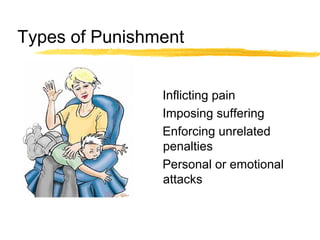
Types of Punishment
Inflicting pain
Imposing suffering
Enforcing unrelated
penalties
Personal or emotional
attacks
Why Punish ?
The misbehavior often stops immediately
Children often show remorse during punishment
The parent gets to blow off steam
The parent feels in control
The parent hasn't let the children "get away with it"
The parent was raised that way
Which Parenting Style Are You?
Strict
Demands continuously
Punishes harshly
Values obedience
Discourages independence and individuality
Exercises physical punishment
Resorts to yelling and threatening
Does not allow reasonable choices to the child
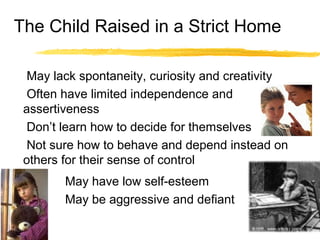
The Child Raised in a Strict Home
May lack spontaneity, curiosity and creativity
Often have limited independence and
assertiveness
Don’t learn how to decide for themselves
Not sure how to behave and depend instead on
others for their sense of control
May have low self-esteem
May be aggressive and defiant
Permissive
Sets no guidelines
Asserts no authority
Remains distant
Remains uninvolved
Uses excuses for not spending quality time
with child
Gives the child too much
Low on making demands
Have little structure
Parent who is substance abuser or immature
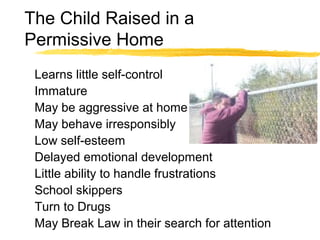
The Child Raised in a
Permissive Home
Learns little self-control
Immature
May be aggressive at home
May behave irresponsibly
Low self-esteem
Delayed emotional development
Little ability to handle frustrations
School skippers
Turn to Drugs
May Break Law in their search for attention
Moderate
Sets reasonable standards
Has reasonable expectations
Encourages independence and individuality
Enforces rules firmly and consistently
Allows choices
Builds a more democratic relationship
Recognizes individual rights
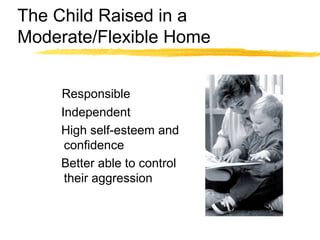
The Child Raised in a
Moderate/Flexible Home
Responsible
Independent
High self-esteem and
confidence
Better able to control
their aggression
Ages and Stages of Children
understand your child's major job at different
ages.
not expect too much from your child too soon
(like expecting a three-year old to tie his shoes)
prevent serious problems
provide safe ways for your child to do her job
and be ready to move on to the next stage.
Knowing Ages and Stages Helps you
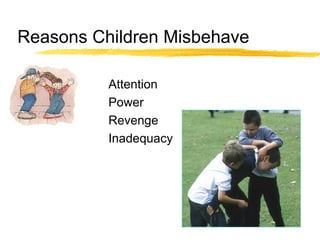
Reasons Children Misbehave
Attention
Power
Revenge
Inadequacy
Steps in Positive Discipline
Ignore minor, irritating behavior
Praise and reward positive behavior
Be specific with praise
Work with the child to set basic rules
Decide together what consequences will result
from breaking the rules
Use consequences consistently and calmly
when rules are broken
Discipline Techniques
Anticipate trouble
Give gentle reminders early
Offer choices
Overlook small annoyances
Discipline Techniques
Fix-up
Ignore
Be Firm
Stay in control
Separation
Behavior management
Redirection
Praise
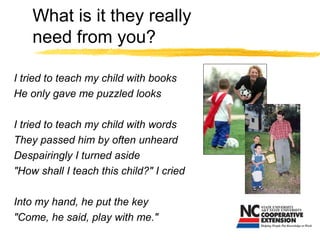
What is it they really
need from you?
I tried to teach my child with books
He only gave me puzzled looks
I tried to teach my child with words
They passed him by often unheard
Despairingly I turned aside
"How shall I teach this child?" I cried
Into my hand, he put the key
"Come, he said, play with me."

Positive guidance and discipline

  • 1.
  • 2.
    What I WillLearn A clearer understanding of discipline and appropriate limits. Styles of parenting and individual parenting style. Effective discipline techniques.
  • 3.
    A Definition ofDiscipline Discipline is a set of rules that govern a person's behavior and conduct. The process of shaping and molding a child’s attitudes and behaviors over the years.
  • 4.
    Effective Discipline Teaches What todo Problem-solving Appropriate interactions Self-discipline Promotes growth Enhances self concept Helps children internalize
  • 5.
    A Definition ofPunishment Punishment defined as imposing external controls by force on children to change their behavior.
  • 6.
    Types of Punishment Inflictingpain Imposing suffering Enforcing unrelated penalties Personal or emotional attacks
  • 7.
    Why Punish ? Themisbehavior often stops immediately Children often show remorse during punishment The parent gets to blow off steam The parent feels in control The parent hasn't let the children "get away with it" The parent was raised that way
  • 8.
  • 9.
    Strict Demands continuously Punishes harshly Valuesobedience Discourages independence and individuality Exercises physical punishment Resorts to yelling and threatening Does not allow reasonable choices to the child
  • 10.
    The Child Raisedin a Strict Home May lack spontaneity, curiosity and creativity Often have limited independence and assertiveness Don’t learn how to decide for themselves Not sure how to behave and depend instead on others for their sense of control May have low self-esteem May be aggressive and defiant
  • 11.
    Permissive Sets no guidelines Assertsno authority Remains distant Remains uninvolved Uses excuses for not spending quality time with child Gives the child too much Low on making demands Have little structure Parent who is substance abuser or immature
  • 12.
    The Child Raisedin a Permissive Home Learns little self-control Immature May be aggressive at home May behave irresponsibly Low self-esteem Delayed emotional development Little ability to handle frustrations School skippers Turn to Drugs May Break Law in their search for attention
  • 13.
    Moderate Sets reasonable standards Hasreasonable expectations Encourages independence and individuality Enforces rules firmly and consistently Allows choices Builds a more democratic relationship Recognizes individual rights
  • 14.
    The Child Raisedin a Moderate/Flexible Home Responsible Independent High self-esteem and confidence Better able to control their aggression
  • 15.
    Ages and Stagesof Children understand your child's major job at different ages. not expect too much from your child too soon (like expecting a three-year old to tie his shoes) prevent serious problems provide safe ways for your child to do her job and be ready to move on to the next stage. Knowing Ages and Stages Helps you
  • 16.
  • 17.
    Steps in PositiveDiscipline Ignore minor, irritating behavior Praise and reward positive behavior Be specific with praise Work with the child to set basic rules Decide together what consequences will result from breaking the rules Use consequences consistently and calmly when rules are broken
  • 18.
    Discipline Techniques Anticipate trouble Givegentle reminders early Offer choices Overlook small annoyances
  • 19.
    Discipline Techniques Fix-up Ignore Be Firm Stayin control Separation Behavior management Redirection Praise
  • 20.
    What is itthey really need from you? I tried to teach my child with books He only gave me puzzled looks I tried to teach my child with words They passed him by often unheard Despairingly I turned aside "How shall I teach this child?" I cried Into my hand, he put the key "Come, he said, play with me."

Editor's Notes

  • #2 Compiled by Marilyn Y. Gore, Area Specialized Extension Agent, Family and Consumer Sciences Use these notes to prepare: http://www.ces.ncsu.edu/depts/fcs/smp9/parent_education/guidance_discipline.htm
  • #3 Read and comment on objectives.
  • #4 Read and comment on slide.
  • #5 Teaches children what to do, not just what not to do Teaches children how to problem-solve to get their needs met Teaches children how to interact appropriately with adults and others Promotes growth in the five areas of development (physical, intellectual, social, emotional and moral) Enhances self concept Helps children internalize all of the above and allows them to become self disciplined
  • #6 Read and comment on slide.
  • #7 Inflicting pain - spanking, slapping, or hitting Imposing suffering Enforcing penalties that are not related to the unacceptable behavior Personal or emotional attacks - name-calling, ridicule, and insults
  • #8 Read and comment on slide.
  • #10 The first style, Strict is demanding, punishing and does not allow the child choices. Parents who exhibit this style value obedience, tradition, order and discourage independence and individuality. It is important for them that children conform to the group norms. They discourage verbal give and take (interpreting that as back talk) and make rules without discussion. They do not like their authority questioned. These parents exercise physical punishment and resort to yelling and threatening as control or discipline measures. This strict style of parenting can be thought of as "limits without freedom" and can be described as a closed circle.
  • #11 Likely Child Outcome of Strict Parenting: A parent who follows this style may love the child very much but does not allow the child to think for him or herself. One risk to strict parenting is that children become followers and may follow those who do not have their best interest at heart. They may have low self-esteem and may be aggressive and defiant.
  • #12 The second parenting style is the Permissive. The permissive parent makes little demand, sets no guidelines and provides no structure and avoids asserting authority. This parent is often referred to as uninvolved because she/he spends a minimal amount of time and effort with the child. This parent is unresponsive, distant and unavailable to assist and parent the child. Drug misuse, and immaturity of a parent are possible reasons for permissive parenting. The permissive style of parenting can be thought of as "freedom without limits," and described as a squiggly line
  • #13 Likely Child Outcome of Permissive Parenting: The parent who follows this style may raise children who are irresponsible and who are so accustomed to having their own way that they become very frustrated when they encounter situations where they can not have their own way. Children of permissive parenting are likely to lack self-control, remain immature in their thinking processes, and may become aggressive at home.
  • #14 The third type of parenting is the Moderate. Although a moderate parent is not a perfect parent, she/he however has more balance in style. She/he often sets high standards and expectations, firmly enforces rules and encourages independence and individuality. At the core of this style, is the recognition of individual rights and choices. Moderate parenting allows communication with the ability to listen, and a more democratic give-and-take arrangement. The moderate style of parenting can be thought of as "freedom within limits," and can be described as a squiggly line within the limits of a circle, but possibly extending beyond those limits
  • #15 Likely Child Outcome of Moderate Parenting: The child of this parent is more likely to become competent, responsible, independent and develop high sense of self-esteem and confidence, and a greater capability to control aggression.
  • #16 Understanding how children develop will help parents and other caregivers know what to expect. Children constantly change and develop as they grow.
  • #17 According to some child development experts, children usually misbehave for one of four basic reasons: attention, power, revenge, or inadequacy. (Refer to the handout "Appropriate Limits for Young Children: a guide for discipline, part one FCS-455) Attention - When children believe they "belong" only when they are noticed. They feel important when they are commanding total attention. Parents can respond by giving positive attention at other times, ignoring inappropriate behavior, setting up routines, encouraging, redirecting, or setting up special times. Power - When children believe they "belong" only when they are in control or are proving that no one can "boss them around." Parents can respond with kind-but firm respect, giving limited choices, setting reasonable limits, encouraging, and redirecting the child to a more acceptable activity. When children test their limits and use a public display to assert themselves, parents can continue to stick to the basic rules letting them know their behavior is unacceptable. Leave the situation if possible (store or home in which you are a guest). Talk when things are calmer at a later time. Revenge - When children believe they "belong" only by hurting others, since they feel hurt themselves. Sometimes the reason for misbehavior is not clear. When there is a new pattern of acting out, children and parents should talk about how they are feeling. Parents can respond by avoiding harsh punishment and criticism, building trust, listening, reflecting feelings, practicing sharing of feelings, encouraging strengths and acting with care. Inadequacy - When children believe they "belong" only when they convince others not to expect anything of them since they are helpless or unable. Parents can respond by encouraging their children to try things, focusing on the child's strengths, not criticizing or giving in to pity, offering opportunities for success and teaching skills in small steps. Other reasons: Boredom, Curiosity, Seeing or Hearing Impairments, Family Crisis, Sensitive to foods or other things in the environment, learned family behavior, hunger, tiredness, illness, frequent over-reacting by adults, too many no’s
  • #18 Read and comment on slide.
  • #19 Read and comment on slide.
  • #20 The type of discipline a parent uses influences the type of person a child becomes. What type of discipline do you use? What type of person do you want your child to become? Fix-up - When children cause trouble or hurt another child, expect them to fix it up - or at least try to help. If they break a toy, ask them to help you fix it. If they make a child cry, have them help with the soothing. If they throw toys around the room, ask them to put them away. Ignore - The best way to deal with misbehavior aimed at getting your attention is to simply ignore it. But be sure to give attention to your children when they behave well. Children need attention for good behavior, not misbehavior. Be Firm - Clearly and firmly state, or even demand, that the child do what needs to be done. Speak in a tone that lets your child know that you mean what you say and that you expect the child to do as he is told. Being firm doesn't mean yelling, nagging, threatening, reasoning, or taking away privileges. Keep suggestions to a minimum, and always speak kindly, even when speaking firmly. Stay in Control – but be balanced in it - Act before the situation gets out of control -- before you get angry and overly frustrated and before the child's behavior becomes unreasonable. Separation - When children irritate one another, fight, squabble, hit or kick, have them rest or play apart for a time. Being apart for a while lets each child calm down. Then you can use other ways to encourage better behavior. Behavior Management - Talk with children calmly to learn what caused a disagreement. Then talk about ways to deal with it. Come to a solution that's agreeable to both you and the children. This helps children learn to be responsible for their behavior. Redirection - When children get rowdy, stop them, explain why you are stopping them, and suggest another activity. When they knock over paint, give them a cloth and a pail of water to clean up the mess. When they race dangerously indoors, if possible, take them outside for a game of chase. When they throw books at each other, gather them for a story time or organize a beanbag toss. Praise - Give more attention and praise for good behavior and less for naughty behavior. Don't make punishment a reward. Let the child know that you appreciate a good attitude and cooperation. Children respond positively to genuine respect and praise.
  • #21 The message from the literature on child development is clear. Human development is not influenced by one factor but by a whole mosaic of factors. (Bronfenbrenner, 1986, Segal, 1983). Children are influenced first and foremost by their parents. Discipline is a special form of love. Discipline tells your child that you care enough to help him/her manage his/her behavior.