Chapter-12 1
Leadership
CHAPTER - 12
Objectives of the Chapter
To understand
 Definition of Leadership
 Traits of Effective Leaders
 Leadership Skills
 Leadership Theories
 Leadership Styles
 Roles and Activities
of Managers
 Determinants of
Leadership
 Task of a Supervisor
 Effective Supervisory
Practices
Chapter-12 3
Definition of Leadership
A leader is one who sets vision, goals and
motivates people and obtains their commitment to
achieve the goals and realize the vision.
Chapter-12 4
Traits of effective leadership
 Some researchers believed cognitive and
psychological factors like intelligence, ambition,
aggressiveness are common traits in leaders
 Others believed height, large body structure
and personal attractiveness are important
 Initiative, desire to lead, integrity, self-
confidence, analytical ability, charisma, creativity
etc are some of the common traits of a leader
Chapter-12 5
 Leaders are born not made
 Leaders can be developed
Leadership behavior Vs. Traits:
Chapter-12 6
Leadership Skills
Robert Katz, identified three skills
 Technical skills
 Human skills
 Conceptual skills
 Technical skills:
A person’s knowledge and ability to make
effective use of any process or technique
Chapter-12 7
 Human skills:
Human skills also involve developing positive
interpersonal; relationships, solving people’s
problems and gaining acceptance of other
employees.
 Conceptual skills:
It refers to the ability to analyze complex
situation, interpret available information.
Leadership Skills Contd…
Chapter-12 8
Leadership Skills Contd…
Organizational Levels
Top
Middle
Supervisor
Conceptual
Human
Technical
Knowledge & Skills required
Chapter-12 9
Leadership Theories
Trait Theories
Early researchers studied the personality
traits and concluded that leaders are born
and not made.
Example: Napoleon
Chapter-12 10
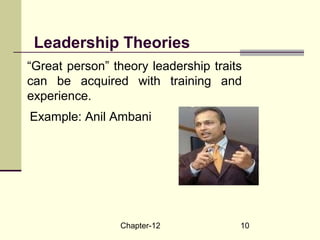
“Great person” theory leadership traits
can be acquired with training and
experience.
Example: Anil Ambani
Leadership Theories
Chapter-12 11
Behavioral Theories
Researcher tried to identify the behavior
that were unique to leader & which
distinguished them from non leaders.
Four behavioral theories
 The Ohio state studies
 University of Michigan studies
 The managerial grid
 Scandinavian studies
Chapter-12 12
In 1945-study conducted at Ohio
state university.
 They defined two dimensions
Initiating structure –
Individual’s ability to define his as
well as subordinate’s tasks and
get them accomplished in time.
The Ohio State Studies
Chapter-12 13
 Consideration - Extent, to which a leader
cares for his subordinates, respects their
ideas and feelings and establishes work
relation by mutual trust and respect.
 The researchers concluded that a “high-
high” type of leadership yielded best results.
The Ohio State Studies contd…
Chapter-12 14
 Research carried out at Survey research
center, university of Michigan.
 Leadership behavior could be categorized
along 2 dimensions.
 Employee-oriented leaders achieve higher
job satisfaction and higher group productivity.
 Production–oriented leaders achieve lower
job satisfaction and lower group productivity.
University of Michigan Studies
Chapter-12 15
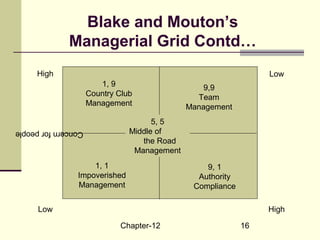
Blake and Mouton’s Managerial Grid
 Blake and Mouton developed a two
dimensional matrix model of leadership styles.
 The model consist of nine rows and column.
 The rows represent the leader's concern for
production, while the column represent concern
for people.
Chapter-12 16
9,9
Team
Management
5, 5
Middle of
the Road
Management
1, 9
Country Club
Management
1, 1
Impoverished
Management
9, 1
Authority
Compliance
Concernforpeople
High
Low High
Low
Blake and Mouton’s
Managerial Grid Contd…
Chapter-12 17
 Behavioral theories were developed (1945 &
1965).
 Research result in emergence of new
dimension called development oriented
behavior.
 Development oriented leaders experimented
with new ideas and practices and embrace
changes
 The subordinate of development oriented
leaders also showed higher level of job
satisfaction
Scandinavian Studies
Chapter-12 18
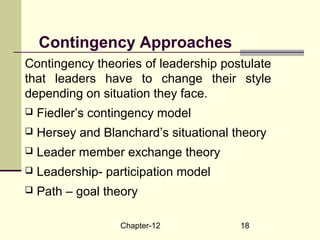
Contingency Approaches
Contingency theories of leadership postulate
that leaders have to change their style
depending on situation they face.
 Fiedler’s contingency model
 Hersey and Blanchard’s situational theory
 Leader member exchange theory
 Leadership- participation model
 Path – goal theory
Chapter-12 19
 Leader–member relationships: The extent to
which a leader is accepted by his subordinates
 Degree of task structure: Degree to which the
task on hand can be performed efficiently.
 The Leader’s Position: It refer to the power or
formal authority that the leader is bestowed within
the organization.
Fiedler’s
Contingency Model
Chapter-12 20
Hersey and Blanchard’s
Situational Theory
 It is other wise called Life cycle” model.
 Maturity level of the subordinate plays a major
role in influencing the leadership style of the
superior
 All employees will not have the same level of
competence and commitment to do the assigned
tasks.
Chapter-12 21
It is other wise called Life cycle” model.
Four styles:
 Low in his ability to perform as well as
willingness to perform - telling style
 Low in ability but high in willingness to perform
- selling style
 Capable of performing but not willing to
perform - participating style
 Capable and is also willing to carry out the task
- delegating style
Hersey and Blanchard’s
Situational Theory Contd…
Chapter-12 22
Leader – Member Exchange Theory George Green –leaders establish a special
relationship with a small group of subordinates,
usually early in their interaction.
The small group is referred to as the in-group
and the rest are called out – group.
 In–group members receive high performance
ratings and receive rewards and promotions
quickly.
 Leaders favor people who have attitudes and
personality similar to their own.
Chapter-12 23
Leadership Participation Model
 Victor Vroom & Philip Yetton
 They established the relationship between
leadership behavior and decision making style
 Problem attributes:
It is categorized into two classes
 Decision-quality
 Employee-acceptance
Chapter-12 24
 Decision-quality dimension include cost
considerations, information availability and nature
of problem structure.
 Employee-acceptance can have dimensions
like need for commitment, their prior approval,
congruence of their goals with that of the
organization, and conflict among the employees.
Leadership Participation Model contd…
Chapter-12 25
Leadership Participation Model contd…
Leadership Styles: 5 styles of leadership
 Autocratic I – leader takes a decision on
his own
 Autocratic II - leader obtains relevant
information from subordinates & then
attempts to find a solution
 Consultative I – leader explains problem
& invites ideas, he takes final decision
Chapter-12 26
 Consultative II - leader meets a group of
subordinates, discuses the problem & listens to
their ideas , final decision may or may not be
according to subordinates
 Group II - after sharing the problem with the
subordinates, the leader initiates a group
discussion till a consensus is reached. The
leader accepts the solution offered by his
subordinates
Leadership Participation Model contd…
Chapter-12 27
Path Goal Theory
 Path goal theory is contingency model of
leadership developed by Robert House.
 According to this theory leader should provide
required support & guidance to his followers.
Chapter-12 28
Path Goal Theory contd…
 Directive leadership:
 Leader clearly tells his subordinates what is
expected gives schedules and instructs ‘how’
 Supportive leadership:
 The leader attempts to address the needs and
problems
Chapter-12 29
 Participative leadership –
Discusses problems & seeks suggestions
 Achievement–oriented leadership: Attempts
to develop his subordinates
Path Goal Theory contd…
Chapter-12 30
LEADERSHIP STYLES
 Autocratic leadership: The leaders attain all
the authority and decision making power
 Consultative leadership: The leaders
encourage employees to participate in decision
making
 Laissez faire: Leader completely delegates
the responsibilities and decision making power
to the subordinates
Chapter-12 31
Leadership Styles contd…
 Bureaucratic leadership: Leaders set
certain rigid rules and regulations and
procedures
 Manipulative leadership: They believe that
the employees should be manipulated to get
them to behave in the way the leader wants
them to behave
 Expert leadership: A person with high level
of knowledge and abilities leads the group
Chapter-12 32
 Likert Suggested Four Systems Of Management
 System 1 management – “exploitative-
authoritative” style- it represents dictatorial
leadership behavior. All the decisions are made
by managers and their i little employee
participation
Likert’s Four Systems of Management
Chapter-12 33
 System 2 management – “benevolent-
authoritative” style:
Though the managers behave in a patronizing
manner, they have confidence and trust in their
subordinates. They permit upward communication
to a certain degree and ask for participation from
subordinates.
Likert’s Four Systems of
Management contd..
Chapter-12 34
 System 3 management – “consultative”
style:
Managers in this system do not have completed
confidence and trust in their subordinates.
Though they seek advice from subordinates,
they retain the right to take the final decision.
Likert’s Four Systems of
Management contd…
Chapter-12 35
 System 4 management – “participative
leadership” style: In this system, managers
trust their subordinates completely and have
confidence in their abilities. They always ask the
opinions of their subordinates and make use of
their ideas.
Likert’s Four Systems of
Management contd…
Chapter-12 36
Roles and activities of
managers
 Interpersonal role:
There are three roles:
 Figurehead role
 Leader role
 Liaison role
Chapter-12 37
 Informational role:
There are three roles:
 Monitor
 Disseminator
 Spokesperson
Roles and activities of
managers contd…
Chapter-12 38
 Decisional role:
 Entrepreneur
 Disturbance handler
 Resource allocator
 Negotiator
Roles and activities of
managers contd…
Chapter-12 39
Activities performed
by managers
 Communication
 Traditional management
 Human Resource Management
 Networking
Chapter-12 40
Determinants of leadership
 Quality of subordinates: a effective
leader always build strong team consist of
people who are independent & self motivated.
 The nature of situation: According to
situation's viewpoint, different individuals are
effective in different situation..
Chapter-12 41
Task of supervisor
First line supervisor:
 Supervise work being done
 Develop work schedule
 Communication with worker
 Making decision of day to day operation
Second or third line supervisor perform
more or less same activity. They may
resolve the problems referred to them by
there subordinates.
Chapter-12 42
Effective Supervisory Practice:
Research conducted by the university of Michigan
indicated the following four supervisory practices were
effective:
 Devote more time to planning & supporting function
 Avoid close supervision
 Concern foe employees
 Promote group cohesiveness
Task of Supervisor contd…
Summary of the Chapter
To understand
 Definition of Leadership
 Traits of Effective Leaders
 Leadership Skills
 Leadership Theories
 Leadership Styles
 Roles and Activities of Managers
 Determinants of Leadership
 Task of a Supervisor
 Effective Supervisory Practices

Leadership ob

  • 1.
  • 2.
    Objectives of theChapter To understand  Definition of Leadership  Traits of Effective Leaders  Leadership Skills  Leadership Theories  Leadership Styles  Roles and Activities of Managers  Determinants of Leadership  Task of a Supervisor  Effective Supervisory Practices
  • 3.
    Chapter-12 3 Definition ofLeadership A leader is one who sets vision, goals and motivates people and obtains their commitment to achieve the goals and realize the vision.
  • 4.
    Chapter-12 4 Traits ofeffective leadership  Some researchers believed cognitive and psychological factors like intelligence, ambition, aggressiveness are common traits in leaders  Others believed height, large body structure and personal attractiveness are important  Initiative, desire to lead, integrity, self- confidence, analytical ability, charisma, creativity etc are some of the common traits of a leader
  • 5.
    Chapter-12 5  Leadersare born not made  Leaders can be developed Leadership behavior Vs. Traits:
  • 6.
    Chapter-12 6 Leadership Skills RobertKatz, identified three skills  Technical skills  Human skills  Conceptual skills  Technical skills: A person’s knowledge and ability to make effective use of any process or technique
  • 7.
    Chapter-12 7  Humanskills: Human skills also involve developing positive interpersonal; relationships, solving people’s problems and gaining acceptance of other employees.  Conceptual skills: It refers to the ability to analyze complex situation, interpret available information. Leadership Skills Contd…
  • 8.
    Chapter-12 8 Leadership SkillsContd… Organizational Levels Top Middle Supervisor Conceptual Human Technical Knowledge & Skills required
  • 9.
    Chapter-12 9 Leadership Theories TraitTheories Early researchers studied the personality traits and concluded that leaders are born and not made. Example: Napoleon
  • 10.
    Chapter-12 10 “Great person”theory leadership traits can be acquired with training and experience. Example: Anil Ambani Leadership Theories
  • 11.
    Chapter-12 11 Behavioral Theories Researchertried to identify the behavior that were unique to leader & which distinguished them from non leaders. Four behavioral theories  The Ohio state studies  University of Michigan studies  The managerial grid  Scandinavian studies
  • 12.
    Chapter-12 12 In 1945-studyconducted at Ohio state university.  They defined two dimensions Initiating structure – Individual’s ability to define his as well as subordinate’s tasks and get them accomplished in time. The Ohio State Studies
  • 13.
    Chapter-12 13  Consideration- Extent, to which a leader cares for his subordinates, respects their ideas and feelings and establishes work relation by mutual trust and respect.  The researchers concluded that a “high- high” type of leadership yielded best results. The Ohio State Studies contd…
  • 14.
    Chapter-12 14  Researchcarried out at Survey research center, university of Michigan.  Leadership behavior could be categorized along 2 dimensions.  Employee-oriented leaders achieve higher job satisfaction and higher group productivity.  Production–oriented leaders achieve lower job satisfaction and lower group productivity. University of Michigan Studies
  • 15.
    Chapter-12 15 Blake andMouton’s Managerial Grid  Blake and Mouton developed a two dimensional matrix model of leadership styles.  The model consist of nine rows and column.  The rows represent the leader's concern for production, while the column represent concern for people.
  • 16.
    Chapter-12 16 9,9 Team Management 5, 5 Middleof the Road Management 1, 9 Country Club Management 1, 1 Impoverished Management 9, 1 Authority Compliance Concernforpeople High Low High Low Blake and Mouton’s Managerial Grid Contd…
  • 17.
    Chapter-12 17  Behavioraltheories were developed (1945 & 1965).  Research result in emergence of new dimension called development oriented behavior.  Development oriented leaders experimented with new ideas and practices and embrace changes  The subordinate of development oriented leaders also showed higher level of job satisfaction Scandinavian Studies
  • 18.
    Chapter-12 18 Contingency Approaches Contingencytheories of leadership postulate that leaders have to change their style depending on situation they face.  Fiedler’s contingency model  Hersey and Blanchard’s situational theory  Leader member exchange theory  Leadership- participation model  Path – goal theory
  • 19.
    Chapter-12 19  Leader–memberrelationships: The extent to which a leader is accepted by his subordinates  Degree of task structure: Degree to which the task on hand can be performed efficiently.  The Leader’s Position: It refer to the power or formal authority that the leader is bestowed within the organization. Fiedler’s Contingency Model
  • 20.
    Chapter-12 20 Hersey andBlanchard’s Situational Theory  It is other wise called Life cycle” model.  Maturity level of the subordinate plays a major role in influencing the leadership style of the superior  All employees will not have the same level of competence and commitment to do the assigned tasks.
  • 21.
    Chapter-12 21 It isother wise called Life cycle” model. Four styles:  Low in his ability to perform as well as willingness to perform - telling style  Low in ability but high in willingness to perform - selling style  Capable of performing but not willing to perform - participating style  Capable and is also willing to carry out the task - delegating style Hersey and Blanchard’s Situational Theory Contd…
  • 22.
    Chapter-12 22 Leader –Member Exchange Theory George Green –leaders establish a special relationship with a small group of subordinates, usually early in their interaction. The small group is referred to as the in-group and the rest are called out – group.  In–group members receive high performance ratings and receive rewards and promotions quickly.  Leaders favor people who have attitudes and personality similar to their own.
  • 23.
    Chapter-12 23 Leadership ParticipationModel  Victor Vroom & Philip Yetton  They established the relationship between leadership behavior and decision making style  Problem attributes: It is categorized into two classes  Decision-quality  Employee-acceptance
  • 24.
    Chapter-12 24  Decision-qualitydimension include cost considerations, information availability and nature of problem structure.  Employee-acceptance can have dimensions like need for commitment, their prior approval, congruence of their goals with that of the organization, and conflict among the employees. Leadership Participation Model contd…
  • 25.
    Chapter-12 25 Leadership ParticipationModel contd… Leadership Styles: 5 styles of leadership  Autocratic I – leader takes a decision on his own  Autocratic II - leader obtains relevant information from subordinates & then attempts to find a solution  Consultative I – leader explains problem & invites ideas, he takes final decision
  • 26.
    Chapter-12 26  ConsultativeII - leader meets a group of subordinates, discuses the problem & listens to their ideas , final decision may or may not be according to subordinates  Group II - after sharing the problem with the subordinates, the leader initiates a group discussion till a consensus is reached. The leader accepts the solution offered by his subordinates Leadership Participation Model contd…
  • 27.
    Chapter-12 27 Path GoalTheory  Path goal theory is contingency model of leadership developed by Robert House.  According to this theory leader should provide required support & guidance to his followers.
  • 28.
    Chapter-12 28 Path GoalTheory contd…  Directive leadership:  Leader clearly tells his subordinates what is expected gives schedules and instructs ‘how’  Supportive leadership:  The leader attempts to address the needs and problems
  • 29.
    Chapter-12 29  Participativeleadership – Discusses problems & seeks suggestions  Achievement–oriented leadership: Attempts to develop his subordinates Path Goal Theory contd…
  • 30.
    Chapter-12 30 LEADERSHIP STYLES Autocratic leadership: The leaders attain all the authority and decision making power  Consultative leadership: The leaders encourage employees to participate in decision making  Laissez faire: Leader completely delegates the responsibilities and decision making power to the subordinates
  • 31.
    Chapter-12 31 Leadership Stylescontd…  Bureaucratic leadership: Leaders set certain rigid rules and regulations and procedures  Manipulative leadership: They believe that the employees should be manipulated to get them to behave in the way the leader wants them to behave  Expert leadership: A person with high level of knowledge and abilities leads the group
  • 32.
    Chapter-12 32  LikertSuggested Four Systems Of Management  System 1 management – “exploitative- authoritative” style- it represents dictatorial leadership behavior. All the decisions are made by managers and their i little employee participation Likert’s Four Systems of Management
  • 33.
    Chapter-12 33  System2 management – “benevolent- authoritative” style: Though the managers behave in a patronizing manner, they have confidence and trust in their subordinates. They permit upward communication to a certain degree and ask for participation from subordinates. Likert’s Four Systems of Management contd..
  • 34.
    Chapter-12 34  System3 management – “consultative” style: Managers in this system do not have completed confidence and trust in their subordinates. Though they seek advice from subordinates, they retain the right to take the final decision. Likert’s Four Systems of Management contd…
  • 35.
    Chapter-12 35  System4 management – “participative leadership” style: In this system, managers trust their subordinates completely and have confidence in their abilities. They always ask the opinions of their subordinates and make use of their ideas. Likert’s Four Systems of Management contd…
  • 36.
    Chapter-12 36 Roles andactivities of managers  Interpersonal role: There are three roles:  Figurehead role  Leader role  Liaison role
  • 37.
    Chapter-12 37  Informationalrole: There are three roles:  Monitor  Disseminator  Spokesperson Roles and activities of managers contd…
  • 38.
    Chapter-12 38  Decisionalrole:  Entrepreneur  Disturbance handler  Resource allocator  Negotiator Roles and activities of managers contd…
  • 39.
    Chapter-12 39 Activities performed bymanagers  Communication  Traditional management  Human Resource Management  Networking
  • 40.
    Chapter-12 40 Determinants ofleadership  Quality of subordinates: a effective leader always build strong team consist of people who are independent & self motivated.  The nature of situation: According to situation's viewpoint, different individuals are effective in different situation..
  • 41.
    Chapter-12 41 Task ofsupervisor First line supervisor:  Supervise work being done  Develop work schedule  Communication with worker  Making decision of day to day operation Second or third line supervisor perform more or less same activity. They may resolve the problems referred to them by there subordinates.
  • 42.
    Chapter-12 42 Effective SupervisoryPractice: Research conducted by the university of Michigan indicated the following four supervisory practices were effective:  Devote more time to planning & supporting function  Avoid close supervision  Concern foe employees  Promote group cohesiveness Task of Supervisor contd…
  • 43.
    Summary of theChapter To understand  Definition of Leadership  Traits of Effective Leaders  Leadership Skills  Leadership Theories  Leadership Styles  Roles and Activities of Managers  Determinants of Leadership  Task of a Supervisor  Effective Supervisory Practices