Leadership
BUS651: Work, Organisation and Management
Dr Sarah Bankins
What is my prep for this seminar?
Please:
 Read textbook chapter 12
 Read through the lecture slides
 Read those materials listed under ‘Additional Readings’ on
iLearn for this week
Learning outcomes
 Explain the meaning of leadership and how it differs from
management
 Explain the different perspectives on studying organisational
leadership (e.g. trait, behavioural, contingency, etc.)
 Explain whether effective leadership has positive performance
outcomes
The Nature of Organisational Leadership
A process whereby an individual exerts an influence upon
others in an organisational context.
The: ‘ability of an individual to influence, motivate and
enable others to contribute toward the effectiveness and
success of the organisation’ House et al. (1999, p. 184).
‘Leadership is the process of influencing others to
understand and agree about what needs to be done and
how to do it, and the process of facilitating individual and
collective efforts to accomplish shared objectives’ Yukl
(2013, p. 23).
Critical accounts of leadership tend to focus on the
hierarchical forms to which it gives rise: power relationships
and gender dominance.
p. 315-317
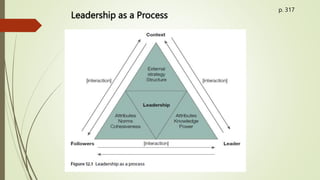
Leadership as a Process
p. 317
Leadership vs. Management
 Management - status quo, consistency, order and efficiency.
Planning, organising, commanding, coordinating, and controlling.
 Leadership - vision, strategy, communications and change.
 Leadership is about direction and pulling together towards a
common goal; management is about implementing those plans and
managing resources to execute them effectively and efficiently.
 Leadership seen as:
- an interpersonal process between leaders and followers (dyadic)
- a value-laden activity (Apps, 1994)
 People can be both leaders and managers, but ‘a person can be a
leader without being a manager, and a person can be a manager
without leading’ (Yukl, 2013, p. 6).
p. 318-320,
317
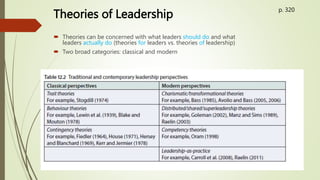
Theories of Leadership
 Theories can be concerned with what leaders should do and what
leaders actually do (theories for leaders vs. theories of leadership)
 Two broad categories: classical and modern
p. 320
Trait Perspective
 Early research on leadership focused on how those in leadership positions
possess ‘superior qualities or attributes compared with the traits possessed by
non-leaders’
 Great Man Theories – what about diverse leaders, female leaders?
 Stogdill (1948; 1974) associates a cluster of traits with leadership: positive
physical characteristics (stamina); SES factors (‘class position’); intelligence,
fluency in speech; task-related (desire to excel); social attributes (tact,
diplomacy).
 Yukl (1998) argued for a mix of traits linked to leadership: energy, internal
locus of control, self-confidence, emotional maturity, integrity, power
motivation, achievement orientation, low need for affiliation.
 Weaknesses:
- A neglect of context
- Failure to recognise the role of national culture (are there really
universally positive traits?)
- What about the role of followers?
p. 321
Behaviour Perspective
 Focus on leaders’ behaviours, rather than their personal
characteristics
 Michigan and Ohio programs of research:
 Task-orientated vs. people-orientated/relationship behaviours
(Michigan)
 Initiating behaviour and consideration (Ohio)
Essentially a focus on goals/tasks/standards/role structures vs. a
focus on trust/nurturing relationships/employee welfare/respect.
 What leadership style is most effective?
 High initiating structure = greater effectiveness
 High consideration = higher employee satisfaction
 Ohio – high on both = most effective leaders
 Research has tended to confirm these frameworks
p. 321-323
Leadership Behavior - Consideration
 This leader is friendly, approachable, looks out for the personal welfare of the
group, keeps the group abreast of new developments, and does small favours
 The degree to which one is trusting and supportive; the leader creates an
environment of friendliness
 Proven to improve job satisfaction, satisfaction with the leader, worker motivation,
and leader effectiveness
Relationship-oriented leadership
Process-focused
Concern for People
Leadership Behavior - Initiating Structure
 This leader assigns specific tasks, specifies procedures to be followed, schedules
work, and clarifies expectations for team members
 The degree to which one is task-oriented
 Proven to increase job performance, group performance, and organisation
performance, as well as satisfaction.
Task-oriented leadership
Results-focused
Concern for production
The Leadership Grid
 For leadership training - allows trainees to assess
current levels of task-oriented and people-oriented
leadership styles.
 Two core dimensions parallel McGregor’s Theories X
and Y.
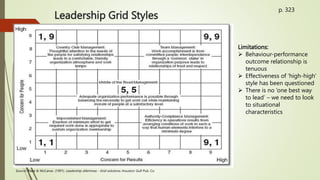
 Blake and McCanse identify five basic combinations
of concern for production and concern for people.
 The styles are: authority-compliance style; country-
club; impoverished management; middle-of-the-road
management; and team management.
p. 322-323
Leadership Grid Styles
Source: Blake & McCanse. (1991). Leadership dilemmas - Grid solutions. Houston: Gulf Pub. Co.
Limitations:
 Behaviour-performance
outcome relationship is
tenuous
 Effectiveness of ‘high-high’
style has been questioned
 There is no ‘one best way
to lead’ – we need to look
to situational
characteristics
p. 323
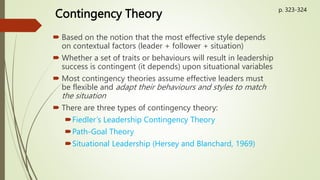
Contingency Theory
 Based on the notion that the most effective style depends
on contextual factors (leader + follower + situation)
 Whether a set of traits or behaviours will result in leadership
success is contingent (it depends) upon situational variables
 Most contingency theories assume effective leaders must
be flexible and adapt their behaviours and styles to match
the situation
 There are three types of contingency theory:
Fiedler’s Leadership Contingency Theory
Path-Goal Theory
Situational Leadership (Hersey and Blanchard, 1969)
p. 323-324
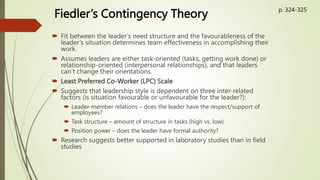
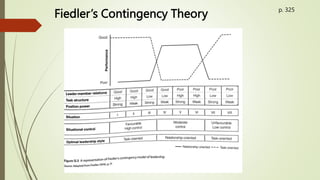
Fiedler’s Contingency Theory
 Fit between the leader’s need structure and the favourableness of the
leader’s situation determines team effectiveness in accomplishing their
work.
 Assumes leaders are either task-oriented (tasks, getting work done) or
relationship-oriented (interpersonal relationships), and that leaders
can’t change their orientations.
 Least Preferred Co-Worker (LPC) Scale
 Suggests that leadership style is dependent on three inter-related
factors (is situation favourable or unfavourable for the leader?):
 Leader-member relations – does the leader have the respect/support of
employees?
 Task structure – amount of structure in tasks (high vs. low)
 Position power – does the leader have formal authority?
 Research suggests better supported in laboratory studies than in field
studies
p. 324-325
Fiedler’s Contingency Theory p. 325
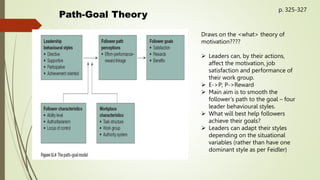
Path-Goal Theory
p. 325-327
Draws on the <what> theory of
motivation????
 Leaders can, by their actions,
affect the motivation, job
satisfaction and performance of
their work group.
 E->P; P->Reward
 Main aim is to smooth the
follower’s path to the goal – four
leader behavioural styles.
 What will best help followers
achieve their goals?
 Leaders can adapt their styles
depending on the situational
variables (rather than have one
dominant style as per Feidler)
 Hersey and Blanchard
 Focuses on followers’ readiness – choosing the right leadership
style depends on this
 Why focus on the follower? They either accept (make) or reject
(break) the leader
 Readiness = the extent to which people have the ability and
willingness to accomplish a specific task
 Focuses on task (directive/giving guidance) and relationship
(supportive) behaviours - sound familiar?!
Adjustment of managerial behaviour depends on development
of employees
Situational Leadership Theory
p. 327
Situational Leadership Theory
 Directing (telling) – if followers are unable and unwilling –
clear and specific directions are needed.
 Coaching (selling) – if followers are unable but willing, then
need ↑ task and r/ship orientation to compensate for ability
and get ‘buy-in’ for what they’re doing.
 Supporting (participating) – if followers are able but unwilling,
then need to focus on participative style to increase
commitment.
 Delegating – if followers are willing and able, can turn over
some decisions/implementation to them.
p. 327
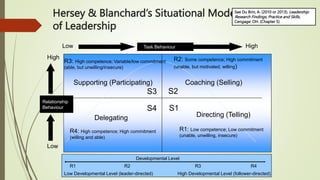
High
Low
Relationship
Behaviour
Task Behaviour
Low High
Supporting (Participating) Coaching (Selling)
Directing (Telling)
Delegating
S3 S2
S1
S4
R1: Low competence; Low commitment
(unable, unwilling, insecure)
R4: High competence; High commitment
(willing and able)
Developmental Level
R1 R2 R3 R4
Low Developmental Level (leader-directed) High Developmental Level (follower-directed)
Hersey & Blanchard’s Situational Model
of Leadership
R2: Some competence; High commitment
(unable, but motivated, willing)
R3: High competence; Variable/low commitment
(able, but unwilling/insecure)
See Du Brin, A. (2010 or 2013). Leadership:
Research Findings, Practice and Skills,
Cengage: OH. (Chapter 5)
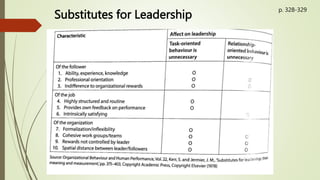
Substitutes for Leadership
 Is leadership even necessary????!!!!
 Situational variables substitute for or neutralise formal
leadership, making a leader’s behaviour unnecessary.
 These situational variables are termed ‘substitutes for
leadership’
 Leadership neutraliser – when any type of leadership is
negated
 Suggests managers should be attentive to potential
substitutes as these can impact directly on motivators.
 Research on the approach mixed
p. 328-329
Substitutes for Leadership
p. 328-329
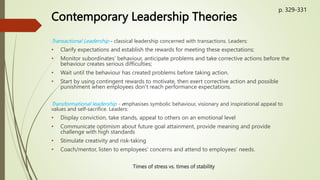
Contemporary Leadership Theories
Transactional Leadership - classical leadership concerned with transactions. Leaders:
• Clarify expectations and establish the rewards for meeting these expectations;
• Monitor subordinates’ behaviour, anticipate problems and take corrective actions before the
behaviour creates serious difficulties;
• Wait until the behaviour has created problems before taking action.
• Start by using contingent rewards to motivate, then exert corrective action and possible
punishment when employees don’t reach performance expectations.
Transformational leadership - emphasises symbolic behaviour, visionary and inspirational appeal to
values and self-sacrifice. Leaders:
• Display conviction, take stands, appeal to others on an emotional level
• Communicate optimism about future goal attainment, provide meaning and provide
challenge with high standards
• Stimulate creativity and risk-taking
• Coach/mentor, listen to employees’ concerns and attend to employees’ needs.
Times of stress vs. times of stability
p. 329-331
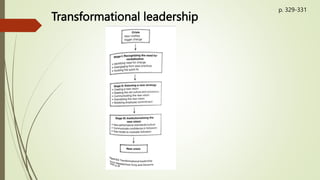
Transformational leadership
p. 329-331
Charisma Defined
Extension of trait theory – charismatic and transformational leaders THINK BIG:
 In leadership, charisma is a special quality of leaders whose purposes, powers, and
extraordinary determination differentiate them from others
 In general use, charisma is having a charming and colorful personality
Charisma = a positive and compelling quality of a person that makes many others
want to be led by that person
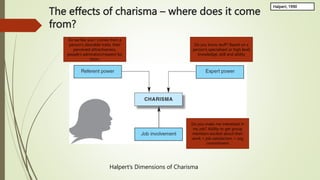
The effects of charisma – where does it come
from?
Halpert’s Dimensions of Charisma
Halpert, 1990
Do we like you? Comes from a
person’s desirable traits, their
perceived attractiveness,
people’s admiration/respect for
them.
Do you know stuff? Based on a
person's specialised or high level
knowledge, skill and ability
Do you make me interested in
my job? Ability to get group
members excited about their
work = job satisfaction = org
commitment
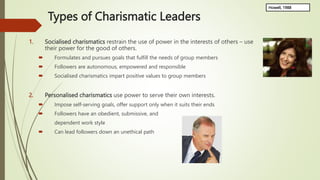
Types of Charismatic Leaders
1. Socialised charismatics restrain the use of power in the interests of others – use
their power for the good of others.
 Formulates and pursues goals that fulfill the needs of group members
 Followers are autonomous, empowered and responsible
 Socialised charismatics impart positive values to group members
2. Personalised charismatics use power to serve their own interests.
 Impose self-serving goals, offer support only when it suits their ends
 Followers have an obedient, submissive, and
dependent work style
 Can lead followers down an unethical path
Howell, 1988
Distributed (Shared) Leadership
• Gifted leaders empower their subordinates by acting as a
teacher or coach rather than an ‘all-knowing commandant’.
• Leader as ‘designer, steward, teacher’ (Senge, p. 340)
• Heterarchy, not hierarchy – leadership is shared throughout
the organisation. Any person at any level can be a leader.
• Leaders can have more power and control if they share
power with others.
• Research has shown it can reduce indirect costs and free up
time for top execs to engage in strategic behaviours.
p. 331-332
Power, Gender and Cross-Cultural Issues
Critical analysts emphasise that leadership is
intrinsically rooted in power.
Power-influence approach – understanding the
amount and type of power of a leader and how it is
exercised.
Gender theory has led to diverse research:
 Whether women lead differently to men
 Whether women have a more interactive style
 Whether feminist leadership characteristics can be identified: consensus building/shared
power/diversity
 Whether there is a female leadership style and whether jobs are gendered
p. 335-336
Is Leadership Important?
Difficult to show causal links between leadership and
performance
Different stakeholders will evaluate effectiveness in
different ways – e.g. employees, government, shareholders,
etc.
Influence on group, innovation, learning – explorative vs.
exploitative innovation (transformational vs. transactional
leadership style).
Role of organisational and national culture in ‘filtering’ and
guiding leadership behaviours.
Sometimes leaders appear of little importance.
p. 337-339
Next week …
Week 11 – Organisational Structure
Source: https://www.alexandrina.sa.gov.au/page.aspx?u=2506

Practice & Leadership theories_lectures.pptx

  • 1.
    Leadership BUS651: Work, Organisationand Management Dr Sarah Bankins
  • 2.
    What is myprep for this seminar? Please:  Read textbook chapter 12  Read through the lecture slides  Read those materials listed under ‘Additional Readings’ on iLearn for this week
  • 3.
    Learning outcomes  Explainthe meaning of leadership and how it differs from management  Explain the different perspectives on studying organisational leadership (e.g. trait, behavioural, contingency, etc.)  Explain whether effective leadership has positive performance outcomes
  • 4.
    The Nature ofOrganisational Leadership A process whereby an individual exerts an influence upon others in an organisational context. The: ‘ability of an individual to influence, motivate and enable others to contribute toward the effectiveness and success of the organisation’ House et al. (1999, p. 184). ‘Leadership is the process of influencing others to understand and agree about what needs to be done and how to do it, and the process of facilitating individual and collective efforts to accomplish shared objectives’ Yukl (2013, p. 23). Critical accounts of leadership tend to focus on the hierarchical forms to which it gives rise: power relationships and gender dominance. p. 315-317
  • 5.
    Leadership as aProcess p. 317
  • 6.
    Leadership vs. Management Management - status quo, consistency, order and efficiency. Planning, organising, commanding, coordinating, and controlling.  Leadership - vision, strategy, communications and change.  Leadership is about direction and pulling together towards a common goal; management is about implementing those plans and managing resources to execute them effectively and efficiently.  Leadership seen as: - an interpersonal process between leaders and followers (dyadic) - a value-laden activity (Apps, 1994)  People can be both leaders and managers, but ‘a person can be a leader without being a manager, and a person can be a manager without leading’ (Yukl, 2013, p. 6). p. 318-320, 317
  • 7.
    Theories of Leadership Theories can be concerned with what leaders should do and what leaders actually do (theories for leaders vs. theories of leadership)  Two broad categories: classical and modern p. 320
  • 8.
    Trait Perspective  Earlyresearch on leadership focused on how those in leadership positions possess ‘superior qualities or attributes compared with the traits possessed by non-leaders’  Great Man Theories – what about diverse leaders, female leaders?  Stogdill (1948; 1974) associates a cluster of traits with leadership: positive physical characteristics (stamina); SES factors (‘class position’); intelligence, fluency in speech; task-related (desire to excel); social attributes (tact, diplomacy).  Yukl (1998) argued for a mix of traits linked to leadership: energy, internal locus of control, self-confidence, emotional maturity, integrity, power motivation, achievement orientation, low need for affiliation.  Weaknesses: - A neglect of context - Failure to recognise the role of national culture (are there really universally positive traits?) - What about the role of followers? p. 321
  • 9.
    Behaviour Perspective  Focuson leaders’ behaviours, rather than their personal characteristics  Michigan and Ohio programs of research:  Task-orientated vs. people-orientated/relationship behaviours (Michigan)  Initiating behaviour and consideration (Ohio) Essentially a focus on goals/tasks/standards/role structures vs. a focus on trust/nurturing relationships/employee welfare/respect.  What leadership style is most effective?  High initiating structure = greater effectiveness  High consideration = higher employee satisfaction  Ohio – high on both = most effective leaders  Research has tended to confirm these frameworks p. 321-323
  • 10.
    Leadership Behavior -Consideration  This leader is friendly, approachable, looks out for the personal welfare of the group, keeps the group abreast of new developments, and does small favours  The degree to which one is trusting and supportive; the leader creates an environment of friendliness  Proven to improve job satisfaction, satisfaction with the leader, worker motivation, and leader effectiveness Relationship-oriented leadership Process-focused Concern for People
  • 11.
    Leadership Behavior -Initiating Structure  This leader assigns specific tasks, specifies procedures to be followed, schedules work, and clarifies expectations for team members  The degree to which one is task-oriented  Proven to increase job performance, group performance, and organisation performance, as well as satisfaction. Task-oriented leadership Results-focused Concern for production
  • 12.
    The Leadership Grid For leadership training - allows trainees to assess current levels of task-oriented and people-oriented leadership styles.  Two core dimensions parallel McGregor’s Theories X and Y.  Blake and McCanse identify five basic combinations of concern for production and concern for people.  The styles are: authority-compliance style; country- club; impoverished management; middle-of-the-road management; and team management. p. 322-323
  • 13.
    Leadership Grid Styles Source:Blake & McCanse. (1991). Leadership dilemmas - Grid solutions. Houston: Gulf Pub. Co. Limitations:  Behaviour-performance outcome relationship is tenuous  Effectiveness of ‘high-high’ style has been questioned  There is no ‘one best way to lead’ – we need to look to situational characteristics p. 323
  • 14.
    Contingency Theory  Basedon the notion that the most effective style depends on contextual factors (leader + follower + situation)  Whether a set of traits or behaviours will result in leadership success is contingent (it depends) upon situational variables  Most contingency theories assume effective leaders must be flexible and adapt their behaviours and styles to match the situation  There are three types of contingency theory: Fiedler’s Leadership Contingency Theory Path-Goal Theory Situational Leadership (Hersey and Blanchard, 1969) p. 323-324
  • 15.
    Fiedler’s Contingency Theory Fit between the leader’s need structure and the favourableness of the leader’s situation determines team effectiveness in accomplishing their work.  Assumes leaders are either task-oriented (tasks, getting work done) or relationship-oriented (interpersonal relationships), and that leaders can’t change their orientations.  Least Preferred Co-Worker (LPC) Scale  Suggests that leadership style is dependent on three inter-related factors (is situation favourable or unfavourable for the leader?):  Leader-member relations – does the leader have the respect/support of employees?  Task structure – amount of structure in tasks (high vs. low)  Position power – does the leader have formal authority?  Research suggests better supported in laboratory studies than in field studies p. 324-325
  • 16.
  • 17.
    Path-Goal Theory p. 325-327 Drawson the <what> theory of motivation????  Leaders can, by their actions, affect the motivation, job satisfaction and performance of their work group.  E->P; P->Reward  Main aim is to smooth the follower’s path to the goal – four leader behavioural styles.  What will best help followers achieve their goals?  Leaders can adapt their styles depending on the situational variables (rather than have one dominant style as per Feidler)
  • 18.
     Hersey andBlanchard  Focuses on followers’ readiness – choosing the right leadership style depends on this  Why focus on the follower? They either accept (make) or reject (break) the leader  Readiness = the extent to which people have the ability and willingness to accomplish a specific task  Focuses on task (directive/giving guidance) and relationship (supportive) behaviours - sound familiar?! Adjustment of managerial behaviour depends on development of employees Situational Leadership Theory p. 327
  • 19.
    Situational Leadership Theory Directing (telling) – if followers are unable and unwilling – clear and specific directions are needed.  Coaching (selling) – if followers are unable but willing, then need ↑ task and r/ship orientation to compensate for ability and get ‘buy-in’ for what they’re doing.  Supporting (participating) – if followers are able but unwilling, then need to focus on participative style to increase commitment.  Delegating – if followers are willing and able, can turn over some decisions/implementation to them. p. 327
  • 20.
    High Low Relationship Behaviour Task Behaviour Low High Supporting(Participating) Coaching (Selling) Directing (Telling) Delegating S3 S2 S1 S4 R1: Low competence; Low commitment (unable, unwilling, insecure) R4: High competence; High commitment (willing and able) Developmental Level R1 R2 R3 R4 Low Developmental Level (leader-directed) High Developmental Level (follower-directed) Hersey & Blanchard’s Situational Model of Leadership R2: Some competence; High commitment (unable, but motivated, willing) R3: High competence; Variable/low commitment (able, but unwilling/insecure) See Du Brin, A. (2010 or 2013). Leadership: Research Findings, Practice and Skills, Cengage: OH. (Chapter 5)
  • 21.
    Substitutes for Leadership Is leadership even necessary????!!!!  Situational variables substitute for or neutralise formal leadership, making a leader’s behaviour unnecessary.  These situational variables are termed ‘substitutes for leadership’  Leadership neutraliser – when any type of leadership is negated  Suggests managers should be attentive to potential substitutes as these can impact directly on motivators.  Research on the approach mixed p. 328-329
  • 22.
  • 23.
    Contemporary Leadership Theories TransactionalLeadership - classical leadership concerned with transactions. Leaders: • Clarify expectations and establish the rewards for meeting these expectations; • Monitor subordinates’ behaviour, anticipate problems and take corrective actions before the behaviour creates serious difficulties; • Wait until the behaviour has created problems before taking action. • Start by using contingent rewards to motivate, then exert corrective action and possible punishment when employees don’t reach performance expectations. Transformational leadership - emphasises symbolic behaviour, visionary and inspirational appeal to values and self-sacrifice. Leaders: • Display conviction, take stands, appeal to others on an emotional level • Communicate optimism about future goal attainment, provide meaning and provide challenge with high standards • Stimulate creativity and risk-taking • Coach/mentor, listen to employees’ concerns and attend to employees’ needs. Times of stress vs. times of stability p. 329-331
  • 24.
  • 25.
    Charisma Defined Extension oftrait theory – charismatic and transformational leaders THINK BIG:  In leadership, charisma is a special quality of leaders whose purposes, powers, and extraordinary determination differentiate them from others  In general use, charisma is having a charming and colorful personality Charisma = a positive and compelling quality of a person that makes many others want to be led by that person
  • 26.
    The effects ofcharisma – where does it come from? Halpert’s Dimensions of Charisma Halpert, 1990 Do we like you? Comes from a person’s desirable traits, their perceived attractiveness, people’s admiration/respect for them. Do you know stuff? Based on a person's specialised or high level knowledge, skill and ability Do you make me interested in my job? Ability to get group members excited about their work = job satisfaction = org commitment
  • 27.
    Types of CharismaticLeaders 1. Socialised charismatics restrain the use of power in the interests of others – use their power for the good of others.  Formulates and pursues goals that fulfill the needs of group members  Followers are autonomous, empowered and responsible  Socialised charismatics impart positive values to group members 2. Personalised charismatics use power to serve their own interests.  Impose self-serving goals, offer support only when it suits their ends  Followers have an obedient, submissive, and dependent work style  Can lead followers down an unethical path Howell, 1988
  • 28.
    Distributed (Shared) Leadership •Gifted leaders empower their subordinates by acting as a teacher or coach rather than an ‘all-knowing commandant’. • Leader as ‘designer, steward, teacher’ (Senge, p. 340) • Heterarchy, not hierarchy – leadership is shared throughout the organisation. Any person at any level can be a leader. • Leaders can have more power and control if they share power with others. • Research has shown it can reduce indirect costs and free up time for top execs to engage in strategic behaviours. p. 331-332
  • 29.
    Power, Gender andCross-Cultural Issues Critical analysts emphasise that leadership is intrinsically rooted in power. Power-influence approach – understanding the amount and type of power of a leader and how it is exercised. Gender theory has led to diverse research:  Whether women lead differently to men  Whether women have a more interactive style  Whether feminist leadership characteristics can be identified: consensus building/shared power/diversity  Whether there is a female leadership style and whether jobs are gendered p. 335-336
  • 30.
    Is Leadership Important? Difficultto show causal links between leadership and performance Different stakeholders will evaluate effectiveness in different ways – e.g. employees, government, shareholders, etc. Influence on group, innovation, learning – explorative vs. exploitative innovation (transformational vs. transactional leadership style). Role of organisational and national culture in ‘filtering’ and guiding leadership behaviours. Sometimes leaders appear of little importance. p. 337-339
  • 31.
    Next week … Week11 – Organisational Structure Source: https://www.alexandrina.sa.gov.au/page.aspx?u=2506

Editor's Notes

  • #4 The objectives of the lecture are related to those of the text chapter. It will:   Explain work organizations, their basic characteristics and their connections to the wider social context Define the term ‘organizational behaviour’ appreciate the meanings and complexities behind the words ‘management’ and ‘organization’ Demonstrate an understanding of why behaviour may vary because of an organization’s strategy, structure, technology and environment Identify the key changes occurring in the world and the effect that they are likely to have on organizational behaviour Describe the contribution to the field of organizational behaviour of three disciplines: psychology, sociology and anthropology Describe the evolution of organizational behaviour as a field of research and learning, and explain an integrated framework for conceptualizing organizational behaviour Describe the challenges of conducting research on organizational behaviour
  • #5  In recent decades has been extensive research in this area which has prompted Burns (1978) to acknowledge that ‘leadership is one of the most observed and least understood phenomena on earth’. Studies of organizational leadership grew in tandem with the development of large-scale industrialization and during the last century systematic research has also been driven by two world wars. Because of this, there is much debate about leadership and a variety of theoretical frameworks influence the theory of organizations.   Managerial leadership involves a process whereby an individual exerts influence upon others in an organizational context. More critical accounts of leadership tend to focus upon the hierarchical forms that it gives rise to power relationships including gender dominance. Leadership is thus defined as a social influence process wherein an individual exercises persuasive skills (Yuki).   The concept of leadership has acquired exceptional pertinence to work organizations concerned with developing a 'strong' workplace culture and building high-performance teams. Leadership as a concept permeates the theory and practice of management. Leadership has been conceived as a matter of personality, as particular behaviour, as a matter of contingency, as a power relation, as the focus of group processes, and as combinations of these variables.   Critical accounts of leadership tend to focus on the hierarchical forms to which it gives rise: power relationships and gender dominance. Here, leadership is viewed broadly as a dialectical process, in which an individual persuades others to do something they would not otherwise do. Leadership is socially constructed through complex social interactions between leaders and followers in a specific context, and is equated with power. Particular theories which have evolved include variations of the “command and control model”, which include ideas related to ‘transformational leadership’, ‘charismatic leadership’ and ‘self-leadership’.
  • #6  Figure 12.1 depicts leadership as a relational phenomenon, which resides in the context, and implies that a leader affects and is affected by other employees or followers and the situation in which she or he operates. The context refers to anything from global economic and political forces to the specific way a task is designed. It is not only constantly changing, but it also shapes the other two parts of the leadership equation .
  • #7  What exactly is the difference between management and leadership? Can be considered by looking at ‘role’’ - Classical management theorists define the role of management in terms of planning, organizing, commanding, coordinating and controlling - emphasizes that leading is a subset of the roles performed by managers. Table 12.1 in the textbook illustrates the mainstream consensus on the distinction between management and leadership. Management is more associated with words like status quo, consistency, order and efficiency, whereas leadership is associated with words such as vision, strategy, communications and change.   Some leadership theorists insist that leadership is fundamentally an interpersonal process, involving dyadic relationships (that is, relationships between two parties) and communications with followers. Others make the distinction by asserting that management is not a value-laden activity, whereas leadership is. The values are a guide during paradox ambiguity and change. (Apps, 1994) Consensus in the practitioner literature that organizational members can and do embody both management and leadership roles. (Adair) Leaders bring about significant change or movement (Kotter, 1990). So, distinctions between leadership and management are frequently made, but no universal agreement exists. Management can be seen as associated with contractual features and more formal aspects of managing; whereas, in contrast, leadership can be seen as having an emphasis on the interpersonal side of matters and promoting values. In this respect, leadership promotes a ‘psychological’ rather than formal contract.
  • #8 An inordinate amount of literature, concerned with both what leaders should do (for leaders) and prescriptive and what leaders actually do (of leadership and analytical). We have divided the theories into two broad categories: classical and modern. Table 13.2 depicts this theorizing of leadership around traits, behaviours, contingencies, competencies and leader–follower relations. But we should note that modern is not necessarily better.   However, it is not always easy to classify any of the theories as one or the other exclusively.  
  • #9  During the first half of the 20th century, researchers focused on the notion that individuals who occupy leadership positions possess superior qualities or attributes as compared to traits possessed by non-leaders or less effective leaders. Leaders were identified as being more intelligent, self-confident, determined and sociable than non-leaders. Hence the idea of a “great man” as a leader. Stogdill (1948). Research extended in 1974 to show that a complex interaction of traits were associated with leaders. These include features including positive physical and mental characteristics. Emphasized the role of clusters of traits in leaders.   Yukl (1998) argues that eight major traits are positively associated with effective leadership: [1] energy, [2] internal locus of control, [3] self-confidence, [4] emotional maturity, [5] integrity, [6] power motivation, [7] achievement orientation, [8] low affiliation need. (See Table 5.3).   Recent studies have shown that an overemphasis on affiliation is viewed negatively relative to leadership quotients; it is less associated with task focus.   The trait perspective has a number of weaknesses including: [1] a neglect of context, [2] failure to recognize the importance of following in the leadership context, and [3] fails to recognize the cultural determination of leadership by overemphasizing other factors. This can include a failure to recognize the distinct conceptualizations of leadership as between respective culture/s.
  • #10  Whereas trait theories emphasize the personal characteristics of leaders, behaviour leadership theorists focus on leaders’ behaviour – that is, away from the notion that leaders are born, towards the investigation of what leaders do, and in particular how they behave towards followers. University of Michigan and Ohio State University pioneered early research - analytical frameworks for followers’ assessments of their leaders’ behaviour, which was distilled into two core dimensions: concern to accomplish task and concern for people. This approach looks at the particular behaviour of leaders asks: ‘what leadership style is most effective?’    The ideal promoted by the Ohio approach to leadership of a high-consideration matching a high-initiating structure emphasizes a reciprocal presence of both trust and task focus/objectivity in the definition of leadership. Robert Blake and Jane Mouton’s highly influential Managerial Grid, later renamed Leadership Grid, is based on an extended version of the production-oriented and employee-oriented theme found in the Michigan and Ohio State studies. The Leadership Grid was designed for leadership training by allowing trainees to assess their current levels of task-oriented and people-orientedleadership styles. Criticisms of the approach include: It has not adequately demonstrated how leaders’ behaviours are associated with performance outcomes. Argued that ‘behaviour research, like the trait approach, suffers from a tendency to look for simple answers to complex questions’. (Yuki) Suggest that the most effective leadership style is the so-called ‘high–high’ style: that is, high production and high people-oriented behaviour. Yet extensive research in Anglo-American countries found only limited support for the universal proposition that ‘high–high’ leaders are more effective. Researchers concluded that there is no ‘one best way’ and that the effectiveness of a given leadership style depends on situational factors.
  • #13  The Leadership Grid was designed for leadership training by allowing trainees to assess their current levels of task-oriented and people-oriented leadership styles. Not surprisingly, it has been noted that these two core dimensions of leadership styles parallel McGregor’s Theories X and Y respectively. The later version, by Blake and McCanse, identifies five basic combinations of concern for production and concern for people, using a nine point scale, where 9 shows high concern for people and 1 shows a low concern The styles are authority-compliance style (scoring 9,1), country-club (scoring 1,9), impoverished management (scoring 1,1), middle-of-the-road management (scoring 5,5) and team management (scoring 9,9). The Leadership Grid model advocates the team management style, which suited the popular human relations theory that high levels of performance and job satisfaction could be mutually achieved.
  • #15 Contingency leadership theories are based on the idea that the most effective leadership style depends upon the leader, the followers and the situation. Three types of theories exist: Fiedler’s co-worker theory, path-goal theory, and situational leadership theory.  
  • #16  Proposes that the fit between the leader’s need structure and the favourableness of the leader’s situation determines the team’s effectiveness in work accomplishment. Assumes that leaders are either task oriented or relationship oriented, and that leaders cannot change their orientations. Fiedler (1967) developed the Least-Preferred Co-worker (LPC) Scale, as the basis of his co-worker theory. This is a self-assessment tool for analysis used by leaders whereby they appraise their staff in terms of those with whom they can work least well. A leader describing their LPC in positive terms will be categorized as relationship orientated, otherwise as task orientated. These form the two axes of kinds of leadership.   Fiedler's model characterizes situations by assessing three factors: [1] leader-follower relations, [2] task structure and [3] position power. Most or least favourable leadership situations can be assessed in these terms, for instance a highly-structured situation, with position power attached to the leader and positive leader-member relations is characterized as favouring the leader. This will favour a task-motivated leader. But if the situation exhibits converse characteristics that would be characterized as favouring a relationship-orientated leader. This theoretical structure has received some criticism, relative to its applicability in field studies and its theoretical premises as to whether it truly measures leadership style. Research suggests that the model has been better supported in laboratory studies than in field studies (Peters et al, 1985)
  • #17  Proposes that the fit between the leader’s need structure and the favourableness of the leader’s situation determines the team’s effectiveness in work accomplishment. Assumes that leaders are either task oriented or relationship oriented, and that leaders cannot change their orientations. Fiedler (1967) developed the Least-Preferred Co-worker (LPC) Scale, as the basis of his co-worker theory. This is a self-assessment tool for analysis used by leaders whereby they appraise their staff in terms of those with whom they can work least well. A leader describing their LPC in positive terms will be categorized as relationship orientated, otherwise as task orientated. These form the two axes of kinds of leadership.   Fiedler's model characterizes situations by assessing three factors: [1] leader-follower relations, [2] task structure and [3] position power. Most or least favourable leadership situations can be assessed in these terms, for instance a highly-structured situation, with position power attached to the leader and positive leader-member relations is characterized as favouring the leader. This will favour a task-motivated leader. But if the situation exhibits converse characteristics that would be characterized as favouring a relationship-orientated leader. This theoretical structure has received some criticism, relative to its applicability in field studies and its theoretical premises as to whether it truly measures leadership style. Research suggests that the model has been better supported in laboratory studies than in field studies (Peters et al, 1985)
  • #18  Draws upon the expectancy theory of motivation, hypothesizes that leaders can affect motivation, job satisfaction and the performance of work group members by their actions. (House, 1971) Correlates leadership behavioural styles (directive/supportive/participative/achievement orientated) with employees’ work and personal goals (figure 13.4). A match is sought between leadership behaviour and both follower and environmental characteristics. Support for this model is mixed.
  • #19  Suggests that the leader’s behaviour should be adjusted to the maturity level of the followers. Model developed by Heresy and Blanchard (1969) - Maturity is defined in terms of the workers’ capability to accept responsibility for completion of their work. Depending on whether the development of the follower is low, moderate or high the manager must adjust his/her style to be telling, selling, participating or delegating. This theory has intuitive appeal but empirical tests have been uneven in terms of a verification of the theory.
  • #22  Mainstream leadership theories examined so far assume that formal leadership is necessary, whatever the circumstances. This basic assumption is challenged by Kerr and Jermier (1978) who contend that there are a variety of situational variables that can substitute for, neutralize or enhance the effects of formal leadership. Referred to as substitutes for leadership. Table 12.3 shows representative examples. Ability, experience and knowledge can serve as follower characteristics; a highly structured and routine job can serve as a job characteristic; and a bureaucracy with explicit directives, formalized areas of responsibility and inflexible application of rules and procedures can serve as an organizational characteristic. A leadership substitute, can make a leader’s behaviour unnecessary. (For example, task-centred behaviour is less relevant for the experienced and well-trained employees often found in self-managed work teams or in professional occupations.) The theory predicts situations when any type of leadership is negated. This situation is referred to as a leadership neutralizer. (For example, when rewards are not within the leader’s control, or if there is spatial distance between leaders and the work group, behaviour may negate these behaviours, but they are still necessary.) Theory suggests that managers should be attentive to the potential substitutes because they impact directly on intrinsic and extrinsic motivators The research results on the substitutes for leadership approach have been mixed – assumes that leadership is replaced by alternatives, but such variables may coexist alongside leadership
  • #23  Mainstream leadership theories examined so far assume that formal leadership is necessary, whatever the circumstances. This basic assumption is challenged by Kerr and Jermier (1978) who contend that there are a variety of situational variables that can substitute for, neutralize or enhance the effects of formal leadership. Referred to as substitutes for leadership. Table 12.3 shows representative examples. Ability, experience and knowledge can serve as follower characteristics; a highly structured and routine job can serve as a job characteristic; and a bureaucracy with explicit directives, formalized areas of responsibility and inflexible application of rules and procedures can serve as an organizational characteristic. A leadership substitute, can make a leader’s behaviour unnecessary. (For example, task-centred behaviour is less relevant for the experienced and well-trained employees often found in self-managed work teams or in professional occupations.) The theory predicts situations when any type of leadership is negated. This situation is referred to as a leadership neutralizer. (For example, when rewards are not within the leader’s control, or if there is spatial distance between leaders and the work group, behaviour may negate these behaviours, but they are still necessary.) Theory suggests that managers should be attentive to the potential substitutes because they impact directly on intrinsic and extrinsic motivators The research results on the substitutes for leadership approach have been mixed – assumes that leadership is replaced by alternatives, but such variables may coexist alongside leadership
  • #24  Most of the leadership theories we have discussed so far in this lecture were developed at a time when Fordism was the dominant production paradigm in Western capitalism. The essence of classical leadership is concerned with an exchange or transaction. Transactional Leadership - Leaders motivate their subordinates by clarifying role and task requirements. The defining features of transactional leadership are: (1) that the leader uses contingent rewards and recognition to motivate employees towards an established goal or purpose, and (2) that the leader exerts corrective and possible punishment when subordinates do not reach performance expectations. Transformational leadership. - emphasizes symbolic leader behaviour, visionary and inspirational messages, appeal to values and self-sacrifice. Based on charisma (Weber) The essence of transformational leadership is about issues around the processes of transformation and change. Evidence indicates that transformational leadership can enhance employee motivation and performance, and levels of satisfaction and organizational measures of effectiveness Some detractors insist that the most consistently successful organizations are led by individuals with an unorthodox combination of attributes, skills or abilities that falls outside the usual transformational leadership paradigm. (Collins, 2002) The research evidence underscores the importance of management development: individuals can be trained to be more transformational.
  • #25  Most of the leadership theories we have discussed so far in this lecture were developed at a time when Fordism was the dominant production paradigm in Western capitalism. The essence of classical leadership is concerned with an exchange or transaction. Transactional Leadership - Leaders motivate their subordinates by clarifying role and task requirements. The defining features of transactional leadership are: (1) that the leader uses contingent rewards and recognition to motivate employees towards an established goal or purpose, and (2) that the leader exerts corrective and possible punishment when subordinates do not reach performance expectations. Transformational leadership. - emphasizes symbolic leader behaviour, visionary and inspirational messages, appeal to values and self-sacrifice. Based on charisma (Weber) The essence of transformational leadership is about issues around the processes of transformation and change. Evidence indicates that transformational leadership can enhance employee motivation and performance, and levels of satisfaction and organizational measures of effectiveness Some detractors insist that the most consistently successful organizations are led by individuals with an unorthodox combination of attributes, skills or abilities that falls outside the usual transformational leadership paradigm. (Collins, 2002) The research evidence underscores the importance of management development: individuals can be trained to be more transformational.
  • #30  Critical analysts emphasize that leadership is intrinsically rooted in power. Assumption made in mainstream leadership literature is that if leaders can persuade their followers to act, then leaders appear to be powerful.   Gender is a further new area of research to affect conceptualizations of leadership. Some research focuses on whether women lead differently than men. Also, research focuses on the patriarchal nature of management leadership. Several academics have argued that women managers have a more interactive style that includes more people-oriented, knowledge-sharing and participative leadership (Rosener, 1990; Helgesen, 1990). Feminist leadership characteristics that have been identified include: consensus building, shared power and the promotion of diversity. Feminist analysis has focused on the way jobs, occupations and organizations are themselves gendered. In contrast, Wajcman (1998) found there is no such thing as a 'female' leadership style.   These areas of research also include a re-evaluation of accepted perspectives – for instance in the case of gender research, that woman are more capable of empathy and therefore better able to succeed in contexts that favour that approach. For instance it has been argued that female ‘consensuality’ could be a learnt aspect relative to their lack of power.  
  • #31  Do leaders actually influence organizational performance? To begin to answer this question, we need a sense of the methodological challenges of measuring the leadership–performance link. Difficult to evaluate the leader– performance relationship, as there are so many alternative measures of performance, it is uncertain which criterion is most relevant, and there are many other possible causes of improved performance Any analysis is of course very much dependent upon the perspective that is used. (For example, shareholders may evaluate the organization’s performance solely in terms of financial outcomes such as profits and share values. Employees may, however, judge the organization’s performance in terms of a healthy and safe workplace) Argument that leaders influence performance seems plausible and is made by numerous writers. (For example, one study found that 44 per cent of the profitability of the organizations studied was accounted for by changing the leader, (Weiner and Mahoney, 1981) Reinforce the findings that leadership has a fundamental role in shaping and guiding the cultural characteristics of their organization Counter-argument is that leadership is of little consequence: more influential are the forces in which the leader is situated. In some sectors, ‘the leader is insignificant’ hypothesis can be made following the global recession caused by the US financial crisis of 2008/09 Enthusiasm for the popular ‘heroic’ theories of leadership waned. Indeed, researchers have shown the ‘dark side’ of charismatic leadership, and some are scathing of the adulatory focus on so-called visionary leaders. (Thomas, 2003) Grint argues that critical to successful leadership: is not a list of innate skills and competences, or how much charisma you have, or whether you have a vision or a strategy for achieving that vision, but whether you have a capacity to learn from your followers. And that learning approach is inevitably embedded in a relational model of leadership. Challenge for researchers is to locate leadership in a wider social context, and to provide empirical evidence to substantiate the emerging theories on the interconnectedness of leadership, learning, creativity and sustainability