Leadership Traits Hughes, Ginnett & Curphy (2002)
Great Man Theory Supposed that certain people are different. Leaders and followers are fundamentally different.  Led to many studies to attempt to discover which physical attributes, intellegence, traits, personality characteristics, or intelligence made leaders different.
Great Man Theory These studies led to 2 conclusions: Leaders are not fundamentally different than followers, many followers have the same characteristics as the leaders There are certain characteristics which  do  contribute to leadership success: intelligence, initiative, stress tolerance, responsibility, friendliness, and dominance Conclusion: Having the right characteristics does not  guarantee  leadership success but might improve the odds. These studies led many researchers to ignore the place the leadership traits play in leadership success.
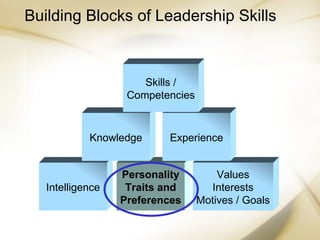
Building Blocks of Leadership Skills Intelligence Personality Traits and Preferences Values Interests Motives / Goals Experience Knowledge Skills / Competencies
What is personality Two basic understandings of personality The impression a person makes on others. Emphasizes a person’s  social reputation.   The underlying, unseen structures and processes inside a person that explain why they behave in a way similar in difference situations.
What are leadership traits? Recurring regularities or trends in a person’s behavior People behave the way they do because of the strengths of the traits they possess. Traits cannot be seen but they can be inferred from consistent patterns of behavior and reliably measured by personality inventories Traits do not predict specific behavior, but can provide a general picture of what people will do.
What are leadership traits? Traits have differing effect depending on the situation. Weak  situation – This is an unfamiliar or ambiguous situation. Traits have a greater effect in weak situations Strong  situation – A situation clearly determined or governed by rules, demands, or organizational policies. Traits have a lesser effect in this type of situation.
The Five Factor Model of Personality I like traveling to foreign countries Intellectance I take personal criticism well. Self-acceptance I remain calm in pressure situations Steadiness Adjustment I am a high achiever Achievement Orientation Adjustment I rarely get in trouble Conformity I practice what I preach Credibility I usually make “to do” lists. Organization Dependability I am usually in a good mood Friendly I am a sympathetic person. Empathy Agreeableness I have a large group of friends Sociability I like having responsibility for others Dominance Surgency
Five Factor Model of Personality Surgency  – (Traits: dominance, sociability) - dominance, self-confidence, the need for power, dynamic. This person is also outgoing, competitive, decisive, impactful, and self-confident. Leaders usually have higher sugency scores than non leaders. Agreeableness  – (Traits: empathy, friendly) – empathy friendliness, need for affiliation. Concerns how well one gets along with others. This person tends to be empathetic, approachable, and optimistic
Five Factor Model of Personality Dependability  (Traits: organization, credibility, conformity, achievement orientation). Relates to work patterns. This person is planful, hardworking, follows through on commitments and doesn’t get in trouble. Persons  low  in dependability tend to be more spontaneous, creative, rule bending and less concerned with following through on commitments. Tends to be more related to management
Five Factor Model of Personality Adjustment  (Traits: steadiness, self-acceptance). Relates to how people react to stress, failure or personal criticism. This person tends to be calm and not to take mistakes and failures personally. Calm and thick-skinned under pressure. Intellectance  – (openness to new experience) How a person responds to new experiences. This person tends to be imaginative, broad-minded, and curious; they seek out new experiences
Dark-Side Personality Traits Argumentative .  This trait identifies leaders who are suspicious, are overly sensitive to criticism, and expect to be mistreated. Leaders possessing this trait do not take personal criticism well and are apt to start arguments and have a hard time ending them. Interpersonal Insensitivity.   Leaders possessing this trait tend to be aloof and unaware of how they come across to others, and to have difficulties putting themselves in "other peoples' shoes."
Dark-Side Personality Traits Narcissism .  Leaders with this trait tend to be overly self-confident, self-centered, and extremely ambitious. They grossly overestimate their abilities, have a strong sense of entitlement, and often hold others in contempt. Extremely arrogant, they are always right and not afraid to tell you so. Such individuals often exploit followers for their own self-aggrandizement.
Dark-Side Personality Traits Fear of Failure .  These individuals make poor leaders because they dread being criticized. As a result, they tend to be overly cautious and reluctant decision-makers. When forced to make decisions, they often impose old solutions to problems even when it is obvious that they will not   work.
Dark-Side Personality Traits Perfectionism .  This dark-side trait identifies leaders who are conscientious and methodical but also attend so closely to details that they have trouble setting and maintaining priorities. They maintain extremely high standards for themselves and their followers, and their inflexibility, nit­picking, and micromanaging tendencies can be extremely irritating.
Dark-Side Personality Traits Impulsivity .  As leaders, these individuals are hedonistic and often ignore the feelings of followers when in pursuit of their own pleasure. They enjoy testing limits, may fail to keep promises and commitments, and often neglect to consider the consequences of their actions.

Leadership traits

  • 1.
    Leadership Traits Hughes,Ginnett & Curphy (2002)
  • 2.
    Great Man TheorySupposed that certain people are different. Leaders and followers are fundamentally different. Led to many studies to attempt to discover which physical attributes, intellegence, traits, personality characteristics, or intelligence made leaders different.
  • 3.
    Great Man TheoryThese studies led to 2 conclusions: Leaders are not fundamentally different than followers, many followers have the same characteristics as the leaders There are certain characteristics which do contribute to leadership success: intelligence, initiative, stress tolerance, responsibility, friendliness, and dominance Conclusion: Having the right characteristics does not guarantee leadership success but might improve the odds. These studies led many researchers to ignore the place the leadership traits play in leadership success.
  • 4.
    Building Blocks ofLeadership Skills Intelligence Personality Traits and Preferences Values Interests Motives / Goals Experience Knowledge Skills / Competencies
  • 5.
    What is personalityTwo basic understandings of personality The impression a person makes on others. Emphasizes a person’s social reputation. The underlying, unseen structures and processes inside a person that explain why they behave in a way similar in difference situations.
  • 6.
    What are leadershiptraits? Recurring regularities or trends in a person’s behavior People behave the way they do because of the strengths of the traits they possess. Traits cannot be seen but they can be inferred from consistent patterns of behavior and reliably measured by personality inventories Traits do not predict specific behavior, but can provide a general picture of what people will do.
  • 7.
    What are leadershiptraits? Traits have differing effect depending on the situation. Weak situation – This is an unfamiliar or ambiguous situation. Traits have a greater effect in weak situations Strong situation – A situation clearly determined or governed by rules, demands, or organizational policies. Traits have a lesser effect in this type of situation.
  • 8.
    The Five FactorModel of Personality I like traveling to foreign countries Intellectance I take personal criticism well. Self-acceptance I remain calm in pressure situations Steadiness Adjustment I am a high achiever Achievement Orientation Adjustment I rarely get in trouble Conformity I practice what I preach Credibility I usually make “to do” lists. Organization Dependability I am usually in a good mood Friendly I am a sympathetic person. Empathy Agreeableness I have a large group of friends Sociability I like having responsibility for others Dominance Surgency
  • 9.
    Five Factor Modelof Personality Surgency – (Traits: dominance, sociability) - dominance, self-confidence, the need for power, dynamic. This person is also outgoing, competitive, decisive, impactful, and self-confident. Leaders usually have higher sugency scores than non leaders. Agreeableness – (Traits: empathy, friendly) – empathy friendliness, need for affiliation. Concerns how well one gets along with others. This person tends to be empathetic, approachable, and optimistic
  • 10.
    Five Factor Modelof Personality Dependability (Traits: organization, credibility, conformity, achievement orientation). Relates to work patterns. This person is planful, hardworking, follows through on commitments and doesn’t get in trouble. Persons low in dependability tend to be more spontaneous, creative, rule bending and less concerned with following through on commitments. Tends to be more related to management
  • 11.
    Five Factor Modelof Personality Adjustment (Traits: steadiness, self-acceptance). Relates to how people react to stress, failure or personal criticism. This person tends to be calm and not to take mistakes and failures personally. Calm and thick-skinned under pressure. Intellectance – (openness to new experience) How a person responds to new experiences. This person tends to be imaginative, broad-minded, and curious; they seek out new experiences
  • 12.
    Dark-Side Personality TraitsArgumentative . This trait identifies leaders who are suspicious, are overly sensitive to criticism, and expect to be mistreated. Leaders possessing this trait do not take personal criticism well and are apt to start arguments and have a hard time ending them. Interpersonal Insensitivity. Leaders possessing this trait tend to be aloof and unaware of how they come across to others, and to have difficulties putting themselves in "other peoples' shoes."
  • 13.
    Dark-Side Personality TraitsNarcissism . Leaders with this trait tend to be overly self-confident, self-centered, and extremely ambitious. They grossly overestimate their abilities, have a strong sense of entitlement, and often hold others in contempt. Extremely arrogant, they are always right and not afraid to tell you so. Such individuals often exploit followers for their own self-aggrandizement.
  • 14.
    Dark-Side Personality TraitsFear of Failure . These individuals make poor leaders because they dread being criticized. As a result, they tend to be overly cautious and reluctant decision-makers. When forced to make decisions, they often impose old solutions to problems even when it is obvious that they will not work.
  • 15.
    Dark-Side Personality TraitsPerfectionism . This dark-side trait identifies leaders who are conscientious and methodical but also attend so closely to details that they have trouble setting and maintaining priorities. They maintain extremely high standards for themselves and their followers, and their inflexibility, nit­picking, and micromanaging tendencies can be extremely irritating.
  • 16.
    Dark-Side Personality TraitsImpulsivity . As leaders, these individuals are hedonistic and often ignore the feelings of followers when in pursuit of their own pleasure. They enjoy testing limits, may fail to keep promises and commitments, and often neglect to consider the consequences of their actions.