Team Building
Why Teams?
Children learn
better in groups
of 2-3.
The Center for Children and Technology
How do Teams Work Best?
Team’s succeed when members have:
1. Commitment to common objectives
More likely when they set them; recognize interdependence
2. Defined, appropriate roles and responsibilities
 Good use of individual talent
 Opportunity for each to grow, learn all skills
3. Effective decision systems, communication and work
procedures
 Open, honest communication
 Accepts conflict, manages it, resolves it well
4. Good personal relationships
 Mutual trust
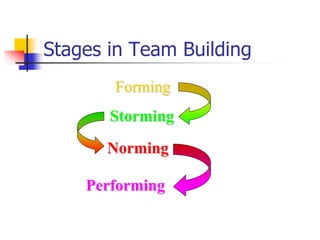
Stages in Team Building
Forming
Storming
Norming
Performing
Stage 1: FORMING
 Team Building
 Define team (optimum
~3 with one or more
girls)
 Determine individual
roles
 Develop trust and
communication
 Task
 Define problem and
strategy
 Identify information
needed
From Individuals A Group
 Help members understand each other:
 Myers-Briggs Type Indicator (MBTI)
 Extraverts ------------------ Introverts
 Sensors --------------------- iNtuitive
 Thinker --------------------- Feelers
 Judger ---------------------- Perceiver
By selecting one from each category, we define our
personality type, ESTJ, ENTJ…INFP
Forming
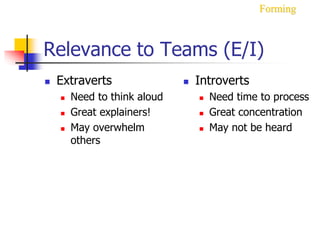
Relevance to Teams (E/I)
 Extraverts
 Need to think aloud
 Great explainers!
 May overwhelm
others
 Introverts
 Need time to process
 Great concentration
 May not be heard
Forming
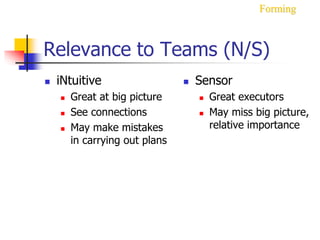
Relevance to Teams (N/S)
 iNtuitive
 Great at big picture
 See connections
 May make mistakes
in carrying out plans
 Sensor
 Great executors
 May miss big picture,
relative importance
Forming
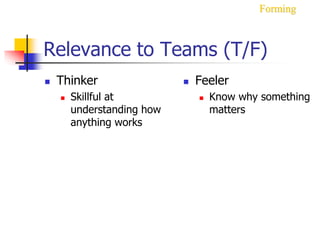
Relevance to Teams (T/F)
 Thinker
 Skillful at
understanding how
anything works
 Feeler
 Know why something
matters
Forming
Relevance to Teams (J/P)
 Judger
 Good at schedules,
plans, completion
 Make decisions easily
(quickly)
 May decide too
quickly and overlook
vital issues
 Preceiver
 Always curious, want
more knowledge
 May not get around
to acting
 Slow judger’s
enough to make
great teams
Forming
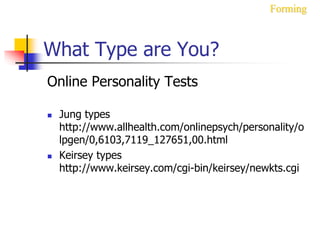
What Type are You?
Online Personality Tests
 Jung types
http://www.allhealth.com/onlinepsych/personality/o
lpgen/0,6103,7119_127651,00.html
 Keirsey types
http://www.keirsey.com/cgi-bin/keirsey/newkts.cgi
Forming
Stage 2: STORMING
During the Storming stage:
 Team members realize that the task is more
difficult than they imagined
 Members may be resistant to the task and fall
back into their comfort zones
 Communication is poor with little listening
 Fluctuations in attitude about their chances of
success
 Among the team members there is disunity and
conflict
 Collaboration between members is minimal and
cliques start to appear
Storming Diagnosis (in order)
 Do we have common goals and objectives?
 Do we agree on roles and responsibilities?
 Use a table to share division of labor
 Do our task, communication, and decision
systems work?
 Do we have adequate interpersonal skills?
Storming
Negotiating Conflict
 Separate problem issues from people
issues
 Be soft on people, hard on problem
 Look for underlying needs, goals of
each party rather than specific solutions
 Find a creative solution that’s good for
both
Storming
Addressing the Problem
Problem Solving
• State your views in clear non-judgmental language
• Clarify the core issues
• Listen carefully to each person’s point of view
• Check understanding of the disagreement by
restating the core issues
• Use techniques such as circling the group for
comments and having some silent thinking time
when emotions run high
Storming
Stage 3: Norming
 During this stage members accept
 their team
 team ground rules
 their roles in the team
 the individuality of fellow members
 Team members realize that they are not
going to drown and start helping each
other
Behaviors
 Competitive relationships become more
cooperative
 Willingness to confront issues and solve
problems
 Ability to express criticism constructively
 More sharing and a sense of team spirit
Norming
Guide for Giving Constructive
Feedback
 When you …. describe behavior
 I feel ….. how behavior affects you
 Because I … why behavior affects you
 (Pause for discussion) …. let other person(s)
respond
 I would like …. what change would you like
 Because …. why change will alleviate problem
 What do you think …. Listen to other person’s
response and discuss options
Norming
Giving Constructive Feedback
 Be descriptive
 Don't use labels
 Don’t exaggerate
 Don’t be judgmental
 Speak for yourself
Norming
Giving Constructive Feedback
(cont.)
 Talk first about yourself, not about the other
person
 Phrase the issue as a statement, not a
question
 Restrict your feedback to things you know for
certain
 Help people hear and accept your
compliments when giving positive feedback
Norming
Receiving Feedback
 Breathe
 Listen carefully
 Ask questions for clarity
 Acknowledge the feedback
 Acknowledge the valid points
 Take time to sort out what you heard
Norming
Stage 4: PERFORMING
Team members have
 Gained insight into personal and team
processes
 A better understanding of each other’s
strengths and weaknesses
 Gained the ability to prevent or work
through group conflict and resolve
differences
 Developed a close attachment to the team
Recipe for Successful Team
 Commitment to shared goals and objectives
 Clearly define roles and responsibilities
 Use best skills of each
 Allows each to develop in all areas
Recipe for Successful Team
 Effective systems and processes
 Clear communication
 Beneficial team behaviors
 Well-defined decision procedures
 Use of scientific approach
 Balanced participation
 Established ground rules
 Awareness of the group process
Recipe for Successful Team
 Good Personal Relationships

Team building

  • 1.
  • 2.
    Why Teams? Children learn betterin groups of 2-3. The Center for Children and Technology
  • 3.
    How do TeamsWork Best? Team’s succeed when members have: 1. Commitment to common objectives More likely when they set them; recognize interdependence 2. Defined, appropriate roles and responsibilities  Good use of individual talent  Opportunity for each to grow, learn all skills 3. Effective decision systems, communication and work procedures  Open, honest communication  Accepts conflict, manages it, resolves it well 4. Good personal relationships  Mutual trust
  • 4.
    Stages in TeamBuilding Forming Storming Norming Performing
  • 5.
    Stage 1: FORMING Team Building  Define team (optimum ~3 with one or more girls)  Determine individual roles  Develop trust and communication  Task  Define problem and strategy  Identify information needed
  • 6.
    From Individuals AGroup  Help members understand each other:  Myers-Briggs Type Indicator (MBTI)  Extraverts ------------------ Introverts  Sensors --------------------- iNtuitive  Thinker --------------------- Feelers  Judger ---------------------- Perceiver By selecting one from each category, we define our personality type, ESTJ, ENTJ…INFP Forming
  • 7.
    Relevance to Teams(E/I)  Extraverts  Need to think aloud  Great explainers!  May overwhelm others  Introverts  Need time to process  Great concentration  May not be heard Forming
  • 8.
    Relevance to Teams(N/S)  iNtuitive  Great at big picture  See connections  May make mistakes in carrying out plans  Sensor  Great executors  May miss big picture, relative importance Forming
  • 9.
    Relevance to Teams(T/F)  Thinker  Skillful at understanding how anything works  Feeler  Know why something matters Forming
  • 10.
    Relevance to Teams(J/P)  Judger  Good at schedules, plans, completion  Make decisions easily (quickly)  May decide too quickly and overlook vital issues  Preceiver  Always curious, want more knowledge  May not get around to acting  Slow judger’s enough to make great teams Forming
  • 11.
    What Type areYou? Online Personality Tests  Jung types http://www.allhealth.com/onlinepsych/personality/o lpgen/0,6103,7119_127651,00.html  Keirsey types http://www.keirsey.com/cgi-bin/keirsey/newkts.cgi Forming
  • 12.
    Stage 2: STORMING Duringthe Storming stage:  Team members realize that the task is more difficult than they imagined  Members may be resistant to the task and fall back into their comfort zones  Communication is poor with little listening  Fluctuations in attitude about their chances of success  Among the team members there is disunity and conflict  Collaboration between members is minimal and cliques start to appear
  • 13.
    Storming Diagnosis (inorder)  Do we have common goals and objectives?  Do we agree on roles and responsibilities?  Use a table to share division of labor  Do our task, communication, and decision systems work?  Do we have adequate interpersonal skills? Storming
  • 14.
    Negotiating Conflict  Separateproblem issues from people issues  Be soft on people, hard on problem  Look for underlying needs, goals of each party rather than specific solutions  Find a creative solution that’s good for both Storming
  • 15.
    Addressing the Problem ProblemSolving • State your views in clear non-judgmental language • Clarify the core issues • Listen carefully to each person’s point of view • Check understanding of the disagreement by restating the core issues • Use techniques such as circling the group for comments and having some silent thinking time when emotions run high Storming
  • 16.
    Stage 3: Norming During this stage members accept  their team  team ground rules  their roles in the team  the individuality of fellow members  Team members realize that they are not going to drown and start helping each other
  • 17.
    Behaviors  Competitive relationshipsbecome more cooperative  Willingness to confront issues and solve problems  Ability to express criticism constructively  More sharing and a sense of team spirit Norming
  • 18.
    Guide for GivingConstructive Feedback  When you …. describe behavior  I feel ….. how behavior affects you  Because I … why behavior affects you  (Pause for discussion) …. let other person(s) respond  I would like …. what change would you like  Because …. why change will alleviate problem  What do you think …. Listen to other person’s response and discuss options Norming
  • 19.
    Giving Constructive Feedback Be descriptive  Don't use labels  Don’t exaggerate  Don’t be judgmental  Speak for yourself Norming
  • 20.
    Giving Constructive Feedback (cont.) Talk first about yourself, not about the other person  Phrase the issue as a statement, not a question  Restrict your feedback to things you know for certain  Help people hear and accept your compliments when giving positive feedback Norming
  • 21.
    Receiving Feedback  Breathe Listen carefully  Ask questions for clarity  Acknowledge the feedback  Acknowledge the valid points  Take time to sort out what you heard Norming
  • 22.
    Stage 4: PERFORMING Teammembers have  Gained insight into personal and team processes  A better understanding of each other’s strengths and weaknesses  Gained the ability to prevent or work through group conflict and resolve differences  Developed a close attachment to the team
  • 23.
    Recipe for SuccessfulTeam  Commitment to shared goals and objectives  Clearly define roles and responsibilities  Use best skills of each  Allows each to develop in all areas
  • 24.
    Recipe for SuccessfulTeam  Effective systems and processes  Clear communication  Beneficial team behaviors  Well-defined decision procedures  Use of scientific approach  Balanced participation  Established ground rules  Awareness of the group process
  • 25.
    Recipe for SuccessfulTeam  Good Personal Relationships