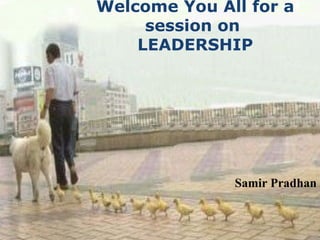
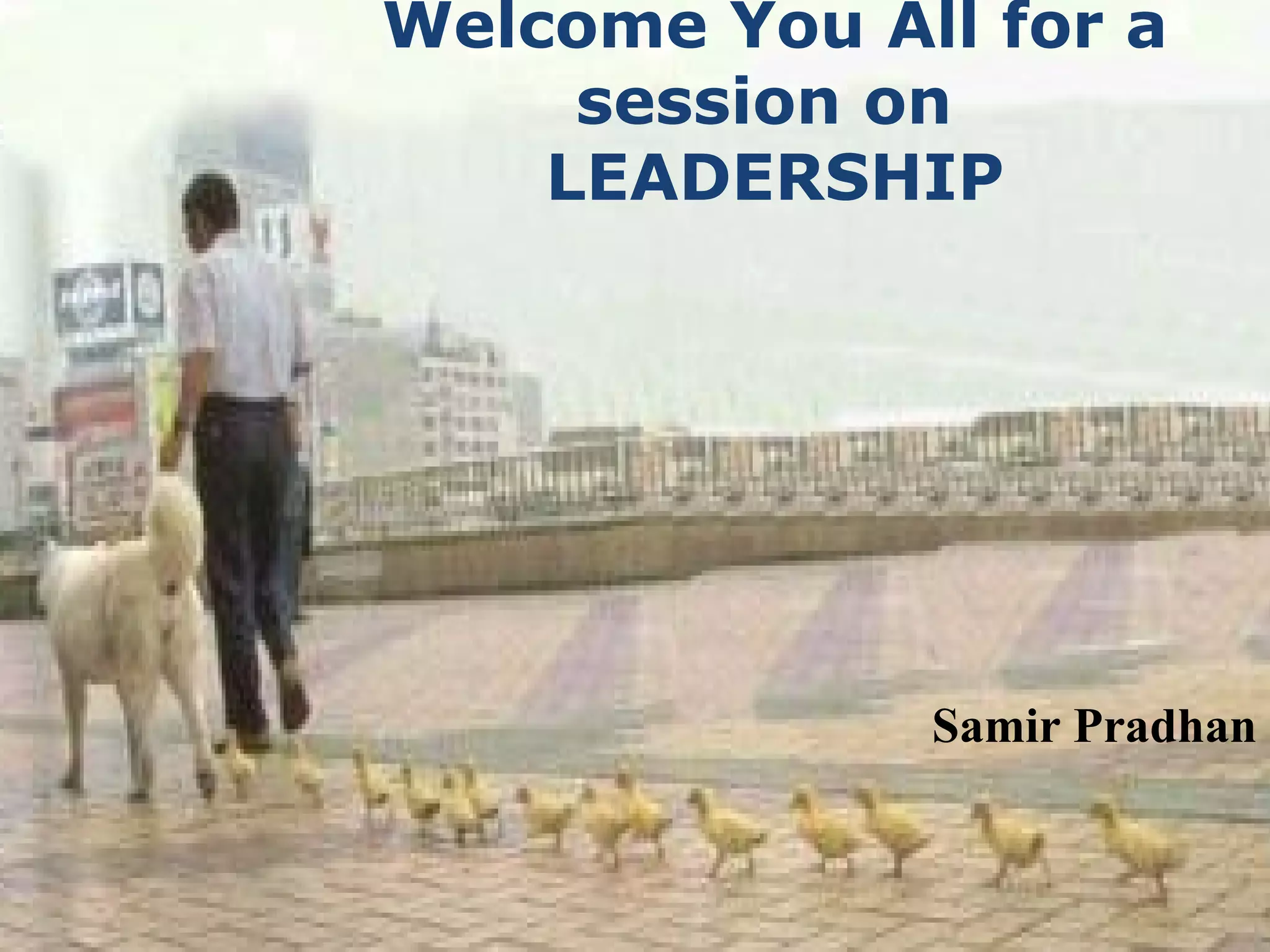
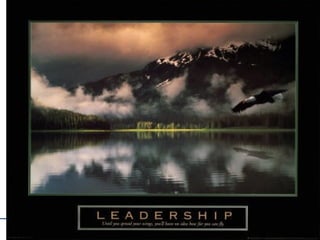
Welcome You All for a session on  LEADERSHIP Samir Pradhan
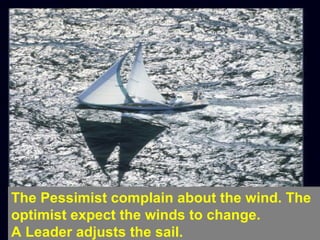
The Pessimist complain about the wind. The optimist expect the winds to change. A Leader adjusts the sail.
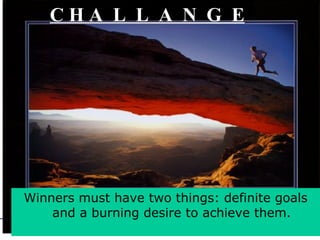
C H A  L  L  A  N  G  E     Winners must have two things: definite goals and a burning desire to achieve them.   
 
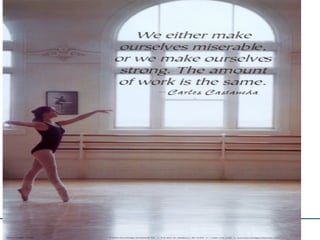
The soul is dyed the color of it's thoughts. Think only of those things that can bear the full light of day. The content of your character is your choice. Day by day, what you choose, what you think and what you do is who you become… The soul is dyed the color of it's thoughts. Think only of those things that can bear the full light of day. The content of your character is your choice. Day by day, what you choose, what you think and what you do is who you become  I N T E G R E I T Y
 
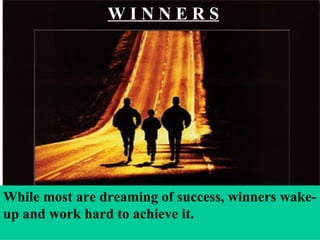
While most are dreaming of success, winners wake-up and work hard to achieve it.   W I N N E R S
 
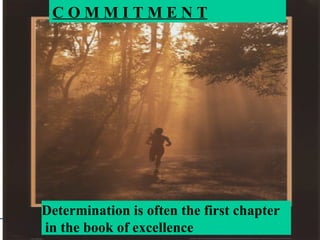
Determination is often the first chapter in the book of excellence  C O M M I T M E N T
 
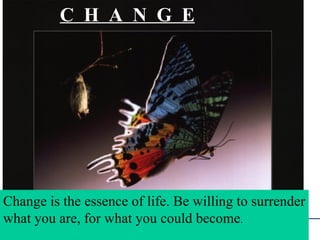
Change is the essence of life. Be willing to surrender what you are, for what you could become .   C  H  A  N  G  E
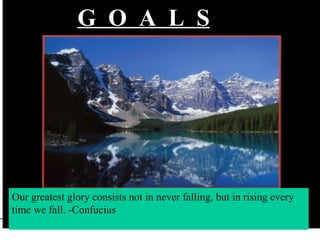
Our greatest glory consists not in never falling, but in rising every time we fall. -Confucius G  O  A  L  S
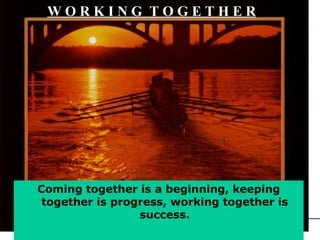
W O R K I N G  T O G E T H E R   Coming together is a beginning, keeping together is progress, working together is success.
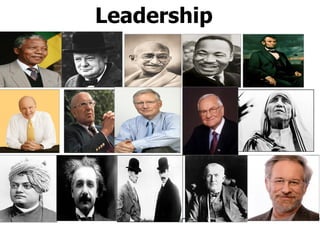
Nelson Mandela Sir Winston Churchill M.K.Gandhi Martin Luther King Abraham Lincoln Leadership
A Leadership Story: A group of workers and their leaders are set a task  of clearing a road through a dense jungle on a remote island to get to the coast where an estuary provides  a perfect site for a port.  The leaders organise the labour into efficient units and monitor the distribution and use of capital assets – progress is excellent. The leaders continue to monitor and evaluate progress, making adjustments along the way to ensure the progress is maintained and efficiency increased wherever possible.  Then, one day amidst all the hustle and bustle and activity, one person climbs up a nearby tree. The person surveys the scene from the top of the tree.
A Leadership Story: And shouts down to the assembled group below… “ Wrong Way!” “ Management is doing things right, leadership is doing the right things” (Warren Bennis and Peter Drucker)
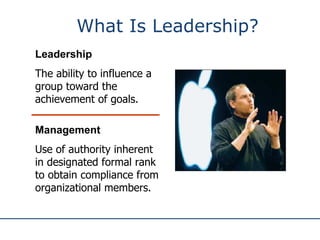
What Is Leadership? Leadership The ability to influence a group toward the achievement of goals. Management Use of authority inherent in designated formal rank to obtain compliance from organizational members.
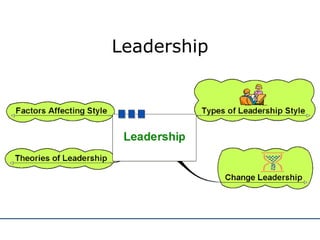
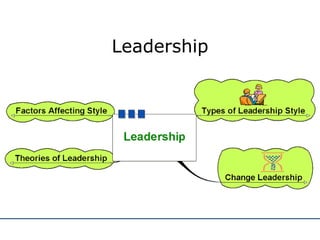
Leadership
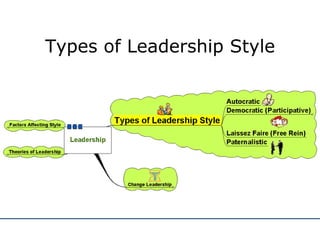
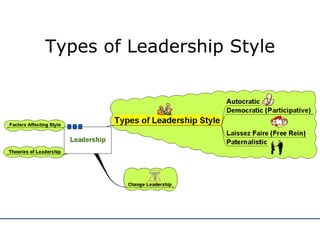
Types of Leadership Style
Types of Leadership Style Autocratic: Leader makes decisions without reference to anyone else High degree of dependency on the leader Can create de-motivation and alienation  of staff May be valuable in some types of business where decisions need to be made quickly and decisively
Basic Approaches to Leadership
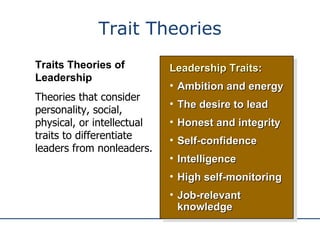
Trait Theories Leadership Traits : Ambition and energy The desire to lead Honest and integrity Self-confidence Intelligence High self-monitoring Job-relevant knowledge Traits Theories of Leadership Theories that consider personality, social, physical, or intellectual traits to differentiate leaders from nonleaders.
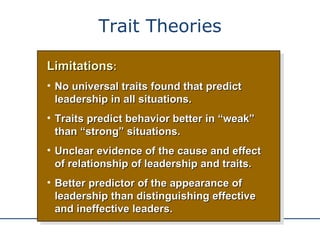
Trait Theories Limitations : No universal traits found that predict leadership in all situations. Traits predict behavior better in “weak” than “strong” situations. Unclear evidence of the cause and effect of relationship of leadership and traits. Better predictor of the appearance of leadership than distinguishing effective and ineffective leaders.
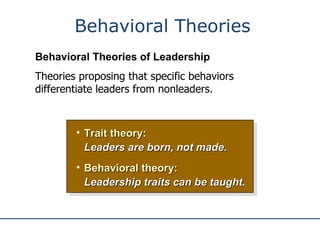
Behavioral Theories Trait theory: Leaders are born, not made. Behavioral theory: Leadership traits can be taught. Behavioral Theories of Leadership Theories proposing that specific behaviors differentiate leaders from nonleaders.
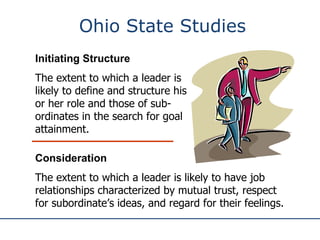
Ohio State Studies Initiating Structure The extent to which a leader is likely to define and structure his or her role and those of sub-ordinates in the search for goal attainment. Consideration The extent to which a leader is likely to have job relationships characterized by mutual trust, respect for subordinate’s ideas, and regard for their feelings.
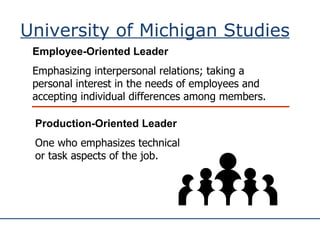
University of Michigan Studies Employee-Oriented Leader Emphasizing interpersonal relations; taking a personal interest in the needs of employees and accepting individual differences among members. Production-Oriented Leader One who emphasizes technical or task aspects of the job.
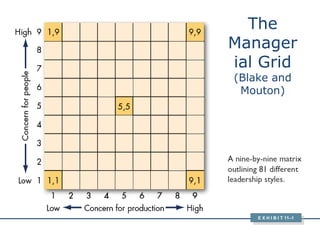
The Managerial Grid (Blake and Mouton) E X H I B I T 11 –1
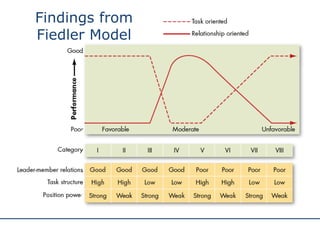
Contingency Theories Fiedler’s Contingency Model The theory that effective groups depend on a proper match between a leader’s style of interacting with subordinates and the degree to which the situation gives control and influence to the leader. Least Preferred Co-Worker (LPC) Questionnaire An instrument that purports to measure whether a person is task- or relationship-oriented.
Fiedler’s Model: Defining the Situation Leader-Member Relations The degree of confidence, trust, and respect subordinates have in their leader. Position Power Influence derived from one’s formal structural position in the organization; includes power to hire, fire, discipline, promote, and give salary increases. Task Structure The degree to which the job assignments are procedurised.
Findings from Fiedler Model
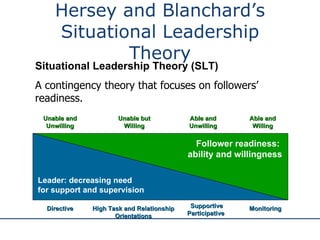
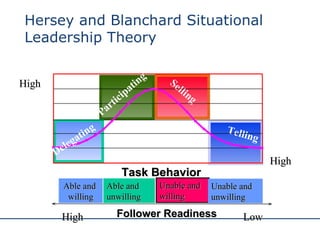
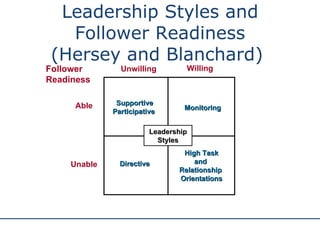
Hersey and Blanchard’s Situational Leadership Theory Situational Leadership Theory (SLT) A contingency theory that focuses on followers’ readiness. Leader: decreasing need  for support and supervision Follower readiness:  ability and willingness Unable and Unwilling Unable but Willing Able and Willing Directive High Task and Relationship Orientations Supportive Participative  Able and Unwilling Monitoring
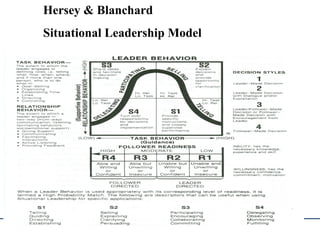
Hersey & Blanchard Situational Leadership Model
Hersey and Blanchard Situational Leadership Theory  Telling Selling Relationship Behavior High High Low High Task Behavior Delegating Follower Readiness Able and  unwilling Able and  willing Unable and  willing Unable and  unwilling Participating
Leadership Styles and Follower Readiness (Hersey and Blanchard)  Willing Unwilling Able Unable Directive High Task and  Relationship  Orientations Supportive Participative  Monitoring Follower Readiness Leadership Styles
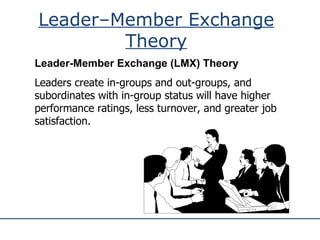
Leader –Member Exchange Theory Leader-Member Exchange (LMX) Theory Leaders create in-groups and out-groups, and subordinates with in-group status will have higher performance ratings, less turnover, and greater job satisfaction.
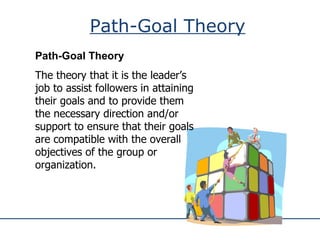
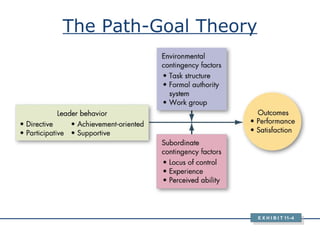
Path-Goal Theory Path-Goal Theory The theory that it is the leader’s job to assist followers in attaining their goals and to provide them the necessary direction and/or support to ensure that their goals are compatible with the overall objectives of the group or organization.
The Path-Goal Theory E X H I B I T 11 –4
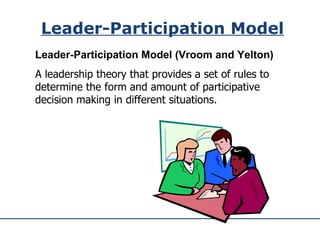
Leader-Participation Model Leader-Participation Model (Vroom and Yelton) A leadership theory that provides a set of rules to determine the form and amount of participative decision making in different situations.
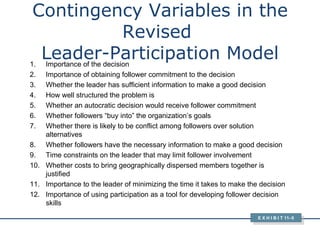
Contingency Variables in the Revised  Leader-Participation Model E X H I B I T 11 –5 Importance of the decision Importance of obtaining follower commitment to the decision Whether the leader has sufficient information to make a good decision How well structured the problem is Whether an autocratic decision would receive follower commitment Whether followers “buy into” the organization’s goals Whether there is likely to be conflict among followers over solution alternatives Whether followers have the necessary information to make a good decision Time constraints on the leader that may limit follower involvement Whether costs to bring geographically dispersed members together is justified Importance to the leader of minimizing the time it takes to make the decision Importance of using participation as a tool for developing follower decision skills
Leadership
Types of Leadership Style
Types of Leadership Style Autocratic: Leader makes decisions without reference to anyone else High degree of dependency on the leader Can create de-motivation and alienation  of staff May be valuable in some types of business where decisions need to be made quickly and decisively
Types of Leadership Style Democratic: Encourages decision making  from different perspectives – leadership may be emphasised throughout  the organisation Consultative:  process of consultation before decisions are taken Persuasive:  Leader takes decision and seeks to persuade others that the decision  is correct
Types of Leadership Style Democratic: May help motivation and involvement Workers feel ownership of the firm and its ideas Improves the sharing of ideas  and experiences within the business Can delay decision making
Types of Leadership Style Laissez-Faire: ‘ Let it be’ – the leadership responsibilities  are shared by all Can be very useful in businesses  where creative ideas are important Can be highly motivational,  as people have control over their working life Can make coordination and decision making  time-consuming and lacking in overall direction Relies on good team work Relies on good interpersonal relations
Types of Leadership Style Paternalistic: Leader acts as a ‘father figure’ Paternalistic leader makes decision but may consult Believes in the need to support staff
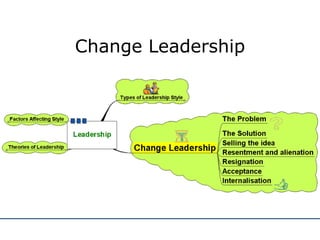
Change Leadership
Change Leadership The most challenging aspect of business is leading and managing change The business environment is subject to fast-paced economic and social change Modern business must adapt  and be flexible to survive Problems in leading change stem mainly from human resource management
Change Leadership Leaders need to be aware of how change impacts on workers: Series of self-esteem states identified by Adams et al and cited by Garrett
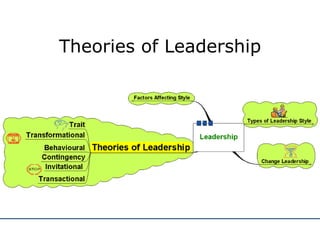
Theories of Leadership
Theories of Leadership Trait theories: Is there a set of characteristics  that determine a good leader? Personality? Dominance and personal presence? Charisma? Self confidence? Achievement? Ability to formulate a clear vision?
Theories of Leadership Trait theories: Are such characteristics  inherently gender biased? Do such characteristics  produce good leaders? Is leadership more than  just bringing about change? Does this imply that leaders are born not bred?
Theories of Leadership Behavioural: Imply that leaders can be trained – focus on the way of doing things Structure based behavioural theories – focus on the leader instituting structures – task orientated Relationship based behavioural theories – focus on the development and maintenance of relationships – process orientated
Theories of Leadership Contingency Theories: Leadership as being more flexible – different leadership styles used at different times depending on the circumstance. Suggests leadership is not a fixed series of characteristics that can be transposed into different contexts
Theories of Leadership May depend on: Type of staff History of the business Culture of the business Quality of the relationships Nature of the changes needed Accepted norms within the institution
Theories of Leadership Transformational: Widespread changes  to a business or organisation Requires: Long term strategic planning Clear objectives Clear vision Leading by example – walk the walk Efficiency of systems and processes
Theories of Leadership Invitational Leadership: Improving the atmosphere and message sent out by the organisation Focus on reducing negative messages  sent out through the everyday actions of the business both externally and, crucially, internally Review internal processes to reduce these Build relationships and sense of belonging and identity with the organisation –  that gets communicated to customers, etc.
Theories of Leadership Transactional Theories: Focus on the management  of the organisation Focus on procedures and efficiency Focus on working to rules  and contracts Managing current issues  and problems
Factors Affecting Style
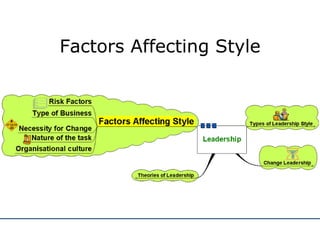
Factors Affecting Style Leadership style may be dependent  on various factors: Risk - decision making and change initiatives  based on degree of risk involved Type of business – creative business  or supply driven? How  important change is –  change for change’s sake? Organisational culture – may be long embedded  and difficult to change Nature of the task – needing cooperation? Direction? Structure?

Leadertypes 99

  • 1.
    Welcome You Allfor a session on LEADERSHIP Samir Pradhan
  • 2.
    The Pessimist complainabout the wind. The optimist expect the winds to change. A Leader adjusts the sail.
  • 3.
    C H A L L A N G E     Winners must have two things: definite goals and a burning desire to achieve them.   
  • 4.
  • 5.
    The soul isdyed the color of it's thoughts. Think only of those things that can bear the full light of day. The content of your character is your choice. Day by day, what you choose, what you think and what you do is who you become… The soul is dyed the color of it's thoughts. Think only of those things that can bear the full light of day. The content of your character is your choice. Day by day, what you choose, what you think and what you do is who you become I N T E G R E I T Y
  • 6.
  • 7.
    While most aredreaming of success, winners wake-up and work hard to achieve it.   W I N N E R S
  • 8.
  • 9.
    Determination is oftenthe first chapter in the book of excellence C O M M I T M E N T
  • 10.
  • 11.
    Change is theessence of life. Be willing to surrender what you are, for what you could become .   C H A N G E
  • 12.
    Our greatest gloryconsists not in never falling, but in rising every time we fall. -Confucius G O A L S
  • 13.
    W O RK I N G T O G E T H E R   Coming together is a beginning, keeping together is progress, working together is success.
  • 14.
    Nelson Mandela SirWinston Churchill M.K.Gandhi Martin Luther King Abraham Lincoln Leadership
  • 15.
    A Leadership Story:A group of workers and their leaders are set a task of clearing a road through a dense jungle on a remote island to get to the coast where an estuary provides a perfect site for a port. The leaders organise the labour into efficient units and monitor the distribution and use of capital assets – progress is excellent. The leaders continue to monitor and evaluate progress, making adjustments along the way to ensure the progress is maintained and efficiency increased wherever possible. Then, one day amidst all the hustle and bustle and activity, one person climbs up a nearby tree. The person surveys the scene from the top of the tree.
  • 16.
    A Leadership Story:And shouts down to the assembled group below… “ Wrong Way!” “ Management is doing things right, leadership is doing the right things” (Warren Bennis and Peter Drucker)
  • 17.
    What Is Leadership?Leadership The ability to influence a group toward the achievement of goals. Management Use of authority inherent in designated formal rank to obtain compliance from organizational members.
  • 18.
  • 19.
  • 20.
    Types of LeadershipStyle Autocratic: Leader makes decisions without reference to anyone else High degree of dependency on the leader Can create de-motivation and alienation of staff May be valuable in some types of business where decisions need to be made quickly and decisively
  • 21.
  • 22.
    Trait Theories LeadershipTraits : Ambition and energy The desire to lead Honest and integrity Self-confidence Intelligence High self-monitoring Job-relevant knowledge Traits Theories of Leadership Theories that consider personality, social, physical, or intellectual traits to differentiate leaders from nonleaders.
  • 23.
    Trait Theories Limitations: No universal traits found that predict leadership in all situations. Traits predict behavior better in “weak” than “strong” situations. Unclear evidence of the cause and effect of relationship of leadership and traits. Better predictor of the appearance of leadership than distinguishing effective and ineffective leaders.
  • 24.
    Behavioral Theories Traittheory: Leaders are born, not made. Behavioral theory: Leadership traits can be taught. Behavioral Theories of Leadership Theories proposing that specific behaviors differentiate leaders from nonleaders.
  • 25.
    Ohio State StudiesInitiating Structure The extent to which a leader is likely to define and structure his or her role and those of sub-ordinates in the search for goal attainment. Consideration The extent to which a leader is likely to have job relationships characterized by mutual trust, respect for subordinate’s ideas, and regard for their feelings.
  • 26.
    University of MichiganStudies Employee-Oriented Leader Emphasizing interpersonal relations; taking a personal interest in the needs of employees and accepting individual differences among members. Production-Oriented Leader One who emphasizes technical or task aspects of the job.
  • 27.
    The Managerial Grid(Blake and Mouton) E X H I B I T 11 –1
  • 28.
    Contingency Theories Fiedler’sContingency Model The theory that effective groups depend on a proper match between a leader’s style of interacting with subordinates and the degree to which the situation gives control and influence to the leader. Least Preferred Co-Worker (LPC) Questionnaire An instrument that purports to measure whether a person is task- or relationship-oriented.
  • 29.
    Fiedler’s Model: Definingthe Situation Leader-Member Relations The degree of confidence, trust, and respect subordinates have in their leader. Position Power Influence derived from one’s formal structural position in the organization; includes power to hire, fire, discipline, promote, and give salary increases. Task Structure The degree to which the job assignments are procedurised.
  • 30.
  • 31.
    Hersey and Blanchard’sSituational Leadership Theory Situational Leadership Theory (SLT) A contingency theory that focuses on followers’ readiness. Leader: decreasing need for support and supervision Follower readiness: ability and willingness Unable and Unwilling Unable but Willing Able and Willing Directive High Task and Relationship Orientations Supportive Participative Able and Unwilling Monitoring
  • 32.
    Hersey & BlanchardSituational Leadership Model
  • 33.
    Hersey and BlanchardSituational Leadership Theory Telling Selling Relationship Behavior High High Low High Task Behavior Delegating Follower Readiness Able and unwilling Able and willing Unable and willing Unable and unwilling Participating
  • 34.
    Leadership Styles andFollower Readiness (Hersey and Blanchard) Willing Unwilling Able Unable Directive High Task and Relationship Orientations Supportive Participative Monitoring Follower Readiness Leadership Styles
  • 35.
    Leader –Member ExchangeTheory Leader-Member Exchange (LMX) Theory Leaders create in-groups and out-groups, and subordinates with in-group status will have higher performance ratings, less turnover, and greater job satisfaction.
  • 36.
    Path-Goal Theory Path-GoalTheory The theory that it is the leader’s job to assist followers in attaining their goals and to provide them the necessary direction and/or support to ensure that their goals are compatible with the overall objectives of the group or organization.
  • 37.
    The Path-Goal TheoryE X H I B I T 11 –4
  • 38.
    Leader-Participation Model Leader-ParticipationModel (Vroom and Yelton) A leadership theory that provides a set of rules to determine the form and amount of participative decision making in different situations.
  • 39.
    Contingency Variables inthe Revised Leader-Participation Model E X H I B I T 11 –5 Importance of the decision Importance of obtaining follower commitment to the decision Whether the leader has sufficient information to make a good decision How well structured the problem is Whether an autocratic decision would receive follower commitment Whether followers “buy into” the organization’s goals Whether there is likely to be conflict among followers over solution alternatives Whether followers have the necessary information to make a good decision Time constraints on the leader that may limit follower involvement Whether costs to bring geographically dispersed members together is justified Importance to the leader of minimizing the time it takes to make the decision Importance of using participation as a tool for developing follower decision skills
  • 40.
  • 41.
  • 42.
    Types of LeadershipStyle Autocratic: Leader makes decisions without reference to anyone else High degree of dependency on the leader Can create de-motivation and alienation of staff May be valuable in some types of business where decisions need to be made quickly and decisively
  • 43.
    Types of LeadershipStyle Democratic: Encourages decision making from different perspectives – leadership may be emphasised throughout the organisation Consultative: process of consultation before decisions are taken Persuasive: Leader takes decision and seeks to persuade others that the decision is correct
  • 44.
    Types of LeadershipStyle Democratic: May help motivation and involvement Workers feel ownership of the firm and its ideas Improves the sharing of ideas and experiences within the business Can delay decision making
  • 45.
    Types of LeadershipStyle Laissez-Faire: ‘ Let it be’ – the leadership responsibilities are shared by all Can be very useful in businesses where creative ideas are important Can be highly motivational, as people have control over their working life Can make coordination and decision making time-consuming and lacking in overall direction Relies on good team work Relies on good interpersonal relations
  • 46.
    Types of LeadershipStyle Paternalistic: Leader acts as a ‘father figure’ Paternalistic leader makes decision but may consult Believes in the need to support staff
  • 47.
  • 48.
    Change Leadership Themost challenging aspect of business is leading and managing change The business environment is subject to fast-paced economic and social change Modern business must adapt and be flexible to survive Problems in leading change stem mainly from human resource management
  • 49.
    Change Leadership Leadersneed to be aware of how change impacts on workers: Series of self-esteem states identified by Adams et al and cited by Garrett
  • 50.
  • 51.
    Theories of LeadershipTrait theories: Is there a set of characteristics that determine a good leader? Personality? Dominance and personal presence? Charisma? Self confidence? Achievement? Ability to formulate a clear vision?
  • 52.
    Theories of LeadershipTrait theories: Are such characteristics inherently gender biased? Do such characteristics produce good leaders? Is leadership more than just bringing about change? Does this imply that leaders are born not bred?
  • 53.
    Theories of LeadershipBehavioural: Imply that leaders can be trained – focus on the way of doing things Structure based behavioural theories – focus on the leader instituting structures – task orientated Relationship based behavioural theories – focus on the development and maintenance of relationships – process orientated
  • 54.
    Theories of LeadershipContingency Theories: Leadership as being more flexible – different leadership styles used at different times depending on the circumstance. Suggests leadership is not a fixed series of characteristics that can be transposed into different contexts
  • 55.
    Theories of LeadershipMay depend on: Type of staff History of the business Culture of the business Quality of the relationships Nature of the changes needed Accepted norms within the institution
  • 56.
    Theories of LeadershipTransformational: Widespread changes to a business or organisation Requires: Long term strategic planning Clear objectives Clear vision Leading by example – walk the walk Efficiency of systems and processes
  • 57.
    Theories of LeadershipInvitational Leadership: Improving the atmosphere and message sent out by the organisation Focus on reducing negative messages sent out through the everyday actions of the business both externally and, crucially, internally Review internal processes to reduce these Build relationships and sense of belonging and identity with the organisation – that gets communicated to customers, etc.
  • 58.
    Theories of LeadershipTransactional Theories: Focus on the management of the organisation Focus on procedures and efficiency Focus on working to rules and contracts Managing current issues and problems
  • 59.
  • 60.
    Factors Affecting StyleLeadership style may be dependent on various factors: Risk - decision making and change initiatives based on degree of risk involved Type of business – creative business or supply driven? How important change is – change for change’s sake? Organisational culture – may be long embedded and difficult to change Nature of the task – needing cooperation? Direction? Structure?