Leadership
www.facebook.com/EgyptianLeanStore
2
What barriers discourage people
from thinking and taking
responsibility?
3
If “managing” is about thinking...
…then “leading” is about
getting other people to think.
What is Leadership?
Leadership – the process of influencing others to facilitate
the attainment of organizationally relevant goals
*One does not have to be in a formal leadership position in
order to exert leadership behavior
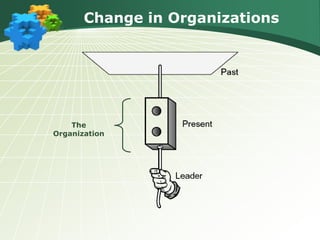
Change in Organizations
The
Organization
Charismatic Leadership
- The ability to influence followers based on a supernatural
gift and attractive powers
- Charismatic leaders are those who have charismatic effects
on their followers to an unusually high degree
- Followers enjoy being with the charismatic leader because
they feel inspired, correct, and important
Charismatic Leadership:
Two Types
Visionary charismatic leaders – focus on the long term
- Through communication ability, links followers’ needs and
goals to job or organizational long-term goals and
possibilities
Crisis-based charismatic leaders – focus on the short-term
- Have an impact when the system must handle a situation for
which existing knowledge, resources, and procedures are
not adequate
Attributes of Charismatic Leaders
- Develop visionary thinking
- Communicating the vision
- Conviction
- Extraordinary behaviors
- Develop self-confidence
Transactional Leadership
- The leader helps the follower identify what must be done to
accomplish the desired results
- The leader takes into consideration the person’s self-
concept and esteem needs
- The leader relies on contingent reward and on management
by exception
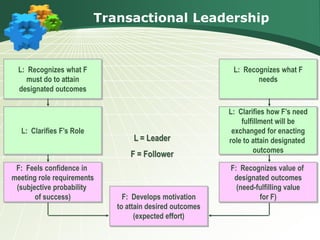
L: Recognizes what F
must do to attain
designated outcomes
L: Recognizes what F
needs
L: Clarifies how F’s need
fulfillment will be
exchanged for enacting
role to attain designated
outcomes
F: Recognizes value of
designated outcomes
(need-fulfilling value
for F)
L: Clarifies F’s Role
F: Feels confidence in
meeting role requirements
(subjective probability
of success) F: Develops motivation
to attain desired outcomes
(expected effort)
Transactional Leadership
L = Leader
F = Follower
Transformational Leadership
- Ability to inspire and motivate followers to achieve results
greater than originally planned
- The leader’s vision provides the follower with motivation for
hard work that is self-rewarding
- To achieve their vision, transformational leaders make major
changes in the firm’s or unit’s:
- Mission
- Way of doing business
- Human resource management
Leadership Actions to Change
Situations (1 of 3)
To modify leader-member relations:
- Request particular people for work in the group
- Effect transfers of particular subordinates out of the unit
- Volunteer to direct difficult or troublesome subordinates
To modify task structure:
- When possible bring new or unusual tasks or problems to
the group
- Break jobs down into smaller subtasks that can be more
highly structured
Leadership Actions to Change
Situations (2 of 3)
To modify position power:
- Show subordinates who is boss by exercising fully the
authority you have
- Make sure that information to the group gets channeled
through you
- Let subordinates participate in planning and decision making
Leadership Actions to Change
Situations (3 of 3)
Forms of Position Power
:Legitimate Power
- Power coming from a formal management position.
- Subordinates’ belief that the leader’s requests are rational.
:Reward Power
- Providing the rewards that subordinates desire (utilitarian power).
:Coercive Power
- The authority to punish or recommend punishment.
- Punishments that subordinates want to avoid.
Forms of Position Power
:Expert Power
- leader’s special knowledge or skill regarding the tasks
performed by followers.
- subordinates believe that the leader has sufficient expertise to
make rational requests.
:Referent Power
- Personality characteristics that command subordinates’
identification, respect, and admiration so they wish to emulate
the leader.
- Charismatic leaders rely heavily on referent power to control
and influence their followers
The Bottom Line
The currency of leadership is
presence.
Where leaders spend their time
determines what is important to
their organization
Lean Leadership
1- Leaders must define the organization’s vision in a way that
highlights the values of their group
2- Leaders must support people’s efforts to achieve the shared
vision through coaching, feedback, and role modeling
3- A leader should recognize and reward success
Good leaders motivate people in a variety of ways,
three of which are the basis to the “lean” approach.
Lean Leadership
The Lean Leader leads a very different way:
- By influence
by example of good thinking
by being knowledgeable
by getting into the messy details
by questioning
by coaching and teaching
- By building robust, sensible systems and processes that
cascade responsibility & enable people to work
effectively and without waste of their time and effort
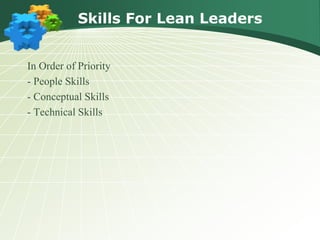
Skills For Lean Leaders
In Order of Priority
- People Skills
- Conceptual Skills
- Technical Skills
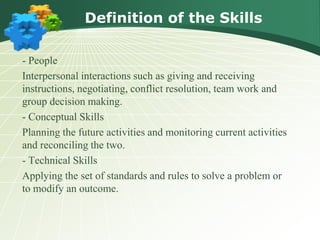
Definition of the Skills
- People
Interpersonal interactions such as giving and receiving
instructions, negotiating, conflict resolution, team work and
group decision making.
- Conceptual Skills
Planning the future activities and monitoring current activities
and reconciling the two.
- Technical Skills
Applying the set of standards and rules to solve a problem or
to modify an outcome.
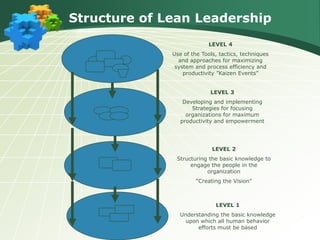
Structure of Lean Leadership
LEVEL 1
Understanding the basic knowledge
upon which all human behavior
efforts must be based
LEVEL 2
Structuring the basic knowledge to
engage the people in the
organization
“Creating the Vision”
LEVEL 3
Developing and implementing
Strategies for focusing
organizations for maximum
productivity and empowerment
LEVEL 4
Use of the Tools, tactics, techniques
and approaches for maximizing
system and process efficiency and
productivity ”Kaizen Events”
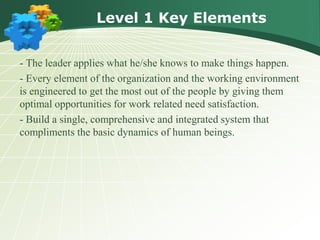
Level 1 Key Elements
- The leader applies what he/she knows to make things happen.
- Every element of the organization and the working environment
is engineered to get the most out of the people by giving them
optimal opportunities for work related need satisfaction.
- Build a single, comprehensive and integrated system that
compliments the basic dynamics of human beings.
Level 2 Key Elements
- Develop the transition of the facts and relationships of level
one into a set of consciously developed and internalized
management and leadership principles and metrics.
- Develop and enlighten philosophy of work belief within the
leadership that the overwhelming majority of people, if given
leadership, respect.
- Provide opportunities for need satisfaction and a worthwhile
goal that employees will attempt to succeed.
- Develop a understanding of rapid adaptation to change.
- Develop a visionary application of beliefs, expectations and
direction that focuses everyone in the organization on critical
objectives in an effective manner.
Level 3 Key Elements
- Value people first
- Pursue Continuous Improvement
- Focus on Micro processes
- Create lean organizational structures
Level 4 Key Elements
Implement the Lean Tools, Tactics, Techniques and
approaches for maximizing system and process
efficiency.
Metric Maps
Pareto Charts
Check Sheets
Focused Communicated Planning
Consensus Decision making
Flow charts
Structured team oriented problem solving
Process re-engineering
QFD
One by one piece flow
SMED
DOE
SPC
Extensive Sharing of Cost and Performance data at all levels
Pokayoke
Empowered, well trained employees
FMEA
Concurrent Engineering
Organization Change
- Don’t expect that you can change your organization unless you’re
the CEO/President but your area of responsibility will improve.
- Change happens in the trenches but must be lead from the top.
- You can almost guarantee world class success in those areas of the
organization that you lead.
- Lead change only in those areas where you can exert significant
and long lasting influence, helps spread the word to other areas.
If you wish to change an organization you must be intimately aware
of group dynamics and resistance to change and must appreciate
that you’re up against an unthinking, self organizing system.
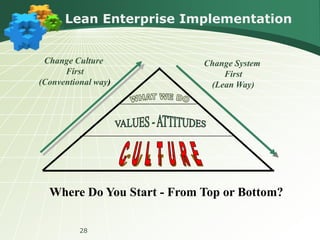
28
Where Do You Start - From Top or Bottom?
Change Culture
First
(Conventional way)
Change System
First
(Lean Way)
Lean Enterprise Implementation
Questions ?
29

Leadership in organizations

  • 1.
  • 2.
    2 What barriers discouragepeople from thinking and taking responsibility?
  • 3.
    3 If “managing” isabout thinking... …then “leading” is about getting other people to think.
  • 4.
    What is Leadership? Leadership– the process of influencing others to facilitate the attainment of organizationally relevant goals *One does not have to be in a formal leadership position in order to exert leadership behavior
  • 5.
  • 6.
    Charismatic Leadership - Theability to influence followers based on a supernatural gift and attractive powers - Charismatic leaders are those who have charismatic effects on their followers to an unusually high degree - Followers enjoy being with the charismatic leader because they feel inspired, correct, and important
  • 7.
    Charismatic Leadership: Two Types Visionarycharismatic leaders – focus on the long term - Through communication ability, links followers’ needs and goals to job or organizational long-term goals and possibilities Crisis-based charismatic leaders – focus on the short-term - Have an impact when the system must handle a situation for which existing knowledge, resources, and procedures are not adequate
  • 8.
    Attributes of CharismaticLeaders - Develop visionary thinking - Communicating the vision - Conviction - Extraordinary behaviors - Develop self-confidence
  • 9.
    Transactional Leadership - Theleader helps the follower identify what must be done to accomplish the desired results - The leader takes into consideration the person’s self- concept and esteem needs - The leader relies on contingent reward and on management by exception
  • 10.
    L: Recognizes whatF must do to attain designated outcomes L: Recognizes what F needs L: Clarifies how F’s need fulfillment will be exchanged for enacting role to attain designated outcomes F: Recognizes value of designated outcomes (need-fulfilling value for F) L: Clarifies F’s Role F: Feels confidence in meeting role requirements (subjective probability of success) F: Develops motivation to attain desired outcomes (expected effort) Transactional Leadership L = Leader F = Follower
  • 11.
    Transformational Leadership - Abilityto inspire and motivate followers to achieve results greater than originally planned - The leader’s vision provides the follower with motivation for hard work that is self-rewarding - To achieve their vision, transformational leaders make major changes in the firm’s or unit’s: - Mission - Way of doing business - Human resource management
  • 12.
    Leadership Actions toChange Situations (1 of 3) To modify leader-member relations: - Request particular people for work in the group - Effect transfers of particular subordinates out of the unit - Volunteer to direct difficult or troublesome subordinates
  • 13.
    To modify taskstructure: - When possible bring new or unusual tasks or problems to the group - Break jobs down into smaller subtasks that can be more highly structured Leadership Actions to Change Situations (2 of 3)
  • 14.
    To modify positionpower: - Show subordinates who is boss by exercising fully the authority you have - Make sure that information to the group gets channeled through you - Let subordinates participate in planning and decision making Leadership Actions to Change Situations (3 of 3)
  • 15.
    Forms of PositionPower :Legitimate Power - Power coming from a formal management position. - Subordinates’ belief that the leader’s requests are rational. :Reward Power - Providing the rewards that subordinates desire (utilitarian power). :Coercive Power - The authority to punish or recommend punishment. - Punishments that subordinates want to avoid.
  • 16.
    Forms of PositionPower :Expert Power - leader’s special knowledge or skill regarding the tasks performed by followers. - subordinates believe that the leader has sufficient expertise to make rational requests. :Referent Power - Personality characteristics that command subordinates’ identification, respect, and admiration so they wish to emulate the leader. - Charismatic leaders rely heavily on referent power to control and influence their followers
  • 17.
    The Bottom Line Thecurrency of leadership is presence. Where leaders spend their time determines what is important to their organization
  • 18.
    Lean Leadership 1- Leadersmust define the organization’s vision in a way that highlights the values of their group 2- Leaders must support people’s efforts to achieve the shared vision through coaching, feedback, and role modeling 3- A leader should recognize and reward success Good leaders motivate people in a variety of ways, three of which are the basis to the “lean” approach.
  • 19.
    Lean Leadership The LeanLeader leads a very different way: - By influence by example of good thinking by being knowledgeable by getting into the messy details by questioning by coaching and teaching - By building robust, sensible systems and processes that cascade responsibility & enable people to work effectively and without waste of their time and effort
  • 20.
    Skills For LeanLeaders In Order of Priority - People Skills - Conceptual Skills - Technical Skills
  • 21.
    Definition of theSkills - People Interpersonal interactions such as giving and receiving instructions, negotiating, conflict resolution, team work and group decision making. - Conceptual Skills Planning the future activities and monitoring current activities and reconciling the two. - Technical Skills Applying the set of standards and rules to solve a problem or to modify an outcome.
  • 22.
    Structure of LeanLeadership LEVEL 1 Understanding the basic knowledge upon which all human behavior efforts must be based LEVEL 2 Structuring the basic knowledge to engage the people in the organization “Creating the Vision” LEVEL 3 Developing and implementing Strategies for focusing organizations for maximum productivity and empowerment LEVEL 4 Use of the Tools, tactics, techniques and approaches for maximizing system and process efficiency and productivity ”Kaizen Events”
  • 23.
    Level 1 KeyElements - The leader applies what he/she knows to make things happen. - Every element of the organization and the working environment is engineered to get the most out of the people by giving them optimal opportunities for work related need satisfaction. - Build a single, comprehensive and integrated system that compliments the basic dynamics of human beings.
  • 24.
    Level 2 KeyElements - Develop the transition of the facts and relationships of level one into a set of consciously developed and internalized management and leadership principles and metrics. - Develop and enlighten philosophy of work belief within the leadership that the overwhelming majority of people, if given leadership, respect. - Provide opportunities for need satisfaction and a worthwhile goal that employees will attempt to succeed. - Develop a understanding of rapid adaptation to change. - Develop a visionary application of beliefs, expectations and direction that focuses everyone in the organization on critical objectives in an effective manner.
  • 25.
    Level 3 KeyElements - Value people first - Pursue Continuous Improvement - Focus on Micro processes - Create lean organizational structures
  • 26.
    Level 4 KeyElements Implement the Lean Tools, Tactics, Techniques and approaches for maximizing system and process efficiency. Metric Maps Pareto Charts Check Sheets Focused Communicated Planning Consensus Decision making Flow charts Structured team oriented problem solving Process re-engineering QFD One by one piece flow SMED DOE SPC Extensive Sharing of Cost and Performance data at all levels Pokayoke Empowered, well trained employees FMEA Concurrent Engineering
  • 27.
    Organization Change - Don’texpect that you can change your organization unless you’re the CEO/President but your area of responsibility will improve. - Change happens in the trenches but must be lead from the top. - You can almost guarantee world class success in those areas of the organization that you lead. - Lead change only in those areas where you can exert significant and long lasting influence, helps spread the word to other areas. If you wish to change an organization you must be intimately aware of group dynamics and resistance to change and must appreciate that you’re up against an unthinking, self organizing system.
  • 28.
    28 Where Do YouStart - From Top or Bottom? Change Culture First (Conventional way) Change System First (Lean Way) Lean Enterprise Implementation
  • 29.