LEADERSHIP
What Is Leadership?
What Is Leadership?
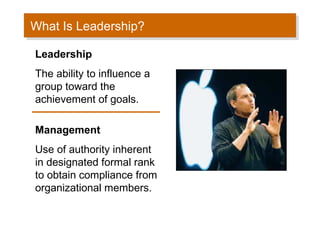
Leadership
The ability to influence a
group toward the
achievement of goals.
Management
Use of authority inherent
in designated formal rank
to obtain compliance from
organizational members.
Trait Theories
Trait Theories
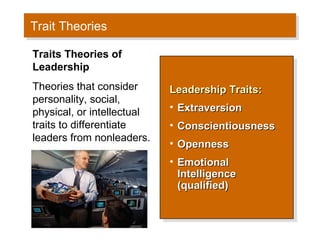
Traits Theories of
Leadership
Theories that consider
personality, social,
physical, or intellectual
traits to differentiate
leaders from nonleaders.

Leadership Traits::
Leadership Traits
•• Extraversion
Extraversion
•• Conscientiousness
Conscientiousness
•• Openness
Openness
•• Emotional
Emotional
Intelligence
Intelligence
(qualified)
(qualified)
Trait Theories
Trait Theories
Limitations::
Limitations
•• No universal traits found that predict
No universal traits found that predict
leadership in all situations.
•• Unclear evidence of the cause and effect
Unclear evidence of the cause and effect
of relationship of leadership and traits.
•• Better predictor of the appearance of
Better predictor of the appearance of
leadership than distinguishing effective
and ineffective leaders.
Trait Approach
Trait Approach
 Traits (examples)
– Extraversion
– Conscientiousness
– Openness

 Assumption: Leaders are born
 Goal: Select leaders
 Problems
– Traits do not generalize across situations
– Better at predicting leader emergence than leader
effectiveness
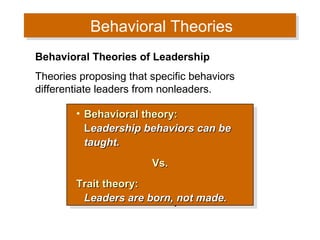
Behavioral Theories
Behavioral Theories
Behavioral Theories of Leadership
Theories proposing that specific behaviors
differentiate leaders from nonleaders.
•• Behavioral theory:
Behavioral theory:
Leadership behaviors can be
taught.
taught.
Vs.
Vs.
Trait theory:
Trait theory:
Leaders are born, not made.
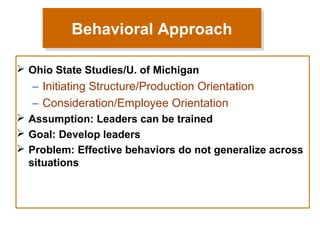
Behavioral Approach
Behavioral Approach
 Ohio State Studies/U. of Michigan

– Initiating Structure/Production Orientation
– Consideration/Employee Orientation
 Assumption: Leaders can be trained
 Goal: Develop leaders
 Problem: Effective behaviors do not generalize across
situations
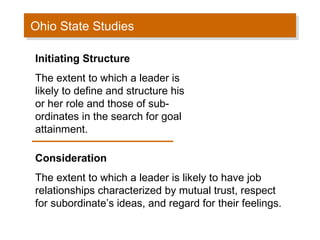
Ohio State Studies
Ohio State Studies
Initiating Structure
The extent to which a leader is
likely to define and structure his
or her role and those of subordinates in the search for goal
attainment.
Consideration
The extent to which a leader is likely to have job
relationships characterized by mutual trust, respect
for subordinate’s ideas, and regard for their feelings.
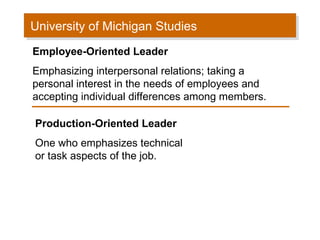
University of Michigan Studies
Employee-Oriented Leader
Emphasizing interpersonal relations; taking a
personal interest in the needs of employees and
accepting individual differences among members.
Production-Oriented Leader
One who emphasizes technical
or task aspects of the job.
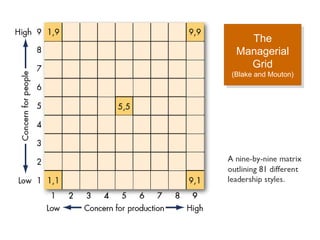
The
The
Managerial
Managerial
Grid
Grid

(Blake and Mouton)
(Blake and Mouton)
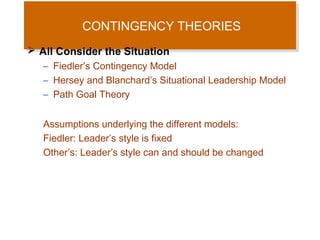
CONTINGENCY THEORIES
 All Consider the Situation
– Fiedler’s Contingency Model
– Hersey and Blanchard’s Situational Leadership Model
– Path Goal Theory
Assumptions underlying the different models:
Fiedler: Leader’s style is fixed
Other’s: Leader’s style can and should be changed
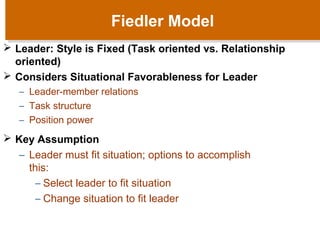
Fiedler Model
Fiedler Model
 Leader: Style is Fixed (Task oriented vs. Relationship
oriented)
 Considers Situational Favorableness for Leader
– Leader-member relations
– Task structure
– Position power

 Key Assumption
– Leader must fit situation; options to accomplish
this:
– Select leader to fit situation
– Change situation to fit leader
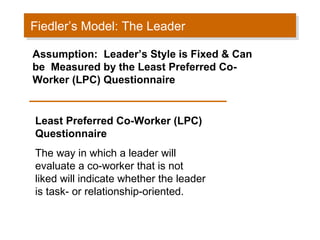
Fiedler’s Model: The Leader
Assumption: Leader’s Style is Fixed & Can
be Measured by the Least Preferred CoWorker (LPC) Questionnaire

Least Preferred Co-Worker (LPC)
Questionnaire
The way in which a leader will
evaluate a co-worker that is not
liked will indicate whether the leader
is task- or relationship-oriented.
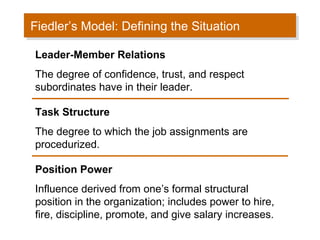
Fiedler’s Model: Defining the Situation
Leader-Member Relations
The degree of confidence, trust, and respect
subordinates have in their leader.
Task Structure
The degree to which the job assignments are
procedurized.
Position Power
Influence derived from one’s formal structural
position in the organization; includes power to hire,
fire, discipline, promote, and give salary increases.
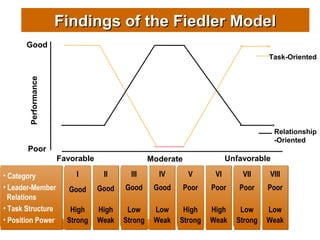
Findings of the Fiedler Model
Good

Performance

Task-Oriented

Relationship
-Oriented

Poor
Favorable
• Category
• Leader-Member
Relations
• Task Structure
• Position Power

Unfavorable

Moderate

I

II

III

IV

V

VI

VII

VIII

Good

Good

Good

Good

Poor

Poor

Poor

Poor

High
Strong

High
Weak

Low
Strong

Low
Weak

High
Strong

High
Weak

Low
Strong

Low
Weak
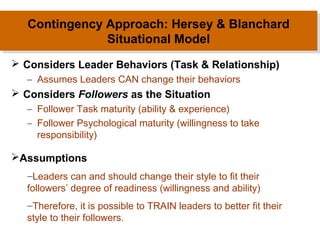
Contingency Approach: Hersey & Blanchard
Situational Model
Situational Model
 Considers Leader Behaviors (Task & Relationship)
– Assumes Leaders CAN change their behaviors

 Considers Followers as the Situation
– Follower Task maturity (ability & experience)
– Follower Psychological maturity (willingness to take
responsibility)

Assumptions
–Leaders can and should change their style to fit their
followers’ degree of readiness (willingness and ability)
–Therefore, it is possible to TRAIN leaders to better fit their
style to their followers.
Hersey and Blanchard’s Situational Leadership
Theory
Theory
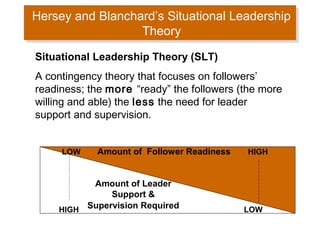
Situational Leadership Theory (SLT)
A contingency theory that focuses on followers’
readiness; the more “ready” the followers (the more
willing and able) the less the need for leader
support and supervision.
LOW

Amount of Follower Readiness

Amount of Leader
Support &
HIGH Supervision Required

HIGH

LOW
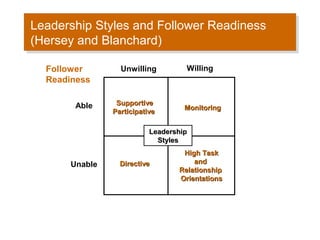
Leadership Styles and Follower Readiness
(Hersey and Blanchard)
Follower
Readiness
Able

Unwilling

Supportive
Participative

Willing

Monitoring

Leadership
Styles

Unable

Directive

High Task
and
Relationship
Orientations
Path-Goal Theory
Path-Goal Theory

Developed by Robert House
Premise
• Leader must help followers
attaining goals and reduce
roadblocks to success
•Leaders must change behaviors
to fit the situation (environmental
contingencies & subordinate
contingencies)
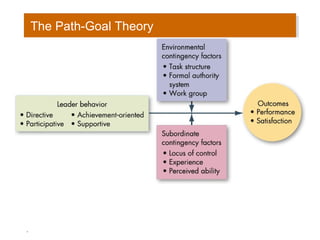
The Path-Goal Theory

.

Leadership

  • 1.
  • 2.
    What Is Leadership? WhatIs Leadership? Leadership The ability to influence a group toward the achievement of goals. Management Use of authority inherent in designated formal rank to obtain compliance from organizational members.
  • 3.
    Trait Theories Trait Theories TraitsTheories of Leadership Theories that consider personality, social, physical, or intellectual traits to differentiate leaders from nonleaders. Leadership Traits:: Leadership Traits •• Extraversion Extraversion •• Conscientiousness Conscientiousness •• Openness Openness •• Emotional Emotional Intelligence Intelligence (qualified) (qualified)
  • 4.
    Trait Theories Trait Theories Limitations:: Limitations ••No universal traits found that predict No universal traits found that predict leadership in all situations. leadership in all situations. •• Unclear evidence of the cause and effect Unclear evidence of the cause and effect of relationship of leadership and traits. of relationship of leadership and traits. •• Better predictor of the appearance of Better predictor of the appearance of leadership than distinguishing effective leadership than distinguishing effective and ineffective leaders. and ineffective leaders.
  • 5.
    Trait Approach Trait Approach Traits (examples) – Extraversion – Conscientiousness – Openness  Assumption: Leaders are born  Goal: Select leaders  Problems – Traits do not generalize across situations – Better at predicting leader emergence than leader effectiveness
  • 6.
    Behavioral Theories Behavioral Theories BehavioralTheories of Leadership Theories proposing that specific behaviors differentiate leaders from nonleaders. •• Behavioral theory: Behavioral theory: Leadership behaviors can be Leadership behaviors can be taught. taught. Vs. Vs. Trait theory: Trait theory: Leaders are born, not made. Leaders are born, not made.
  • 7.
    Behavioral Approach Behavioral Approach Ohio State Studies/U. of Michigan – Initiating Structure/Production Orientation – Consideration/Employee Orientation  Assumption: Leaders can be trained  Goal: Develop leaders  Problem: Effective behaviors do not generalize across situations
  • 8.
    Ohio State Studies OhioState Studies Initiating Structure The extent to which a leader is likely to define and structure his or her role and those of subordinates in the search for goal attainment. Consideration The extent to which a leader is likely to have job relationships characterized by mutual trust, respect for subordinate’s ideas, and regard for their feelings.
  • 9.
    University of MichiganStudies University of Michigan Studies Employee-Oriented Leader Emphasizing interpersonal relations; taking a personal interest in the needs of employees and accepting individual differences among members. Production-Oriented Leader One who emphasizes technical or task aspects of the job.
  • 10.
  • 11.
    CONTINGENCY THEORIES CONTINGENCY THEORIES All Consider the Situation – Fiedler’s Contingency Model – Hersey and Blanchard’s Situational Leadership Model – Path Goal Theory Assumptions underlying the different models: Fiedler: Leader’s style is fixed Other’s: Leader’s style can and should be changed
  • 12.
    Fiedler Model Fiedler Model Leader: Style is Fixed (Task oriented vs. Relationship oriented)  Considers Situational Favorableness for Leader – Leader-member relations – Task structure – Position power  Key Assumption – Leader must fit situation; options to accomplish this: – Select leader to fit situation – Change situation to fit leader
  • 13.
    Fiedler’s Model: TheLeader Fiedler’s Model: The Leader Assumption: Leader’s Style is Fixed & Can be Measured by the Least Preferred CoWorker (LPC) Questionnaire Least Preferred Co-Worker (LPC) Questionnaire The way in which a leader will evaluate a co-worker that is not liked will indicate whether the leader is task- or relationship-oriented.
  • 14.
    Fiedler’s Model: Definingthe Situation Fiedler’s Model: Defining the Situation Leader-Member Relations The degree of confidence, trust, and respect subordinates have in their leader. Task Structure The degree to which the job assignments are procedurized. Position Power Influence derived from one’s formal structural position in the organization; includes power to hire, fire, discipline, promote, and give salary increases.
  • 15.
    Findings of theFiedler Model Good Performance Task-Oriented Relationship -Oriented Poor Favorable • Category • Leader-Member Relations • Task Structure • Position Power Unfavorable Moderate I II III IV V VI VII VIII Good Good Good Good Poor Poor Poor Poor High Strong High Weak Low Strong Low Weak High Strong High Weak Low Strong Low Weak
  • 16.
    Contingency Approach: Hersey& Blanchard Contingency Approach: Hersey & Blanchard Situational Model Situational Model  Considers Leader Behaviors (Task & Relationship) – Assumes Leaders CAN change their behaviors  Considers Followers as the Situation – Follower Task maturity (ability & experience) – Follower Psychological maturity (willingness to take responsibility) Assumptions –Leaders can and should change their style to fit their followers’ degree of readiness (willingness and ability) –Therefore, it is possible to TRAIN leaders to better fit their style to their followers.
  • 17.
    Hersey and Blanchard’sSituational Leadership Hersey and Blanchard’s Situational Leadership Theory Theory Situational Leadership Theory (SLT) A contingency theory that focuses on followers’ readiness; the more “ready” the followers (the more willing and able) the less the need for leader support and supervision. LOW Amount of Follower Readiness Amount of Leader Support & HIGH Supervision Required HIGH LOW
  • 18.
    Leadership Styles andFollower Readiness Leadership Styles and Follower Readiness (Hersey and Blanchard) (Hersey and Blanchard) Follower Readiness Able Unwilling Supportive Participative Willing Monitoring Leadership Styles Unable Directive High Task and Relationship Orientations
  • 19.
    Path-Goal Theory Path-Goal Theory Developedby Robert House Premise • Leader must help followers attaining goals and reduce roadblocks to success •Leaders must change behaviors to fit the situation (environmental contingencies & subordinate contingencies)
  • 20.
    The Path-Goal Theory ThePath-Goal Theory .

Editor's Notes

  • #16 Fiedler asserts that if the leader’s style matches the situation, he or she will be effective. His model predicts that low-LPC, task motivated leaders will be effective in high and low situational control. High-LPC, relationship motivated leaders will be effective in moderate situational control. The Fiedler model has several practical implications for managers: Leaders must understand their style and the situation. Leaders should focus on changing the situation to match their style. A good relationship with followers can compensate for a lack of power. Leaders can compensate for task ambiguity through training and experience.