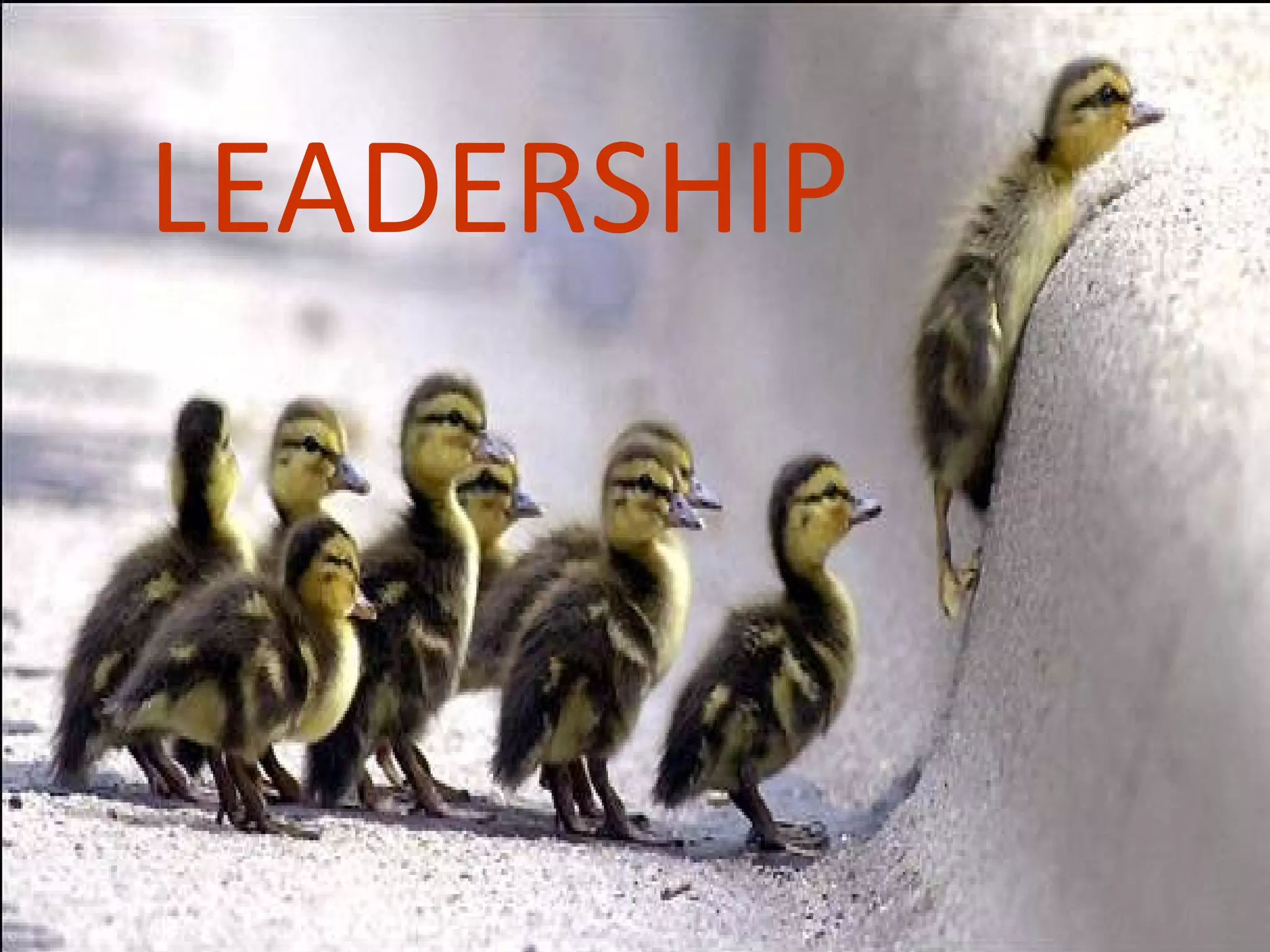
LEADERSHIP
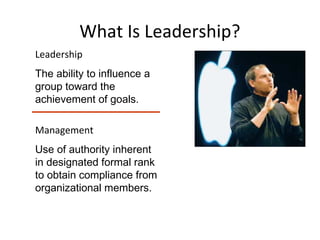
What Is Leadership?
Leadership
The ability to influence a
group toward the
achievement of goals.
Management
Use of authority inherent
in designated formal rank
to obtain compliance from
organizational members.
LEADERSHIP THEORIES
• TRAIT THEORY
• BEHAVIOURAL THEORIES
• CONTINGENCY THEORIES
1, Trait Theories
Leadership TraitsLeadership Traits::
• Ambition and energyAmbition and energy
• The desire to leadThe desire to lead
• Honest and integrityHonest and integrity
• Self-confidenceSelf-confidence
• IntelligenceIntelligence
• High self-monitoringHigh self-monitoring
• Job-relevant knowledgeJob-relevant knowledge
Leadership TraitsLeadership Traits::
• Ambition and energyAmbition and energy
• The desire to leadThe desire to lead
• Honest and integrityHonest and integrity
• Self-confidenceSelf-confidence
• IntelligenceIntelligence
• High self-monitoringHigh self-monitoring
• Job-relevant knowledgeJob-relevant knowledge
Traits Theories of
Leadership
Theories that consider
personality, social,
physical, or intellectual
traits to differentiate
leaders from nonleaders.
Trait Theories
LimitationsLimitations::
• No universal traits found that predict leadershipNo universal traits found that predict leadership
in all situations.in all situations.
• Unclear evidence of the cause and effect ofUnclear evidence of the cause and effect of
relationship of leadership and traits.relationship of leadership and traits.
LimitationsLimitations::
• No universal traits found that predict leadershipNo universal traits found that predict leadership
in all situations.in all situations.
• Unclear evidence of the cause and effect ofUnclear evidence of the cause and effect of
relationship of leadership and traits.relationship of leadership and traits.
2. Behavioral Theories
• Trait theory:Trait theory:
Leaders are born, not made.Leaders are born, not made.
• Behavioral theory:Behavioral theory:
Leadership traits can be taught.Leadership traits can be taught.
• Trait theory:Trait theory:
Leaders are born, not made.Leaders are born, not made.
• Behavioral theory:Behavioral theory:
Leadership traits can be taught.Leadership traits can be taught.
Behavioral Theories of Leadership
Theories proposing that specific behaviors
differentiate leaders from nonleaders.
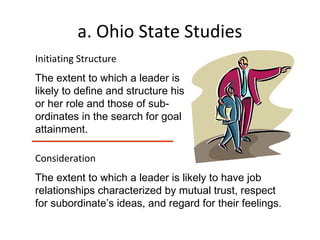
a. Ohio State Studies
Initiating Structure
The extent to which a leader is
likely to define and structure his
or her role and those of sub-
ordinates in the search for goal
attainment.
Consideration
The extent to which a leader is likely to have job
relationships characterized by mutual trust, respect
for subordinate’s ideas, and regard for their feelings.
b. University of Michigan Studies
Employee-Oriented Leader
Emphasizing interpersonal relations; taking a
personal interest in the needs of employees and
accepting individual differences among members.
Production-Oriented Leader
One who emphasizes technical
or task aspects of the job.
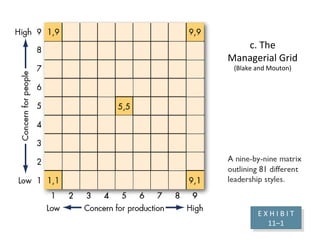
c. The
Managerial Grid
(Blake and Mouton)
E X H I B I T
11–1
E X H I B I T
11–1
3. Contingency Theories
Fiedler’s Contingency Model
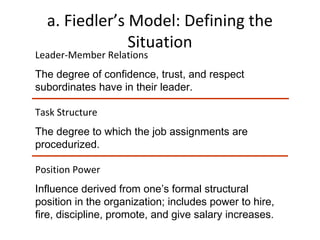
a. Fiedler’s Model: Defining the
Situation
Leader-Member Relations
The degree of confidence, trust, and respect
subordinates have in their leader.
Position Power
Influence derived from one’s formal structural
position in the organization; includes power to hire,
fire, discipline, promote, and give salary increases.
Task Structure
The degree to which the job assignments are
procedurized.
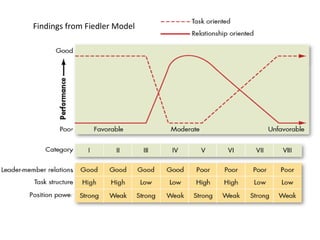
Findings from Fiedler Model
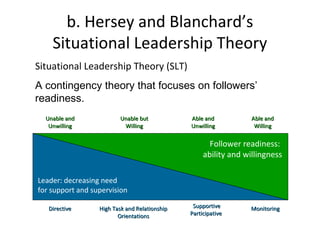
b. Hersey and Blanchard’s
Situational Leadership Theory
Situational Leadership Theory (SLT)
A contingency theory that focuses on followers’
readiness.
Leader: decreasing need
for support and supervision
Follower readiness:
ability and willingness
Unable andUnable and
UnwillingUnwilling
Unable butUnable but
WillingWilling
Able andAble and
WillingWilling
DirectiveDirective High Task and RelationshipHigh Task and Relationship
OrientationsOrientations
SupportiveSupportive
ParticipativeParticipative
Able andAble and
UnwillingUnwilling
MonitoringMonitoring
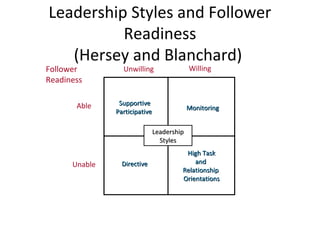
Leadership Styles and Follower
Readiness
(Hersey and Blanchard)
WillingUnwilling
Able
Unable DirectiveDirective
High TaskHigh Task
andand
RelationshipRelationship
OrientationsOrientations
SupportiveSupportive
ParticipativeParticipative MonitoringMonitoring
Follower
Readiness
LeadershipLeadership
StylesStyles
c.Leader–Member Exchange Theory
Leader-Member Exchange (LMX) Theory
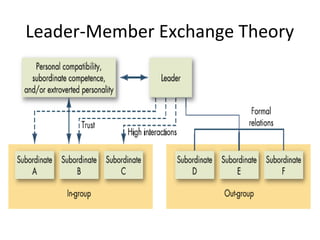
Leaders create in-groups and out-groups, and
subordinates with in-group status will have higher
performance ratings, less turnover, and greater job
satisfaction.
Leader-Member Exchange Theory
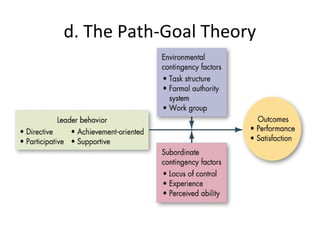
d. The Path-Goal Theory
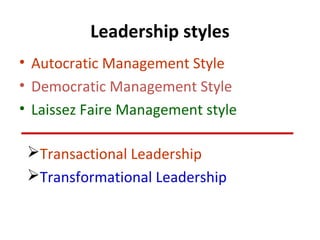
Leadership styles
• Autocratic Management Style
• Democratic Management Style
• Laissez Faire Management style
Transactional Leadership
Transformational Leadership
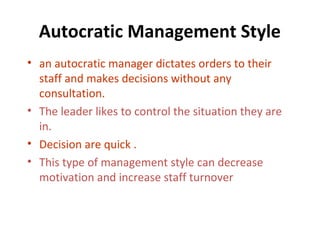
Autocratic Management Style
• an autocratic manager dictates orders to their
staff and makes decisions without any
consultation.
• The leader likes to control the situation they are
in.
• Decision are quick .
• This type of management style can decrease
motivation and increase staff turnover
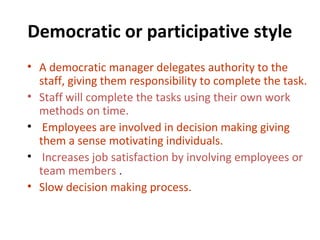
Democratic or participative style
• A democratic manager delegates authority to the
staff, giving them responsibility to complete the task.
• Staff will complete the tasks using their own work
methods on time.
• Employees are involved in decision making giving
them a sense motivating individuals.
• Increases job satisfaction by involving employees or
team members .
• Slow decision making process.
Laissez Faire Management style
• A laissez faire manager sets the tasks and gives staff
complete freedom to complete the task as they see fit.
“leave it be”.
• It works for teams in which the individuals are very
experienced and skilled self-starters.
• There is minimal involvement from the manager.
• The manager coaches or supply information if
required.
• Benefits - staff are developed to take responsibility .
• Staff feel lost and not reach the goals set within the
time frame
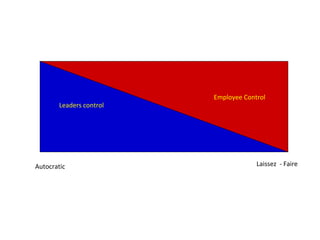
Autocratic Laissez - Faire
Leaders control
Employee Control
Transactional and Transformational
Leadership
Transactional Leaders
Leaders who guide or motivate their followers
in the direction of established goals by
clarifying role and task requirements.
Transformational Leaders
Leaders who provide individualized
consideration and intellectual stimulation,
and who possess charisma.
Characteristics of Transactional
Leaders
Contingent Reward: Contracts exchange of
rewards for effort, promises rewards for good
performance, recognizes accomplishments.
Management by Exception: Watches and
searches for deviations from rules and
standards, takes corrective action.
Characteristics of Transformational
Leaders
Idealized Influence: Provides vision and sense of mission,
instills pride, gains respect and trust.
Inspiration: Communicates high expectations, uses
symbols to focus efforts, expresses important purposes in
simple ways.
Intellectual Stimulation: Promotes intelligence, rationality,
and careful problem solving.
Individualized Consideration: Gives personal attention,
treats each employee individually, coaches, advises.

Leadershipconceptsandtheories 120810034143-phpapp01

  • 1.
  • 2.
    What Is Leadership? Leadership Theability to influence a group toward the achievement of goals. Management Use of authority inherent in designated formal rank to obtain compliance from organizational members.
  • 3.
    LEADERSHIP THEORIES • TRAITTHEORY • BEHAVIOURAL THEORIES • CONTINGENCY THEORIES
  • 4.
    1, Trait Theories LeadershipTraitsLeadership Traits:: • Ambition and energyAmbition and energy • The desire to leadThe desire to lead • Honest and integrityHonest and integrity • Self-confidenceSelf-confidence • IntelligenceIntelligence • High self-monitoringHigh self-monitoring • Job-relevant knowledgeJob-relevant knowledge Leadership TraitsLeadership Traits:: • Ambition and energyAmbition and energy • The desire to leadThe desire to lead • Honest and integrityHonest and integrity • Self-confidenceSelf-confidence • IntelligenceIntelligence • High self-monitoringHigh self-monitoring • Job-relevant knowledgeJob-relevant knowledge Traits Theories of Leadership Theories that consider personality, social, physical, or intellectual traits to differentiate leaders from nonleaders.
  • 5.
    Trait Theories LimitationsLimitations:: • Nouniversal traits found that predict leadershipNo universal traits found that predict leadership in all situations.in all situations. • Unclear evidence of the cause and effect ofUnclear evidence of the cause and effect of relationship of leadership and traits.relationship of leadership and traits. LimitationsLimitations:: • No universal traits found that predict leadershipNo universal traits found that predict leadership in all situations.in all situations. • Unclear evidence of the cause and effect ofUnclear evidence of the cause and effect of relationship of leadership and traits.relationship of leadership and traits.
  • 6.
    2. Behavioral Theories •Trait theory:Trait theory: Leaders are born, not made.Leaders are born, not made. • Behavioral theory:Behavioral theory: Leadership traits can be taught.Leadership traits can be taught. • Trait theory:Trait theory: Leaders are born, not made.Leaders are born, not made. • Behavioral theory:Behavioral theory: Leadership traits can be taught.Leadership traits can be taught. Behavioral Theories of Leadership Theories proposing that specific behaviors differentiate leaders from nonleaders.
  • 7.
    a. Ohio StateStudies Initiating Structure The extent to which a leader is likely to define and structure his or her role and those of sub- ordinates in the search for goal attainment. Consideration The extent to which a leader is likely to have job relationships characterized by mutual trust, respect for subordinate’s ideas, and regard for their feelings.
  • 8.
    b. University ofMichigan Studies Employee-Oriented Leader Emphasizing interpersonal relations; taking a personal interest in the needs of employees and accepting individual differences among members. Production-Oriented Leader One who emphasizes technical or task aspects of the job.
  • 9.
    c. The Managerial Grid (Blakeand Mouton) E X H I B I T 11–1 E X H I B I T 11–1
  • 10.
  • 11.
    a. Fiedler’s Model:Defining the Situation Leader-Member Relations The degree of confidence, trust, and respect subordinates have in their leader. Position Power Influence derived from one’s formal structural position in the organization; includes power to hire, fire, discipline, promote, and give salary increases. Task Structure The degree to which the job assignments are procedurized.
  • 12.
  • 13.
    b. Hersey andBlanchard’s Situational Leadership Theory Situational Leadership Theory (SLT) A contingency theory that focuses on followers’ readiness. Leader: decreasing need for support and supervision Follower readiness: ability and willingness Unable andUnable and UnwillingUnwilling Unable butUnable but WillingWilling Able andAble and WillingWilling DirectiveDirective High Task and RelationshipHigh Task and Relationship OrientationsOrientations SupportiveSupportive ParticipativeParticipative Able andAble and UnwillingUnwilling MonitoringMonitoring
  • 14.
    Leadership Styles andFollower Readiness (Hersey and Blanchard) WillingUnwilling Able Unable DirectiveDirective High TaskHigh Task andand RelationshipRelationship OrientationsOrientations SupportiveSupportive ParticipativeParticipative MonitoringMonitoring Follower Readiness LeadershipLeadership StylesStyles
  • 15.
    c.Leader–Member Exchange Theory Leader-MemberExchange (LMX) Theory Leaders create in-groups and out-groups, and subordinates with in-group status will have higher performance ratings, less turnover, and greater job satisfaction.
  • 16.
  • 17.
  • 18.
    Leadership styles • AutocraticManagement Style • Democratic Management Style • Laissez Faire Management style Transactional Leadership Transformational Leadership
  • 19.
    Autocratic Management Style •an autocratic manager dictates orders to their staff and makes decisions without any consultation. • The leader likes to control the situation they are in. • Decision are quick . • This type of management style can decrease motivation and increase staff turnover
  • 20.
    Democratic or participativestyle • A democratic manager delegates authority to the staff, giving them responsibility to complete the task. • Staff will complete the tasks using their own work methods on time. • Employees are involved in decision making giving them a sense motivating individuals. • Increases job satisfaction by involving employees or team members . • Slow decision making process.
  • 21.
    Laissez Faire Managementstyle • A laissez faire manager sets the tasks and gives staff complete freedom to complete the task as they see fit. “leave it be”. • It works for teams in which the individuals are very experienced and skilled self-starters. • There is minimal involvement from the manager. • The manager coaches or supply information if required. • Benefits - staff are developed to take responsibility . • Staff feel lost and not reach the goals set within the time frame
  • 22.
    Autocratic Laissez -Faire Leaders control Employee Control
  • 23.
    Transactional and Transformational Leadership TransactionalLeaders Leaders who guide or motivate their followers in the direction of established goals by clarifying role and task requirements. Transformational Leaders Leaders who provide individualized consideration and intellectual stimulation, and who possess charisma.
  • 24.
    Characteristics of Transactional Leaders ContingentReward: Contracts exchange of rewards for effort, promises rewards for good performance, recognizes accomplishments. Management by Exception: Watches and searches for deviations from rules and standards, takes corrective action.
  • 25.
    Characteristics of Transformational Leaders IdealizedInfluence: Provides vision and sense of mission, instills pride, gains respect and trust. Inspiration: Communicates high expectations, uses symbols to focus efforts, expresses important purposes in simple ways. Intellectual Stimulation: Promotes intelligence, rationality, and careful problem solving. Individualized Consideration: Gives personal attention, treats each employee individually, coaches, advises.