LEADERSHIP
CONCEPT , STYLES AND
THEORIES
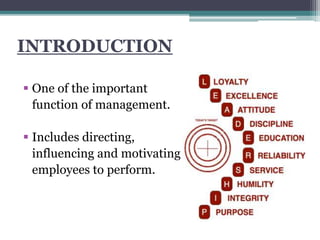
INTRODUCTION
 One of the important
function of management.
 Includes directing,
influencing and motivating
employees to perform.
DEFINITION
• “Leadership is the ability of a superior to
influence the behaviour of a subordinate or
group and persuade them to follow a particular
course of action.”
- Chester Bernard
• “Leadership is the lifting of a man’s vision to
higher sights, the raising of a man’s performance
to a higher standard, the building of a man’s
personality beyond its normal limitations.”
- Peter Drucker
MEANING
• The term Leadership means to lead people.
• It refers to the ability of one individual to
influence others.
• It is the art of motivating a group of people to act
towards achieving a common objectives.
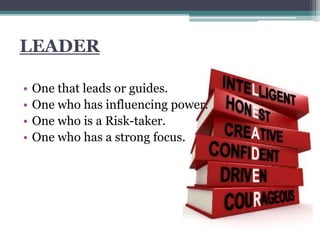
LEADER
• One that leads or guides.
• One who has influencing power.
• One who is a Risk-taker.
• One who has a strong focus.
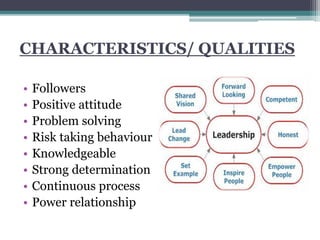
CHARACTERISTICS/ QUALITIES
• Followers
• Positive attitude
• Problem solving
• Risk taking behaviour
• Knowledgeable
• Strong determination
• Continuous process
• Power relationship
SIGNIFICANCE
• Goal- oriented
• Effective planning
• Motivating employees
• Building morale
• Creating confidence
• Developing team-work
• Co-ordination
• Initiates action
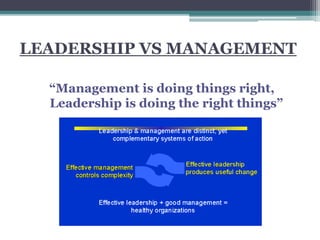
LEADERSHIP VS MANAGEMENT
“Management is doing things right,
Leadership is doing the right things”
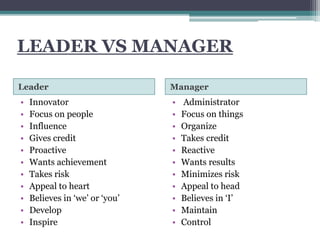
LEADER VS MANAGER
Leader Manager
• Innovator
• Focus on people
• Influence
• Gives credit
• Proactive
• Wants achievement
• Takes risk
• Appeal to heart
• Believes in ‘we’ or ‘you’
• Develop
• Inspire
• Administrator
• Focus on things
• Organize
• Takes credit
• Reactive
• Wants results
• Minimizes risk
• Appeal to head
• Believes in ‘I’
• Maintain
• Control
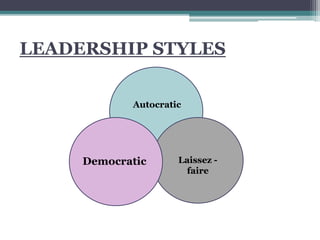
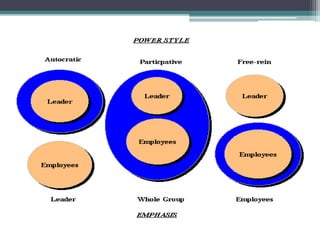
LEADERSHIP STYLES
Autocratic
Democratic Laissez -
faire
AUTOCRATIC/AUTHORITARIAN
STYLE
• This style is used when leaders tell their
employees what they want them to do, and how
they want it accomplished, without getting
the advice of their team.
• It can be used when:-
i. You have all the information to solve the
problem,
ii. You are short on time, and
iii. Your employees are well- motivated.
DEMOCRATIC/ PARTICIPATIVE
STYLE
• This style involves the leader including one or
more employees in the decision- making
process (determining what to do and how to do
it). However, the leader maintains the final
decision making authority.
• Consultative
• Persuasive
• Weakness in information
LAISSEZ-FAIRE or FREE REIGN
STYLE
• In this style, the leader allows the employees to
make the decisions. However, the leader is still
responsible for the decisions that are made .
• This style is used when you have full trust and
confidence in the employees. – positive
• This style is also used to blame others when
things go wrong. – negative
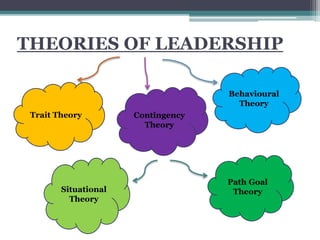
THEORIES OF LEADERSHIP
Behavioural
Theory
Trait Theory Contingency
Theory
Path Goal
TheorySituational
Theory
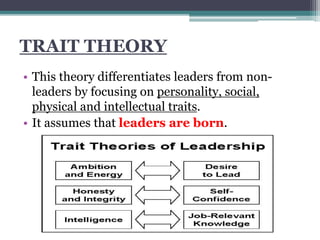
TRAIT THEORY
• This theory differentiates leaders from non-
leaders by focusing on personality, social,
physical and intellectual traits.
• It assumes that leaders are born.
BEHAVIOURAL THEORY
• This theory is based on the belief that great
leaders are made, not born.
• People can learn to become leaders through
teaching and observation.
• This approach says that anyone who adopts the
appropriate behaviour can be a good leader.
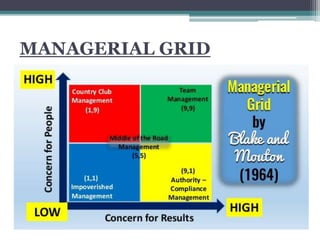
MANAGERIAL GRID
CONTINGENCY THEORY
• Single leadership style is not applicable to all
situations.
• There is no best way to lead, to make decisions,
to organize instead, the optimal course of action
is dependent upon the internal and external
situations.
• Theories of contingency theory:-
a) Fiedler’s contingency model
b) Situational theory
c) Path goal theory
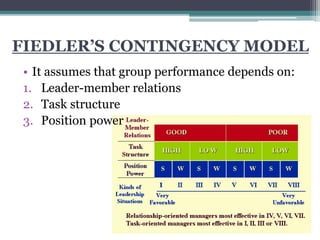
FIEDLER’S CONTINGENCY MODEL
• It assumes that group performance depends on:
1. Leader-member relations
2. Task structure
3. Position power
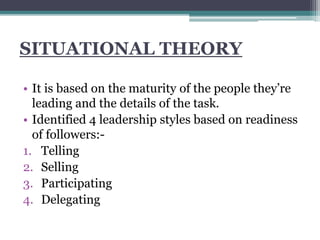
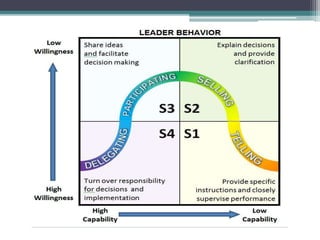
SITUATIONAL THEORY
• It is based on the maturity of the people they’re
leading and the details of the task.
• Identified 4 leadership styles based on readiness
of followers:-
1. Telling
2. Selling
3. Participating
4. Delegating
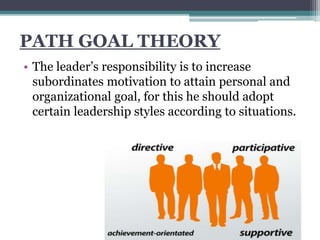
PATH GOAL THEORY
• The leader’s responsibility is to increase
subordinates motivation to attain personal and
organizational goal, for this he should adopt
certain leadership styles according to situations.
Leadership

Leadership

  • 1.
  • 2.
    INTRODUCTION  One ofthe important function of management.  Includes directing, influencing and motivating employees to perform.
  • 3.
    DEFINITION • “Leadership isthe ability of a superior to influence the behaviour of a subordinate or group and persuade them to follow a particular course of action.” - Chester Bernard • “Leadership is the lifting of a man’s vision to higher sights, the raising of a man’s performance to a higher standard, the building of a man’s personality beyond its normal limitations.” - Peter Drucker
  • 4.
    MEANING • The termLeadership means to lead people. • It refers to the ability of one individual to influence others. • It is the art of motivating a group of people to act towards achieving a common objectives.
  • 5.
    LEADER • One thatleads or guides. • One who has influencing power. • One who is a Risk-taker. • One who has a strong focus.
  • 6.
    CHARACTERISTICS/ QUALITIES • Followers •Positive attitude • Problem solving • Risk taking behaviour • Knowledgeable • Strong determination • Continuous process • Power relationship
  • 7.
    SIGNIFICANCE • Goal- oriented •Effective planning • Motivating employees • Building morale • Creating confidence • Developing team-work • Co-ordination • Initiates action
  • 8.
    LEADERSHIP VS MANAGEMENT “Managementis doing things right, Leadership is doing the right things”
  • 9.
    LEADER VS MANAGER LeaderManager • Innovator • Focus on people • Influence • Gives credit • Proactive • Wants achievement • Takes risk • Appeal to heart • Believes in ‘we’ or ‘you’ • Develop • Inspire • Administrator • Focus on things • Organize • Takes credit • Reactive • Wants results • Minimizes risk • Appeal to head • Believes in ‘I’ • Maintain • Control
  • 10.
  • 12.
    AUTOCRATIC/AUTHORITARIAN STYLE • This styleis used when leaders tell their employees what they want them to do, and how they want it accomplished, without getting the advice of their team. • It can be used when:- i. You have all the information to solve the problem, ii. You are short on time, and iii. Your employees are well- motivated.
  • 13.
    DEMOCRATIC/ PARTICIPATIVE STYLE • Thisstyle involves the leader including one or more employees in the decision- making process (determining what to do and how to do it). However, the leader maintains the final decision making authority. • Consultative • Persuasive • Weakness in information
  • 14.
    LAISSEZ-FAIRE or FREEREIGN STYLE • In this style, the leader allows the employees to make the decisions. However, the leader is still responsible for the decisions that are made . • This style is used when you have full trust and confidence in the employees. – positive • This style is also used to blame others when things go wrong. – negative
  • 15.
    THEORIES OF LEADERSHIP Behavioural Theory TraitTheory Contingency Theory Path Goal TheorySituational Theory
  • 16.
    TRAIT THEORY • Thistheory differentiates leaders from non- leaders by focusing on personality, social, physical and intellectual traits. • It assumes that leaders are born.
  • 17.
    BEHAVIOURAL THEORY • Thistheory is based on the belief that great leaders are made, not born. • People can learn to become leaders through teaching and observation. • This approach says that anyone who adopts the appropriate behaviour can be a good leader.
  • 18.
  • 19.
    CONTINGENCY THEORY • Singleleadership style is not applicable to all situations. • There is no best way to lead, to make decisions, to organize instead, the optimal course of action is dependent upon the internal and external situations. • Theories of contingency theory:- a) Fiedler’s contingency model b) Situational theory c) Path goal theory
  • 20.
    FIEDLER’S CONTINGENCY MODEL •It assumes that group performance depends on: 1. Leader-member relations 2. Task structure 3. Position power
  • 21.
    SITUATIONAL THEORY • Itis based on the maturity of the people they’re leading and the details of the task. • Identified 4 leadership styles based on readiness of followers:- 1. Telling 2. Selling 3. Participating 4. Delegating
  • 23.
    PATH GOAL THEORY •The leader’s responsibility is to increase subordinates motivation to attain personal and organizational goal, for this he should adopt certain leadership styles according to situations.