Leading with Influence
Learning Outcomes State the differences among trait, behavioral, and situational leadership theorists. Explain why the terms  manager  and  leader  are not interchangeable. Describe leadership trait theory, and identify Ghiselli’s six significant leadership traits. Discuss the major similarity and difference between two-dimensional leadership styles and the Leadership Grid ® . Identify the management levels at which charismatic, transformational, transactional, symbolic, and servant leadership styles are most appropriate. After studying this chapter, you should be able to:
Learning Outcomes (cont’d) State the primary difference between the contingency leadership model and other situational approaches to leadership. Discuss the major criticism of both the leadership continuum model and the path-goal leadership model. Describe the major characteristic of the normative leadership model. Define the key terms listed at the end of the chapter. After studying this chapter, you should be able to:
IDEAS ON MANAGEMENT  at American Express What leadership traits does Ken Chenault have? Which behavioral leadership styles does Ken Chenault use? Is Ken Chenault a charismatic, transformational, symbolic, and/or servant leader? Which situational leadership styles does Ken Chenault use? Is handling complaints important at American Express?
Leadership Leadership The process of influencing employees to work toward the achievement of organizational objectives. Leadership versus Management Leadership is a functional activity incorporated within the broader scope of management activities. Managers lacking the ability to influence others are not true leaders.
Leadership Trait Theory Leadership Trait Theorists Attempt to determine a list of distinctive characteristics that account for leadership effectiveness. Have been unsuccessful in identifying a universal set of traits that all leaders possess. The Ghiselli Study (1971) Concluded that certain traits are important to effective leadership: supervisory ability, need for occupational achievement, intelligence, decisiveness, self-assurance, and initiative.
Behavioral Leadership Theories Behavioral Leadership Theorists Early researchers who attempted to identify the “best leadership style” for all situations. Attempted to determine distinctive styles used by effective leaders. Also focused on the relationship between leaders and followers. Leadership Style The combination of traits, skills, and behaviors managers use in interacting with employees.
Join the Discussion Ethics & Social Responsibility   Dilbert Do you agree with Scott Adams that leadership is basically manipulation? Do we really need leaders? Is it ethical and socially responsible to make fun of CEOs?
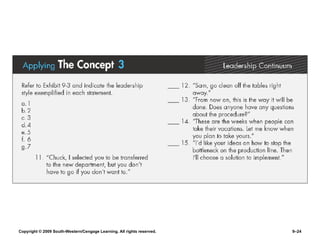
Basic Leadership Styles Autocratic Leader One who makes all the decisions, tells employees what to do, and closely supervises employees. Considered a Theory X-type leader. Democratic Leader One who encourages employee participation in decisions, works with employees to determine what to do, and does not closely supervise employees. Considered a Theory Y-type leader.
Basic Leadership Styles (cont’d) Laissez-Faire Leader One who takes a leave-employees-alone approach, allowing them to make the decisions and decide what to do, and does not follow up.
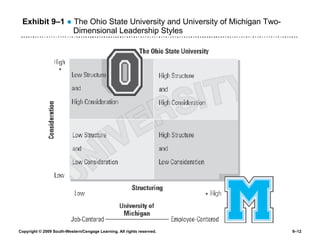
Two-Dimensional Leadership Styles Two-Dimensional Leadership Styles Based on job structure and employee consideration, which result in four possible leadership styles. The Ohio State University Structuring The extent to which the leader takes charge to plan, organize, lead, and control as the employee performs the task. Consideration The extent to which the leader communicates to develop trust, friendship, support, and respect. University of Michigan Job-centered Analogous to structuring. Employee-centered Analogous to consideration.
Exhibit 9 – 1   ●  The Ohio State University and University of Michigan Two-Dimensional Leadership Styles
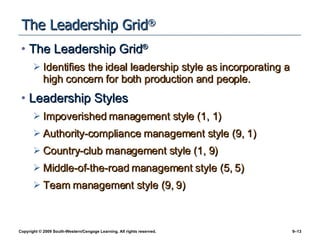
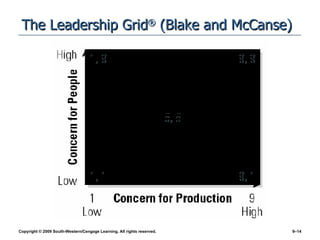
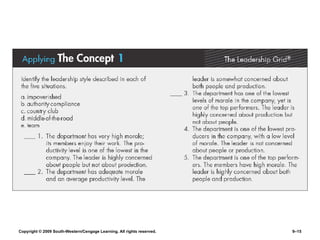
The Leadership Grid ® The Leadership Grid ® Identifies the ideal leadership style as incorporating a high concern for both production and people. Leadership Styles Impoverished management style (1, 1) Authority-compliance management style (9, 1) Country-club management style (1, 9) Middle-of-the-road management style (5, 5) Team management style (9, 9)
The Leadership Grid ®  (Blake and McCanse)
 
Contemporary Perspectives Charismatic Leadership A leadership style that inspires loyalty, enthusiasm, and high levels of performance. Transformational Leadership A leadership style that brings about continuous learning, innovation, and change. Transactional Leadership A leadership style based on exchange.
Contemporary Perspectives (cont’d) Symbolic Leadership A leadership style based on establishing and maintaining a strong organizational culture. Servant Leadership A leadership style based on simultaneously meeting the needs and goals of employees and the goals of the organization. Focuses on motivating employees by meeting their higher-level needs. Motivates employees to go beyond role requirements and do what it takes to attain the goals of the organization.
Situational Approaches to Leadership Situational Leadership Theorists Attempt to determine the appropriate leadership style for various situations. Contingency leadership model Leadership continuum model Path-goal model Normative leadership theory Situational Leadership ®  model Leadership substitutes and neutralizers “Should the leader change his/her style or should the situation be changed to fit the leader’s style?”
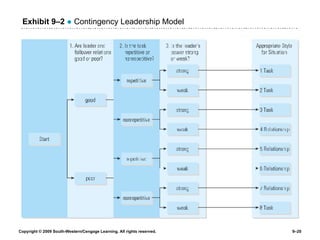
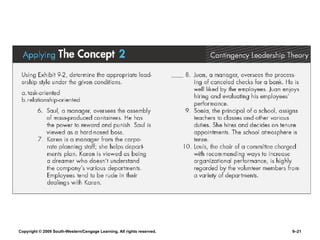
Contingency Leadership Model Contingency Leadership Model (Fiedler) Used to determine if one’s leadership style is task- or relationship-oriented and if the situation matches the leader’s style. Leadership style The Least Preferred Coworker (LPC) scale measures a leader’s task (job) or relationship (employee) orientation. Situational favorableness Leader-follower relations (good or poor?) Task structure (structured or unstructured?) Position power (strong or weak?)
Exhibit 9 –2   ●  Contingency Leadership Model
 
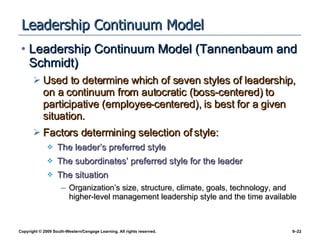
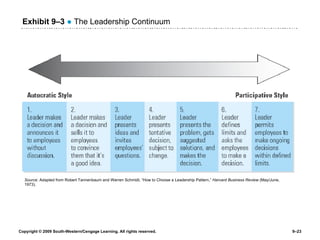
Leadership Continuum Model Leadership Continuum Model (Tannenbaum and Schmidt) Used to determine which of seven styles of leadership, on a continuum from autocratic (boss-centered) to participative (employee-centered), is best for a given situation. Factors determining selection of style: The leader’s preferred style The subordinates’ preferred style for the leader The situation Organization’s size, structure, climate, goals, technology, and higher-level management leadership style and the time available
Exhibit 9 –3   ●  The Leadership Continuum Source : Adapted from Robert Tannenbaum and Warren Schmidt, “How to Choose a Leadership Pattern,”  Harvard Business Review  (May/June, 1973).
 
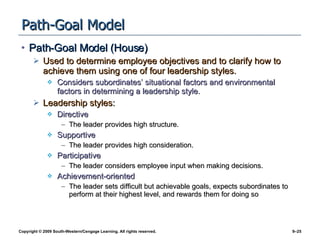
Path-Goal Model Path-Goal Model (House) Used to determine employee objectives and to clarify how to achieve them using one of four leadership styles. Considers subordinates’ situational factors and environmental factors in determining a leadership style. Leadership styles: Directive The leader provides high structure. Supportive The leader provides high consideration. Participative The leader considers employee input when making decisions. Achievement-oriented The leader sets difficult but achievable goals, expects subordinates to perform at their highest level, and rewards them for doing so
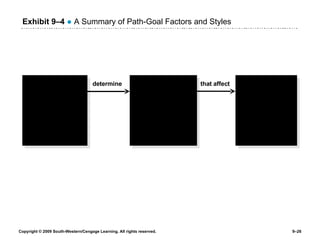
Exhibit 9 –4   ●  A Summary of Path-Goal Factors and Styles Situational Factors Subordinate authoritarianism locus of control ability Environmental task structure formal authority work group Goal Achievement Performance Satisfaction Leadership Styles Directive Supportive Participative Achievement-oriented determine that affect
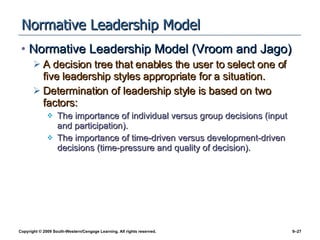
Normative Leadership Model Normative Leadership Model (Vroom and Jago) A decision tree that enables the user to select one of five leadership styles appropriate for a situation. Determination of leadership style is based on two factors: The importance of individual versus group decisions (input and participation). The importance of time-driven versus development-driven decisions (time-pressure and quality of decision).
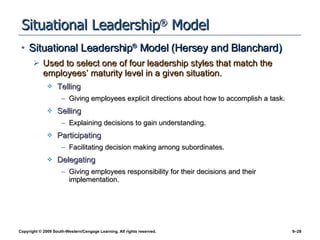
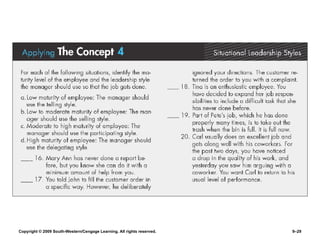
Situational Leadership ®  Model Situational Leadership ®  Model (Hersey and Blanchard) Used to select one of four leadership styles that match the employees’ maturity level in a given situation. Telling Giving employees explicit directions about how to accomplish a task. Selling Explaining decisions to gain understanding. Participating Facilitating decision making among subordinates. Delegating Giving employees responsibility for their decisions and their implementation.
 
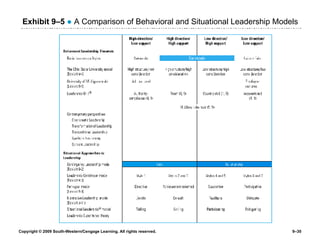
Exhibit 9 –5   ●  A Comparison of Behavioral and Situational Leadership Models
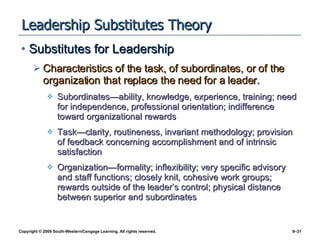
Leadership Substitutes Theory Substitutes for Leadership Characteristics of the task, of subordinates, or of the organization that replace the need for a leader. Subordinates—ability, knowledge, experience, training; need for independence, professional orientation; indifference toward organizational rewards Task—clarity, routineness, invariant methodology; provision of feedback concerning accomplishment and of intrinsic satisfaction Organization—formality; inflexibility; very specific advisory and staff functions; closely knit, cohesive work groups; rewards outside of the leader’s control; physical distance between superior and subordinates
Join the Discussion Ethics & Social Responsibility   Leadership and Gender Is it ethical and socially responsible to say that people of a particular gender make better leaders? Do you think men and women lead in the same way, or not? Are men or women more ethical and socially responsible as leaders? Would you prefer to have a man or a woman  as boss?
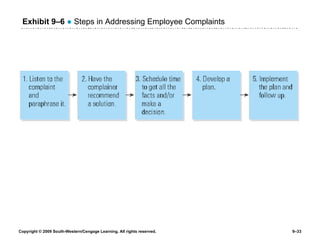
Exhibit 9 –6   ●  Steps in Addressing Employee Complaints
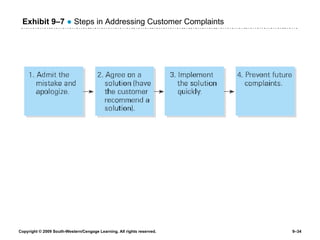
Exhibit 9 –7   ●  Steps in Addressing Customer Complaints
KEY TERMS leadership leadership trait theorists behavioral leadership theorists leadership style two-dimensional leadership styles Leadership Grid ® charismatic leadership transformational leadership transactional leadership symbolic leadership servant leadership situational approaches to leadership contingency leadership model leadership continuum model path-goal model Situational Leadership ®  model substitutes for leadership complaint

Chapter 9 - Leading with Influence

  • 1.
  • 2.
    Learning Outcomes Statethe differences among trait, behavioral, and situational leadership theorists. Explain why the terms manager and leader are not interchangeable. Describe leadership trait theory, and identify Ghiselli’s six significant leadership traits. Discuss the major similarity and difference between two-dimensional leadership styles and the Leadership Grid ® . Identify the management levels at which charismatic, transformational, transactional, symbolic, and servant leadership styles are most appropriate. After studying this chapter, you should be able to:
  • 3.
    Learning Outcomes (cont’d)State the primary difference between the contingency leadership model and other situational approaches to leadership. Discuss the major criticism of both the leadership continuum model and the path-goal leadership model. Describe the major characteristic of the normative leadership model. Define the key terms listed at the end of the chapter. After studying this chapter, you should be able to:
  • 4.
    IDEAS ON MANAGEMENT at American Express What leadership traits does Ken Chenault have? Which behavioral leadership styles does Ken Chenault use? Is Ken Chenault a charismatic, transformational, symbolic, and/or servant leader? Which situational leadership styles does Ken Chenault use? Is handling complaints important at American Express?
  • 5.
    Leadership Leadership Theprocess of influencing employees to work toward the achievement of organizational objectives. Leadership versus Management Leadership is a functional activity incorporated within the broader scope of management activities. Managers lacking the ability to influence others are not true leaders.
  • 6.
    Leadership Trait TheoryLeadership Trait Theorists Attempt to determine a list of distinctive characteristics that account for leadership effectiveness. Have been unsuccessful in identifying a universal set of traits that all leaders possess. The Ghiselli Study (1971) Concluded that certain traits are important to effective leadership: supervisory ability, need for occupational achievement, intelligence, decisiveness, self-assurance, and initiative.
  • 7.
    Behavioral Leadership TheoriesBehavioral Leadership Theorists Early researchers who attempted to identify the “best leadership style” for all situations. Attempted to determine distinctive styles used by effective leaders. Also focused on the relationship between leaders and followers. Leadership Style The combination of traits, skills, and behaviors managers use in interacting with employees.
  • 8.
    Join the DiscussionEthics & Social Responsibility Dilbert Do you agree with Scott Adams that leadership is basically manipulation? Do we really need leaders? Is it ethical and socially responsible to make fun of CEOs?
  • 9.
    Basic Leadership StylesAutocratic Leader One who makes all the decisions, tells employees what to do, and closely supervises employees. Considered a Theory X-type leader. Democratic Leader One who encourages employee participation in decisions, works with employees to determine what to do, and does not closely supervise employees. Considered a Theory Y-type leader.
  • 10.
    Basic Leadership Styles(cont’d) Laissez-Faire Leader One who takes a leave-employees-alone approach, allowing them to make the decisions and decide what to do, and does not follow up.
  • 11.
    Two-Dimensional Leadership StylesTwo-Dimensional Leadership Styles Based on job structure and employee consideration, which result in four possible leadership styles. The Ohio State University Structuring The extent to which the leader takes charge to plan, organize, lead, and control as the employee performs the task. Consideration The extent to which the leader communicates to develop trust, friendship, support, and respect. University of Michigan Job-centered Analogous to structuring. Employee-centered Analogous to consideration.
  • 12.
    Exhibit 9 –1 ● The Ohio State University and University of Michigan Two-Dimensional Leadership Styles
  • 13.
    The Leadership Grid® The Leadership Grid ® Identifies the ideal leadership style as incorporating a high concern for both production and people. Leadership Styles Impoverished management style (1, 1) Authority-compliance management style (9, 1) Country-club management style (1, 9) Middle-of-the-road management style (5, 5) Team management style (9, 9)
  • 14.
    The Leadership Grid® (Blake and McCanse)
  • 15.
  • 16.
    Contemporary Perspectives CharismaticLeadership A leadership style that inspires loyalty, enthusiasm, and high levels of performance. Transformational Leadership A leadership style that brings about continuous learning, innovation, and change. Transactional Leadership A leadership style based on exchange.
  • 17.
    Contemporary Perspectives (cont’d)Symbolic Leadership A leadership style based on establishing and maintaining a strong organizational culture. Servant Leadership A leadership style based on simultaneously meeting the needs and goals of employees and the goals of the organization. Focuses on motivating employees by meeting their higher-level needs. Motivates employees to go beyond role requirements and do what it takes to attain the goals of the organization.
  • 18.
    Situational Approaches toLeadership Situational Leadership Theorists Attempt to determine the appropriate leadership style for various situations. Contingency leadership model Leadership continuum model Path-goal model Normative leadership theory Situational Leadership ® model Leadership substitutes and neutralizers “Should the leader change his/her style or should the situation be changed to fit the leader’s style?”
  • 19.
    Contingency Leadership ModelContingency Leadership Model (Fiedler) Used to determine if one’s leadership style is task- or relationship-oriented and if the situation matches the leader’s style. Leadership style The Least Preferred Coworker (LPC) scale measures a leader’s task (job) or relationship (employee) orientation. Situational favorableness Leader-follower relations (good or poor?) Task structure (structured or unstructured?) Position power (strong or weak?)
  • 20.
    Exhibit 9 –2 ● Contingency Leadership Model
  • 21.
  • 22.
    Leadership Continuum ModelLeadership Continuum Model (Tannenbaum and Schmidt) Used to determine which of seven styles of leadership, on a continuum from autocratic (boss-centered) to participative (employee-centered), is best for a given situation. Factors determining selection of style: The leader’s preferred style The subordinates’ preferred style for the leader The situation Organization’s size, structure, climate, goals, technology, and higher-level management leadership style and the time available
  • 23.
    Exhibit 9 –3 ● The Leadership Continuum Source : Adapted from Robert Tannenbaum and Warren Schmidt, “How to Choose a Leadership Pattern,” Harvard Business Review (May/June, 1973).
  • 24.
  • 25.
    Path-Goal Model Path-GoalModel (House) Used to determine employee objectives and to clarify how to achieve them using one of four leadership styles. Considers subordinates’ situational factors and environmental factors in determining a leadership style. Leadership styles: Directive The leader provides high structure. Supportive The leader provides high consideration. Participative The leader considers employee input when making decisions. Achievement-oriented The leader sets difficult but achievable goals, expects subordinates to perform at their highest level, and rewards them for doing so
  • 26.
    Exhibit 9 –4 ● A Summary of Path-Goal Factors and Styles Situational Factors Subordinate authoritarianism locus of control ability Environmental task structure formal authority work group Goal Achievement Performance Satisfaction Leadership Styles Directive Supportive Participative Achievement-oriented determine that affect
  • 27.
    Normative Leadership ModelNormative Leadership Model (Vroom and Jago) A decision tree that enables the user to select one of five leadership styles appropriate for a situation. Determination of leadership style is based on two factors: The importance of individual versus group decisions (input and participation). The importance of time-driven versus development-driven decisions (time-pressure and quality of decision).
  • 28.
    Situational Leadership ® Model Situational Leadership ® Model (Hersey and Blanchard) Used to select one of four leadership styles that match the employees’ maturity level in a given situation. Telling Giving employees explicit directions about how to accomplish a task. Selling Explaining decisions to gain understanding. Participating Facilitating decision making among subordinates. Delegating Giving employees responsibility for their decisions and their implementation.
  • 29.
  • 30.
    Exhibit 9 –5 ● A Comparison of Behavioral and Situational Leadership Models
  • 31.
    Leadership Substitutes TheorySubstitutes for Leadership Characteristics of the task, of subordinates, or of the organization that replace the need for a leader. Subordinates—ability, knowledge, experience, training; need for independence, professional orientation; indifference toward organizational rewards Task—clarity, routineness, invariant methodology; provision of feedback concerning accomplishment and of intrinsic satisfaction Organization—formality; inflexibility; very specific advisory and staff functions; closely knit, cohesive work groups; rewards outside of the leader’s control; physical distance between superior and subordinates
  • 32.
    Join the DiscussionEthics & Social Responsibility Leadership and Gender Is it ethical and socially responsible to say that people of a particular gender make better leaders? Do you think men and women lead in the same way, or not? Are men or women more ethical and socially responsible as leaders? Would you prefer to have a man or a woman as boss?
  • 33.
    Exhibit 9 –6 ● Steps in Addressing Employee Complaints
  • 34.
    Exhibit 9 –7 ● Steps in Addressing Customer Complaints
  • 35.
    KEY TERMS leadershipleadership trait theorists behavioral leadership theorists leadership style two-dimensional leadership styles Leadership Grid ® charismatic leadership transformational leadership transactional leadership symbolic leadership servant leadership situational approaches to leadership contingency leadership model leadership continuum model path-goal model Situational Leadership ® model substitutes for leadership complaint