Introduction
Laplace Transforms
Math 337 - Elementary Differential Equations
Lecture Notes – Laplace Transforms: Part A
Joseph M. Mahaffy,
hmahaffy@math.sdsu.edui
Department of Mathematics and Statistics
Dynamical Systems Group
Computational Sciences Research Center
San Diego State University
San Diego, CA 92182-7720
http://www-rohan.sdsu.edu/∼jmahaffy
Spring 2020
Joseph M. Mahaffy, hmahaffy@math.sdsu.edui
Lecture Notes – Laplace Transforms: Part A
— (1/26)
Introduction
Laplace Transforms
Outline
1 Introduction
Background
2 Laplace Transforms
Short Table of Laplace Transforms
Properties of Laplace Transform
Laplace Transform of Derivatives
Joseph M. Mahaffy, hmahaffy@math.sdsu.edui
Lecture Notes – Laplace Transforms: Part A
— (2/26)
Introduction
Laplace Transforms
Background
Integral Transforms
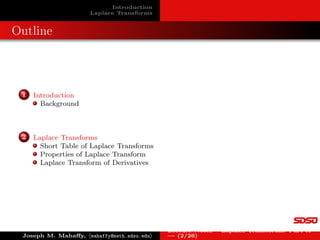
Integral Transform: This is a relation
F(s) =
Z β
α
K(t, s)f(t)dt,
which takes a given function f(t) and outputs another function F(s)
The function K(t, s) is the integral kernel of the transform, and the
function F(s) is the transform of f(t)
Integral Transforms allow one to find solutions of problems
(usually involving differentiation) through algebraic methods
Properties of the Integral Transform allow manipulation of
the function in the transformed to an easier expression, which
can be inverted to find a solution
Joseph M. Mahaffy, hmahaffy@math.sdsu.edui
Lecture Notes – Laplace Transforms: Part A
— (3/26)
Introduction
Laplace Transforms
Background
Integral Transforms
Integral Transforms
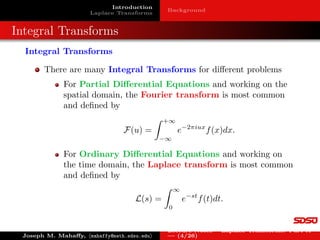
There are many Integral Transforms for different problems
For Partial Differential Equations and working on the
spatial domain, the Fourier transform is most common
and defined by
F(u) =
Z +∞
−∞
e−2πiux
f(x)dx.
For Ordinary Differential Equations and working on
the time domain, the Laplace transform is most common
and defined by
L(s) =
Z ∞
0
e−st
f(t)dt.
Joseph M. Mahaffy, hmahaffy@math.sdsu.edui
Lecture Notes – Laplace Transforms: Part A
— (4/26)
Introduction
Laplace Transforms
Background
Laplace Transforms
Time Domain
Laplace Domain or
Complex Frequency Domain
Linear
Differential
Equation
Laplace
Transformed
Equation
Time
Domain
Solution
Laplace
Solution
Algebra
Laplace Transform
Inverse Laplace
Transform
Laplace Transforms
Joseph M. Mahaffy, hmahaffy@math.sdsu.edui
Lecture Notes – Laplace Transforms: Part A
— (5/26)
Introduction
Laplace Transforms
Background
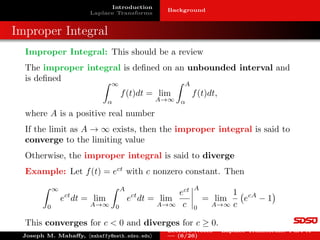
Improper Integral
Improper Integral: This should be a review
The improper integral is defined on an unbounded interval and
is defined Z ∞
α
f(t)dt = lim
A→∞
Z A
α
f(t)dt,
where A is a positive real number
If the limit as A → ∞ exists, then the improper integral is said to
converge to the limiting value
Otherwise, the improper integral is said to diverge
Example: Let f(t) = ect
with c nonzero constant. Then
Z ∞
0
ect
dt = lim
A→∞
Z A
0
ect
dt = lim
A→∞
ect
c
A
0
= lim
A→∞
1
c
ecA
− 1

This converges for c  0 and diverges for c ≥ 0.
Joseph M. Mahaffy, hmahaffy@math.sdsu.edui
Lecture Notes – Laplace Transforms: Part A
— (6/26)
Introduction
Laplace Transforms
Short Table of Laplace Transforms
Properties of Laplace Transform
Laplace Transform of Derivatives
Laplace Transform
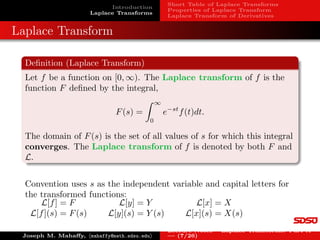
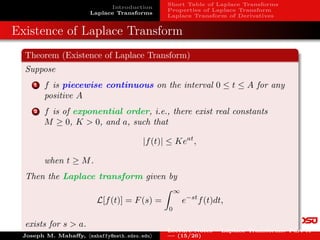
Definition (Laplace Transform)
Let f be a function on [0, ∞). The Laplace transform of f is the
function F defined by the integral,
F(s) =
Z ∞
0
e−st
f(t)dt.
The domain of F(s) is the set of all values of s for which this integral
converges. The Laplace transform of f is denoted by both F and
L.
Convention uses s as the independent variable and capital letters for
the transformed functions:
L[f] = F L[y] = Y L[x] = X
L[f](s) = F(s) L[y](s) = Y (s) L[x](s) = X(s)
Joseph M. Mahaffy, hmahaffy@math.sdsu.edui
Lecture Notes – Laplace Transforms: Part A
— (7/26)
Introduction
Laplace Transforms
Short Table of Laplace Transforms
Properties of Laplace Transform
Laplace Transform of Derivatives
Examples: Laplace Transform
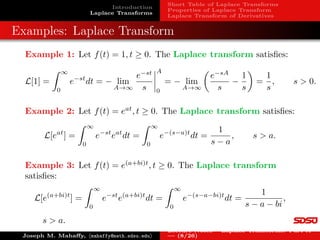
Example 1: Let f(t) = 1, t ≥ 0. The Laplace transform satisfies:
L[1] =
Z ∞
0
e−st
dt = − lim
A→∞
e−st
s
A
0
= − lim
A→∞

e−sA
s
−
1
s

=
1
s
, s  0.
Example 2: Let f(t) = eat
, t ≥ 0. The Laplace transform satisfies:
L[eat
] =
Z ∞
0
e−st
eat
dt =
Z ∞
0
e−(s−a)t
dt =
1
s − a
, s  a.
Example 3: Let f(t) = e(a+bi)t
, t ≥ 0. The Laplace transform
satisfies:
L[e(a+bi)t
] =
Z ∞
0
e−st
e(a+bi)t
dt =
Z ∞
0
e−(s−a−bi)t
dt =
1
s − a − bi
,
s  a.
Joseph M. Mahaffy, hmahaffy@math.sdsu.edui
Lecture Notes – Laplace Transforms: Part A
— (8/26)
Introduction
Laplace Transforms
Short Table of Laplace Transforms
Properties of Laplace Transform
Laplace Transform of Derivatives
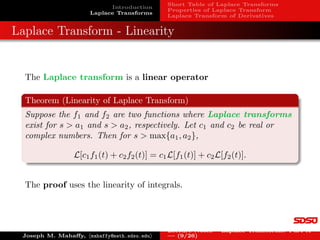
Laplace Transform - Linearity
The Laplace transform is a linear operator
Theorem (Linearity of Laplace Transform)
Suppose the f1 and f2 are two functions where Laplace transforms
exist for s  a1 and s  a2, respectively. Let c1 and c2 be real or
complex numbers. Then for s  max{a1, a2},
L[c1f1(t) + c2f2(t)] = c1L[f1(t)] + c2L[f2(t)].
The proof uses the linearity of integrals.
Joseph M. Mahaffy, hmahaffy@math.sdsu.edui
Lecture Notes – Laplace Transforms: Part A
— (9/26)
Introduction
Laplace Transforms
Short Table of Laplace Transforms
Properties of Laplace Transform
Laplace Transform of Derivatives
Examples: Laplace Transform
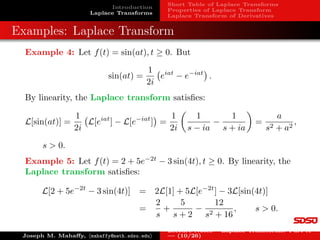
Example 4: Let f(t) = sin(at), t ≥ 0. But
sin(at) =
1
2i
eiat
− e−iat

.
By linearity, the Laplace transform satisfies:
L[sin(at)] =
1
2i
L[eiat
] − L[e−iat
]

=
1
2i

1
s − ia
−
1
s + ia

=
a
s2 + a2
,
s  0.
Example 5: Let f(t) = 2 + 5e−2t
− 3 sin(4t), t ≥ 0. By linearity, the
Laplace transform satisfies:
L[2 + 5e−2t
− 3 sin(4t)] = 2L[1] + 5L[e−2t
] − 3L[sin(4t)]
=
2
s
+
5
s + 2
−
12
s2 + 16
, s  0.
Joseph M. Mahaffy, hmahaffy@math.sdsu.edui
Lecture Notes – Laplace Transforms: Part A
— (10/26)
Introduction
Laplace Transforms
Short Table of Laplace Transforms
Properties of Laplace Transform
Laplace Transform of Derivatives
Examples: Laplace Transform
Example 6: Let f(t) = t cos(at), t ≥ 0. The Laplace transform
satisfies:
L[t cos(at)] =
Z ∞
0
e−st
t cos(at)dt =
1
2
Z ∞
0

te−(s−ia)t
+ te−(s+ia)t

dt.
Integration by parts gives
Z ∞
0
te−(s−ia)t
dt =

te−(s−ia)t
s − ia
+
e−(s−ia)t
(s − ia)2
∞
0
=
1
(s − ia)2
, s  0.
Similarly, Z ∞
0
te−(s+ia)t
dt =
1
(s + ia)2
, s  0.
Thus,
L[t cos(at)] =
1
2

1
(s − ia)2
+
1
(s + ia)2

=
s2
− a2
(s2 + a2)2
, s  0.
Joseph M. Mahaffy, hmahaffy@math.sdsu.edui
Lecture Notes – Laplace Transforms: Part A
— (11/26)
Introduction
Laplace Transforms
Short Table of Laplace Transforms
Properties of Laplace Transform
Laplace Transform of Derivatives
Piecewise Continuous Functions
Definition (Piecewise Continuous)
A function f is said to be a piecewise continuous on an interval
α ≤ t ≤ β if the interval can be partitioned by a finite number of
points α = t0  t1  ...  tn = β so that:
1 f is continuous on each subinterval ti−1  t  ti, and
2 f approaches a finite limit as the endpoints of each subinterval
are approached from within the subinterval.
α β
t1 t2
t
y
The figure to the right shows the
graph of a piecewise continuous
function defined for t ∈ [α, β)
with jump discontinuities at
t = t1 and t2.
It is continuous on the subintervals
(α, t1), (t1, t2), and (t2, β).
Joseph M. Mahaffy, hmahaffy@math.sdsu.edui
Lecture Notes – Laplace Transforms: Part A
— (12/26)
Introduction
Laplace Transforms
Short Table of Laplace Transforms
Properties of Laplace Transform
Laplace Transform of Derivatives
Examples: Laplace Transform
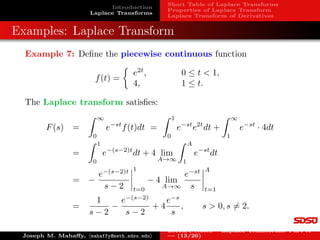
Example 7: Define the piecewise continuous function
f(t) =

e2t
, 0 ≤ t  1,
4, 1 ≤ t.
The Laplace transform satisfies:
F(s) =
Z ∞
0
e−st
f(t)dt =
Z 1
0
e−st
e2t
dt +
Z ∞
1
e−st
· 4dt
=
Z 1
0
e−(s−2)t
dt + 4 lim
A→∞
Z A
1
e−st
dt
= −
e−(s−2)t
s − 2
1
t=0
− 4 lim
A→∞
e−st
s

LaplaceA ppt.pdf

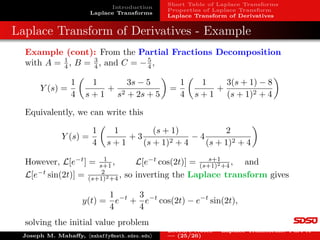
  • 1.
    Introduction Laplace Transforms Math 337- Elementary Differential Equations Lecture Notes – Laplace Transforms: Part A Joseph M. Mahaffy, hmahaffy@math.sdsu.edui Department of Mathematics and Statistics Dynamical Systems Group Computational Sciences Research Center San Diego State University San Diego, CA 92182-7720 http://www-rohan.sdsu.edu/∼jmahaffy Spring 2020 Joseph M. Mahaffy, hmahaffy@math.sdsu.edui Lecture Notes – Laplace Transforms: Part A — (1/26)
  • 2.
    Introduction Laplace Transforms Outline 1 Introduction Background 2Laplace Transforms Short Table of Laplace Transforms Properties of Laplace Transform Laplace Transform of Derivatives Joseph M. Mahaffy, hmahaffy@math.sdsu.edui Lecture Notes – Laplace Transforms: Part A — (2/26)
  • 3.
    Introduction Laplace Transforms Background Integral Transforms IntegralTransform: This is a relation F(s) = Z β α K(t, s)f(t)dt, which takes a given function f(t) and outputs another function F(s) The function K(t, s) is the integral kernel of the transform, and the function F(s) is the transform of f(t) Integral Transforms allow one to find solutions of problems (usually involving differentiation) through algebraic methods Properties of the Integral Transform allow manipulation of the function in the transformed to an easier expression, which can be inverted to find a solution Joseph M. Mahaffy, hmahaffy@math.sdsu.edui Lecture Notes – Laplace Transforms: Part A — (3/26)
  • 4.
    Introduction Laplace Transforms Background Integral Transforms IntegralTransforms There are many Integral Transforms for different problems For Partial Differential Equations and working on the spatial domain, the Fourier transform is most common and defined by F(u) = Z +∞ −∞ e−2πiux f(x)dx. For Ordinary Differential Equations and working on the time domain, the Laplace transform is most common and defined by L(s) = Z ∞ 0 e−st f(t)dt. Joseph M. Mahaffy, hmahaffy@math.sdsu.edui Lecture Notes – Laplace Transforms: Part A — (4/26)
  • 5.
    Introduction Laplace Transforms Background Laplace Transforms TimeDomain Laplace Domain or Complex Frequency Domain Linear Differential Equation Laplace Transformed Equation Time Domain Solution Laplace Solution Algebra Laplace Transform Inverse Laplace Transform Laplace Transforms Joseph M. Mahaffy, hmahaffy@math.sdsu.edui Lecture Notes – Laplace Transforms: Part A — (5/26)
  • 6.
    Introduction Laplace Transforms Background Improper Integral ImproperIntegral: This should be a review The improper integral is defined on an unbounded interval and is defined Z ∞ α f(t)dt = lim A→∞ Z A α f(t)dt, where A is a positive real number If the limit as A → ∞ exists, then the improper integral is said to converge to the limiting value Otherwise, the improper integral is said to diverge Example: Let f(t) = ect with c nonzero constant. Then Z ∞ 0 ect dt = lim A→∞ Z A 0 ect dt = lim A→∞ ect c
  • 10.
    A 0 = lim A→∞ 1 c ecA − 1 Thisconverges for c 0 and diverges for c ≥ 0. Joseph M. Mahaffy, hmahaffy@math.sdsu.edui Lecture Notes – Laplace Transforms: Part A — (6/26)
  • 11.
    Introduction Laplace Transforms Short Tableof Laplace Transforms Properties of Laplace Transform Laplace Transform of Derivatives Laplace Transform Definition (Laplace Transform) Let f be a function on [0, ∞). The Laplace transform of f is the function F defined by the integral, F(s) = Z ∞ 0 e−st f(t)dt. The domain of F(s) is the set of all values of s for which this integral converges. The Laplace transform of f is denoted by both F and L. Convention uses s as the independent variable and capital letters for the transformed functions: L[f] = F L[y] = Y L[x] = X L[f](s) = F(s) L[y](s) = Y (s) L[x](s) = X(s) Joseph M. Mahaffy, hmahaffy@math.sdsu.edui Lecture Notes – Laplace Transforms: Part A — (7/26)
  • 12.
    Introduction Laplace Transforms Short Tableof Laplace Transforms Properties of Laplace Transform Laplace Transform of Derivatives Examples: Laplace Transform Example 1: Let f(t) = 1, t ≥ 0. The Laplace transform satisfies: L[1] = Z ∞ 0 e−st dt = − lim A→∞ e−st s
  • 16.
    A 0 = − lim A→∞ e−sA s − 1 s = 1 s ,s 0. Example 2: Let f(t) = eat , t ≥ 0. The Laplace transform satisfies: L[eat ] = Z ∞ 0 e−st eat dt = Z ∞ 0 e−(s−a)t dt = 1 s − a , s a. Example 3: Let f(t) = e(a+bi)t , t ≥ 0. The Laplace transform satisfies: L[e(a+bi)t ] = Z ∞ 0 e−st e(a+bi)t dt = Z ∞ 0 e−(s−a−bi)t dt = 1 s − a − bi , s a. Joseph M. Mahaffy, hmahaffy@math.sdsu.edui Lecture Notes – Laplace Transforms: Part A — (8/26)
  • 17.
    Introduction Laplace Transforms Short Tableof Laplace Transforms Properties of Laplace Transform Laplace Transform of Derivatives Laplace Transform - Linearity The Laplace transform is a linear operator Theorem (Linearity of Laplace Transform) Suppose the f1 and f2 are two functions where Laplace transforms exist for s a1 and s a2, respectively. Let c1 and c2 be real or complex numbers. Then for s max{a1, a2}, L[c1f1(t) + c2f2(t)] = c1L[f1(t)] + c2L[f2(t)]. The proof uses the linearity of integrals. Joseph M. Mahaffy, hmahaffy@math.sdsu.edui Lecture Notes – Laplace Transforms: Part A — (9/26)
  • 18.
    Introduction Laplace Transforms Short Tableof Laplace Transforms Properties of Laplace Transform Laplace Transform of Derivatives Examples: Laplace Transform Example 4: Let f(t) = sin(at), t ≥ 0. But sin(at) = 1 2i eiat − e−iat . By linearity, the Laplace transform satisfies: L[sin(at)] = 1 2i L[eiat ] − L[e−iat ] = 1 2i 1 s − ia − 1 s + ia = a s2 + a2 , s 0. Example 5: Let f(t) = 2 + 5e−2t − 3 sin(4t), t ≥ 0. By linearity, the Laplace transform satisfies: L[2 + 5e−2t − 3 sin(4t)] = 2L[1] + 5L[e−2t ] − 3L[sin(4t)] = 2 s + 5 s + 2 − 12 s2 + 16 , s 0. Joseph M. Mahaffy, hmahaffy@math.sdsu.edui Lecture Notes – Laplace Transforms: Part A — (10/26)
  • 19.
    Introduction Laplace Transforms Short Tableof Laplace Transforms Properties of Laplace Transform Laplace Transform of Derivatives Examples: Laplace Transform Example 6: Let f(t) = t cos(at), t ≥ 0. The Laplace transform satisfies: L[t cos(at)] = Z ∞ 0 e−st t cos(at)dt = 1 2 Z ∞ 0 te−(s−ia)t + te−(s+ia)t dt. Integration by parts gives Z ∞ 0 te−(s−ia)t dt = te−(s−ia)t s − ia + e−(s−ia)t (s − ia)2 ∞ 0 = 1 (s − ia)2 , s 0. Similarly, Z ∞ 0 te−(s+ia)t dt = 1 (s + ia)2 , s 0. Thus, L[t cos(at)] = 1 2 1 (s − ia)2 + 1 (s + ia)2 = s2 − a2 (s2 + a2)2 , s 0. Joseph M. Mahaffy, hmahaffy@math.sdsu.edui Lecture Notes – Laplace Transforms: Part A — (11/26)
  • 20.
    Introduction Laplace Transforms Short Tableof Laplace Transforms Properties of Laplace Transform Laplace Transform of Derivatives Piecewise Continuous Functions Definition (Piecewise Continuous) A function f is said to be a piecewise continuous on an interval α ≤ t ≤ β if the interval can be partitioned by a finite number of points α = t0 t1 ... tn = β so that: 1 f is continuous on each subinterval ti−1 t ti, and 2 f approaches a finite limit as the endpoints of each subinterval are approached from within the subinterval. α β t1 t2 t y The figure to the right shows the graph of a piecewise continuous function defined for t ∈ [α, β) with jump discontinuities at t = t1 and t2. It is continuous on the subintervals (α, t1), (t1, t2), and (t2, β). Joseph M. Mahaffy, hmahaffy@math.sdsu.edui Lecture Notes – Laplace Transforms: Part A — (12/26)
  • 21.
    Introduction Laplace Transforms Short Tableof Laplace Transforms Properties of Laplace Transform Laplace Transform of Derivatives Examples: Laplace Transform Example 7: Define the piecewise continuous function f(t) = e2t , 0 ≤ t 1, 4, 1 ≤ t. The Laplace transform satisfies: F(s) = Z ∞ 0 e−st f(t)dt = Z 1 0 e−st e2t dt + Z ∞ 1 e−st · 4dt = Z 1 0 e−(s−2)t dt + 4 lim A→∞ Z A 1 e−st dt = − e−(s−2)t s − 2
  • 25.