LANGUAGE
TESTING
Collected BY
Ahmed Mohamed Ahmed Abbas
What is testing???
What is Testing?
 Definition: “A test is an activity whose main
purpose is to convey (usually to the tester) how
well the testee knows or can do something” (Ur
1996:33)
 Language Testing is the practice and study of
evaluating the proficiency of an individual in
using a particular language effectively.
LANGUAGE TESTING
The activity of developing and using language
tests. As a psychometric activity, language
testing traditionally was more concerned with
the production, development and analysis of
tests. Recent critical and ethical approaches
to language testing have placed more
emphasis on the uses of language tests. The
purpose of a language test is to determine a
person’s knowledge and/or ability in the
language and to discriminate that person’s
ability from that of others.
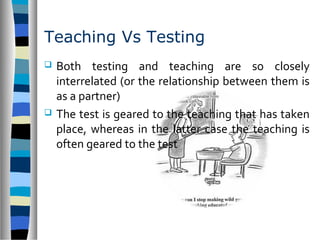
Teaching Vs Testing
 Both testing and teaching are so closely
interrelated (or the relationship between them is
as a partner)
 The test is geared to the teaching that has taken
place, whereas in the latter case the teaching is
often geared to the test
Functions of testing
 As devices to reinforce learning and to motivate
the student
 As a mean of assessing the student’s
performance in the language
 As information tool for teacher to know about
where the students are at the moment, to help
decide what to teach next
 As information for students to find about what
they know, so that they also have an awareness
of what they need to learn or review
 Diagnose students’ strengths and weaknesses,
to identify what they know and what they don’t
know
 Get students to make an effort (in doing the
test itself), which is likely to lead to better
results and a feeling of satisfaction
 Give students tasks which themselves may
actually provide useful review or practice, as
well as testing
 Provide students with a sense of achievement
and progress in their learning.
Effect of testing
The effect of testing on teaching and learning is
known as backwash. There are two different
backwashes in the test, they are:
 The test will cause harmful backwash if the test
content and testing techniques are at variance
with the objective of the course.
 It will have beneficial backwash If the result of the
test give an immediate effect on teaching (the
syllabus was redesigned, new books were
chosen, classes were conducted differently)
Testing and Assessment
Two types of assessment:
Formative
it’s assessment with the purpose to
check on students’ progress or to see
how far they have mastered what
should they learn.
Summative
it’s used at the end of the term,
semester or year in order to measure
what has been achieved by groups and
individuals
Types of tests
Five types of testing:
 Proficiency test
 Achievement test
 Diagnostic test
 Placement test
 Direct & indirect test
Proficiency test
 Proficiency tests are designed to measure
people’s ability in language, regardless any
training they may have in that language.
 The content of a proficiency test is not based on
the content of the objectives of language
courses. It’s based on a specification of what
candidates have to be able to do in the language
in order to be considered proficient.
Achievement test
 The content of the course in achievement tests
are directly related to language course.
 The purpose is being able to establish how
successful individual students, group 0f students
and the course in achieving the objectives.
 There are two kinds of achievement tests:
Final achievement test
Progress achievement test
Final achievement test:
 It’s administered at the end of a course of study
 The content of the test must be related to the
courses with which they are concerned, but the
nature of this relationship is a matter of
disagreement amongst language testers.
 In the view of some testers, the content of a final
achievement test should be based directly on a
detailed course syllabus or the books and other
materials used.
The disadvantages
 If the syllabus, the books and other materials are
badly designed, the result of a test can be very
misleading.
 Successful performance on the test may not truly
indicate successful achievement of course
objectives.
For example:
 A course may have an objective to develop
conversational abilities, but the course and the
test require students only to utter statements
about certain topics.
 A course may aim to develop a reading ability in
German, but the test limits to the vocabulary the
students have to meet.
Diagnostic Test
 It’s used to identify learners’ strength and
weaknesses.
 It’s intended primarily to ascertain what learning
still needs to take place.
Placement test
 It’s intended to provide information that
will help to place students at the stage of
the teaching programme most appropriate
to their abilities.
 Typically it’s used to assign students to
classes at different level.
Direct & Indirect Testing
 It’s said to be direct when it requires the
candidate to perform precisely the skill
that we wish to measure.
 Direct testing is easier to carry out when it
is intended to measure the productive skills
of speaking and writing.
Indirect testing
 It attempts to measure the abilities underlie the
skills in which we are interested.
 E.g. One section of TOEFL in writing section, it’s
developed as an indirect measure of writing
ability.
“at first the old woman seemed unwilling to
accept anything that was offered her by my
friend and I”
Thank you

Language testing

  • 1.
  • 2.
  • 3.
    What is Testing? Definition: “A test is an activity whose main purpose is to convey (usually to the tester) how well the testee knows or can do something” (Ur 1996:33)  Language Testing is the practice and study of evaluating the proficiency of an individual in using a particular language effectively.
  • 4.
    LANGUAGE TESTING The activityof developing and using language tests. As a psychometric activity, language testing traditionally was more concerned with the production, development and analysis of tests. Recent critical and ethical approaches to language testing have placed more emphasis on the uses of language tests. The purpose of a language test is to determine a person’s knowledge and/or ability in the language and to discriminate that person’s ability from that of others.
  • 5.
    Teaching Vs Testing Both testing and teaching are so closely interrelated (or the relationship between them is as a partner)  The test is geared to the teaching that has taken place, whereas in the latter case the teaching is often geared to the test
  • 6.
    Functions of testing As devices to reinforce learning and to motivate the student  As a mean of assessing the student’s performance in the language  As information tool for teacher to know about where the students are at the moment, to help decide what to teach next  As information for students to find about what they know, so that they also have an awareness of what they need to learn or review
  • 7.
     Diagnose students’strengths and weaknesses, to identify what they know and what they don’t know  Get students to make an effort (in doing the test itself), which is likely to lead to better results and a feeling of satisfaction  Give students tasks which themselves may actually provide useful review or practice, as well as testing  Provide students with a sense of achievement and progress in their learning.
  • 8.
    Effect of testing Theeffect of testing on teaching and learning is known as backwash. There are two different backwashes in the test, they are:  The test will cause harmful backwash if the test content and testing techniques are at variance with the objective of the course.  It will have beneficial backwash If the result of the test give an immediate effect on teaching (the syllabus was redesigned, new books were chosen, classes were conducted differently)
  • 9.
    Testing and Assessment Twotypes of assessment: Formative it’s assessment with the purpose to check on students’ progress or to see how far they have mastered what should they learn. Summative it’s used at the end of the term, semester or year in order to measure what has been achieved by groups and individuals
  • 10.
    Types of tests Fivetypes of testing:  Proficiency test  Achievement test  Diagnostic test  Placement test  Direct & indirect test
  • 11.
    Proficiency test  Proficiencytests are designed to measure people’s ability in language, regardless any training they may have in that language.  The content of a proficiency test is not based on the content of the objectives of language courses. It’s based on a specification of what candidates have to be able to do in the language in order to be considered proficient.
  • 12.
    Achievement test  Thecontent of the course in achievement tests are directly related to language course.  The purpose is being able to establish how successful individual students, group 0f students and the course in achieving the objectives.  There are two kinds of achievement tests: Final achievement test Progress achievement test
  • 13.
    Final achievement test: It’s administered at the end of a course of study  The content of the test must be related to the courses with which they are concerned, but the nature of this relationship is a matter of disagreement amongst language testers.  In the view of some testers, the content of a final achievement test should be based directly on a detailed course syllabus or the books and other materials used.
  • 14.
    The disadvantages  Ifthe syllabus, the books and other materials are badly designed, the result of a test can be very misleading.  Successful performance on the test may not truly indicate successful achievement of course objectives.
  • 15.
    For example:  Acourse may have an objective to develop conversational abilities, but the course and the test require students only to utter statements about certain topics.  A course may aim to develop a reading ability in German, but the test limits to the vocabulary the students have to meet.
  • 16.
    Diagnostic Test  It’sused to identify learners’ strength and weaknesses.  It’s intended primarily to ascertain what learning still needs to take place.
  • 17.
    Placement test  It’sintended to provide information that will help to place students at the stage of the teaching programme most appropriate to their abilities.  Typically it’s used to assign students to classes at different level.
  • 18.
    Direct & IndirectTesting  It’s said to be direct when it requires the candidate to perform precisely the skill that we wish to measure.  Direct testing is easier to carry out when it is intended to measure the productive skills of speaking and writing.
  • 19.
    Indirect testing  Itattempts to measure the abilities underlie the skills in which we are interested.  E.g. One section of TOEFL in writing section, it’s developed as an indirect measure of writing ability. “at first the old woman seemed unwilling to accept anything that was offered her by my friend and I”
  • 20.