 What is test?
 What is testing?
 What is the purpose of testing?
 The effect of testing
 Why are tests inaccurate?
 The need of testing
 What is to be done!
 A general definition:
“a procedure intended to establish the quality,
performance, or reliability of something,
especially before it is taken into widespread
use.”
A test or examination is an assessment intended
to measure a test-taker's knowledge, skill,
aptitude, physical fitness, or classification in
many other topics (e.g., beliefs). A test may be
administered orally, on paper, on a computer,
or in a confined area that requires a test taker
to physically perform a set of skills. Tests vary in
style, rigor and requirements
Testing is the practice of making
objective judgments regarding the
extent to which the
system (device) meets, exceeds or fails to
meet stated objectives.
 There are two fundamental purposes of
testing:
First, testing is about verifying that what was specified is
what was
delivered: it verifies that the product (system) meets the
functional, performance,
design, and implementation requirements identified in the
procurement specifications.
Second, testing is about managing risk for both the
acquiring agency and the system’s
vendor/developer/integrator.
 The effect of testing on teaching and
learning is known as backwash.
 The test preparation with all dominate
teaching and learning activities and if
the test content and testing techniques
are at variance with the objective of
course , there is likely to be harmful
backwash.
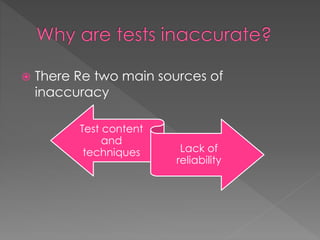
 There Re two main sources of
inaccuracy
Test content
and
techniques Lack of
reliability
 1)Quality Assurance .
2)Verification and validating the
product/application
before it goes live in the market.
3) In Testing we have to learn more
domains.
4)Meets the requirements.
5) Intending of finding errors in the
application.
 Testing has discussed above
 Assessment
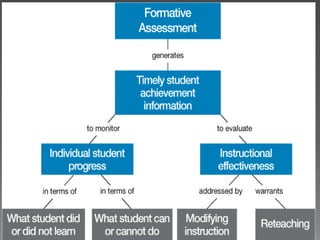
 Formative Assessment occurs in the
short term, as learners are in the process
of making meaning of new content and
of integrating it into what they already
know. Feedback to the learner is
immediate (or nearly so), to enable the
learner to change his/her behavior and
understandings right away.
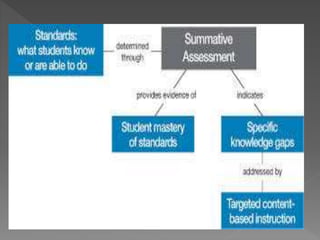
 Summative Assessment takes place at the
end of a large chunk of learning, with the
results being primarily for the teacher's or
school's use. Results may take time to be
returned to the student/parent, feedback
to the student is usually very limited, and the
student usually has no opportunity to be
reassessed. Thus, Summative Assessment
tends to have the least impact on
improving an individual student's
understanding or performance.
 The teaching profession can make three
contribution to the improvement of
testing.
They can write better test themselves.
They can enlighten other people who
are involved in testing process .
They can put pressure on professional
testers and examining boards to improve
their tests.
 A test that proves ideal for one purpose
may be quit useless for another , a
technique that may work very well in
one situation can be entirely
inappropriate in another.
 To measure large proficiency.
 To discover how successful students
have been in achieving the objectives of
a course of study.
 To diagnose student strength and
weakness.
 To assist placement of students by
identifying the stages or part of a
teaching programme most appropriate
to their ability.
Testing for Language TeachersArthur Hughes

Testing for Language Teachers Arthur Hughes

  • 2.
     What istest?  What is testing?  What is the purpose of testing?  The effect of testing  Why are tests inaccurate?  The need of testing  The need of testing  What is to be done!
  • 3.
     A generaldefinition: “a procedure intended to establish the quality, performance, or reliability of something, especially before it is taken into widespread use.” A test or examination is an assessment intended to measure a test-taker's knowledge, skill, aptitude, physical fitness, or classification in many other topics (e.g., beliefs). A test may be administered orally, on paper, on a computer, or in a confined area that requires a test taker to physically perform a set of skills. Tests vary in style, rigor and requirements
  • 4.
    Testing is thepractice of making objective judgments regarding the extent to which the system (device) meets, exceeds or fails to meet stated objectives.
  • 5.
     There aretwo fundamental purposes of testing: First, testing is about verifying that what was specified is what was delivered: it verifies that the product (system) meets the functional, performance, design, and implementation requirements identified in the procurement specifications. Second, testing is about managing risk for both the acquiring agency and the system’s vendor/developer/integrator.
  • 6.
     The effectof testing on teaching and learning is known as backwash.  The test preparation with all dominate teaching and learning activities and if the test content and testing techniques are at variance with the objective of course , there is likely to be harmful backwash.
  • 7.
     There Retwo main sources of inaccuracy Test content and techniques Lack of reliability
  • 8.
     1)Quality Assurance. 2)Verification and validating the product/application before it goes live in the market. 3) In Testing we have to learn more domains. 4)Meets the requirements. 5) Intending of finding errors in the application.
  • 9.
     Testing hasdiscussed above  Assessment  Formative Assessment occurs in the short term, as learners are in the process of making meaning of new content and of integrating it into what they already know. Feedback to the learner is immediate (or nearly so), to enable the learner to change his/her behavior and understandings right away.
  • 10.
     Summative Assessmenttakes place at the end of a large chunk of learning, with the results being primarily for the teacher's or school's use. Results may take time to be returned to the student/parent, feedback to the student is usually very limited, and the student usually has no opportunity to be reassessed. Thus, Summative Assessment tends to have the least impact on improving an individual student's understanding or performance.
  • 13.
     The teachingprofession can make three contribution to the improvement of testing. They can write better test themselves. They can enlighten other people who are involved in testing process . They can put pressure on professional testers and examining boards to improve their tests.
  • 14.
     A testthat proves ideal for one purpose may be quit useless for another , a technique that may work very well in one situation can be entirely inappropriate in another.
  • 15.
     To measurelarge proficiency.  To discover how successful students have been in achieving the objectives of a course of study.  To diagnose student strength and weakness.  To assist placement of students by identifying the stages or part of a teaching programme most appropriate to their ability.