Mohammed Pazhouhesh
Khayyam University of Mashhad
M. Pazhouhesh Khayyam University 1
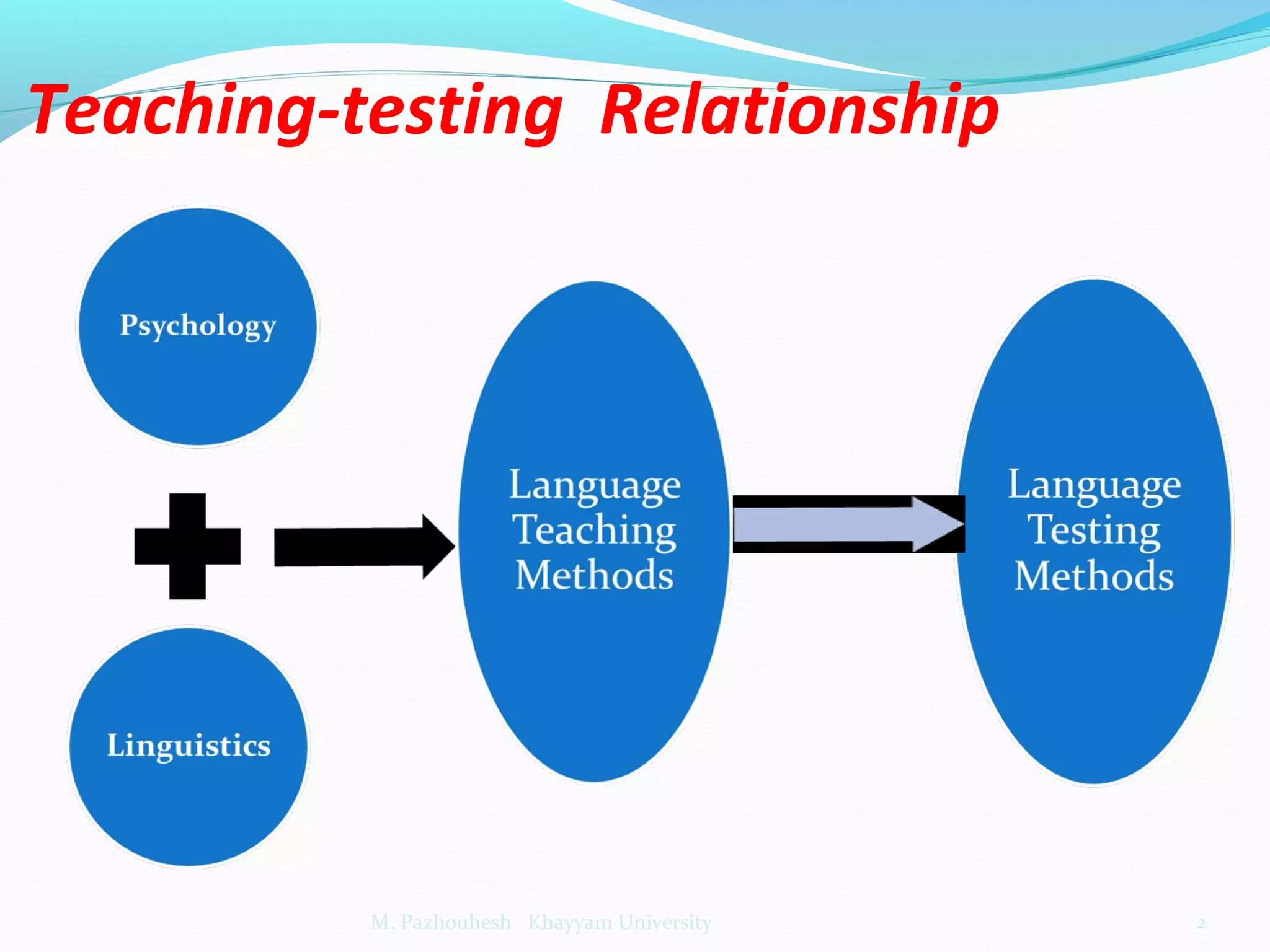
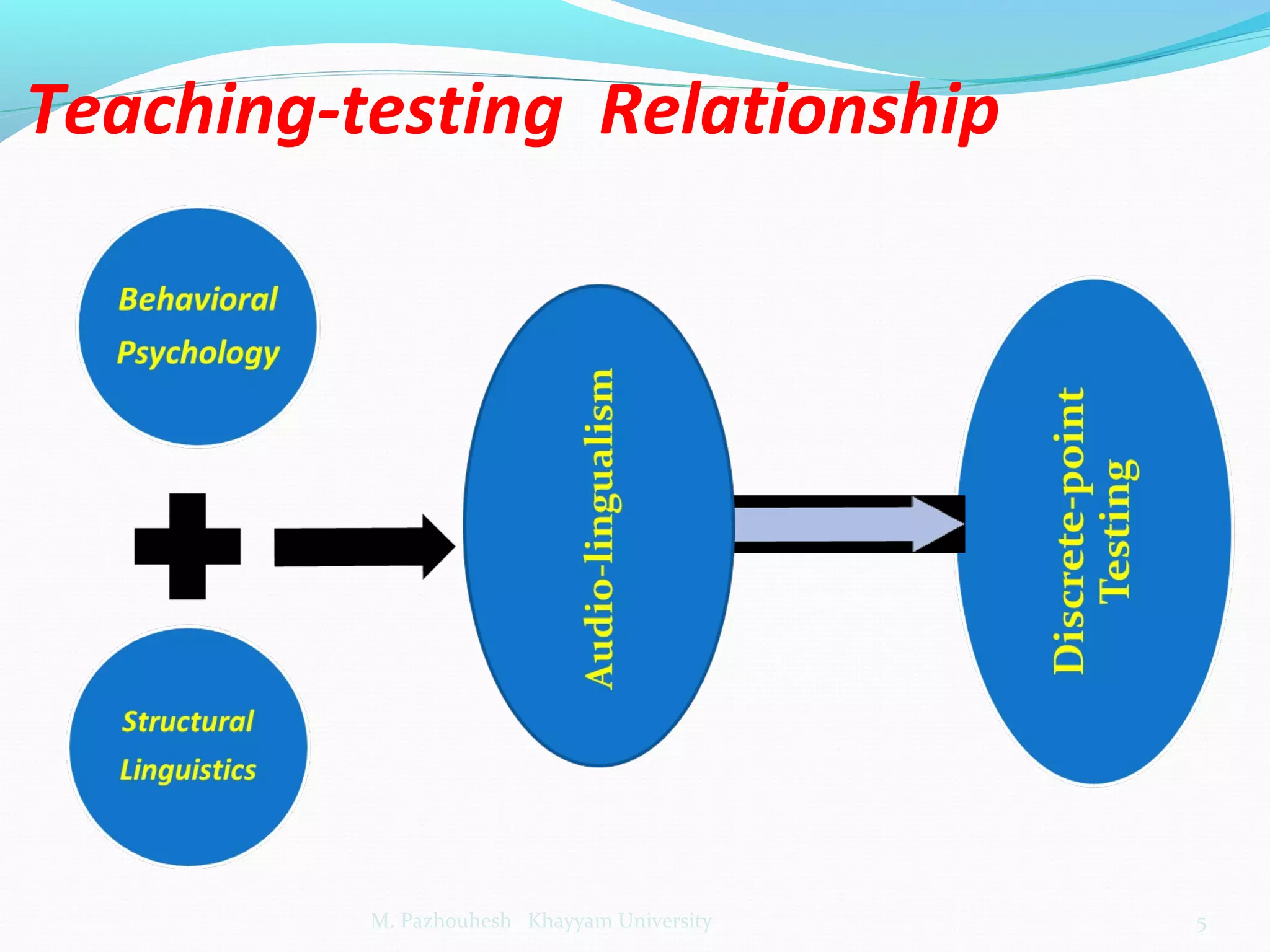
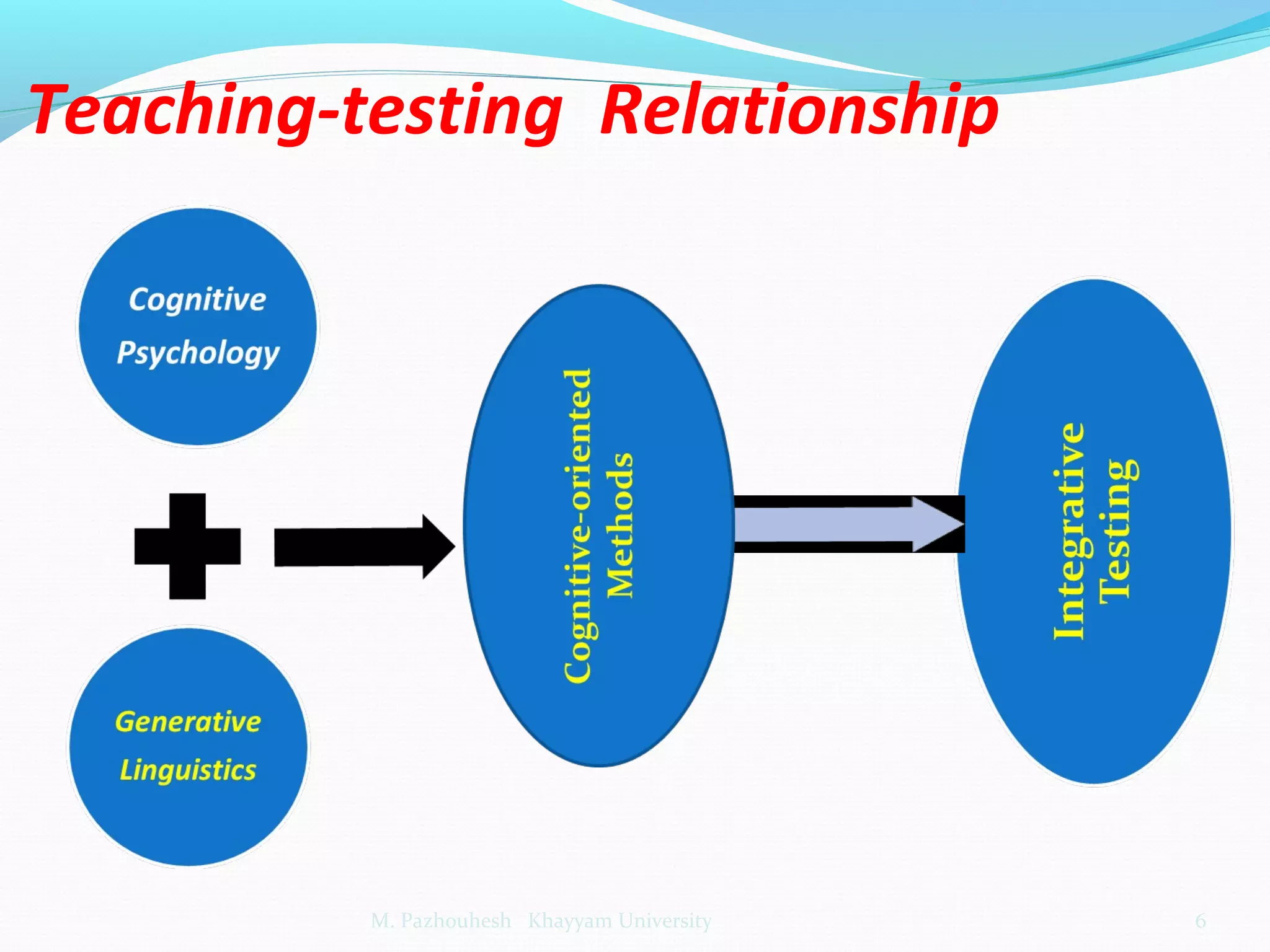
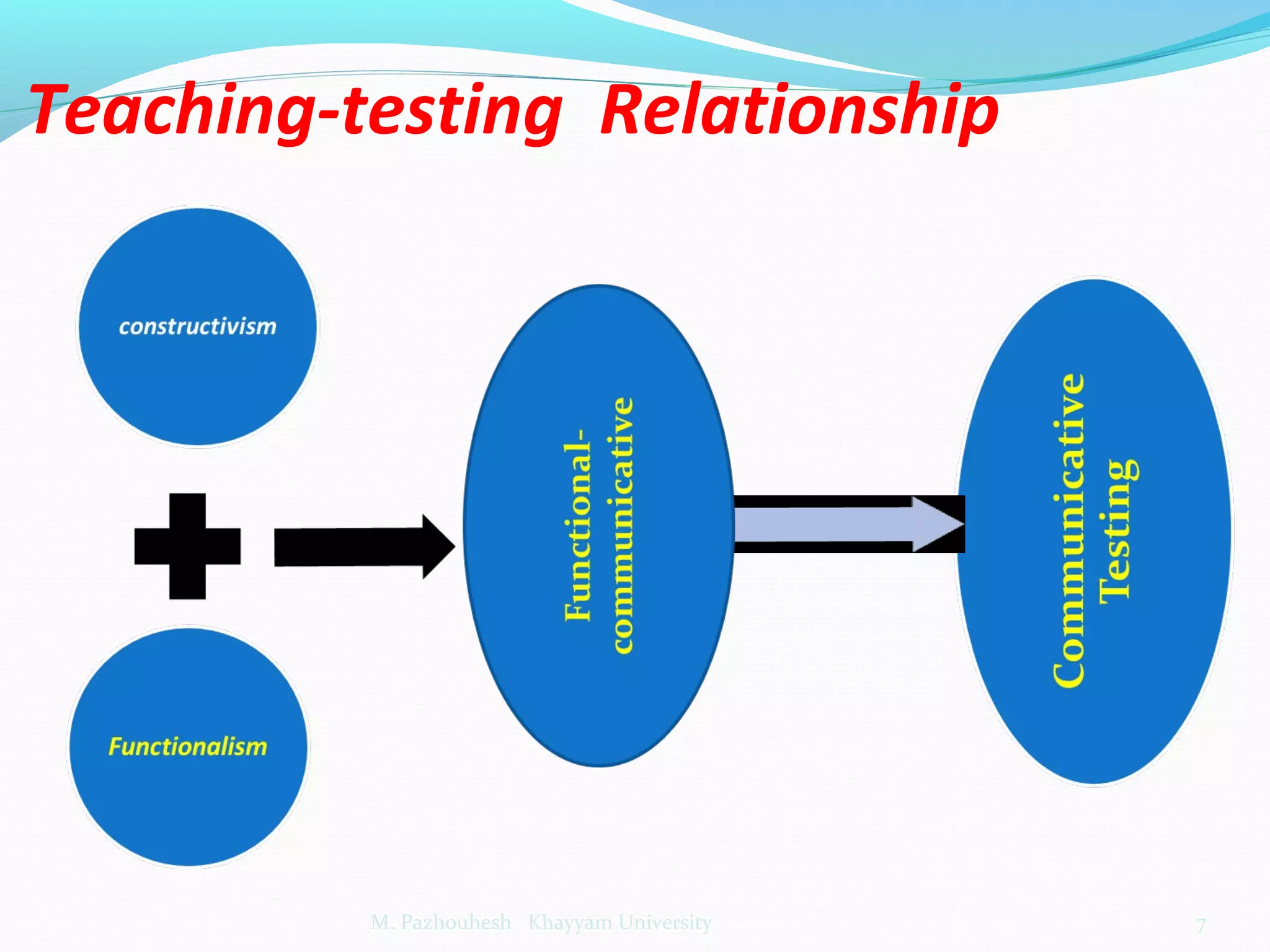
Teaching-testing Relationship
2M. Pazhouhesh Khayyam University
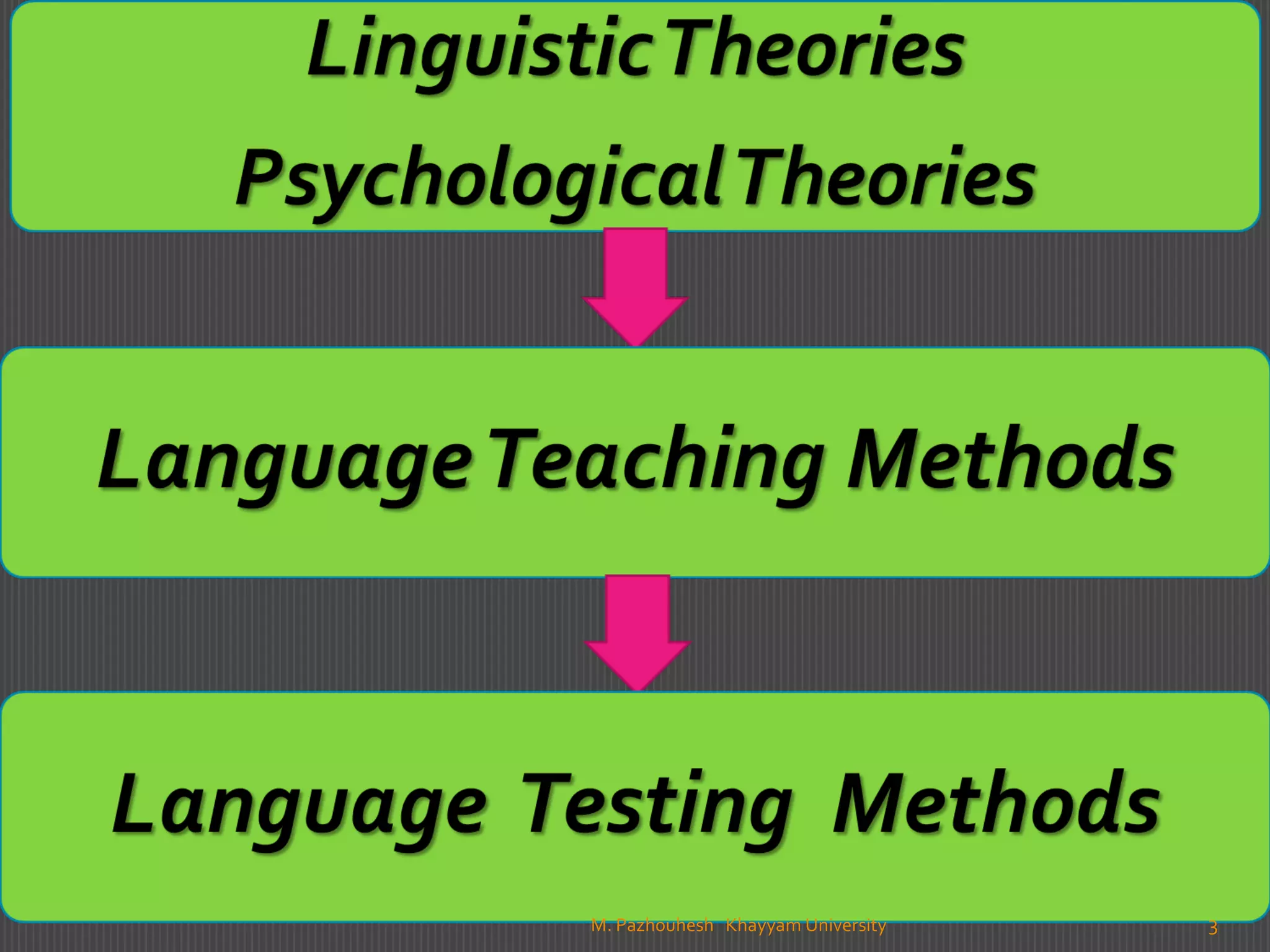
3M. Pazhouhesh Khayyam University
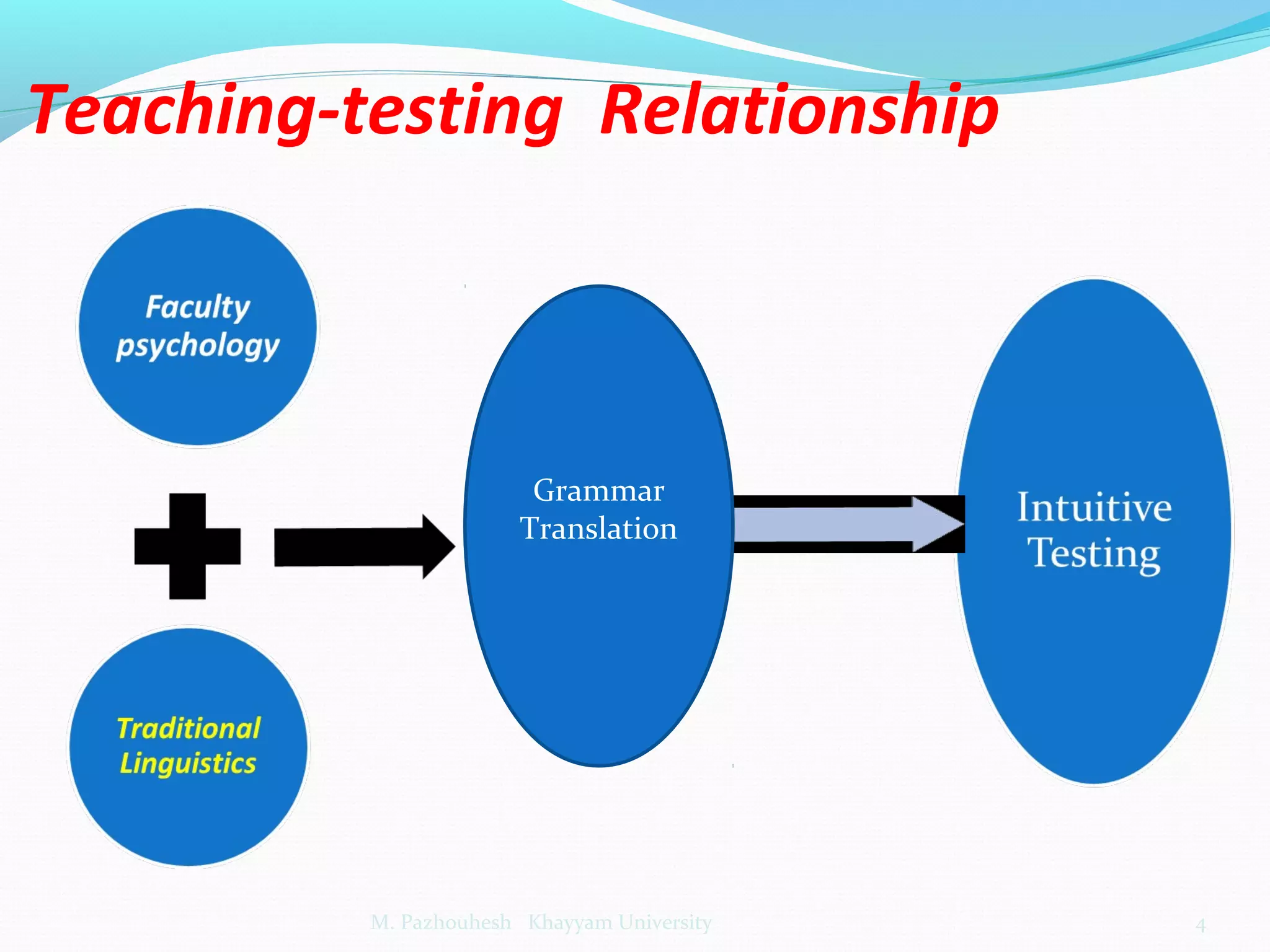
Teaching-testing Relationship
4M. Pazhouhesh Khayyam University
Grammar
Translation
Teaching-testing Relationship
5M. Pazhouhesh Khayyam University
Teaching-testing Relationship
6M. Pazhouhesh Khayyam University
Teaching-testing Relationship
7M. Pazhouhesh Khayyam University
Approaches to Language Testing
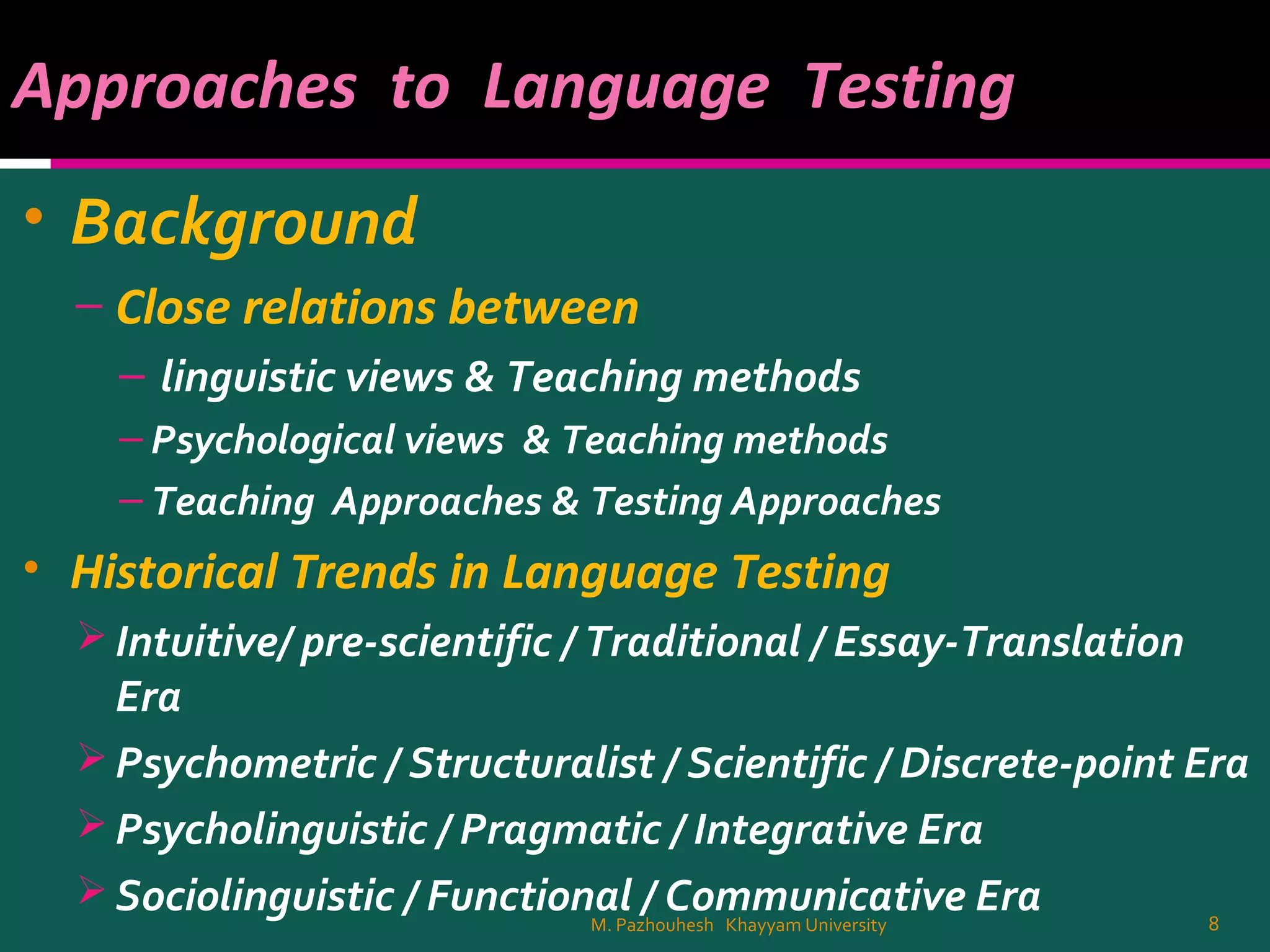
• Background
– Close relations between
– linguistic views & Teaching methods
– Psychological views & Teaching methods
– Teaching Approaches & Testing Approaches
• Historical Trends in Language Testing
 Intuitive/ pre-scientific / Traditional / Essay-Translation
Era
 Psychometric / Structuralist / Scientific / Discrete-point Era
 Psycholinguistic / Pragmatic / Integrative Era
 Sociolinguistic / Functional / Communicative Era 8M. Pazhouhesh Khayyam University
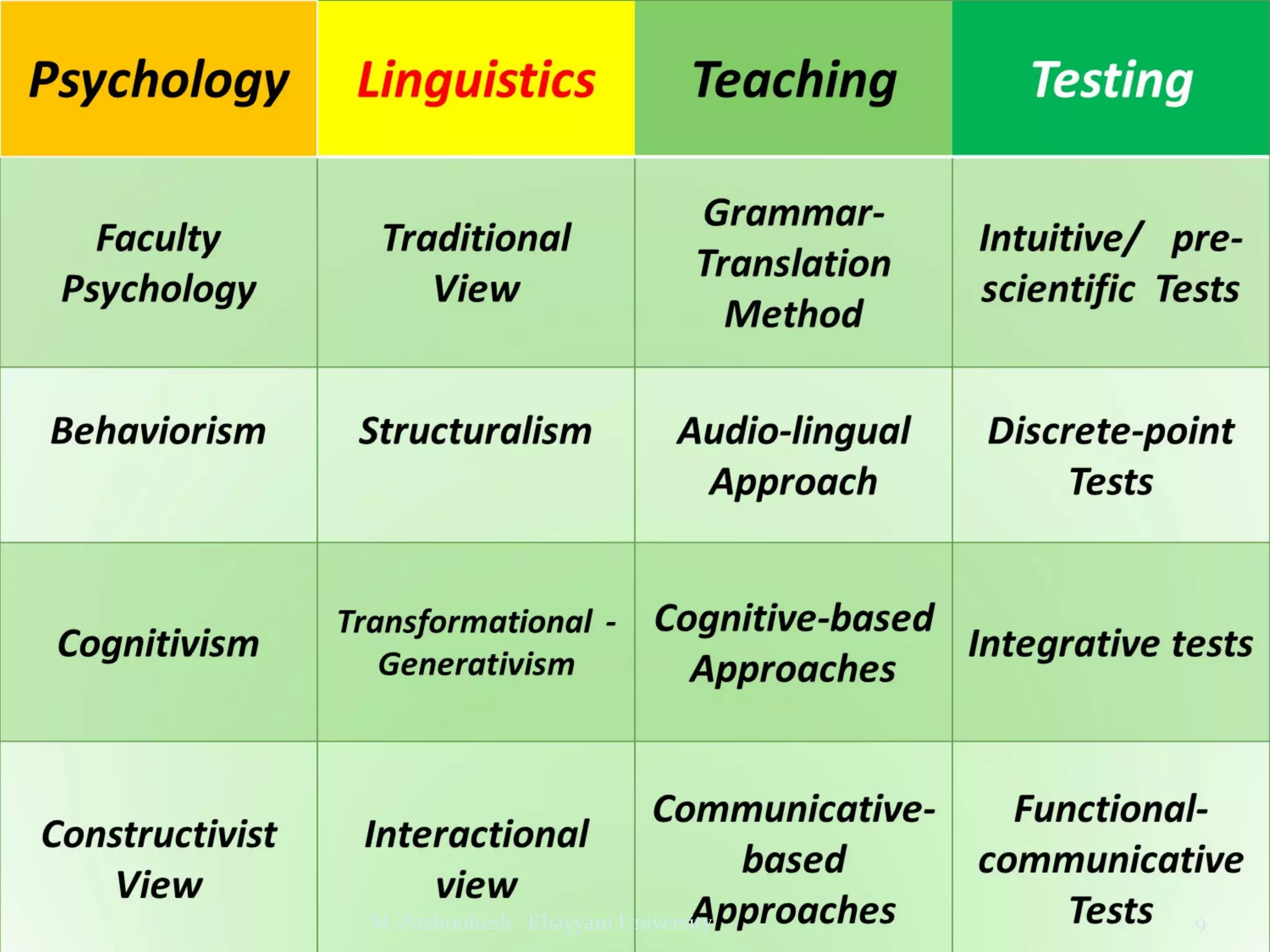
9M. Pazhouhesh Khayyam University
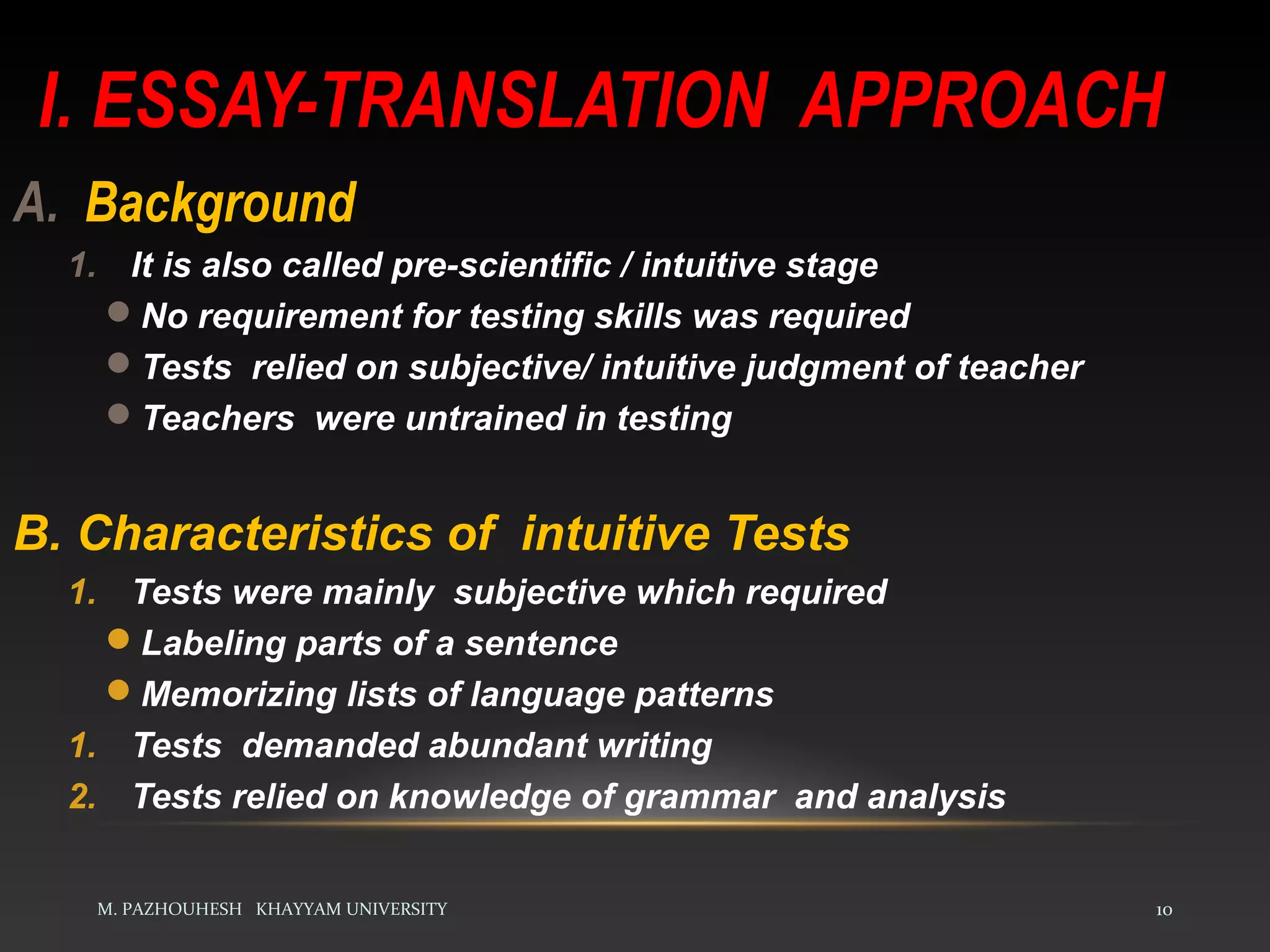
I. ESSAY-TRANSLATION APPROACH
M. PAZHOUHESH KHAYYAM UNIVERSITY 10
A. Background
1. It is also called pre-scientific / intuitive stage
No requirement for testing skills was required
Tests relied on subjective/ intuitive judgment of teacher
Teachers were untrained in testing
B. Characteristics of intuitive Tests
1. Tests were mainly subjective which required
Labeling parts of a sentence
Memorizing lists of language patterns
1. Tests demanded abundant writing
2. Tests relied on knowledge of grammar and analysis
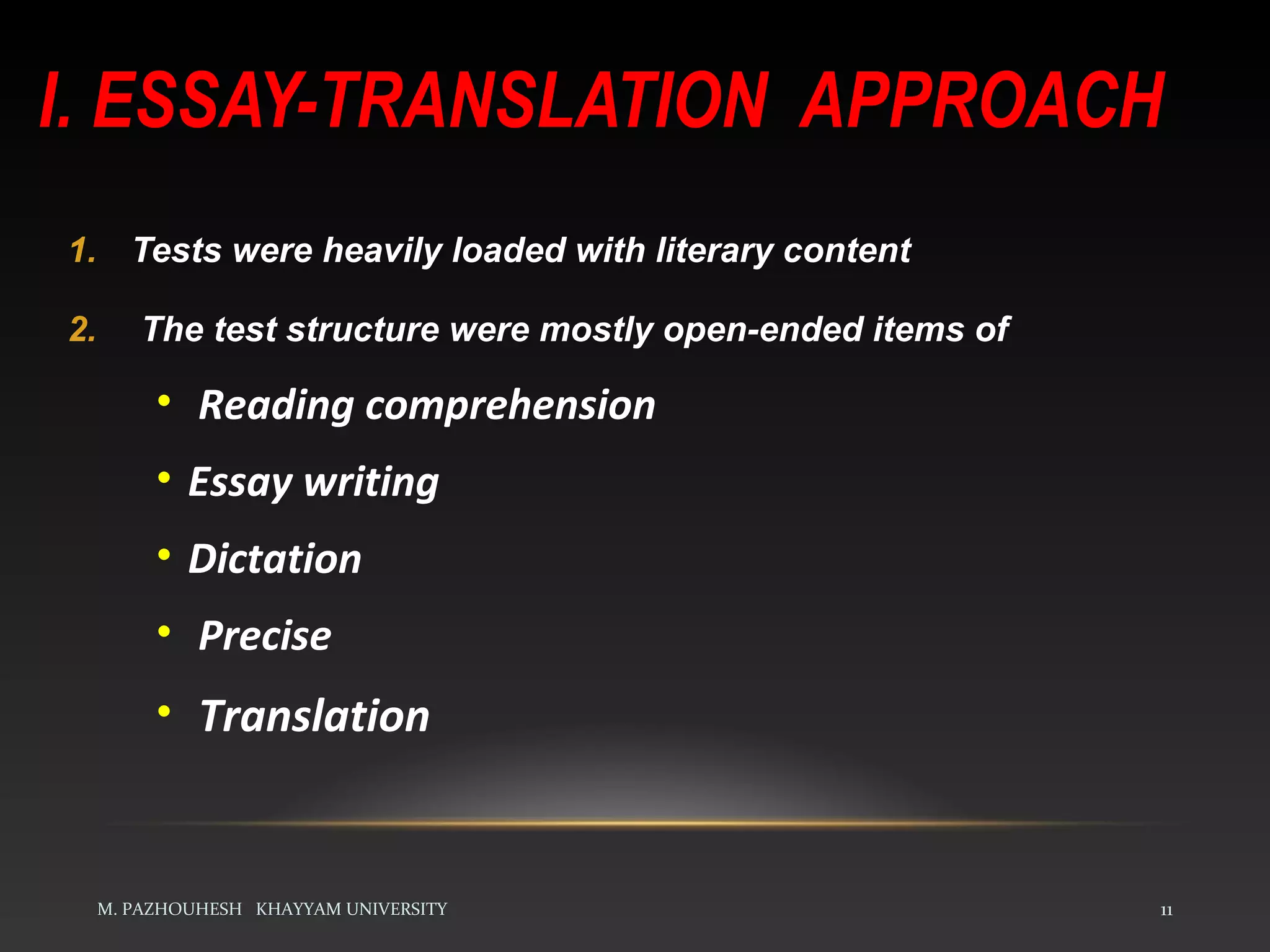
I. ESSAY-TRANSLATION APPROACH
M. PAZHOUHESH KHAYYAM UNIVERSITY 11
1. Tests were heavily loaded with literary content
2. The test structure were mostly open-ended items of
• Reading comprehension
• Essay writing
• Dictation
• Precise
• Translation
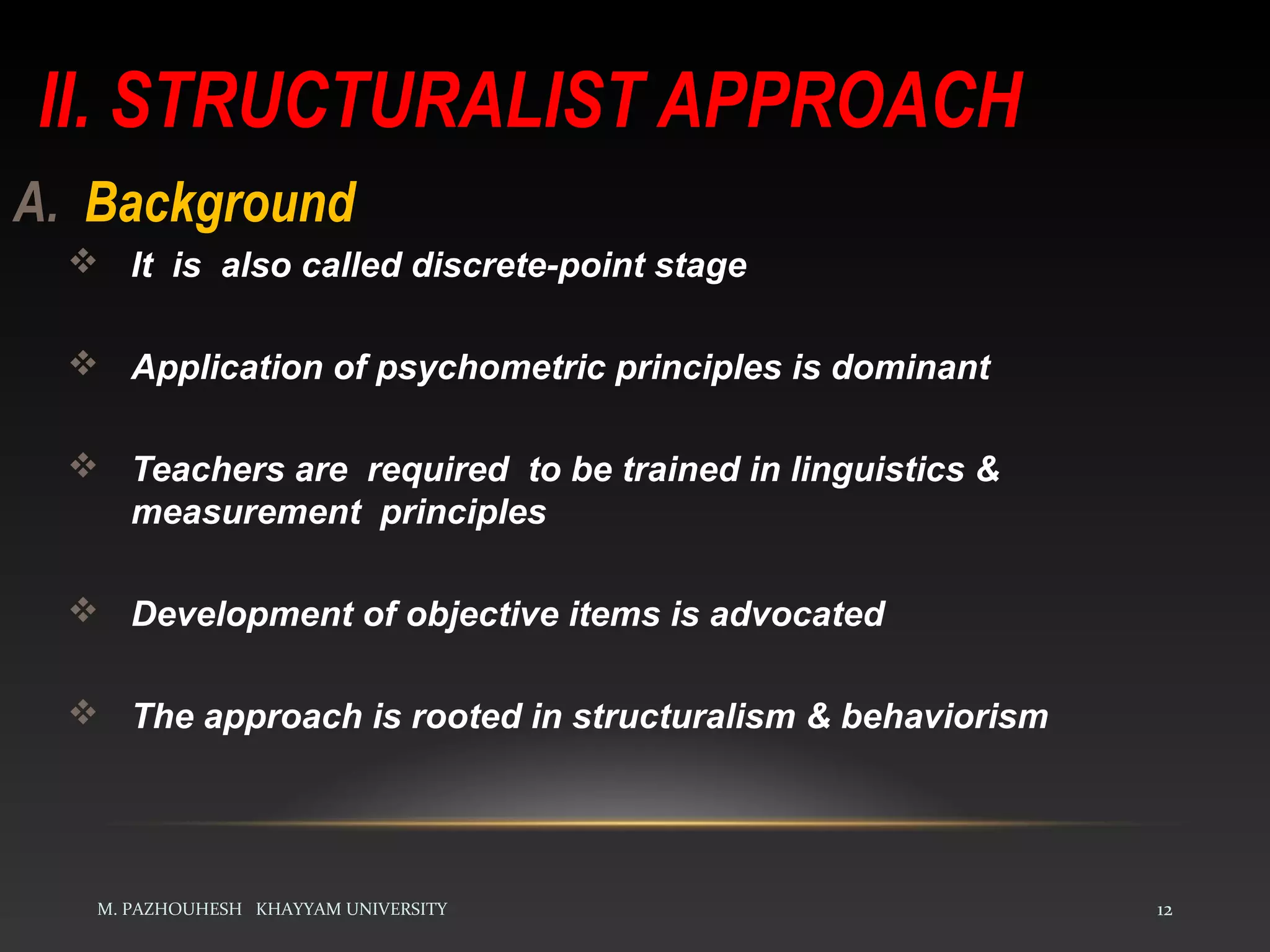
II. STRUCTURALIST APPROACH
M. PAZHOUHESH KHAYYAM UNIVERSITY 12
A. Background
 It is also called discrete-point stage
 Application of psychometric principles is dominant
 Teachers are required to be trained in linguistics &
measurement principles
 Development of objective items is advocated
 The approach is rooted in structuralism & behaviorism
II. SRTUCTURALIST APPROACH
M. PAZHOUHESH KHAYYAM UNIVERSITY 13
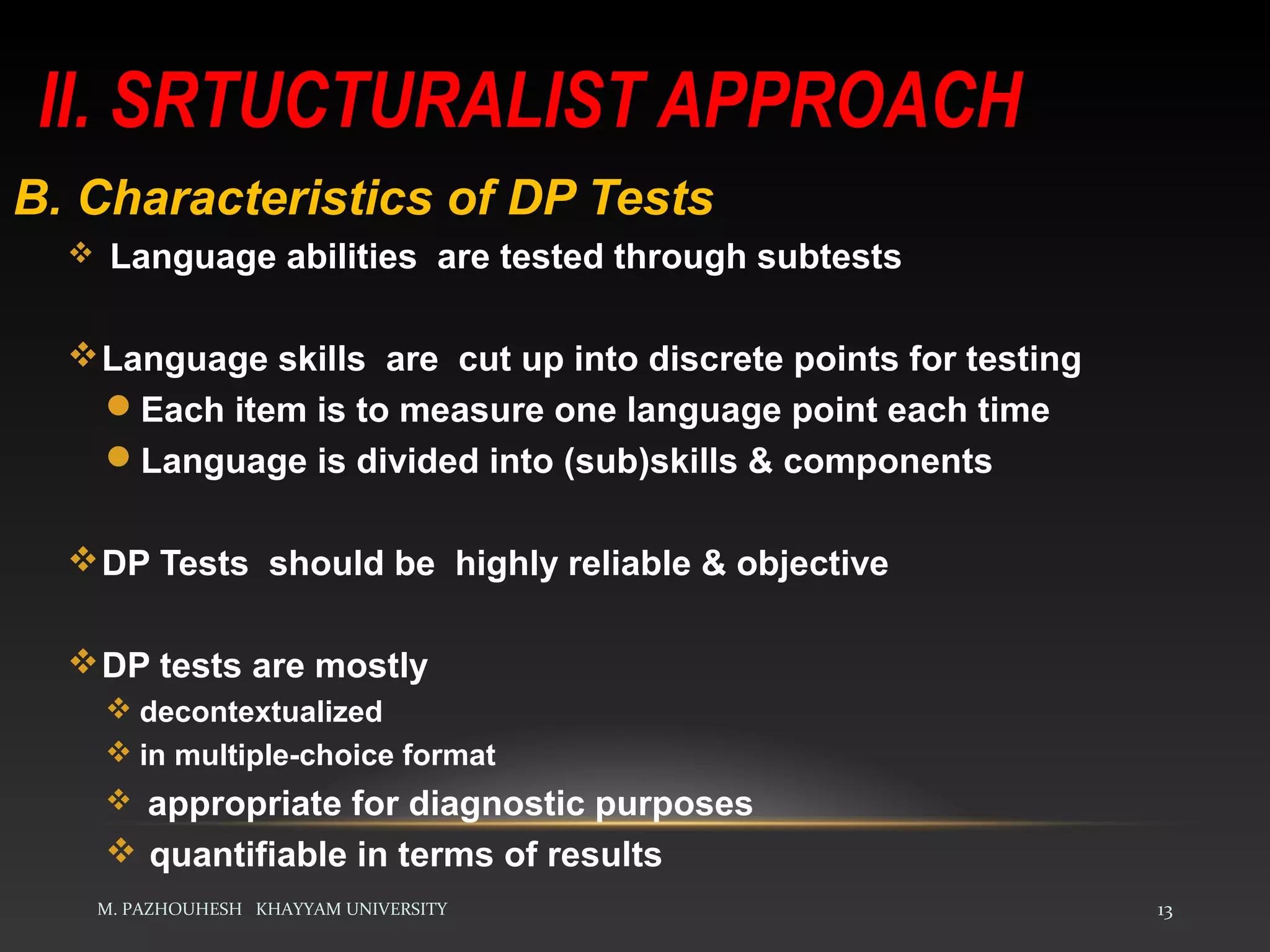
B. Characteristics of DP Tests
 Language abilities are tested through subtests
Language skills are cut up into discrete points for testing
Each item is to measure one language point each time
Language is divided into (sub)skills & components
DP Tests should be highly reliable & objective
DP tests are mostly
 decontextualized
 in multiple-choice format
 appropriate for diagnostic purposes
 quantifiable in terms of results
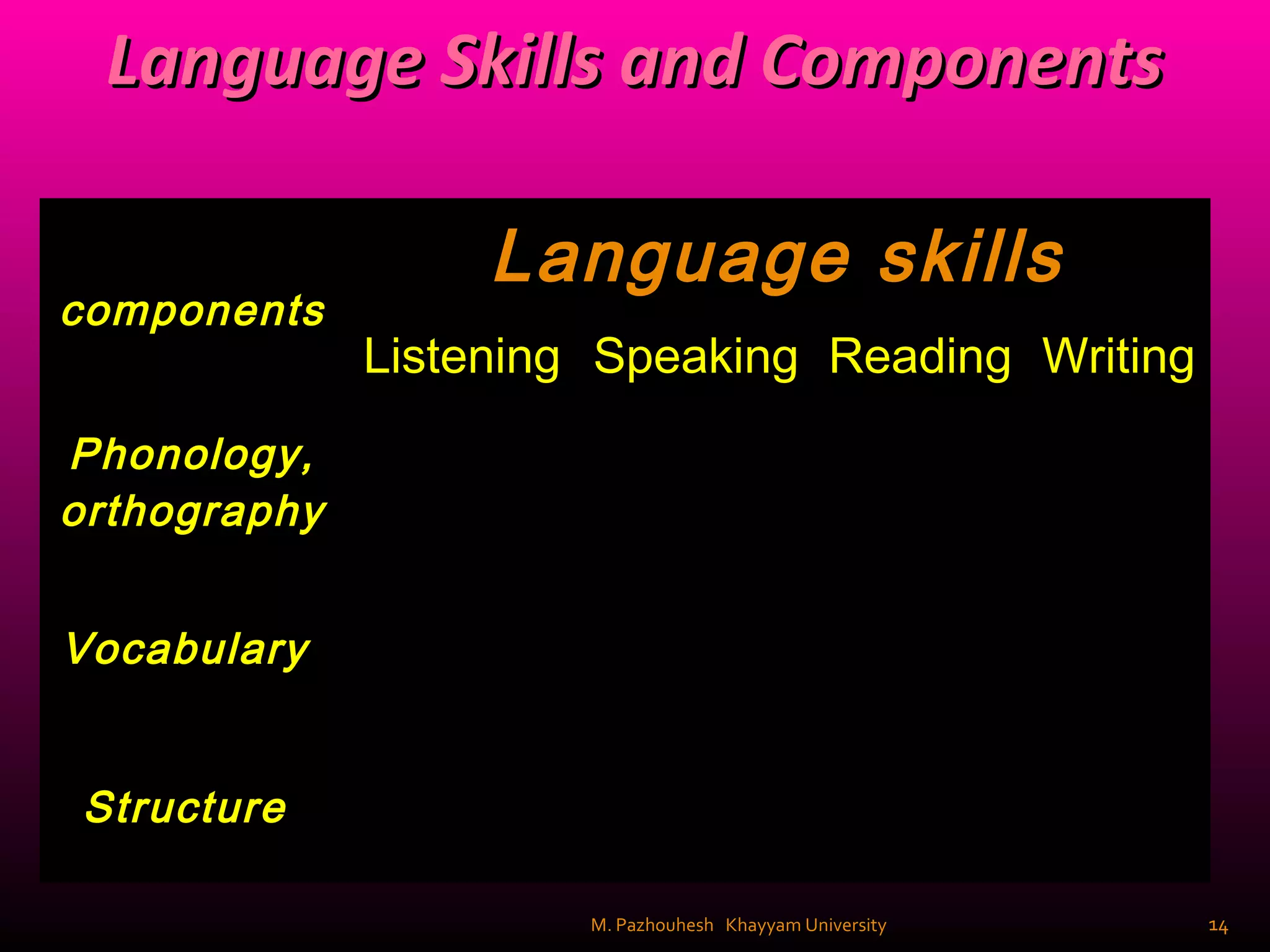
Language Skills and ComponentsLanguage Skills and Components
componentscomponents
Language skillsLanguage skills
ListeningListening SpeakingSpeaking ReadingReading WritingWriting
Phonology,Phonology,
orthographyorthography
VocabularyVocabulary
StructureStructure
14M. Pazhouhesh Khayyam University
III. INTEGRATIVE APPROACH
M. PAZHOUHESH KHAYYAM UNIVERSITY 15
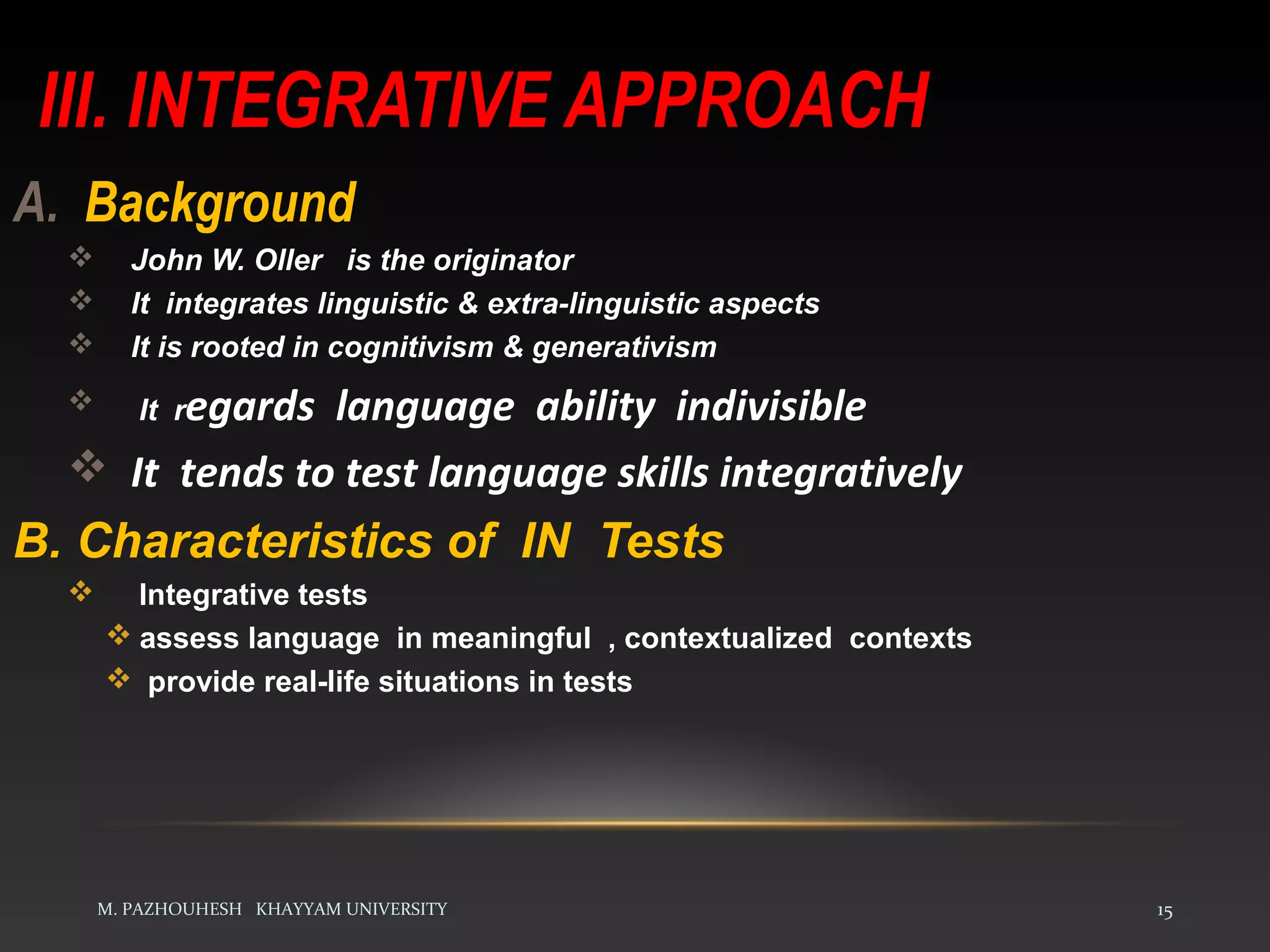
A. Background
 John W. Oller is the originator
 It integrates linguistic & extra-linguistic aspects
 It is rooted in cognitivism & generativism
 It regards language ability indivisible
 It tends to test language skills integratively
B. Characteristics of IN Tests
 Integrative tests
 assess language in meaningful , contextualized contexts
 provide real-life situations in tests
III. INTEGRATIVE APPROACH
M. PAZHOUHESH KHAYYAM UNIVERSITY 16
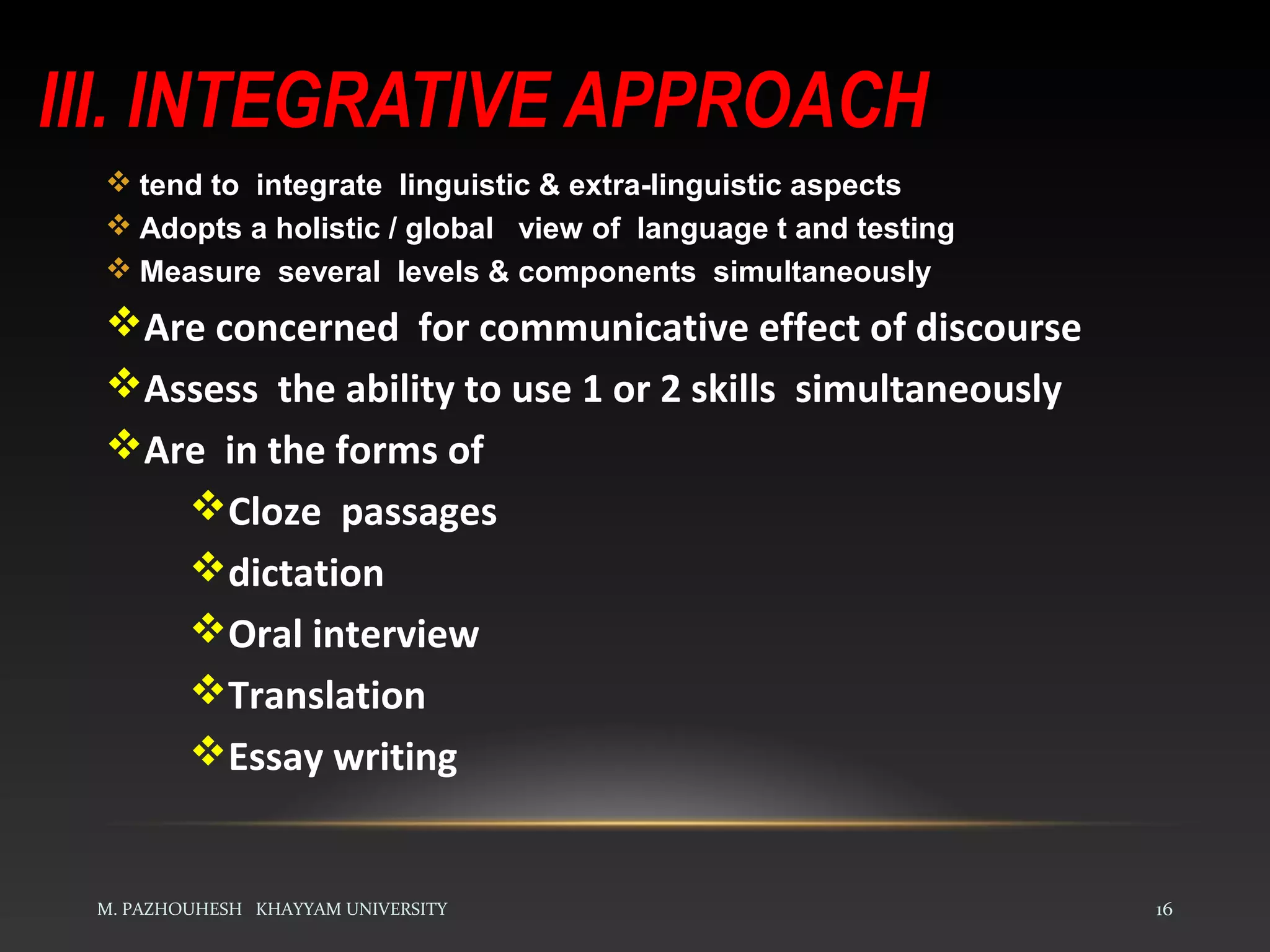
 tend to integrate linguistic & extra-linguistic aspects
 Adopts a holistic / global view of language t and testing
 Measure several levels & components simultaneously
Are concerned for communicative effect of discourse
Assess the ability to use 1 or 2 skills simultaneously
Are in the forms of
Cloze passages
dictation
Oral interview
Translation
Essay writing
III. Pragmatic Approach
Background
 PR tests are
 rooted in Pragmatics & Psycholinguistics
 adopt a holistic pragmatic approach
 are concerned with pragmatic mapping
o Emphasize correspondence between linguistic & extra-linguistic
aspects of language
17M. Pazhouhesh Khayyam University
o Characteristics of PR Tests
oPR tests tend to
oTest language in meaningful , natural context
o meet naturalness criteria by requiring learners
• To utilize normal contextual clues in the language
• To comprehend linguistic & extra-linguistic contexts
• To map pragmatically linguistic features with extra-
linguistic aspects
oHave learners employ their pragmatic expectancy
grammar
18M. Pazhouhesh Khayyam University
19M. Pazhouhesh Khayyam University
IV. Communicative Approach
 Background
o Communicative tests
 are rooted in Social constructivism & Functional view of
language
 Focus on social interaction & transaction
Emerged after functional-notional approach to TEFL
Tend to assess communicative competence
• Grammatical Competence( linguistic aspects)
• Textual Competence( cohesion & coherence)
• Illocutionary Competence( functional use of language)
• Sociolinguistic Competence ( extra-linguistic aspects)
20M. Pazhouhesh Khayyam University
 Characteristics of Communicative Tests
oCommunicative tests tend to
 Measure language ability in meaningful, communicative
context
 Are concerned with real life ,communicative use of language
 Focus on tapping language use rather than language usage
oAdopt the Divisibility Hypothesis by
• obtaining Learner’s language proficiency profiles
• Matching and tailoring instruction with the learner’s needs
o be culturally loaded
o use authentic language in tests
oShow a Preference for qualitative (rather than quantitative)
modes of assessment
oTo be in the forms of :
• Oral interview
• Essay writing
• Comprehension questions on an authentic passage
• Reading an article and reacting to it
• Listening to a lecture & reacting to it 21M. Pazhouhesh Khayyam University
 Characteristics of a communicative test
 It should be interactive.
 It should be direct in nature with tasks reflecting
realistic discourse processing activities.
 Texts and tasks should be relevant to the intended
situation.
 Ability should be sampled within meaningful and
developing contexts.
 The test should be based on an a priori specification, so
what is to be tested and how it is to be tested should be
laid down at the test design stage. [Adapted from Weir, 1993]
22M. Pazhouhesh Khayyam University

Approaches to Language Testing

  • 1.
    Mohammed Pazhouhesh Khayyam Universityof Mashhad M. Pazhouhesh Khayyam University 1
  • 2.
  • 3.
  • 4.
    Teaching-testing Relationship 4M. PazhouheshKhayyam University Grammar Translation
  • 5.
  • 6.
  • 7.
  • 8.
    Approaches to LanguageTesting • Background – Close relations between – linguistic views & Teaching methods – Psychological views & Teaching methods – Teaching Approaches & Testing Approaches • Historical Trends in Language Testing  Intuitive/ pre-scientific / Traditional / Essay-Translation Era  Psychometric / Structuralist / Scientific / Discrete-point Era  Psycholinguistic / Pragmatic / Integrative Era  Sociolinguistic / Functional / Communicative Era 8M. Pazhouhesh Khayyam University
  • 9.
  • 10.
    I. ESSAY-TRANSLATION APPROACH M.PAZHOUHESH KHAYYAM UNIVERSITY 10 A. Background 1. It is also called pre-scientific / intuitive stage No requirement for testing skills was required Tests relied on subjective/ intuitive judgment of teacher Teachers were untrained in testing B. Characteristics of intuitive Tests 1. Tests were mainly subjective which required Labeling parts of a sentence Memorizing lists of language patterns 1. Tests demanded abundant writing 2. Tests relied on knowledge of grammar and analysis
  • 11.
    I. ESSAY-TRANSLATION APPROACH M.PAZHOUHESH KHAYYAM UNIVERSITY 11 1. Tests were heavily loaded with literary content 2. The test structure were mostly open-ended items of • Reading comprehension • Essay writing • Dictation • Precise • Translation
  • 12.
    II. STRUCTURALIST APPROACH M.PAZHOUHESH KHAYYAM UNIVERSITY 12 A. Background  It is also called discrete-point stage  Application of psychometric principles is dominant  Teachers are required to be trained in linguistics & measurement principles  Development of objective items is advocated  The approach is rooted in structuralism & behaviorism
  • 13.
    II. SRTUCTURALIST APPROACH M.PAZHOUHESH KHAYYAM UNIVERSITY 13 B. Characteristics of DP Tests  Language abilities are tested through subtests Language skills are cut up into discrete points for testing Each item is to measure one language point each time Language is divided into (sub)skills & components DP Tests should be highly reliable & objective DP tests are mostly  decontextualized  in multiple-choice format  appropriate for diagnostic purposes  quantifiable in terms of results
  • 14.
    Language Skills andComponentsLanguage Skills and Components componentscomponents Language skillsLanguage skills ListeningListening SpeakingSpeaking ReadingReading WritingWriting Phonology,Phonology, orthographyorthography VocabularyVocabulary StructureStructure 14M. Pazhouhesh Khayyam University
  • 15.
    III. INTEGRATIVE APPROACH M.PAZHOUHESH KHAYYAM UNIVERSITY 15 A. Background  John W. Oller is the originator  It integrates linguistic & extra-linguistic aspects  It is rooted in cognitivism & generativism  It regards language ability indivisible  It tends to test language skills integratively B. Characteristics of IN Tests  Integrative tests  assess language in meaningful , contextualized contexts  provide real-life situations in tests
  • 16.
    III. INTEGRATIVE APPROACH M.PAZHOUHESH KHAYYAM UNIVERSITY 16  tend to integrate linguistic & extra-linguistic aspects  Adopts a holistic / global view of language t and testing  Measure several levels & components simultaneously Are concerned for communicative effect of discourse Assess the ability to use 1 or 2 skills simultaneously Are in the forms of Cloze passages dictation Oral interview Translation Essay writing
  • 17.
    III. Pragmatic Approach Background PR tests are  rooted in Pragmatics & Psycholinguistics  adopt a holistic pragmatic approach  are concerned with pragmatic mapping o Emphasize correspondence between linguistic & extra-linguistic aspects of language 17M. Pazhouhesh Khayyam University
  • 18.
    o Characteristics ofPR Tests oPR tests tend to oTest language in meaningful , natural context o meet naturalness criteria by requiring learners • To utilize normal contextual clues in the language • To comprehend linguistic & extra-linguistic contexts • To map pragmatically linguistic features with extra- linguistic aspects oHave learners employ their pragmatic expectancy grammar 18M. Pazhouhesh Khayyam University
  • 19.
  • 20.
    IV. Communicative Approach Background o Communicative tests  are rooted in Social constructivism & Functional view of language  Focus on social interaction & transaction Emerged after functional-notional approach to TEFL Tend to assess communicative competence • Grammatical Competence( linguistic aspects) • Textual Competence( cohesion & coherence) • Illocutionary Competence( functional use of language) • Sociolinguistic Competence ( extra-linguistic aspects) 20M. Pazhouhesh Khayyam University
  • 21.
     Characteristics ofCommunicative Tests oCommunicative tests tend to  Measure language ability in meaningful, communicative context  Are concerned with real life ,communicative use of language  Focus on tapping language use rather than language usage oAdopt the Divisibility Hypothesis by • obtaining Learner’s language proficiency profiles • Matching and tailoring instruction with the learner’s needs o be culturally loaded o use authentic language in tests oShow a Preference for qualitative (rather than quantitative) modes of assessment oTo be in the forms of : • Oral interview • Essay writing • Comprehension questions on an authentic passage • Reading an article and reacting to it • Listening to a lecture & reacting to it 21M. Pazhouhesh Khayyam University
  • 22.
     Characteristics ofa communicative test  It should be interactive.  It should be direct in nature with tasks reflecting realistic discourse processing activities.  Texts and tasks should be relevant to the intended situation.  Ability should be sampled within meaningful and developing contexts.  The test should be based on an a priori specification, so what is to be tested and how it is to be tested should be laid down at the test design stage. [Adapted from Weir, 1993] 22M. Pazhouhesh Khayyam University