Language Testing Evaluation
Bikash Chandra Taly
PhD in English Language
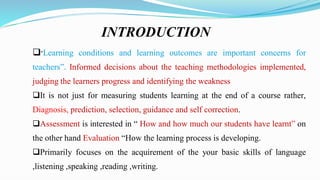
INTRODUCTION
“Learning conditions and learning outcomes are important concerns for
teachers”. Informed decisions about the teaching methodologies implemented,
judging the learners progress and identifying the weakness
It is not just for measuring students learning at the end of a course rather,
Diagnosis, prediction, selection, guidance and self correction.
Assessment is interested in “ How and how much our students have learnt” on
the other hand Evaluation “How the learning process is developing.
Primarily focuses on the acquirement of the your basic skills of language
,listening ,speaking ,reading ,writing.
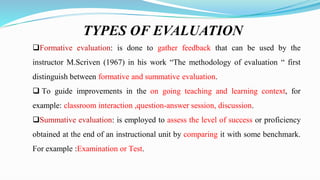
TYPES OF EVALUATION
Formative evaluation: is done to gather feedback that can be used by the
instructor M.Scriven (1967) in his work “The methodology of evaluation “ first
distinguish between formative and summative evaluation.
 To guide improvements in the on going teaching and learning context, for
example: classroom interaction ,question-answer session, discussion.
Summative evaluation: is employed to assess the level of success or proficiency
obtained at the end of an instructional unit by comparing it with some benchmark.
For example :Examination or Test.
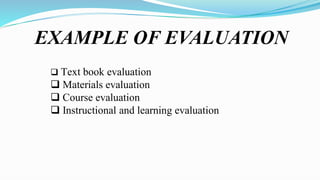
EXAMPLE OF EVALUATION
 Text book evaluation
 Materials evaluation
 Course evaluation
 Instructional and learning evaluation
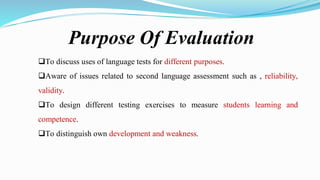
Purpose Of Evaluation
To discuss uses of language tests for different purposes.
Aware of issues related to second language assessment such as , reliability,
validity.
To design different testing exercises to measure students learning and
competence.
To distinguish own development and weakness.
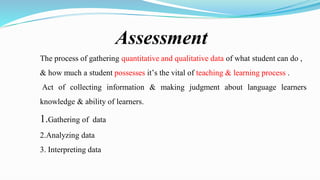
Assessment
The process of gathering quantitative and qualitative data of what student can do ,
& how much a student possesses it’s the vital of teaching & learning process .
Act of collecting information & making judgment about language learners
knowledge & ability of learners.
1.Gathering of data
2.Analyzing data
3. Interpreting data
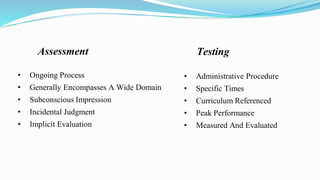
Assessment
• Ongoing Process
• Generally Encompasses A Wide Domain
• Subconscious Impression
• Incidental Judgment
• Implicit Evaluation
Testing
• Administrative Procedure
• Specific Times
• Curriculum Referenced
• Peak Performance
• Measured And Evaluated
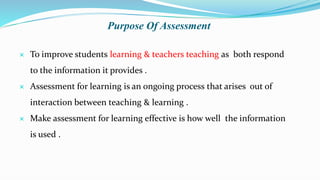
Purpose Of Assessment
 To improve students learning & teachers teaching as both respond
to the information it provides .
 Assessment for learning is an ongoing process that arises out of
interaction between teaching & learning .
 Make assessment for learning effective is how well the information
is used .
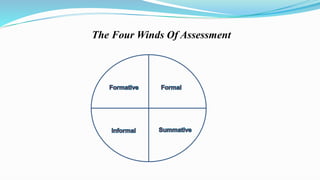
The Four Winds Of Assessment
 Stern (1983, p. 340) notes that “if the ultimate objective
of language teaching is effective language learning, then
our main concern must be the learning outcome”.
 The needs of assessing the outcome of learning have led
to the development and elaboration of different test
formats.
Testing
 Norm-referenced versus criterion-referenced
 Discrete point versus integrative
 Direct versus indirect
 Objective testing versus subjective
Types Of Testing
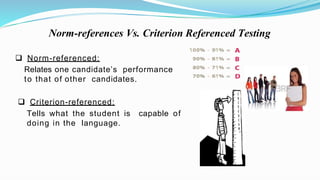
Norm-references Vs. Criterion Referenced Testing
 Norm-referenced:
Relates one candidate’s performance
to that of other candidates.
 Criterion-referenced:
Tells what the student is capable of
doing in the language.
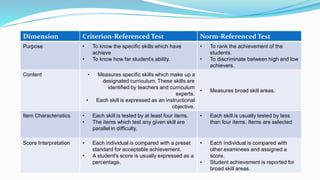
Dimension Criterion-Referenced Test Norm-Referenced Test
Purpose • To know the specific skills which have
achieve
• To know how far student’s ability.
• To rank the achievement of the
students.
• To discriminate between high and low
achievers.
Content • Measures specific skills which make up a
designated curriculum. These skills are
identified by teachers and curriculum
experts.
• Each skill is expressed as an instructional
objective.
• Measures broad skill areas.
Item Characteristics • Each skill is tested by at least four items.
• The items which test any given skill are
parallel in difficulty.
• Each skill is usually tested by less
than four items. Items are selected
Score Interpretation • Each individual is compared with a preset
standard for acceptable achievement.
• A student's score is usually expressed as a
percentage.
• Each individual is compared with
other examinees and assigned a
score.
• Student achievement is reported for
broad skill areas.
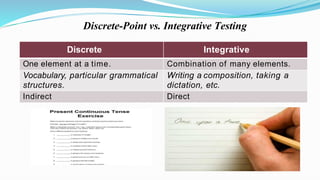
Discrete-Point vs. Integrative Testing
Discrete Integrative
One element at a time. Combination of many elements.
Vocabulary, particular grammatical
structures.
Writing a composition, taking a
dictation, etc.
Indirect Direct
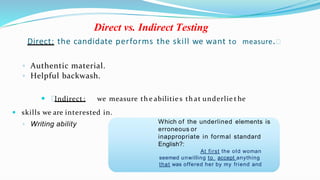
Direct vs. Indirect Testing
Direct: the candidate performs the skill we want to measure.
◦ Authentic material.
◦ Helpful backwash.
 Indirect : we measure th e abilitie s th at underlie t he
 skills we are interested in.
◦ Writing ability Which of the underlined elements is
erroneous or
inappropriate in formal standard
English?:
At first the old woman
seemed unwilling to accept anything
that was offered her by my friend and
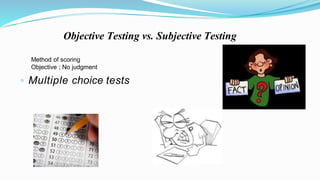
Objective Testing vs. Subjective Testing
◦ Multiple choice tests
Method of scoring
Objective ; No judgment
Conclusion
1.Planing ,designing and preparing a test are thus crucial parts of the teaching
learning process.
2.They are a prominent part of course design and plan for they provide direction to
future plans and course of action to be undertaken.
3.The information gathered through tests and evaluation provides important clues as
to the changes that need to be brought into the curriculum or the teaching methods in
order to attain the desired outcomes.
4.It is of prime importance for the language teacher to be familiar with the process
because testing and evaluation in language teaching unlike other subjects is both
skill and content based:Comprehension as well as proficiency in performance of the
language skills.
References
• Hughes, Arthur. Testing for Language Teachers. New York:
Cambridge UP, 2003.
• Brown, H. Douglas.(2003).Language Assessment: Principles and
Classroom Practices. California: Longman.

Language Testing Evaluation

  • 1.
    Language Testing Evaluation BikashChandra Taly PhD in English Language
  • 2.
    INTRODUCTION “Learning conditions andlearning outcomes are important concerns for teachers”. Informed decisions about the teaching methodologies implemented, judging the learners progress and identifying the weakness It is not just for measuring students learning at the end of a course rather, Diagnosis, prediction, selection, guidance and self correction. Assessment is interested in “ How and how much our students have learnt” on the other hand Evaluation “How the learning process is developing. Primarily focuses on the acquirement of the your basic skills of language ,listening ,speaking ,reading ,writing.
  • 3.
    TYPES OF EVALUATION Formativeevaluation: is done to gather feedback that can be used by the instructor M.Scriven (1967) in his work “The methodology of evaluation “ first distinguish between formative and summative evaluation.  To guide improvements in the on going teaching and learning context, for example: classroom interaction ,question-answer session, discussion. Summative evaluation: is employed to assess the level of success or proficiency obtained at the end of an instructional unit by comparing it with some benchmark. For example :Examination or Test.
  • 4.
    EXAMPLE OF EVALUATION Text book evaluation  Materials evaluation  Course evaluation  Instructional and learning evaluation
  • 5.
    Purpose Of Evaluation Todiscuss uses of language tests for different purposes. Aware of issues related to second language assessment such as , reliability, validity. To design different testing exercises to measure students learning and competence. To distinguish own development and weakness.
  • 6.
    Assessment The process ofgathering quantitative and qualitative data of what student can do , & how much a student possesses it’s the vital of teaching & learning process . Act of collecting information & making judgment about language learners knowledge & ability of learners. 1.Gathering of data 2.Analyzing data 3. Interpreting data
  • 7.
    Assessment • Ongoing Process •Generally Encompasses A Wide Domain • Subconscious Impression • Incidental Judgment • Implicit Evaluation Testing • Administrative Procedure • Specific Times • Curriculum Referenced • Peak Performance • Measured And Evaluated
  • 8.
    Purpose Of Assessment To improve students learning & teachers teaching as both respond to the information it provides .  Assessment for learning is an ongoing process that arises out of interaction between teaching & learning .  Make assessment for learning effective is how well the information is used .
  • 9.
    The Four WindsOf Assessment
  • 10.
     Stern (1983,p. 340) notes that “if the ultimate objective of language teaching is effective language learning, then our main concern must be the learning outcome”.  The needs of assessing the outcome of learning have led to the development and elaboration of different test formats. Testing
  • 11.
     Norm-referenced versuscriterion-referenced  Discrete point versus integrative  Direct versus indirect  Objective testing versus subjective Types Of Testing
  • 12.
    Norm-references Vs. CriterionReferenced Testing  Norm-referenced: Relates one candidate’s performance to that of other candidates.  Criterion-referenced: Tells what the student is capable of doing in the language.
  • 13.
    Dimension Criterion-Referenced TestNorm-Referenced Test Purpose • To know the specific skills which have achieve • To know how far student’s ability. • To rank the achievement of the students. • To discriminate between high and low achievers. Content • Measures specific skills which make up a designated curriculum. These skills are identified by teachers and curriculum experts. • Each skill is expressed as an instructional objective. • Measures broad skill areas. Item Characteristics • Each skill is tested by at least four items. • The items which test any given skill are parallel in difficulty. • Each skill is usually tested by less than four items. Items are selected Score Interpretation • Each individual is compared with a preset standard for acceptable achievement. • A student's score is usually expressed as a percentage. • Each individual is compared with other examinees and assigned a score. • Student achievement is reported for broad skill areas.
  • 14.
    Discrete-Point vs. IntegrativeTesting Discrete Integrative One element at a time. Combination of many elements. Vocabulary, particular grammatical structures. Writing a composition, taking a dictation, etc. Indirect Direct
  • 15.
    Direct vs. IndirectTesting Direct: the candidate performs the skill we want to measure. ◦ Authentic material. ◦ Helpful backwash.  Indirect : we measure th e abilitie s th at underlie t he  skills we are interested in. ◦ Writing ability Which of the underlined elements is erroneous or inappropriate in formal standard English?: At first the old woman seemed unwilling to accept anything that was offered her by my friend and
  • 16.
    Objective Testing vs.Subjective Testing ◦ Multiple choice tests Method of scoring Objective ; No judgment
  • 17.
    Conclusion 1.Planing ,designing andpreparing a test are thus crucial parts of the teaching learning process. 2.They are a prominent part of course design and plan for they provide direction to future plans and course of action to be undertaken. 3.The information gathered through tests and evaluation provides important clues as to the changes that need to be brought into the curriculum or the teaching methods in order to attain the desired outcomes. 4.It is of prime importance for the language teacher to be familiar with the process because testing and evaluation in language teaching unlike other subjects is both skill and content based:Comprehension as well as proficiency in performance of the language skills.
  • 18.
    References • Hughes, Arthur.Testing for Language Teachers. New York: Cambridge UP, 2003. • Brown, H. Douglas.(2003).Language Assessment: Principles and Classroom Practices. California: Longman.