KINDS OF TESTS AND
TESTING
PAOLA ENRÍQUEZ D.
2.10.13
OUTLINE
• Tests according to the information they provide
• Proficienccy tests
• Achievement tests
• Diagnostic tests
• Placement tests

• Direct VS. Indirect testing
• Discrete point VS. Integrative testing
• Norm-referenced VS. Criterion-referenced testing

• Objective VS. Subjective testing
• Computer adaptive testing
• Communicative language testing
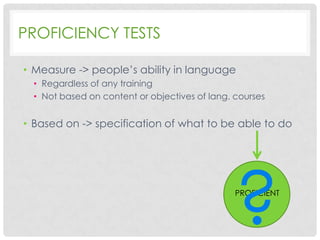
PROFICIENCY TESTS
• Measure -> people’s ability in language
• Regardless of any training
• Not based on content or objectives of lang. courses

• Based on -> specification of what to be able to do

?

PROFICIENT
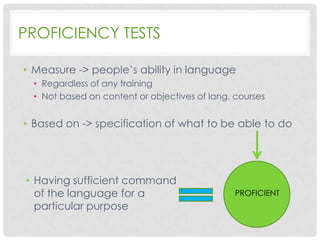
PROFICIENCY TESTS
• Measure -> people’s ability in language
• Regardless of any training
• Not based on content or objectives of lang. courses

• Based on -> specification of what to be able to do

• Having sufficient command
of the language for a
particular purpose

PROFICIENT
PROFICIENCY TESTS
• Measure -> people’s ability in language
• Regardless of any training
• Not based on content or objectives of lang. courses

• Based on -> specification of what to be able to do

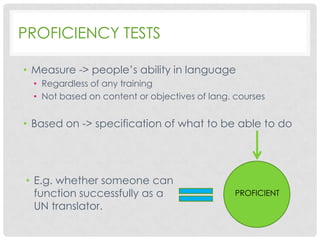
• E.g. whether someone can
function successfully as a
UN translator.

PROFICIENT
PROFICIENCY TESTS
• Measure -> people’s ability in language
• Regardless of any training
• Not based on content or objectives of lang. courses

• Based on -> specification of what to be able to do

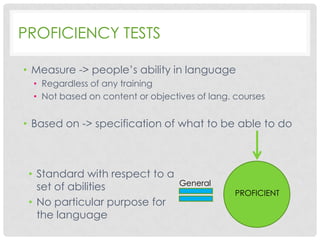
• Standard with respect to a
set of abilities
• No particular purpose for
the language

General

PROFICIENT
PROFICIENCY TESTS
• Measure -> people’s ability in language
• Regardless of any training
• Not based on content or objectives of lang. courses

• Based on -> specification of what to be able to do

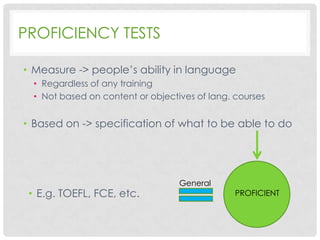
• E.g. TOEFL, FCE, etc.

General

PROFICIENT
PROFICIENCY TESTS

Not based
on courses
that
candidates
may have
taken
previously
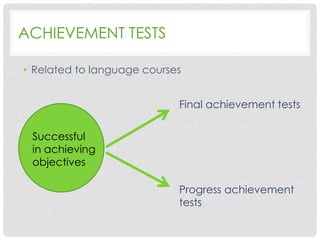
ACHIEVEMENT TESTS
• Related to language courses
Final achievement tests
Successful
in achieving
objectives
Progress achievement
tests
FINAL ACHIEVEMENT TESTS
• At the end of the course of study
• Content related to the course
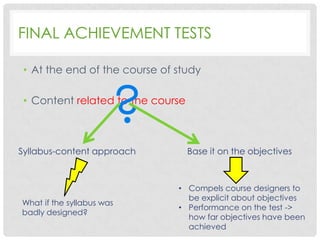
FINAL ACHIEVEMENT TESTS
• At the end of the course of study

?

• Content related to the course

Syllabus-content approach

What if the syllabus was
badly designed?

Base it on the objectives

• Compels course designers to
be explicit about objectives
• Performance on the test ->
how far objectives have been
achieved
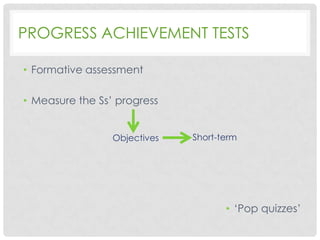
PROGRESS ACHIEVEMENT TESTS
• Formative assessment
• Measure the Ss’ progress
Objectives

Short-term

• ‘Pop quizzes’
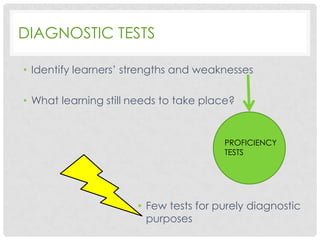
DIAGNOSTIC TESTS
• Identify learners’ strengths and weaknesses
• What learning still needs to take place?

PROFICIENCY
TESTS

• Few tests for purely diagnostic
purposes
PLACEMENT TESTS
• Place Ss at a stage (level) -> abilities
• No placement test will work for every
institution

• Tailor-made -> constructed for
particular situations
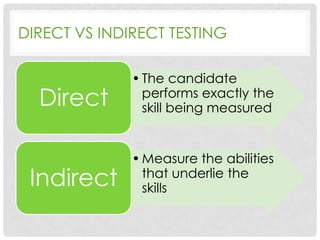
DIRECT VS INDIRECT TESTING

Direct

• The candidate
performs exactly the
skill being measured

Indirect

• Measure the abilities
that underlie the
skills
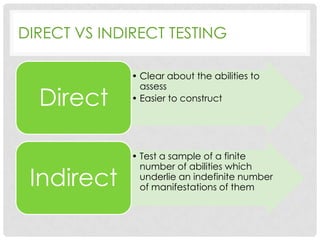
DIRECT VS INDIRECT TESTING

Direct

Indirect

• Clear about the abilities to
assess
• Easier to construct

• Test a sample of a finite
number of abilities which
underlie an indefinite number
of manifestations of them
DIRECT VS INDIRECT TESTING

Direct

Indirect

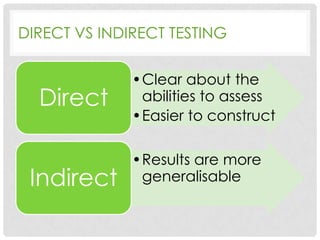
•Clear about the
abilities to assess
•Easier to construct
•Results are more
generalisable
DISCRETE POINT VS INTEGRATIVE TESTING

Discrete
Point

Integrative

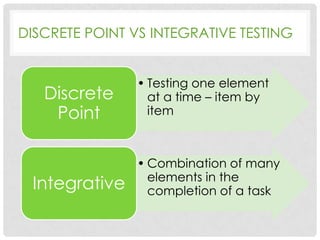
• Testing one element
at a time – item by
item

• Combination of many
elements in the
completion of a task
DISCRETE POINT VS INTEGRATIVE TESTING

Discrete
Point

Integrative

•e.g.

•e.g.
NORM-REFERENCED VS CRITERIONREFERENCED TESTING

NORMREFERENCED

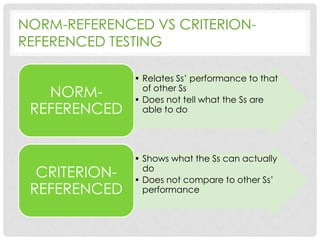
• Relates Ss’ performance to that
of other Ss
• Does not tell what the Ss are
able to do

CRITERIONREFERENCED

• Shows what the Ss can actually
do
• Does not compare to other Ss’
performance
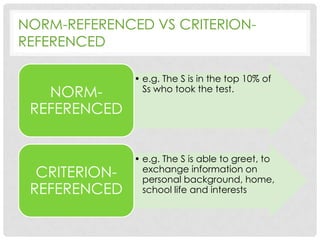
NORM-REFERENCED VS CRITERIONREFERENCED

NORMREFERENCED

CRITERIONREFERENCED

• e.g. The S is in the top 10% of
Ss who took the test.

• e.g. The S is able to greet, to
exchange information on
personal background, home,
school life and interests
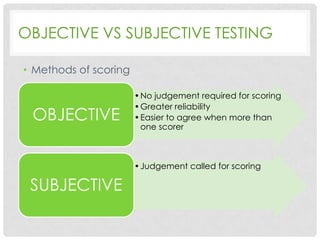
OBJECTIVE VS SUBJECTIVE TESTING
• Methods of scoring

OBJECTIVE

• No judgement required for scoring
• Greater reliability
• Easier to agree when more than
one scorer

• Judgement called for scoring

SUBJECTIVE
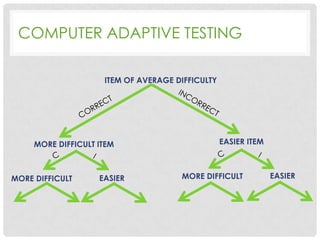
COMPUTER ADAPTIVE TESTING
ITEM OF AVERAGE DIFFICULTY

MORE DIFFICULT ITEM

MORE DIFFICULT

EASIER

EASIER ITEM

MORE DIFFICULT

EASIER
COMMUNICATIVE LANGUAGE TESTING

• Ability to take part in acts of communication

http://www.youtube.com/watch?v=DeFjGWp_8v0
REFERENCE
• Hughes, Arthur. Testing for Language Teachers. New
York: Cambridge UP, 2003.

Kinds of tests and testing

  • 1.
    KINDS OF TESTSAND TESTING PAOLA ENRÍQUEZ D. 2.10.13
  • 2.
    OUTLINE • Tests accordingto the information they provide • Proficienccy tests • Achievement tests • Diagnostic tests • Placement tests • Direct VS. Indirect testing • Discrete point VS. Integrative testing • Norm-referenced VS. Criterion-referenced testing • Objective VS. Subjective testing • Computer adaptive testing • Communicative language testing
  • 3.
    PROFICIENCY TESTS • Measure-> people’s ability in language • Regardless of any training • Not based on content or objectives of lang. courses • Based on -> specification of what to be able to do ? PROFICIENT
  • 4.
    PROFICIENCY TESTS • Measure-> people’s ability in language • Regardless of any training • Not based on content or objectives of lang. courses • Based on -> specification of what to be able to do • Having sufficient command of the language for a particular purpose PROFICIENT
  • 5.
    PROFICIENCY TESTS • Measure-> people’s ability in language • Regardless of any training • Not based on content or objectives of lang. courses • Based on -> specification of what to be able to do • E.g. whether someone can function successfully as a UN translator. PROFICIENT
  • 6.
    PROFICIENCY TESTS • Measure-> people’s ability in language • Regardless of any training • Not based on content or objectives of lang. courses • Based on -> specification of what to be able to do • Standard with respect to a set of abilities • No particular purpose for the language General PROFICIENT
  • 7.
    PROFICIENCY TESTS • Measure-> people’s ability in language • Regardless of any training • Not based on content or objectives of lang. courses • Based on -> specification of what to be able to do • E.g. TOEFL, FCE, etc. General PROFICIENT
  • 8.
    PROFICIENCY TESTS Not based oncourses that candidates may have taken previously
  • 9.
    ACHIEVEMENT TESTS • Relatedto language courses Final achievement tests Successful in achieving objectives Progress achievement tests
  • 10.
    FINAL ACHIEVEMENT TESTS •At the end of the course of study • Content related to the course
  • 11.
    FINAL ACHIEVEMENT TESTS •At the end of the course of study ? • Content related to the course Syllabus-content approach What if the syllabus was badly designed? Base it on the objectives • Compels course designers to be explicit about objectives • Performance on the test -> how far objectives have been achieved
  • 12.
    PROGRESS ACHIEVEMENT TESTS •Formative assessment • Measure the Ss’ progress Objectives Short-term • ‘Pop quizzes’
  • 13.
    DIAGNOSTIC TESTS • Identifylearners’ strengths and weaknesses • What learning still needs to take place? PROFICIENCY TESTS • Few tests for purely diagnostic purposes
  • 14.
    PLACEMENT TESTS • PlaceSs at a stage (level) -> abilities • No placement test will work for every institution • Tailor-made -> constructed for particular situations
  • 15.
    DIRECT VS INDIRECTTESTING Direct • The candidate performs exactly the skill being measured Indirect • Measure the abilities that underlie the skills
  • 16.
    DIRECT VS INDIRECTTESTING Direct Indirect • Clear about the abilities to assess • Easier to construct • Test a sample of a finite number of abilities which underlie an indefinite number of manifestations of them
  • 17.
    DIRECT VS INDIRECTTESTING Direct Indirect •Clear about the abilities to assess •Easier to construct •Results are more generalisable
  • 18.
    DISCRETE POINT VSINTEGRATIVE TESTING Discrete Point Integrative • Testing one element at a time – item by item • Combination of many elements in the completion of a task
  • 19.
    DISCRETE POINT VSINTEGRATIVE TESTING Discrete Point Integrative •e.g. •e.g.
  • 20.
    NORM-REFERENCED VS CRITERIONREFERENCEDTESTING NORMREFERENCED • Relates Ss’ performance to that of other Ss • Does not tell what the Ss are able to do CRITERIONREFERENCED • Shows what the Ss can actually do • Does not compare to other Ss’ performance
  • 21.
    NORM-REFERENCED VS CRITERIONREFERENCED NORMREFERENCED CRITERIONREFERENCED •e.g. The S is in the top 10% of Ss who took the test. • e.g. The S is able to greet, to exchange information on personal background, home, school life and interests
  • 22.
    OBJECTIVE VS SUBJECTIVETESTING • Methods of scoring OBJECTIVE • No judgement required for scoring • Greater reliability • Easier to agree when more than one scorer • Judgement called for scoring SUBJECTIVE
  • 23.
    COMPUTER ADAPTIVE TESTING ITEMOF AVERAGE DIFFICULTY MORE DIFFICULT ITEM MORE DIFFICULT EASIER EASIER ITEM MORE DIFFICULT EASIER
  • 24.
    COMMUNICATIVE LANGUAGE TESTING •Ability to take part in acts of communication http://www.youtube.com/watch?v=DeFjGWp_8v0
  • 25.
    REFERENCE • Hughes, Arthur.Testing for Language Teachers. New York: Cambridge UP, 2003.