Nurul Fuadah bt Mohd Hassan
Sakinah bt Mohamad @Md.Som
            Noraziah bt Razak
     Nur Hanisah bt Alimuddin
   Language learning is about the acquisition
    of communicative competence, i.e. about
    learning how to use language appropriately
    in various communicative situations (Braun,
    2006).
   The usefulness of CL in teaching and
    learning has received growing attention and
    recognition (Hunston 2002; Sinclair 2004;
    Conrad 2005;
    O’Keeffe, McCarthy, and Carter 2007;
    Bennett 2010; Reppen 2010).
   According to Barlow (2002):

   Syllabus Design
   Materials Development
   Classroom Activities
   Written Language: Language teachers are now using on-line corpora
    in the classroom to help learners distinguish central and typical uses
    of words from mannered, poetic, and erroneous uses. (Ejerhed &
    Church)
   Grammar: Written Language Corpora have been used to improve
    spelling correctors, hyphenation routines and grammar checkers,
    which are being integrated into commercial word-processing
    packages. (Ejerhed & Church)
   Corpus linguistics has provided a new weapon for translation
    studies, broadened the research scope and introduced a brand-new
    thought pattern for translation scholars. This paper introduces the
    design and application of Translational English Corpus (Shen Guo-
    rong, 2010).
   By applying the techniques used by corpus linguists in the study of
    natural language texts to a corpus of programming language texts
    (i.e., source code repositories), we can gain new insights into the
    communication medium that is programming language (Delorey,
    Knutson and Davies).
   According to (Johns and King 1991: iii), DDL is ‘the
    use in the classroom of computer generated
    concordances to get students to explore the
    regularities of patterning in the target language, and
    the development of activities and exercises based on
    concordance output’.
   An opportunity for lifelong learning in the field of
    language education.
   Fits well with contemporary learning paradigms and
    with the so-called 21st C learning or lifelong
    learning.
   Emerged in the mid-1980s.
   Research on DDL:
    - Vocabulary Acquisition (Steven, 1991; Cobb, 1997)
    - Writing Instruction (Gaskell & Cobb, 2004; Ross &
   The Longman Learners’ Corpus
   The International Corpus of Learner English
    (ICLE)
   World English Corpus
   The British National Corpus (BNC)
   ELISA (English Language Interview Corpus as a
    Second-language Application) (Braun, 2006).
   Contains a series of narrative interviews with
    native speakers of different varieties of English
    and from different walks of life.
   Covers a variety of communicatively relevant
    topics from the broad area of professional,
    social and cultural life.
   Spoken discourse is becoming increasingly
    important in international communication and
    hence in the learning and teaching context.
   Spontaneous conversation certainly has a role
    to play in language learning.
•   Title of Article: A Corpus Based Study of
    Idioms in Academic Writing
•   Writers: Rita Simpson And Dushyanthi Mendis
•   Link:
    http://203.72.145.166/TESOL/TQD_2008/VOL
•   Purpose of study: addresses the advantages
    and limitations of a corpus-based approach to
    researching and teaching idioms in a specific
    genre by drawing on a specialized corpus of
    1.7million words of academic discourse.
•   a specialized corpus of contemporary speech
    recorded at the University of Michigan between
    1997 and 2001.
•   It is freely available and searchable via the Web.
•   It contains 197 hours of recorded speech,
    totaling about 1.7 million words in 152 speech
    events.
•   These speech events range from large lectures,
    to dissertation defenses, to one-on-one office-
    hour interactions and small peer-led study group
    sessions, and each transcript is categorized
    along several dimensions, including primary
    discourse mode and academic division.
   Definition of Idiom: a group of words that
    occur in a more or less fixed phrase and
    whose overall meaning cannot be predicted
    by analyzing the meanings of its constituent
    parts.
   Research questions:
   (a) How many idioms occur in the various sub
    registers within academic spoken language?
   (b) What functions do these idioms perform?
   They found 238 idiom types, with 562 tokens in
    the corpus.
   Over half of these idiom types occur only once, and
    about10% occur more than four times in the
    corpus.
   They found that 11 transcripts of a variety of
    speech events contained 10 or more idioms.
   The speech events included in these transcripts are
    of an organic chemistry study group, a meeting
    between a graduate student and his adviser, a class
    on ethics issues in journalism, and a large public
    lecture by a recent Nobel laureate in physics.
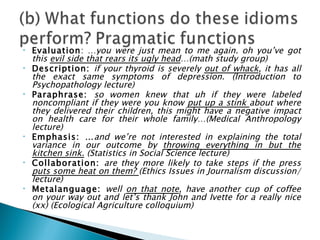
•   Evaluation: …you were just mean to me again. oh you’ve got
    this evil side that rears its ugly head…(math study group)
•   Description: if your thyroid is severely out of whack, it has all
    the exact same symptoms of depression. (Introduction to
    Psychopathology lecture)
•   Paraphrase: so women knew that uh if they were labeled
    noncompliant if they were you know put up a stink about where
    they delivered their children, this might have a negative impact
    on health care for their whole family…(Medical Anthropology
    lecture)
•   Emphasis: …and we’re not interested in explaining the total
    variance in our outcome by throwing everything in but the
    kitchen sink. (Statistics in Social Science lecture)
•   Collaboration: are they more likely to take steps if the press
    puts some heat on them? (Ethics Issues in Journalism discussion/
    lecture)
•   Metalanguage: well on that note, have another cup of coffee
    on your way out and let’s thank John and Ivette for a really nice
    (xx) (Ecological Agriculture colloquium)
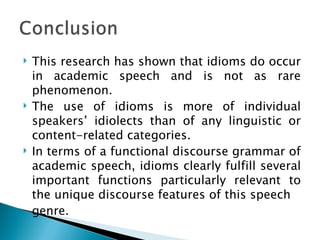
   This research has shown that idioms do occur
    in academic speech and is not as rare
    phenomenon.
   The use of idioms is more of individual
    speakers’ idiolects than of any linguistic or
    content-related categories.
   In terms of a functional discourse grammar of
    academic speech, idioms clearly fulfill several
    important functions particularly relevant to
    the unique discourse features of this speech
    genre.
   Braun, Sabine (2006): ELISA - a pedagogically enriched corpus for language learning
    purposes. In: Braun, Sabine; Kohn, Kurt & Joybrato Mukherjee (eds), forthcoming. Retrieved
    21st April 2012 from http://epubs.surrey.ac.uk/1292/1/fulltext.pdf
   Chambers, Angela (2005): Integrating corpus consultation in language studies. Language
    Learning & Technology 9, 111-125. Retrieved 21st April 2012 from
    http://llt.msu.edu/vol9num2/pdf/chambers.pdf
   Daniel P. Delorey, Charles D. Knutson, and Mark Davies : Mining programming
    language vocabularies from source code. Retrieved 25th April 2012
   Ejerhed, E. & Church, K. Written Language Corpora, Retrieved 24th April 2012 from
    http://speech.bme.ogi.edu/HLTsurvey/ch12node4.html#SECTION122
   Granger, Sylviane (2003): The international corpus of learner English: a new resource for
    foreign language learning and teaching and second language acquisition research. TESOL
    Quarterly 37:3, 538-545. Retrieved 21st April 2012 from http://nhlrc.ucla.edu/media/files/
    KISSELEV--International-Corpus-of-Learner-Eng-2w-4xg.pdf
   Meunier, Fanny (2011): Corpus linguistics and second/foreign language learning:
    exploring multiple paths. RBLA, Belo Horizonte, 11, 459-477. Retrieved 21st April 2012
    from http://www.scielo.br/pdf/rbla/v11n2/a08v11n2.pdf
   Pascual Pérez-Paredes, María Sánchez-Tornel, José M. Alcaraz Calero (2011): The
    role of corpus linguistics in developing innovation in data-driven language learning.
    Congreso Internacional De Innovacion Docente Universidad Politecnica De Cartagena.
    Retrieved 21st April 2012 from
    http://repositorio.bib.upct.es/dspace/bitstream/10317/2209/1/c159.pdf
   SHEN Guo-rong (2010): Corpus-based approaches to translation studies. Cross-cultural
                                             th

Corpus linguistics in language learning

  • 1.
    Nurul Fuadah btMohd Hassan Sakinah bt Mohamad @Md.Som Noraziah bt Razak Nur Hanisah bt Alimuddin
  • 2.
    Language learning is about the acquisition of communicative competence, i.e. about learning how to use language appropriately in various communicative situations (Braun, 2006).  The usefulness of CL in teaching and learning has received growing attention and recognition (Hunston 2002; Sinclair 2004; Conrad 2005; O’Keeffe, McCarthy, and Carter 2007; Bennett 2010; Reppen 2010).
  • 3.
    According to Barlow (2002):  Syllabus Design  Materials Development  Classroom Activities
  • 4.
    Written Language: Language teachers are now using on-line corpora in the classroom to help learners distinguish central and typical uses of words from mannered, poetic, and erroneous uses. (Ejerhed & Church)  Grammar: Written Language Corpora have been used to improve spelling correctors, hyphenation routines and grammar checkers, which are being integrated into commercial word-processing packages. (Ejerhed & Church)  Corpus linguistics has provided a new weapon for translation studies, broadened the research scope and introduced a brand-new thought pattern for translation scholars. This paper introduces the design and application of Translational English Corpus (Shen Guo- rong, 2010).  By applying the techniques used by corpus linguists in the study of natural language texts to a corpus of programming language texts (i.e., source code repositories), we can gain new insights into the communication medium that is programming language (Delorey, Knutson and Davies).
  • 5.
    According to (Johns and King 1991: iii), DDL is ‘the use in the classroom of computer generated concordances to get students to explore the regularities of patterning in the target language, and the development of activities and exercises based on concordance output’.  An opportunity for lifelong learning in the field of language education.  Fits well with contemporary learning paradigms and with the so-called 21st C learning or lifelong learning.  Emerged in the mid-1980s.  Research on DDL: - Vocabulary Acquisition (Steven, 1991; Cobb, 1997) - Writing Instruction (Gaskell & Cobb, 2004; Ross &
  • 6.
    The Longman Learners’ Corpus  The International Corpus of Learner English (ICLE)  World English Corpus  The British National Corpus (BNC)
  • 7.
    ELISA (English Language Interview Corpus as a Second-language Application) (Braun, 2006).  Contains a series of narrative interviews with native speakers of different varieties of English and from different walks of life.  Covers a variety of communicatively relevant topics from the broad area of professional, social and cultural life.  Spoken discourse is becoming increasingly important in international communication and hence in the learning and teaching context.  Spontaneous conversation certainly has a role to play in language learning.
  • 8.
    Title of Article: A Corpus Based Study of Idioms in Academic Writing • Writers: Rita Simpson And Dushyanthi Mendis • Link: http://203.72.145.166/TESOL/TQD_2008/VOL • Purpose of study: addresses the advantages and limitations of a corpus-based approach to researching and teaching idioms in a specific genre by drawing on a specialized corpus of 1.7million words of academic discourse.
  • 9.
    a specialized corpus of contemporary speech recorded at the University of Michigan between 1997 and 2001. • It is freely available and searchable via the Web. • It contains 197 hours of recorded speech, totaling about 1.7 million words in 152 speech events. • These speech events range from large lectures, to dissertation defenses, to one-on-one office- hour interactions and small peer-led study group sessions, and each transcript is categorized along several dimensions, including primary discourse mode and academic division.
  • 10.
    Definition of Idiom: a group of words that occur in a more or less fixed phrase and whose overall meaning cannot be predicted by analyzing the meanings of its constituent parts.  Research questions:  (a) How many idioms occur in the various sub registers within academic spoken language?  (b) What functions do these idioms perform?
  • 11.
    They found 238 idiom types, with 562 tokens in the corpus.  Over half of these idiom types occur only once, and about10% occur more than four times in the corpus.  They found that 11 transcripts of a variety of speech events contained 10 or more idioms.  The speech events included in these transcripts are of an organic chemistry study group, a meeting between a graduate student and his adviser, a class on ethics issues in journalism, and a large public lecture by a recent Nobel laureate in physics.
  • 12.
    Evaluation: …you were just mean to me again. oh you’ve got this evil side that rears its ugly head…(math study group) • Description: if your thyroid is severely out of whack, it has all the exact same symptoms of depression. (Introduction to Psychopathology lecture) • Paraphrase: so women knew that uh if they were labeled noncompliant if they were you know put up a stink about where they delivered their children, this might have a negative impact on health care for their whole family…(Medical Anthropology lecture) • Emphasis: …and we’re not interested in explaining the total variance in our outcome by throwing everything in but the kitchen sink. (Statistics in Social Science lecture) • Collaboration: are they more likely to take steps if the press puts some heat on them? (Ethics Issues in Journalism discussion/ lecture) • Metalanguage: well on that note, have another cup of coffee on your way out and let’s thank John and Ivette for a really nice (xx) (Ecological Agriculture colloquium)
  • 13.
    This research has shown that idioms do occur in academic speech and is not as rare phenomenon.  The use of idioms is more of individual speakers’ idiolects than of any linguistic or content-related categories.  In terms of a functional discourse grammar of academic speech, idioms clearly fulfill several important functions particularly relevant to the unique discourse features of this speech genre.
  • 14.
    Braun, Sabine (2006): ELISA - a pedagogically enriched corpus for language learning purposes. In: Braun, Sabine; Kohn, Kurt & Joybrato Mukherjee (eds), forthcoming. Retrieved 21st April 2012 from http://epubs.surrey.ac.uk/1292/1/fulltext.pdf  Chambers, Angela (2005): Integrating corpus consultation in language studies. Language Learning & Technology 9, 111-125. Retrieved 21st April 2012 from http://llt.msu.edu/vol9num2/pdf/chambers.pdf  Daniel P. Delorey, Charles D. Knutson, and Mark Davies : Mining programming language vocabularies from source code. Retrieved 25th April 2012  Ejerhed, E. & Church, K. Written Language Corpora, Retrieved 24th April 2012 from http://speech.bme.ogi.edu/HLTsurvey/ch12node4.html#SECTION122  Granger, Sylviane (2003): The international corpus of learner English: a new resource for foreign language learning and teaching and second language acquisition research. TESOL Quarterly 37:3, 538-545. Retrieved 21st April 2012 from http://nhlrc.ucla.edu/media/files/ KISSELEV--International-Corpus-of-Learner-Eng-2w-4xg.pdf  Meunier, Fanny (2011): Corpus linguistics and second/foreign language learning: exploring multiple paths. RBLA, Belo Horizonte, 11, 459-477. Retrieved 21st April 2012 from http://www.scielo.br/pdf/rbla/v11n2/a08v11n2.pdf  Pascual Pérez-Paredes, María Sánchez-Tornel, José M. Alcaraz Calero (2011): The role of corpus linguistics in developing innovation in data-driven language learning. Congreso Internacional De Innovacion Docente Universidad Politecnica De Cartagena. Retrieved 21st April 2012 from http://repositorio.bib.upct.es/dspace/bitstream/10317/2209/1/c159.pdf  SHEN Guo-rong (2010): Corpus-based approaches to translation studies. Cross-cultural th