LANGUAGE TESTING


                       Language Testing is the practice and
                       study of evaluating the proficiency of an
                       individual in using a particular language
                       effectively.
                                                Winning entry from the 2009/10
                                                Priscilla Allen, University of Washington.


http://washington.academia.edu/PriscillaAllen
LANGUAGE TESTING
The activity of developing and using language
tests. As a psychometric activity, language testing
traditionally was more concerned with the
production, development and analysis of tests.
Recent critical and ethical approaches to language
testing have placed more emphasis on the uses of
language tests. The purpose of a language test is
to determine a person’s knowledge and/or ability
in the language and to discriminate that person’s
ability from that of others.


                  Alan Davies, University of Edinburgh.
LANGUAGE TESTING

Such ability may be of different kinds,
achievement, proficiency or aptitude. Tests, unlike
scales, consist of specified tasks through which
language abilities are elicited. The term language
assessment is used in free variation with language
testing although it is also used somewhat more
widely to include for example classroom testing
for learning and institutional examinations.


                   Alan Davies, University of Edinburgh.
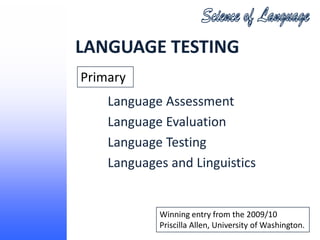
LANGUAGE TESTING
Primary
    Language Assessment
    Language Evaluation
    Language Testing
    Languages and Linguistics


            Winning entry from the 2009/10
            Priscilla Allen, University of Washington.
LANGUAGE TESTING
Language Assessment

Language assessment is a
program under the field of
applied linguistics that essentially
focuses on evaluating a person’s
fluency in a language.

                            By: Karize Uy
LANGUAGE TESTING
                 Language Assessment

                  The foundation of a language
                  assessment involves its language
                  content standards and language
                  policies.

                                                          By: Karize Uy
http://www.wisegeek.com/what-is-language-assessment.htm
LANGUAGE TESTING
                 Language Assessment

                  These two determine what a
                  student should learn from a
                  language course and the
                  expectations and goals he should
                  meet by the end of the course.
                                                          By: Karize Uy

http://www.wisegeek.com/what-is-language-assessment.htm
LANGUAGE TESTING
                 Language Assessment

                 Another important factor in a
                 language assessment is the
                 language performance standard.
                 This determines the language skills a
                 student should develop in order to
                 pass the assessment.
                                                          By: Karize Uy
http://www.wisegeek.com/what-is-language-assessment.htm
LANGUAGE TESTING
                 Language Assessment
                 This can include skills such as
                 reading, writing, speaking, and listening.
                 These skills can be evaluated by, for
                 example, counting the number of pauses
                 within talk time, the use of different syntax
                 and patterns for sentences, and even the
                 knowledge of proper etiquette during
                 situational conversations.
                                                          By: Karize Uy
http://www.wisegeek.com/what-is-language-assessment.htm
LANGUAGE TESTING
                 Language Assessment

                 Collecting information on the progress of
                 students’ learning using a variety of
                 procedures (e.g., checklists, formal tests,
                 inventories, self-assessment, writing
                 folders).


                                                          By: Karize Uy
http://www.wisegeek.com/what-is-language-assessment.htm
LANGUAGE TESTING
                Language Evaluation

                Evaluation is used for various
                purposes in education. Student
                evaluation gauges students’
                growth, development, and
                progress against stated learning
                objectives.

http://www.sasked.gov.sk.ca/docs/ela20/eval.html
LANGUAGE TESTING
                Language Evaluation


                Making judgements on the basis
                of the information collected.


http://www.sasked.gov.sk.ca/docs/ela20/eval.html
LANGUAGE TESTING
                Language Evaluation

                Evaluation tells educators the strengths and
                weaknesses of the program in order that
                adjustments and adaptations can be made. In
                addition, teachers grow professionally when they
                reflect on their own teaching and when they keep
                informed of current instructional strategies and
                evaluation methods they may use in their
                programs.

http://www.sasked.gov.sk.ca/docs/ela20/eval.html
LANGUAGE TESTING
Language Evaluation
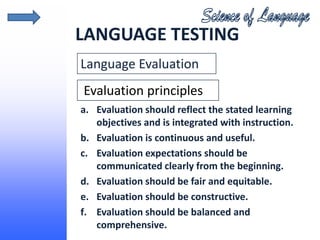
Evaluation principles
a. Evaluation should reflect the stated learning
   objectives and is integrated with instruction.
b. Evaluation is continuous and useful.
c. Evaluation expectations should be
   communicated clearly from the beginning.
d. Evaluation should be fair and equitable.
e. Evaluation should be constructive.
f. Evaluation should be balanced and
   comprehensive.

Language Testing

  • 1.
    LANGUAGE TESTING Language Testing is the practice and study of evaluating the proficiency of an individual in using a particular language effectively. Winning entry from the 2009/10 Priscilla Allen, University of Washington. http://washington.academia.edu/PriscillaAllen
  • 2.
    LANGUAGE TESTING The activityof developing and using language tests. As a psychometric activity, language testing traditionally was more concerned with the production, development and analysis of tests. Recent critical and ethical approaches to language testing have placed more emphasis on the uses of language tests. The purpose of a language test is to determine a person’s knowledge and/or ability in the language and to discriminate that person’s ability from that of others. Alan Davies, University of Edinburgh.
  • 3.
    LANGUAGE TESTING Such abilitymay be of different kinds, achievement, proficiency or aptitude. Tests, unlike scales, consist of specified tasks through which language abilities are elicited. The term language assessment is used in free variation with language testing although it is also used somewhat more widely to include for example classroom testing for learning and institutional examinations. Alan Davies, University of Edinburgh.
  • 4.
    LANGUAGE TESTING Primary Language Assessment Language Evaluation Language Testing Languages and Linguistics Winning entry from the 2009/10 Priscilla Allen, University of Washington.
  • 5.
    LANGUAGE TESTING Language Assessment Languageassessment is a program under the field of applied linguistics that essentially focuses on evaluating a person’s fluency in a language. By: Karize Uy
  • 6.
    LANGUAGE TESTING Language Assessment The foundation of a language assessment involves its language content standards and language policies. By: Karize Uy http://www.wisegeek.com/what-is-language-assessment.htm
  • 7.
    LANGUAGE TESTING Language Assessment These two determine what a student should learn from a language course and the expectations and goals he should meet by the end of the course. By: Karize Uy http://www.wisegeek.com/what-is-language-assessment.htm
  • 8.
    LANGUAGE TESTING Language Assessment Another important factor in a language assessment is the language performance standard. This determines the language skills a student should develop in order to pass the assessment. By: Karize Uy http://www.wisegeek.com/what-is-language-assessment.htm
  • 9.
    LANGUAGE TESTING Language Assessment This can include skills such as reading, writing, speaking, and listening. These skills can be evaluated by, for example, counting the number of pauses within talk time, the use of different syntax and patterns for sentences, and even the knowledge of proper etiquette during situational conversations. By: Karize Uy http://www.wisegeek.com/what-is-language-assessment.htm
  • 10.
    LANGUAGE TESTING Language Assessment Collecting information on the progress of students’ learning using a variety of procedures (e.g., checklists, formal tests, inventories, self-assessment, writing folders). By: Karize Uy http://www.wisegeek.com/what-is-language-assessment.htm
  • 11.
    LANGUAGE TESTING Language Evaluation Evaluation is used for various purposes in education. Student evaluation gauges students’ growth, development, and progress against stated learning objectives. http://www.sasked.gov.sk.ca/docs/ela20/eval.html
  • 12.
    LANGUAGE TESTING Language Evaluation Making judgements on the basis of the information collected. http://www.sasked.gov.sk.ca/docs/ela20/eval.html
  • 13.
    LANGUAGE TESTING Language Evaluation Evaluation tells educators the strengths and weaknesses of the program in order that adjustments and adaptations can be made. In addition, teachers grow professionally when they reflect on their own teaching and when they keep informed of current instructional strategies and evaluation methods they may use in their programs. http://www.sasked.gov.sk.ca/docs/ela20/eval.html
  • 14.
    LANGUAGE TESTING Language Evaluation Evaluationprinciples a. Evaluation should reflect the stated learning objectives and is integrated with instruction. b. Evaluation is continuous and useful. c. Evaluation expectations should be communicated clearly from the beginning. d. Evaluation should be fair and equitable. e. Evaluation should be constructive. f. Evaluation should be balanced and comprehensive.