




Presented: Mary Honey T. Quilab
ADAPTING
INSTRUCTIONAL
MATERIALS
TABLE OF
CONTENTS
DEFINITIONS OF MATERIALS
ADAPTATION
01
REASONS FOR ADAPTING
INSTRUCTIONAL MATERIALS
02
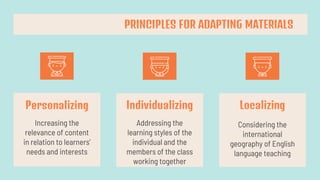
PRINCIPLES FOR ADAPTING
MATERIALS
03
TABLE OF
CONTENTS
04
05
06
POINTS TO REMEMBER IN ADAPTING
MATERIALS
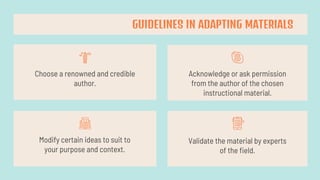
GUIDELINES IN ADAPTING MATERIALS
ADAPTING TEXTBOOKS AND
SUPPLEMENTARY MATERIALS
DEFINITIONS OF
MATERIALS
ADAPTATION
01
The process of
modification of the
original composition of
the material to suit the
content of the
intended learners
Modifying primary
source documents so
that all students can
read and analyze them
in their classrooms
The application of
some strategies to
make the learning
materials more
effective and flexible
DEFINITIONS OF MATERIALS ADAPTATION
REASONS FOR
ADAPTING
MATERIALS
02
To achieve congruence, among
several related variables like
the teaching materials,
methodologies, students,
course objectives, the target
language, subject matter, and
the teacher’s own personality
and teaching style
REASONS FOR ADAPTING MATERIALS
SALUT
BONJOUR
To make learning materials
more meaningful and offer
opportunities and challenges
for the students to
communicate in various
contexts
REASONS FOR ADAPTING MATERIALS
SALUT
BONJOUR
PRINCIPLES
FOR ADAPTING
MATERIALS
03
Increasing the
relevance of content
in relation to learners’
needs and interests
Personalizing
Addressing the
learning styles of the
individual and the
members of the class
working together
Individualizing
Considering the
international
geography of English
language teaching
Localizing
PRINCIPLES FOR ADAPTING MATERIALS
POINTS TO
REMEMBER IN
ADAPTING
MATERIALS
04
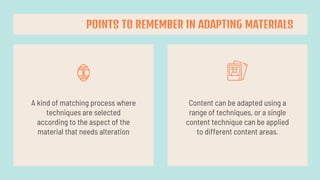
A kind of matching process where
techniques are selected
according to the aspect of the
material that needs alteration
Content can be adapted using a
range of techniques, or a single
content technique can be applied
to different content areas.
POINTS TO REMEMBER IN ADAPTING MATERIALS
Adaptation can have both
quantitative and qualitative
effects.
Techniques can be used
individually or in combination
with others.
POINTS TO REMEMBER IN ADAPTING MATERIALS
GUIDELINES IN
ADAPTING
MATERIALS
05
Choose a renowned and credible
author.
Acknowledge or ask permission
from the author of the chosen
instructional material.
Modify certain ideas to suit to
your purpose and context.
Validate the material by experts
of the field.
GUIDELINES IN ADAPTING MATERIALS
ADAPTING
TEXTBOOKS AND
SUPPLEMENTARY
MATERIALS
06
A good teacher must…
• select appropriately from what is
available
• be creative with what is available
• modify activities to suit learners’
needs
• supplement by providing extra
activities
ADAPTING TEXTBOOKS AND SUPPLEMENTARY MATERIALS
HOLA
ADAPTING TEXTBOOKS AND SUPPLEMENTARY MATERIALS
To adapt commercial textbooks…
• modify content
 re-write
 re-structure
• modify tasks
 add or delete content
 reorganize content
 address omissions
 extend tasks
GUTEN
TAG
ADAPTING TEXTBOOKS AND SUPPLEMENTARY MATERIALS
To adapt commercial textbooks…
• expand
 subtract
 abridge
GUTEN
TAG
Appropriating language materials for the
“marginalized” sector of the society
INCLUSIVITY
ADAPTING TEXTBOOKS AND SUPPLEMENTARY MATERIALS
• Language determines
thought and behavior
patterns of people.
• Language reflects
values of society.
Why?
• Instructional materials
have lasting influences
in propagating negative
ideas.
• Instructional materials
have a way of
perpetuating
stereotypes.
Why?
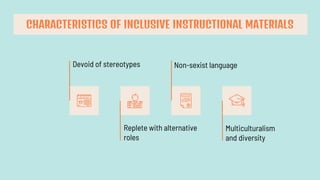
Devoid of stereotypes
Replete with alternative
roles
Non-sexist language
Multiculturalism
and diversity
CHARACTERISTICS OF INCLUSIVE INSTRUCTIONAL MATERIALS
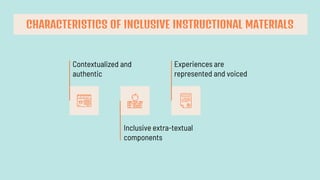
Contextualized and
authentic
Inclusive extra-textual
components
Experiences are
represented and voiced
CHARACTERISTICS OF INCLUSIVE INSTRUCTIONAL MATERIALS
THANK
YOU!

Adapting materials

  • 1.
    Presented: Mary HoneyT. Quilab ADAPTING INSTRUCTIONAL MATERIALS
  • 2.
    TABLE OF CONTENTS DEFINITIONS OFMATERIALS ADAPTATION 01 REASONS FOR ADAPTING INSTRUCTIONAL MATERIALS 02 PRINCIPLES FOR ADAPTING MATERIALS 03
  • 3.
    TABLE OF CONTENTS 04 05 06 POINTS TOREMEMBER IN ADAPTING MATERIALS GUIDELINES IN ADAPTING MATERIALS ADAPTING TEXTBOOKS AND SUPPLEMENTARY MATERIALS
  • 4.
  • 5.
    The process of modificationof the original composition of the material to suit the content of the intended learners Modifying primary source documents so that all students can read and analyze them in their classrooms The application of some strategies to make the learning materials more effective and flexible DEFINITIONS OF MATERIALS ADAPTATION
  • 6.
  • 7.
    To achieve congruence,among several related variables like the teaching materials, methodologies, students, course objectives, the target language, subject matter, and the teacher’s own personality and teaching style REASONS FOR ADAPTING MATERIALS SALUT BONJOUR
  • 8.
    To make learningmaterials more meaningful and offer opportunities and challenges for the students to communicate in various contexts REASONS FOR ADAPTING MATERIALS SALUT BONJOUR
  • 9.
  • 10.
    Increasing the relevance ofcontent in relation to learners’ needs and interests Personalizing Addressing the learning styles of the individual and the members of the class working together Individualizing Considering the international geography of English language teaching Localizing PRINCIPLES FOR ADAPTING MATERIALS
  • 11.
  • 12.
    A kind ofmatching process where techniques are selected according to the aspect of the material that needs alteration Content can be adapted using a range of techniques, or a single content technique can be applied to different content areas. POINTS TO REMEMBER IN ADAPTING MATERIALS
  • 13.
    Adaptation can haveboth quantitative and qualitative effects. Techniques can be used individually or in combination with others. POINTS TO REMEMBER IN ADAPTING MATERIALS
  • 14.
  • 15.
    Choose a renownedand credible author. Acknowledge or ask permission from the author of the chosen instructional material. Modify certain ideas to suit to your purpose and context. Validate the material by experts of the field. GUIDELINES IN ADAPTING MATERIALS
  • 16.
  • 17.
    A good teachermust… • select appropriately from what is available • be creative with what is available • modify activities to suit learners’ needs • supplement by providing extra activities ADAPTING TEXTBOOKS AND SUPPLEMENTARY MATERIALS HOLA
  • 18.
    ADAPTING TEXTBOOKS ANDSUPPLEMENTARY MATERIALS To adapt commercial textbooks… • modify content  re-write  re-structure • modify tasks  add or delete content  reorganize content  address omissions  extend tasks GUTEN TAG
  • 19.
    ADAPTING TEXTBOOKS ANDSUPPLEMENTARY MATERIALS To adapt commercial textbooks… • expand  subtract  abridge GUTEN TAG
  • 20.
    Appropriating language materialsfor the “marginalized” sector of the society INCLUSIVITY ADAPTING TEXTBOOKS AND SUPPLEMENTARY MATERIALS
  • 21.
    • Language determines thoughtand behavior patterns of people. • Language reflects values of society. Why?
  • 22.
    • Instructional materials havelasting influences in propagating negative ideas. • Instructional materials have a way of perpetuating stereotypes. Why?
  • 23.
    Devoid of stereotypes Repletewith alternative roles Non-sexist language Multiculturalism and diversity CHARACTERISTICS OF INCLUSIVE INSTRUCTIONAL MATERIALS
  • 24.
    Contextualized and authentic Inclusive extra-textual components Experiencesare represented and voiced CHARACTERISTICS OF INCLUSIVE INSTRUCTIONAL MATERIALS
  • 25.