













Language
Acquisition


        5th Level
T:Lama Albabtain
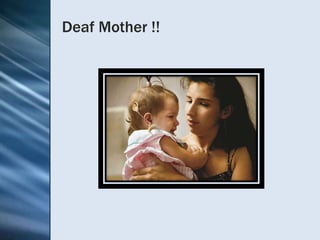
Deaf Mother !!
Chimps ?
What is Language Acquistion ?
Language acquisition is the process by which
  humans acquire the capacity to perceive and
comprehend language, as well as to produce and
   use words and sentences to communicate.
Language acquisition usually refers to first
language acquisition, which studies infants'
acquisition of their native language. This is
distinguished from second language
acquisition, which deals with the acquisition (in
both children and adults) of additional
languages.
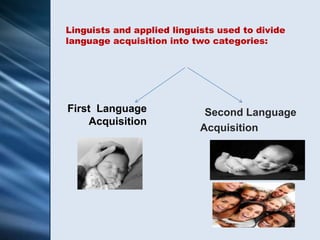
Linguists and applied linguists used to divide
language acquisition into two categories:


First Language               Second Language
    Acquisition
                            Acquisition
1- what is First Language Acquisition -
First Language Acquisition is a universal process
         regardless of home language.

                                                    •
First Language Acquisition
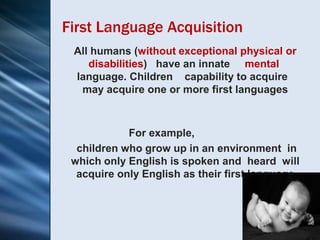
 All humans (without exceptional physical or
    disabilities) have an innate mental
 language. Children capability to acquire
  may acquire one or more first languages


            For example,
  children who grow up in an environment in
 which only English is spoken and heard will
  acquire only English as their first language
When does First Language Acquisition
occur?
•
 Acquisition occurs passively and unconsciously
through implicit learning. In other words, children
   do not need explicit instruction to acquire their
   first language but rather seem to just "pick up"
            language in the same way they learn to
                               eat, drink, and walk
Second language acquisition
•
    Second language acquisition assumes that A
    second language learner has A good knowledge
    about his/her first language before starting the
    process of learning the elements of the second
    language including its vocabulary, phonological
    components, grammatical patterns, language
    functions, structures, and writing rules .
As a mater of fact, knowing a first language affects
the process of second language acquisition in
two different ways. Some researchers believe
that second language acquisition is often
hindered by the knowledge of one's first languag
•
   All humans have the ability to learn additional
 languages although, just as with other areas of
     study like math or science, some people are
better at learning second languages than others.
Older children and adults may learn one or more
                               second languages
What Is The Difference Between
Acquisition And Learning
As opposed to acquisition, learning occurs
actively and consciously through explicit
instruction and education. In other words, older
children and adults need explicit teaching to
learn their second languages. Language learning
requires explicit instruction in speaking and
hearing additional languages.
For example, while children who acquire English •
as their first language just seem unconsciously
and without instruction to "know" that most
adjectives precede nouns in English, those same
children as adults must be taught that most
adjectives follow nouns in Spanish
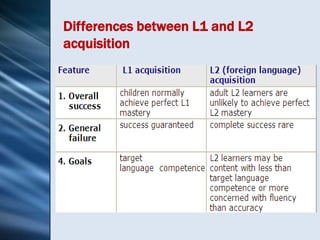
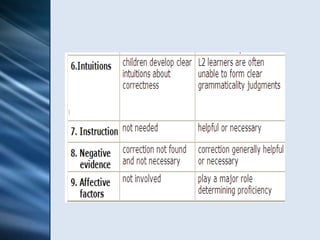
Differences between L1 and L2
          Acquisition
Differences between L1 and L2
acquisition
Some Facts About Language
       Acquisition
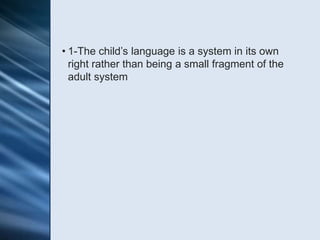
• 1-The child’s language is a system in its own
  right rather than being a small fragment of the
  adult system
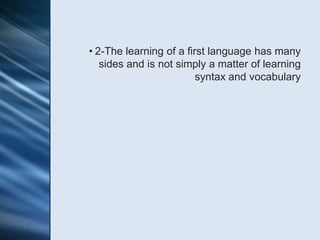
• 2-The learning of a first language has many
   sides and is not simply a matter of learning
                         syntax and vocabulary
• 3-The use of the first language goes hand in
     hand with the child’s needs and interests
• 4-Wherever there is a relationship between
  cognition and language development, language
  depends on cognition
• 5-The child’s use and learning of language is
  partly determined by mental capacity
6-There are particular stages of development
through which all children progress, even if the rate
               of progression varies
• 7-The child learns to adapt its language use to
  particular situations
• 8-Adults adapt their speech in systematic ways
  when talking to children

Language acquisition 1st lecture

  • 1.
    Language Acquisition 5th Level T:Lama Albabtain
  • 3.
  • 4.
  • 6.
    What is LanguageAcquistion ?
  • 7.
    Language acquisition isthe process by which humans acquire the capacity to perceive and comprehend language, as well as to produce and use words and sentences to communicate.
  • 8.
    Language acquisition usuallyrefers to first language acquisition, which studies infants' acquisition of their native language. This is distinguished from second language acquisition, which deals with the acquisition (in both children and adults) of additional languages.
  • 9.
    Linguists and appliedlinguists used to divide language acquisition into two categories: First Language Second Language Acquisition Acquisition
  • 11.
    1- what isFirst Language Acquisition - First Language Acquisition is a universal process regardless of home language. •
  • 12.
    First Language Acquisition All humans (without exceptional physical or disabilities) have an innate mental language. Children capability to acquire may acquire one or more first languages For example, children who grow up in an environment in which only English is spoken and heard will acquire only English as their first language
  • 13.
    When does FirstLanguage Acquisition occur?
  • 14.
    • Acquisition occurspassively and unconsciously through implicit learning. In other words, children do not need explicit instruction to acquire their first language but rather seem to just "pick up" language in the same way they learn to eat, drink, and walk
  • 15.
    Second language acquisition • Second language acquisition assumes that A second language learner has A good knowledge about his/her first language before starting the process of learning the elements of the second language including its vocabulary, phonological components, grammatical patterns, language functions, structures, and writing rules .
  • 16.
    As a materof fact, knowing a first language affects the process of second language acquisition in two different ways. Some researchers believe that second language acquisition is often hindered by the knowledge of one's first languag
  • 17.
    All humans have the ability to learn additional languages although, just as with other areas of study like math or science, some people are better at learning second languages than others. Older children and adults may learn one or more second languages
  • 18.
    What Is TheDifference Between Acquisition And Learning
  • 19.
    As opposed toacquisition, learning occurs actively and consciously through explicit instruction and education. In other words, older children and adults need explicit teaching to learn their second languages. Language learning requires explicit instruction in speaking and hearing additional languages.
  • 20.
    For example, whilechildren who acquire English • as their first language just seem unconsciously and without instruction to "know" that most adjectives precede nouns in English, those same children as adults must be taught that most adjectives follow nouns in Spanish
  • 21.
    Differences between L1and L2 Acquisition
  • 22.
    Differences between L1and L2 acquisition
  • 24.
    Some Facts AboutLanguage Acquisition
  • 25.
    • 1-The child’slanguage is a system in its own right rather than being a small fragment of the adult system
  • 26.
    • 2-The learningof a first language has many sides and is not simply a matter of learning syntax and vocabulary
  • 27.
    • 3-The useof the first language goes hand in hand with the child’s needs and interests
  • 28.
    • 4-Wherever thereis a relationship between cognition and language development, language depends on cognition
  • 29.
    • 5-The child’suse and learning of language is partly determined by mental capacity
  • 30.
    6-There are particularstages of development through which all children progress, even if the rate of progression varies
  • 31.
    • 7-The childlearns to adapt its language use to particular situations • 8-Adults adapt their speech in systematic ways when talking to children