Child Language Acquisition Speaking.
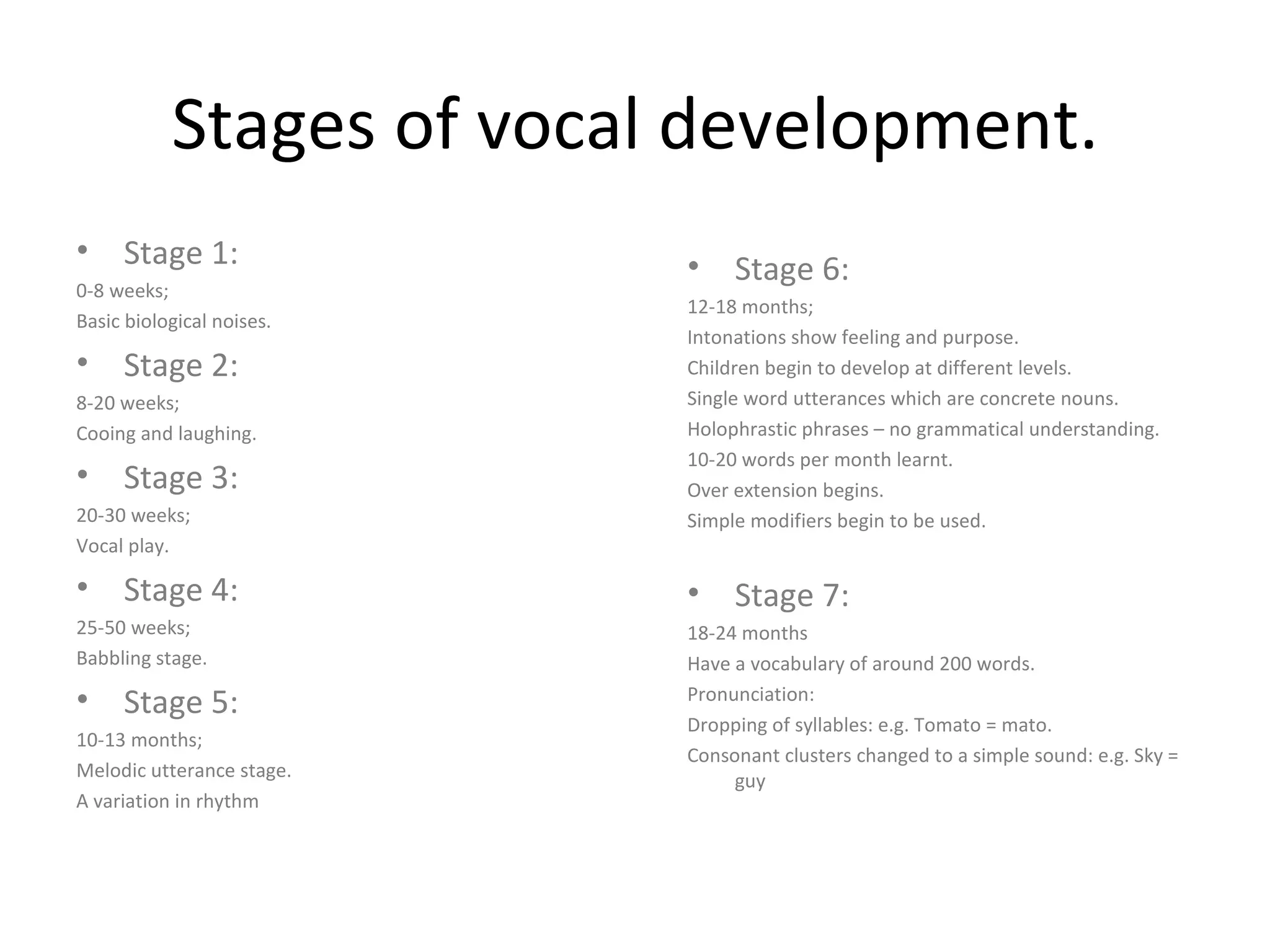
Stages of vocal development. Stage 1: 0-8 weeks; Basic biological noises. Stage 2: 8-20 weeks; Cooing and laughing. Stage 3: 20-30 weeks; Vocal play. Stage 4: 25-50 weeks; Babbling stage. Stage 5: 10-13 months; Melodic utterance stage. A variation in rhythm Stage 6: 12-18 months; Intonations show feeling and purpose. Children begin to develop at different levels. Single word utterances which are concrete nouns. Holophrastic phrases – no grammatical understanding. 10-20 words per month learnt. Over extension begins. Simple modifiers begin to be used. Stage 7: 18-24 months Have a vocabulary of around 200 words. Pronunciation: Dropping of syllables: e.g. Tomato = mato. Consonant clusters changed to a simple sound: e.g. Sky = guy
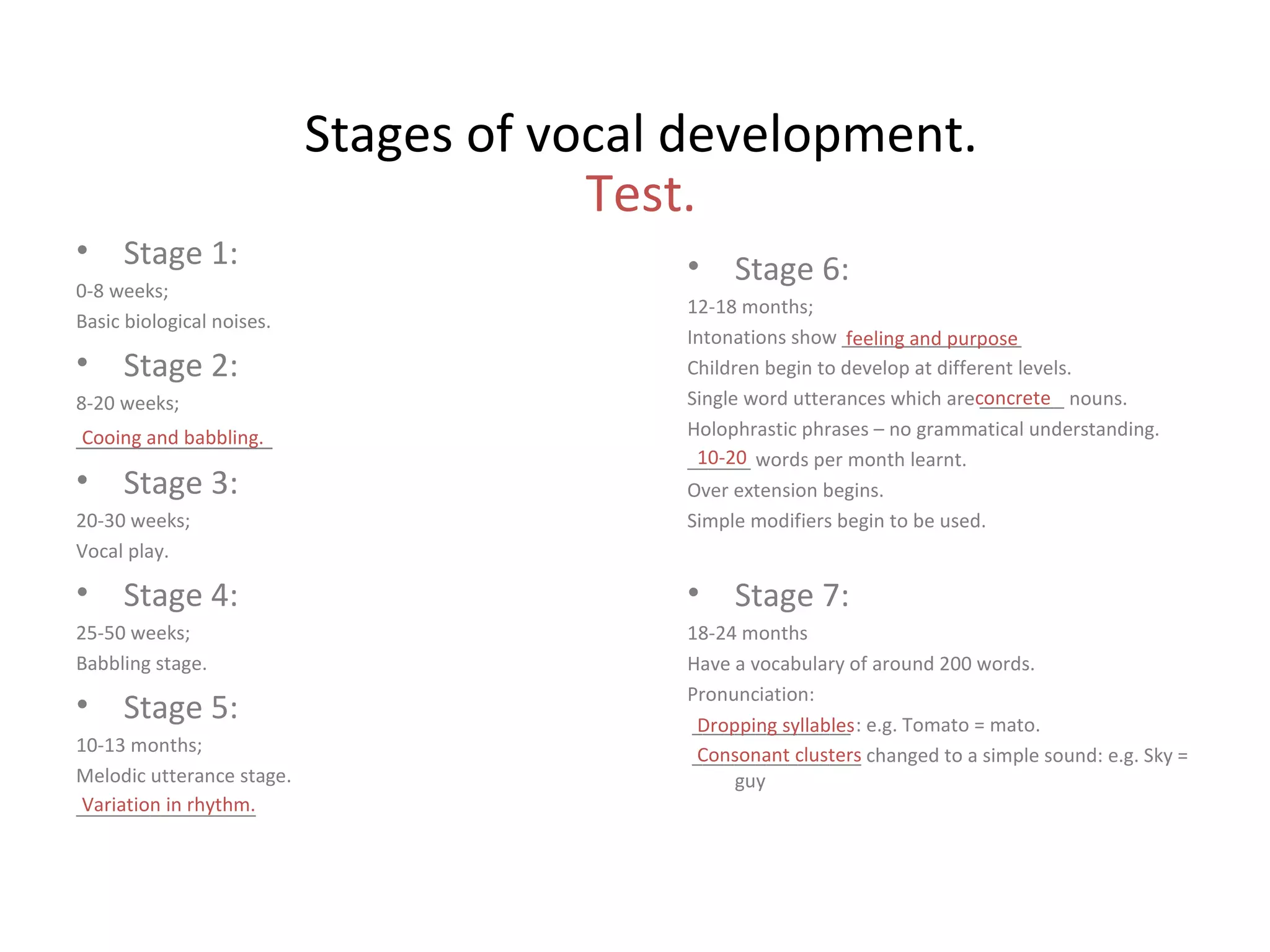
Stages of vocal development. Stage 1: 0-8 weeks; Basic biological noises. Stage 2: 8-20 weeks; ________________ Stage 3: 20-30 weeks; Vocal play. Stage 4: 25-50 weeks; Babbling stage. Stage 5: 10-13 months; Melodic utterance stage. _________________ Stage 6: 12-18 months; Intonations show _________________ Children begin to develop at different levels. Single word utterances which are ________ nouns. Holophrastic phrases – no grammatical understanding. ______ words per month learnt. Over extension begins. Simple modifiers begin to be used. Stage 7: 18-24 months Have a vocabulary of around 200 words. Pronunciation: _______________ : e.g. Tomato = mato. ________________ changed to a simple sound: e.g. Sky = guy Test. Cooing and babbling. Variation in rhythm. feeling and purpose concrete 10-20 Dropping syllables Consonant clusters
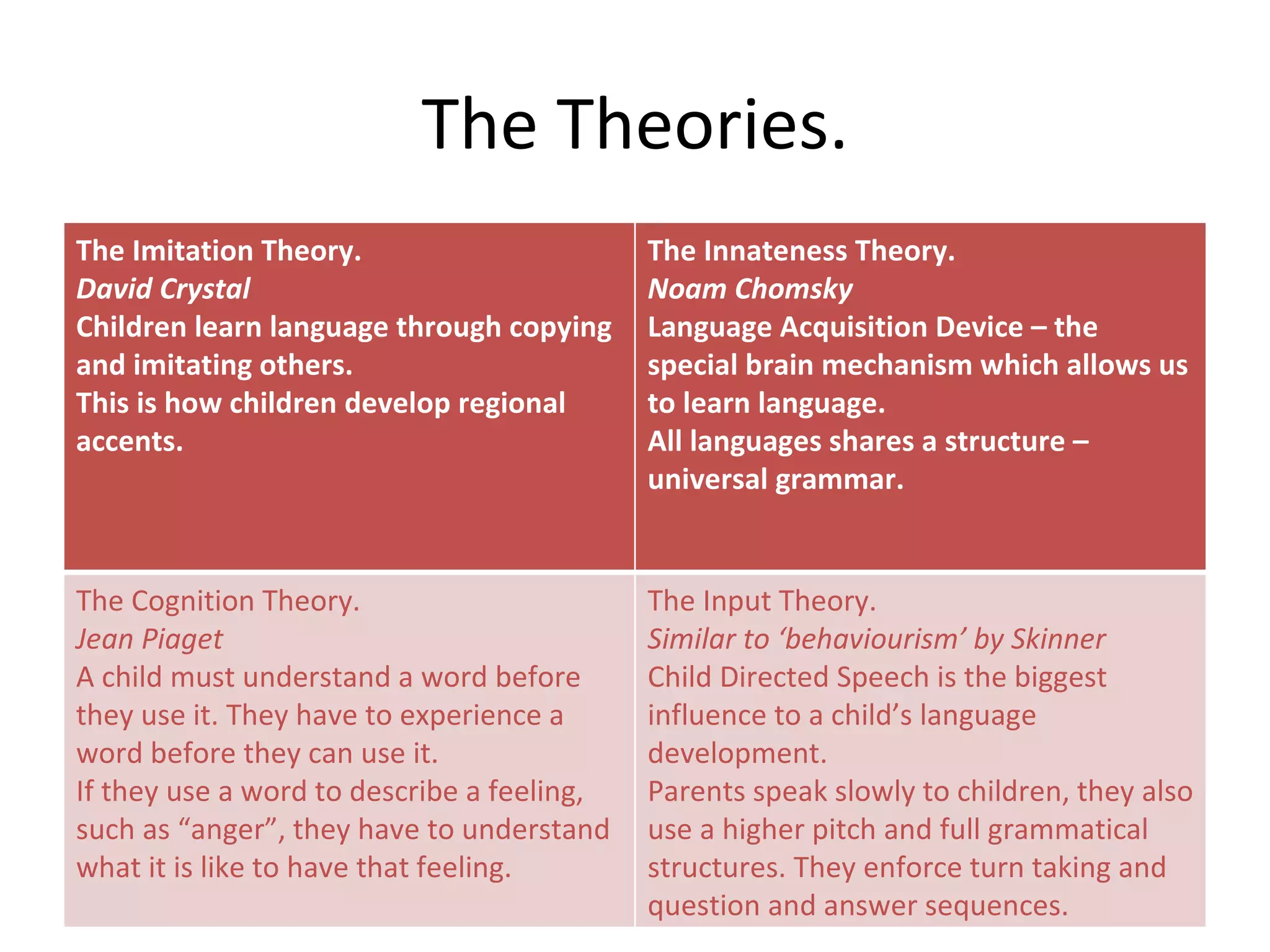
The Theories. The Imitation Theory. David Crystal Children learn language through copying and imitating others. This is how children develop regional accents. The Innateness Theory. Noam Chomsky Language Acquisition Device – the special brain mechanism which allows us to learn language. All languages shares a structure – universal grammar. The Cognition Theory. Jean Piaget A child must understand a word before they use it. They have to experience a word before they can use it. If they use a word to describe a feeling, such as “anger”, they have to understand what it is like to have that feeling. The Input Theory. Similar to ‘behaviourism’ by Skinner Child Directed Speech is the biggest influence to a child’s language development. Parents speak slowly to children, they also use a higher pitch and full grammatical structures. They enforce turn taking and question and answer sequences.
The Theories. Test. The Imitation Theory. David Crystal Children learn language through copying and imitating others. This is how children develop regional accents. The Innateness Theory. Noam Chomsky Language Acquisition Device – the special brain mechanism which allows us to learn language. All languages shares a structure – universal grammar. The Cognition Theory. Jean Piaget A child must understand a word before they use it. They have to experience a word before they can use it. If they use a word to describe a feeling, such as “anger”, they have to understand what it is like to have that feeling. The Input Theory. Similar to ‘behaviourism’ by Skinner Child Directed Speech is the biggest influence to a child’s language development. Parents speak slowly to children, they also use a higher pitch and full grammatical structures. They enforce turn taking and question and answer sequences.
Over and underextension Categorical Analogical Mismatch Statements One word is applied to everything in that category. For example: “apple” = orange, peach... Other round fruits. One word used to describe something in a different category. For example: “ball” = apple, melon... Other things which resemble a ball. The word used is random, has loose association with the objet. Perhaps through the environment or the child’s personal experience. For example: “duck” = When they see an empty pond.
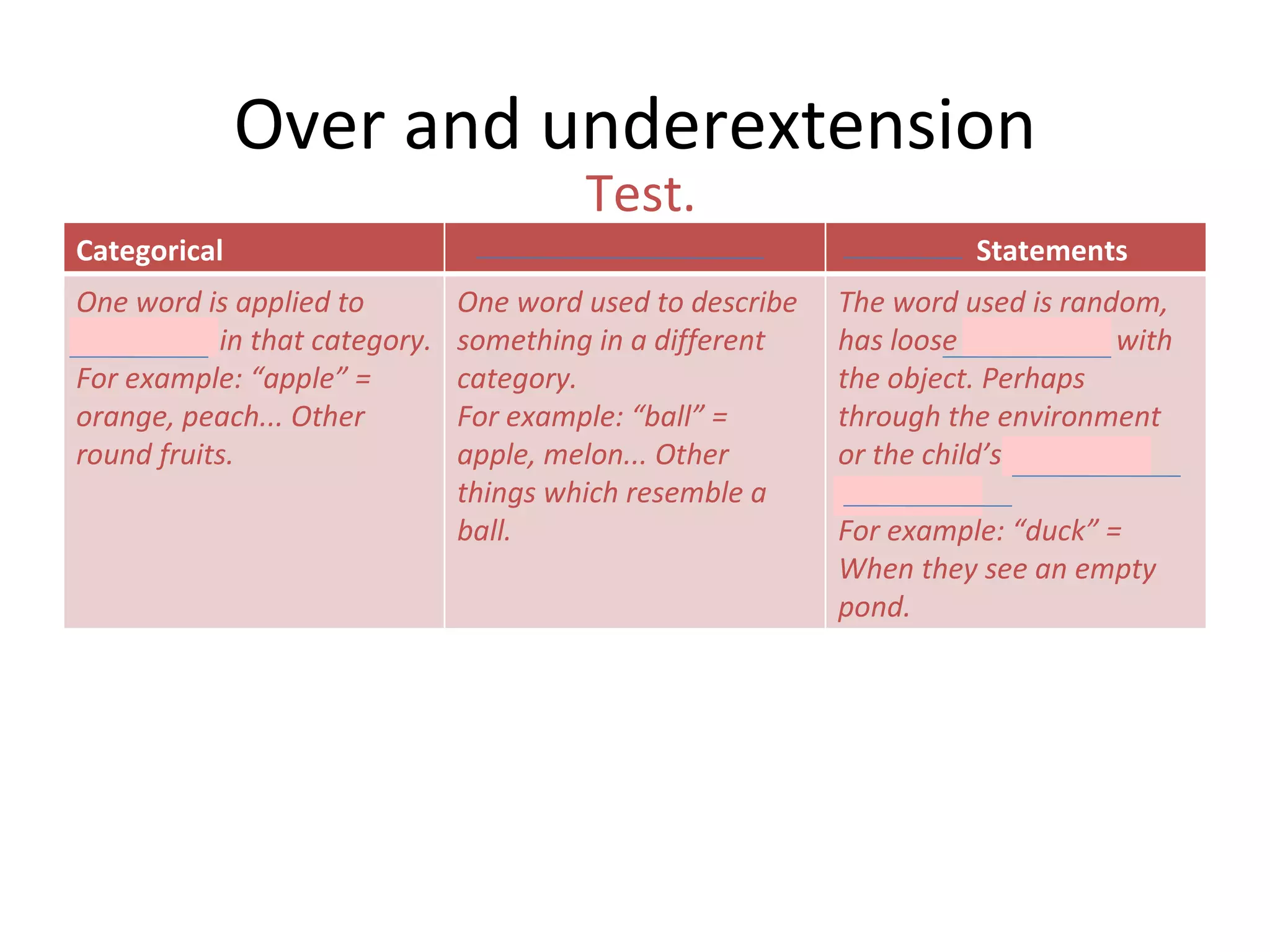
Over and underextension Test. Categorical Analogical Mismatch Statements One word is applied to everything in that category. For example: “apple” = orange, peach... Other round fruits. One word used to describe something in a different category. For example: “ball” = apple, melon... Other things which resemble a ball. The word used is random, has loose association with the object. Perhaps through the environment or the child’s personal experience. For example: “duck” = When they see an empty pond.
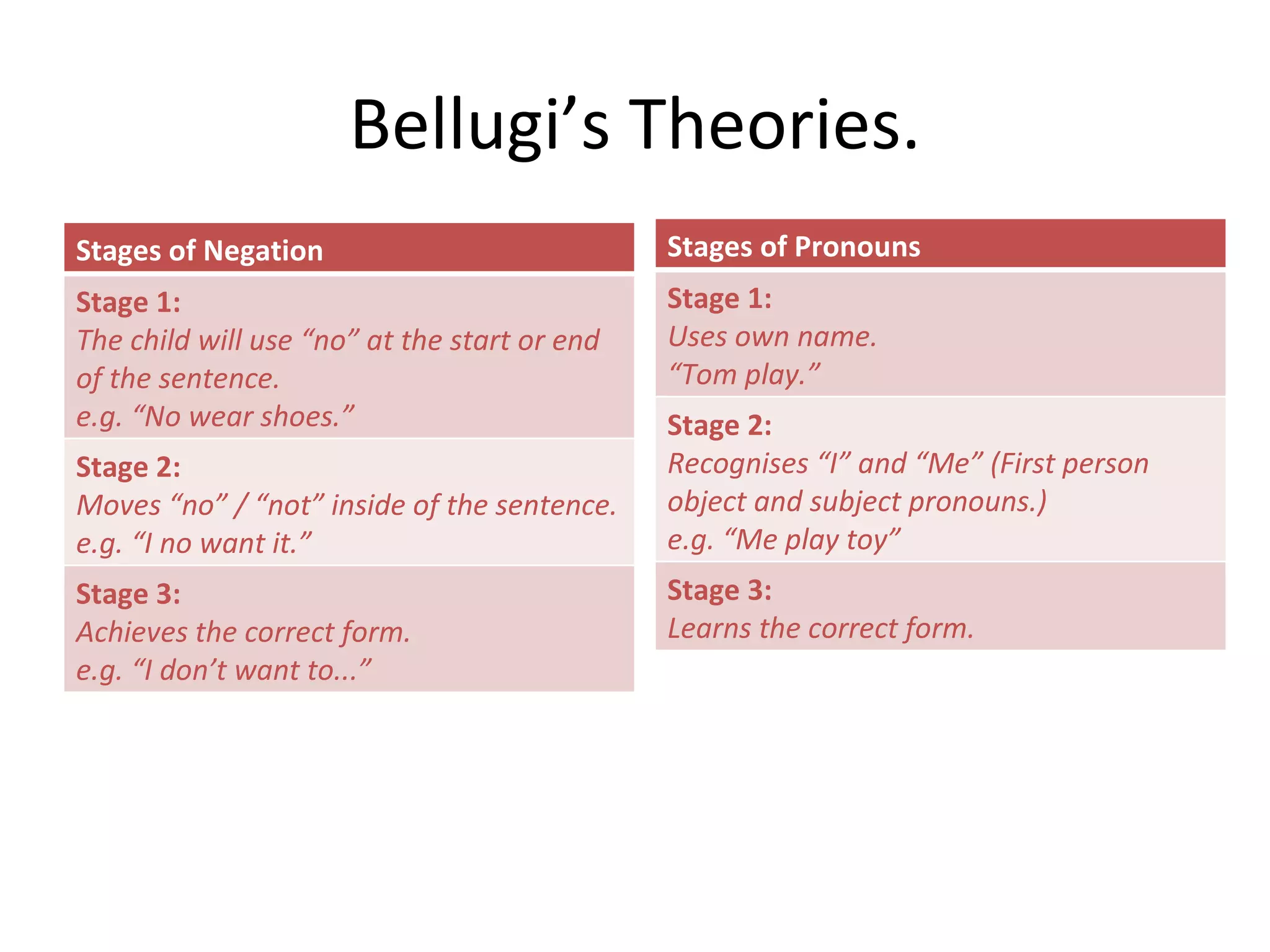
Bellugi’s Theories. Stages of Negation Stage 1: The child will use “no” at the start or end of the sentence. e.g. “No wear shoes.” Stage 2: Moves “no” / “not” inside of the sentence. e.g. “I no want it.” Stage 3: Achieves the correct form. e.g. “I don’t want to...” Stages of Pronouns Stage 1: Uses own name. “ Tom play.” Stage 2: Recognises “I” and “Me” (First person object and subject pronouns.) e.g. “Me play toy” Stage 3: Learns the correct form.
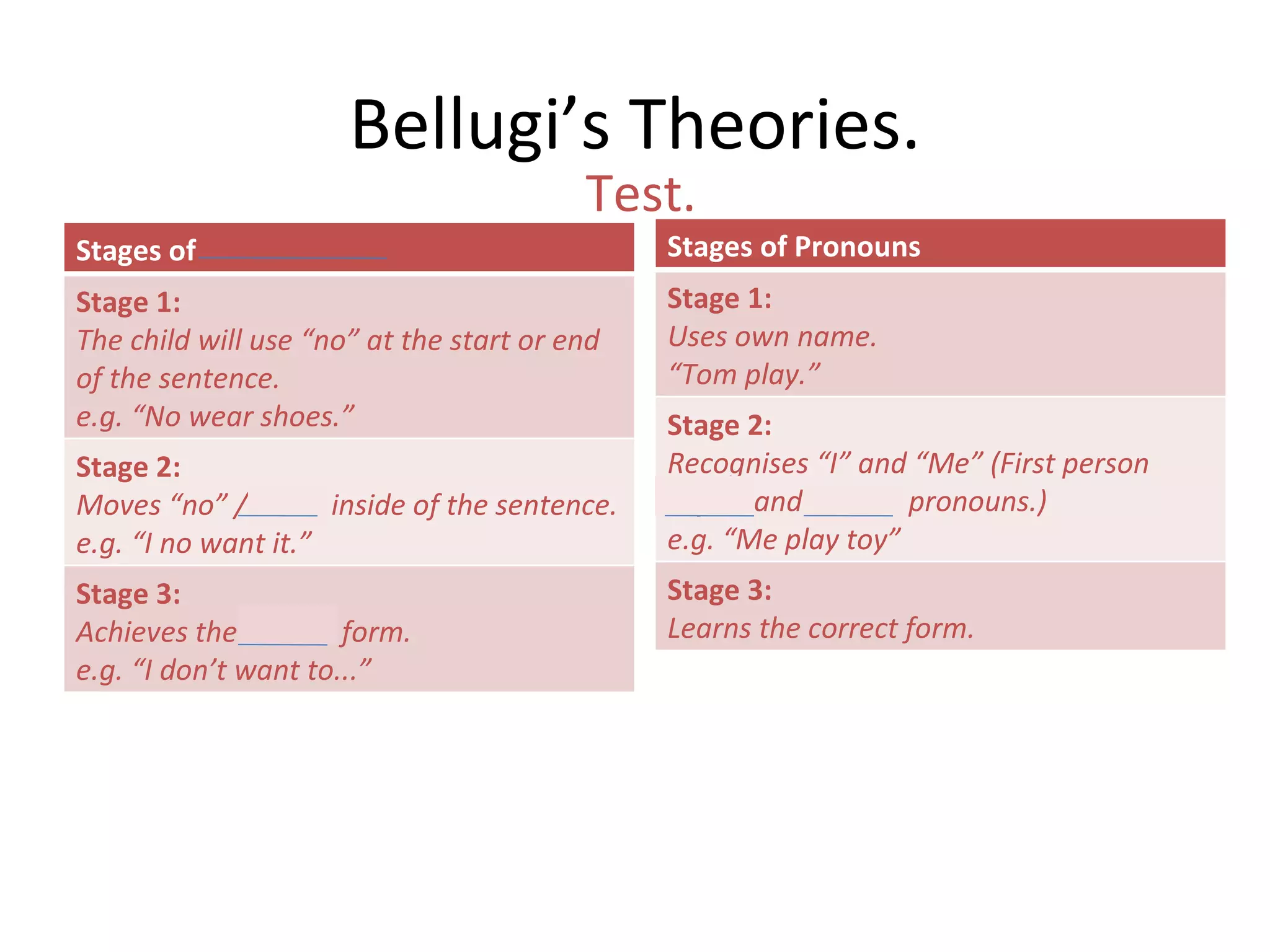
Bellugi’s Theories. Test. Stages of Negation Stage 1: The child will use “no” at the start or end of the sentence. e.g. “No wear shoes.” Stage 2: Moves “no” / “not” inside of the sentence. e.g. “I no want it.” Stage 3: Achieves the correct form. e.g. “I don’t want to...” Stages of Pronouns Stage 1: Uses own name. “ Tom play.” Stage 2: Recognises “I” and “Me” (First person object and subject pronouns.) e.g. “Me play toy” Stage 3: Learns the correct form.

Child language acquisition

  • 1.
  • 2.
    Stages of vocaldevelopment. Stage 1: 0-8 weeks; Basic biological noises. Stage 2: 8-20 weeks; Cooing and laughing. Stage 3: 20-30 weeks; Vocal play. Stage 4: 25-50 weeks; Babbling stage. Stage 5: 10-13 months; Melodic utterance stage. A variation in rhythm Stage 6: 12-18 months; Intonations show feeling and purpose. Children begin to develop at different levels. Single word utterances which are concrete nouns. Holophrastic phrases – no grammatical understanding. 10-20 words per month learnt. Over extension begins. Simple modifiers begin to be used. Stage 7: 18-24 months Have a vocabulary of around 200 words. Pronunciation: Dropping of syllables: e.g. Tomato = mato. Consonant clusters changed to a simple sound: e.g. Sky = guy
  • 3.
    Stages of vocaldevelopment. Stage 1: 0-8 weeks; Basic biological noises. Stage 2: 8-20 weeks; ________________ Stage 3: 20-30 weeks; Vocal play. Stage 4: 25-50 weeks; Babbling stage. Stage 5: 10-13 months; Melodic utterance stage. _________________ Stage 6: 12-18 months; Intonations show _________________ Children begin to develop at different levels. Single word utterances which are ________ nouns. Holophrastic phrases – no grammatical understanding. ______ words per month learnt. Over extension begins. Simple modifiers begin to be used. Stage 7: 18-24 months Have a vocabulary of around 200 words. Pronunciation: _______________ : e.g. Tomato = mato. ________________ changed to a simple sound: e.g. Sky = guy Test. Cooing and babbling. Variation in rhythm. feeling and purpose concrete 10-20 Dropping syllables Consonant clusters
  • 4.
    The Theories. TheImitation Theory. David Crystal Children learn language through copying and imitating others. This is how children develop regional accents. The Innateness Theory. Noam Chomsky Language Acquisition Device – the special brain mechanism which allows us to learn language. All languages shares a structure – universal grammar. The Cognition Theory. Jean Piaget A child must understand a word before they use it. They have to experience a word before they can use it. If they use a word to describe a feeling, such as “anger”, they have to understand what it is like to have that feeling. The Input Theory. Similar to ‘behaviourism’ by Skinner Child Directed Speech is the biggest influence to a child’s language development. Parents speak slowly to children, they also use a higher pitch and full grammatical structures. They enforce turn taking and question and answer sequences.
  • 5.
    The Theories. Test.The Imitation Theory. David Crystal Children learn language through copying and imitating others. This is how children develop regional accents. The Innateness Theory. Noam Chomsky Language Acquisition Device – the special brain mechanism which allows us to learn language. All languages shares a structure – universal grammar. The Cognition Theory. Jean Piaget A child must understand a word before they use it. They have to experience a word before they can use it. If they use a word to describe a feeling, such as “anger”, they have to understand what it is like to have that feeling. The Input Theory. Similar to ‘behaviourism’ by Skinner Child Directed Speech is the biggest influence to a child’s language development. Parents speak slowly to children, they also use a higher pitch and full grammatical structures. They enforce turn taking and question and answer sequences.
  • 6.
    Over and underextensionCategorical Analogical Mismatch Statements One word is applied to everything in that category. For example: “apple” = orange, peach... Other round fruits. One word used to describe something in a different category. For example: “ball” = apple, melon... Other things which resemble a ball. The word used is random, has loose association with the objet. Perhaps through the environment or the child’s personal experience. For example: “duck” = When they see an empty pond.
  • 7.
    Over and underextensionTest. Categorical Analogical Mismatch Statements One word is applied to everything in that category. For example: “apple” = orange, peach... Other round fruits. One word used to describe something in a different category. For example: “ball” = apple, melon... Other things which resemble a ball. The word used is random, has loose association with the object. Perhaps through the environment or the child’s personal experience. For example: “duck” = When they see an empty pond.
  • 8.
    Bellugi’s Theories. Stagesof Negation Stage 1: The child will use “no” at the start or end of the sentence. e.g. “No wear shoes.” Stage 2: Moves “no” / “not” inside of the sentence. e.g. “I no want it.” Stage 3: Achieves the correct form. e.g. “I don’t want to...” Stages of Pronouns Stage 1: Uses own name. “ Tom play.” Stage 2: Recognises “I” and “Me” (First person object and subject pronouns.) e.g. “Me play toy” Stage 3: Learns the correct form.
  • 9.
    Bellugi’s Theories. Test.Stages of Negation Stage 1: The child will use “no” at the start or end of the sentence. e.g. “No wear shoes.” Stage 2: Moves “no” / “not” inside of the sentence. e.g. “I no want it.” Stage 3: Achieves the correct form. e.g. “I don’t want to...” Stages of Pronouns Stage 1: Uses own name. “ Tom play.” Stage 2: Recognises “I” and “Me” (First person object and subject pronouns.) e.g. “Me play toy” Stage 3: Learns the correct form.