(Psycholinguistics) 
Presented to: Dr. M Iqbal butt 
Presented By: Muhammad Sajjad Raja
The Goals 
Behaviourist learning theory 
Mentalist theory of language learning 
What is ‘Interlanguage’ ? 
A computional model of L2 acquisition
Interlanguage 
Earlier we noted that some researchers 
consider that the systematic development of 
learner langauge refelects a mental system of 
L2 knowledge. This system is often reffered to 
as interlanguage. To understand what is 
meantby interlangauge we need to briefly 
consider behaviourist learning theory and 
mentalist views of language learning.
Behaviourist Learning Theory 
The dominant psychology theory of the 
1950s and 1960s was beahviourist learning 
theory. According to this theory, language 
learning is like any other kind of learning in 
that it involves habit formation. Habits are 
formed when learners respond ti stimuli in the 
enviroment and subsequently have their 
responses reinforced so that they are rembered. 
Thus, a habit is a stimulus-response connection.
Behaviourist Learning Theory 
It was believed that all behaviour, 
including the kind of complex behaviour 
found in language acquisition, could be 
explained in terms of habits. Learning took 
place when learners had the opportunity to 
practise making the correct response to a 
given stimulus. Learners imitated models of 
correct language and received positive 
reinforcement if they were correct and 
negative reinforcement if they were incorrect.
Behaviourist Learning Theory 
Behaviour cannot adequately account 
for L2 acquisition. Learners frequently do not 
produce output that simply reproduce the 
input. Furthermore, the systematic nature of 
their errors demonstrates that they are actively 
involved in constructing their own ‘rules’, 
rules that sometimes bear little resemblance to 
the patterns of language modelled in the input.
A mentalist theory of language 
learning 
The obvious inadequacies of 
behaviourist explanations of L2 
acquisition led researchers to look 
towards an alternative theoretical 
framework. They did not have to look 
very far as the 1960s witnessed a major 
shift in thinking in psychology and 
lingusitic.
In the 1960s and 1970s a mentalist theory of first language (L1) 
acquisition emerged. According to this theory: 
• Only human beings are capable of learning 
language. 
• The human mind is equipped with a faculty for 
learning language, reffered to as a Language 
Acquisition Device. This is separate from the 
faculties responsible for other kinds of cognitive 
activity. 
• This faculty is the primary determinant of 
language acquisition. 
• Inout is needed, but only to ‘trigger’ the operation 
of the language acquisition device.
What is ‘Interlanguage’ ? 
In term ‘interlanguage’ was coined 
by the American linguist, Larry Slinker, in 
recognation of the fact that L2 learners 
construct a linguistic system that draws, in 
part, on the learner’s L1 but is also 
different from it and also from the target 
language. A learner’s interlanguage is, 
therefore, a unique linguistic system.
The concept of interlanguage involves the following premises 
about L2 acquisition: 
• The learner constructs a system of abstract linguistic rules 
which underlies comprehension and production of the L2. 
This system of rules is viewed as a ‘mental grammar’ and is 
reffered to as an ‘interlanguage’. 
• The learner’s grammar is permeable. That is, grammar is 
open to influence from the outside . It is also influence from 
the inside. 
• The learner’s grammar is transitional. Learners change their 
grammar from one time to another by adding rules, deleting 
rules, and restructuring the whole system. This is results in 
an interlanguage continuum. That is, learners construct a 
series of mental grammars or interlanguages as they 
gradually increase the complexity of their L2 knowledge.
The concept of interlanguage involves the following premises 
about L2 acquisition: 
• Some researchers have claimed that the systems learners 
construct contain variable rules. That is, they argue that 
learners are likely to have competing rules at any one stage 
of development. However, other researchers srgue that 
interlanguage systems are homogenous and that variability 
reflects the mistakes learners make when they try to use 
their knowledge to communicate. 
• Learners employ various learning strategies to develop their 
interlanguages. The different kinds of errors learners 
produce reflect different learning strategies. 
• The learner’s grammar is likely to fossilize. The prevalence 
of backsliding is typical of fossilized learners. Fossilization 
does not occur in L1 acquisition and thus is unique to L2 
grammars.
What is ‘interlanguage’ ? 
This concept of interlanguage 
offers a general account of how L2 
acquisition takes place. It incorporates 
elements from mentalist theories of 
linguistic (i.g. the nation of a ‘language 
acquisition device’) and elements from 
cognitive psychology (i.g. ‘learning 
strategies’).
A computional model of L2 
acquisition 
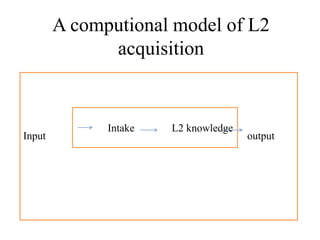
The concept of interlanguage can 
be viewed as a methaphor of how L2 
acquisition takes place. It implies that the 
human mind functions like a computer . 
Figure 3.1 reprents the basic 
computational metaphor that has grown 
out of ‘interlanguage’ and that informs 
much of SLA.
A computional model of L2 
acquisition 
The learner is exposed to input, which is 
processed in two stages. First, parts of it are attended 
to and taken into short-term memory. These are 
reffered to as intake. Second, some of the intake is 
stored in long-term memory as L2 knowledge. The 
processes responsible for creating intake and L2 
knowledge occur within the ‘black box’ of the 
learner’s mind where the learner’s interlanguage is 
constructed. Finally, L2 knowledge is used by the 
learner to produce spoken and written output.
A computional model of L2 
acquisition 
Intake L2 knowledge 
Input output
A computional model of 
language learning 
As we shall shortly see, this basic model of L2 
acquisition can be elaborated in anumber of ways. For 
example, a component labelled ‘social context’ might be 
added to explain how the nature of the input varies from 
one setting to another. The ‘L2 knowledge’ component 
can be broken up into two or more components to reflect 
the different kinds of knowledge learners construct. An 
arrow can be drawn from ‘output’ to ‘input’ to show that 
what a leraner says or writes can also serve as samples of 
language from which intake can be derived.
Ppt of-interlanguage-chapter-3

Ppt of-interlanguage-chapter-3

  • 1.
    (Psycholinguistics) Presented to:Dr. M Iqbal butt Presented By: Muhammad Sajjad Raja
  • 2.
    The Goals Behaviouristlearning theory Mentalist theory of language learning What is ‘Interlanguage’ ? A computional model of L2 acquisition
  • 3.
    Interlanguage Earlier wenoted that some researchers consider that the systematic development of learner langauge refelects a mental system of L2 knowledge. This system is often reffered to as interlanguage. To understand what is meantby interlangauge we need to briefly consider behaviourist learning theory and mentalist views of language learning.
  • 4.
    Behaviourist Learning Theory The dominant psychology theory of the 1950s and 1960s was beahviourist learning theory. According to this theory, language learning is like any other kind of learning in that it involves habit formation. Habits are formed when learners respond ti stimuli in the enviroment and subsequently have their responses reinforced so that they are rembered. Thus, a habit is a stimulus-response connection.
  • 5.
    Behaviourist Learning Theory It was believed that all behaviour, including the kind of complex behaviour found in language acquisition, could be explained in terms of habits. Learning took place when learners had the opportunity to practise making the correct response to a given stimulus. Learners imitated models of correct language and received positive reinforcement if they were correct and negative reinforcement if they were incorrect.
  • 6.
    Behaviourist Learning Theory Behaviour cannot adequately account for L2 acquisition. Learners frequently do not produce output that simply reproduce the input. Furthermore, the systematic nature of their errors demonstrates that they are actively involved in constructing their own ‘rules’, rules that sometimes bear little resemblance to the patterns of language modelled in the input.
  • 7.
    A mentalist theoryof language learning The obvious inadequacies of behaviourist explanations of L2 acquisition led researchers to look towards an alternative theoretical framework. They did not have to look very far as the 1960s witnessed a major shift in thinking in psychology and lingusitic.
  • 8.
    In the 1960sand 1970s a mentalist theory of first language (L1) acquisition emerged. According to this theory: • Only human beings are capable of learning language. • The human mind is equipped with a faculty for learning language, reffered to as a Language Acquisition Device. This is separate from the faculties responsible for other kinds of cognitive activity. • This faculty is the primary determinant of language acquisition. • Inout is needed, but only to ‘trigger’ the operation of the language acquisition device.
  • 9.
    What is ‘Interlanguage’? In term ‘interlanguage’ was coined by the American linguist, Larry Slinker, in recognation of the fact that L2 learners construct a linguistic system that draws, in part, on the learner’s L1 but is also different from it and also from the target language. A learner’s interlanguage is, therefore, a unique linguistic system.
  • 10.
    The concept ofinterlanguage involves the following premises about L2 acquisition: • The learner constructs a system of abstract linguistic rules which underlies comprehension and production of the L2. This system of rules is viewed as a ‘mental grammar’ and is reffered to as an ‘interlanguage’. • The learner’s grammar is permeable. That is, grammar is open to influence from the outside . It is also influence from the inside. • The learner’s grammar is transitional. Learners change their grammar from one time to another by adding rules, deleting rules, and restructuring the whole system. This is results in an interlanguage continuum. That is, learners construct a series of mental grammars or interlanguages as they gradually increase the complexity of their L2 knowledge.
  • 11.
    The concept ofinterlanguage involves the following premises about L2 acquisition: • Some researchers have claimed that the systems learners construct contain variable rules. That is, they argue that learners are likely to have competing rules at any one stage of development. However, other researchers srgue that interlanguage systems are homogenous and that variability reflects the mistakes learners make when they try to use their knowledge to communicate. • Learners employ various learning strategies to develop their interlanguages. The different kinds of errors learners produce reflect different learning strategies. • The learner’s grammar is likely to fossilize. The prevalence of backsliding is typical of fossilized learners. Fossilization does not occur in L1 acquisition and thus is unique to L2 grammars.
  • 12.
    What is ‘interlanguage’? This concept of interlanguage offers a general account of how L2 acquisition takes place. It incorporates elements from mentalist theories of linguistic (i.g. the nation of a ‘language acquisition device’) and elements from cognitive psychology (i.g. ‘learning strategies’).
  • 13.
    A computional modelof L2 acquisition The concept of interlanguage can be viewed as a methaphor of how L2 acquisition takes place. It implies that the human mind functions like a computer . Figure 3.1 reprents the basic computational metaphor that has grown out of ‘interlanguage’ and that informs much of SLA.
  • 14.
    A computional modelof L2 acquisition The learner is exposed to input, which is processed in two stages. First, parts of it are attended to and taken into short-term memory. These are reffered to as intake. Second, some of the intake is stored in long-term memory as L2 knowledge. The processes responsible for creating intake and L2 knowledge occur within the ‘black box’ of the learner’s mind where the learner’s interlanguage is constructed. Finally, L2 knowledge is used by the learner to produce spoken and written output.
  • 15.
    A computional modelof L2 acquisition Intake L2 knowledge Input output
  • 16.
    A computional modelof language learning As we shall shortly see, this basic model of L2 acquisition can be elaborated in anumber of ways. For example, a component labelled ‘social context’ might be added to explain how the nature of the input varies from one setting to another. The ‘L2 knowledge’ component can be broken up into two or more components to reflect the different kinds of knowledge learners construct. An arrow can be drawn from ‘output’ to ‘input’ to show that what a leraner says or writes can also serve as samples of language from which intake can be derived.