First Language Acquisition
Native languageL1MothertongueArterial language
What are they?The language(s) a person has learned from birth or speaks the best.     It is often the basis for sociolinguistic identity.  Sometimes, there can be more than one mother tongue.Those children are usually called bilingual.
 By contrast, a second language is any language that one speaks other than one's first language.Language acquisition The process by whichhumans acquire the capacity to perceive, produce and use words to understand and communicate.
 This capacityinvolves the picking up of diversecapacitiesincludingsyntax, phonetics, and an extensive vocabulary.
It is a keyaspect that distinguisheshumansfromotherorganisms.
 A range of theorieshas been created to explain this: innatism, opposed to the othertheories in whichlanguage is simplylearned.The basic capacity to learn language is innate, while the particular form/meaning connections of individual languages are acquired through prolonged exposure to a specific speech community.   
   Three theoretical approaches Cognitive theory.Jean Piaget (1896-1980).A child first becomes aware of a concept, such as relative size, and only afterward do they acquire the words and patterns to convey that concept. Imitation and positive reinforcement.  Children learn by imitating and repeating what they hear. Innateness of certain linguistic features. Connected with Noam Chomsky. Children are born with an innate capacity for learning human language. 
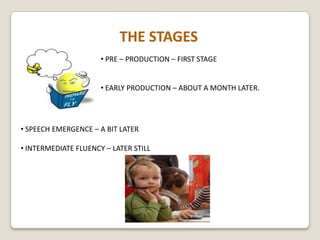
Stages in child language acquisition: Pre-speech: Infants learn to pay attention to speech,  intonation and the rhythm of speech long before they begin to speak.
 Respond to speech more keenly than to other sounds. 
 Children learn to recognize the distinctive sounds, the phonemes of the language they hear from birth long before they are able to pronounce them. Babbling stage: Begins at several months of age. 
 Many native speech sounds may be absent.  Very few consonant clusters and repeated syllables are common.One word (holophrastic) stage: Infants may utter their first word as early as nine months: usually mama, dada  (these words resemble babbling). Combining words: 18 months - 2 years.  By two and a half years most children speak in sentences of several words,but their grammar is far from complete.
By six the child's grammar approximates that of adults.  Universallyacceptedfacts  Child Language acquisition is a natural consequence of human society. 
  The outcome of first language acquisition will be the same regardless of individual differences in intelligence. 
  Although the basic ability to acquire language is innate to the child, no specific structural property of language has yet been proven to be innate. Second Language Acquisition L2 acquisition proceedsaccording to predictablestages.
Children acquire language best in low-anxietyenvironments.
 Culture is closelyrelated and essential.
Focus on meaning rather than on grammar.
Involvemanysenses.

First language acquisition

  • 1.
  • 2.
  • 3.
    What are they?Thelanguage(s) a person has learned from birth or speaks the best. It is often the basis for sociolinguistic identity. Sometimes, there can be more than one mother tongue.Those children are usually called bilingual.
  • 4.
    By contrast,a second language is any language that one speaks other than one's first language.Language acquisition The process by whichhumans acquire the capacity to perceive, produce and use words to understand and communicate.
  • 5.
    This capacityinvolvesthe picking up of diversecapacitiesincludingsyntax, phonetics, and an extensive vocabulary.
  • 6.
    It is akeyaspect that distinguisheshumansfromotherorganisms.
  • 7.
    A rangeof theorieshas been created to explain this: innatism, opposed to the othertheories in whichlanguage is simplylearned.The basic capacity to learn language is innate, while the particular form/meaning connections of individual languages are acquired through prolonged exposure to a specific speech community.   
  • 8.
       Three theoretical approachesCognitive theory.Jean Piaget (1896-1980).A child first becomes aware of a concept, such as relative size, and only afterward do they acquire the words and patterns to convey that concept. Imitation and positive reinforcement. Children learn by imitating and repeating what they hear. Innateness of certain linguistic features. Connected with Noam Chomsky. Children are born with an innate capacity for learning human language. 
  • 9.
    Stages in childlanguage acquisition: Pre-speech: Infants learn to pay attention to speech,  intonation and the rhythm of speech long before they begin to speak.
  • 10.
     Respond to speechmore keenly than to other sounds. 
  • 11.
     Children learn torecognize the distinctive sounds, the phonemes of the language they hear from birth long before they are able to pronounce them. Babbling stage: Begins at several months of age. 
  • 12.
    Many nativespeech sounds may be absent.  Very few consonant clusters and repeated syllables are common.One word (holophrastic) stage: Infants may utter their first word as early as nine months: usually mama, dada  (these words resemble babbling). Combining words: 18 months - 2 years.  By two and a half years most children speak in sentences of several words,but their grammar is far from complete.
  • 13.
    By six thechild's grammar approximates that of adults.  Universallyacceptedfacts  Child Language acquisition is a natural consequence of human society. 
  • 14.
      The outcome offirst language acquisition will be the same regardless of individual differences in intelligence. 
  • 15.
      Although the basicability to acquire language is innate to the child, no specific structural property of language has yet been proven to be innate. Second Language Acquisition L2 acquisition proceedsaccording to predictablestages.
  • 16.
    Children acquire languagebest in low-anxietyenvironments.
  • 17.
    Culture iscloselyrelated and essential.
  • 18.
    Focus on meaningrather than on grammar.
  • 19.