Downloaded 29 times
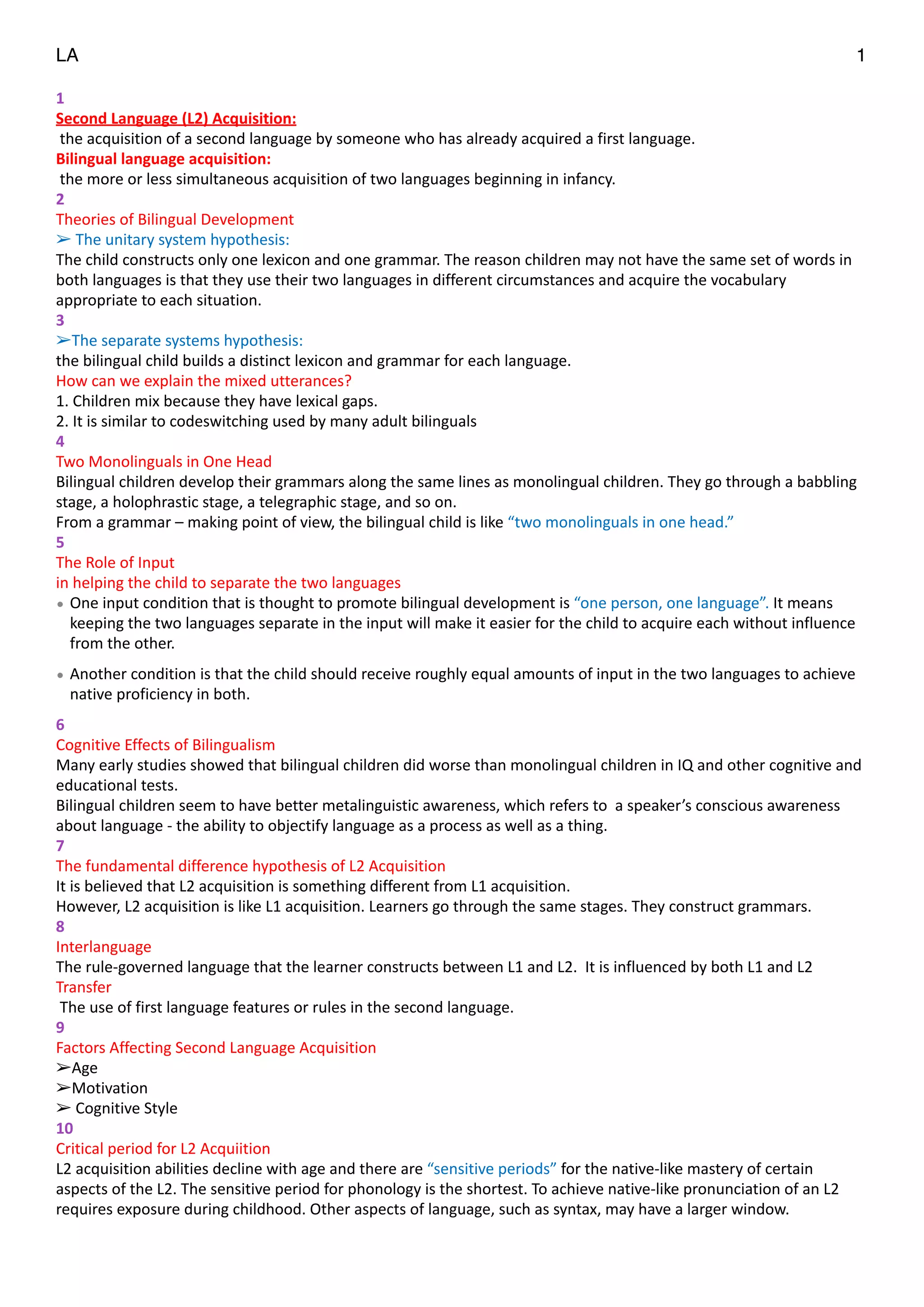
![LA 4
15
The Acquisition of Word Meaning
• Intuitively we know children learn words when we label objects.
• Children overextend words by calling all men daddy.
• After child acquired about 75-100 words, begin to narrow the meanings.
• Underextension – when children apply a word like “bird” only to family pet but not to animals in
trees outside.
• Children learn about fourteen words a day for the first six years of life!
• Syntactic bootstrapping is when children use syntax and context clues to determine word
meaning.
16
The Acquisition of Morphology
Morphology: The study of the structure of words; the component of the grammar that includes the rules
of word formation.
• Overgeneralization is evidence of “rule learning”, when children use terms like bringed, goed…we
know they are not using imitation to acquire language.
• Children usually go through 3 phases of acquisition of irregular forms of verbs
o Phase 1 – child uses correct form (brought)
o Phase 2 – when child forms rules for past tense and applies the rule to all verbs (bringed)
o Phase 3 – child understands past tense and knows there are exceptions to the rule. They
use (brought) again but now understand the root of the word is bring.
Children acquiring other language may also have to learn number and gender rules.
17
The Acquisition of Syntax
• In a study done on children, infants tend to look longer at videos of the sentences they hear.
Results show that children as young as 17 months can understand the differences between
sentences
o i.e. "The dog is chasing the cat." vs."The cat is in the tree."
• Around the age of 2, children start to put words together.
o These 2 word sentences have clear syntactic and semantic relations.
▪ i.e. "mommy sock" (noun noun) expresses a subject + object relation [Mommy has
my sock]
• Telegraphic speech occurs as children create multiword utterances. During this stage, they tend to
leave out auxiliaries, function words, and determiners. But the sentences contain the required words
for basic understanding.
o i.e. "Daddy build house."
• Between ages 2 years 6 months and 3 years 6 months, a "language explosion" occurs.
18
The Acquisition of Pragmatics
• Birth to 9 months
o looking/listening to speaker (eye contact)
o smiles/coos/vocalizes in response to a voice
o enjoys being played with
o Recognizes familiar people
• 9-1 year 1/2 months
o Shakes head no, Waves
o reaches to request objects
o comments by pointing
o teases, scolds, warns using gestures
• 1.5 years - 3 years
o Verbal turn-taking
o Expresses emotion](https://image.slidesharecdn.com/laslidesofthe1stbook-140723172657-phpapp01/75/Language-Acquisition-4-2048.jpg)
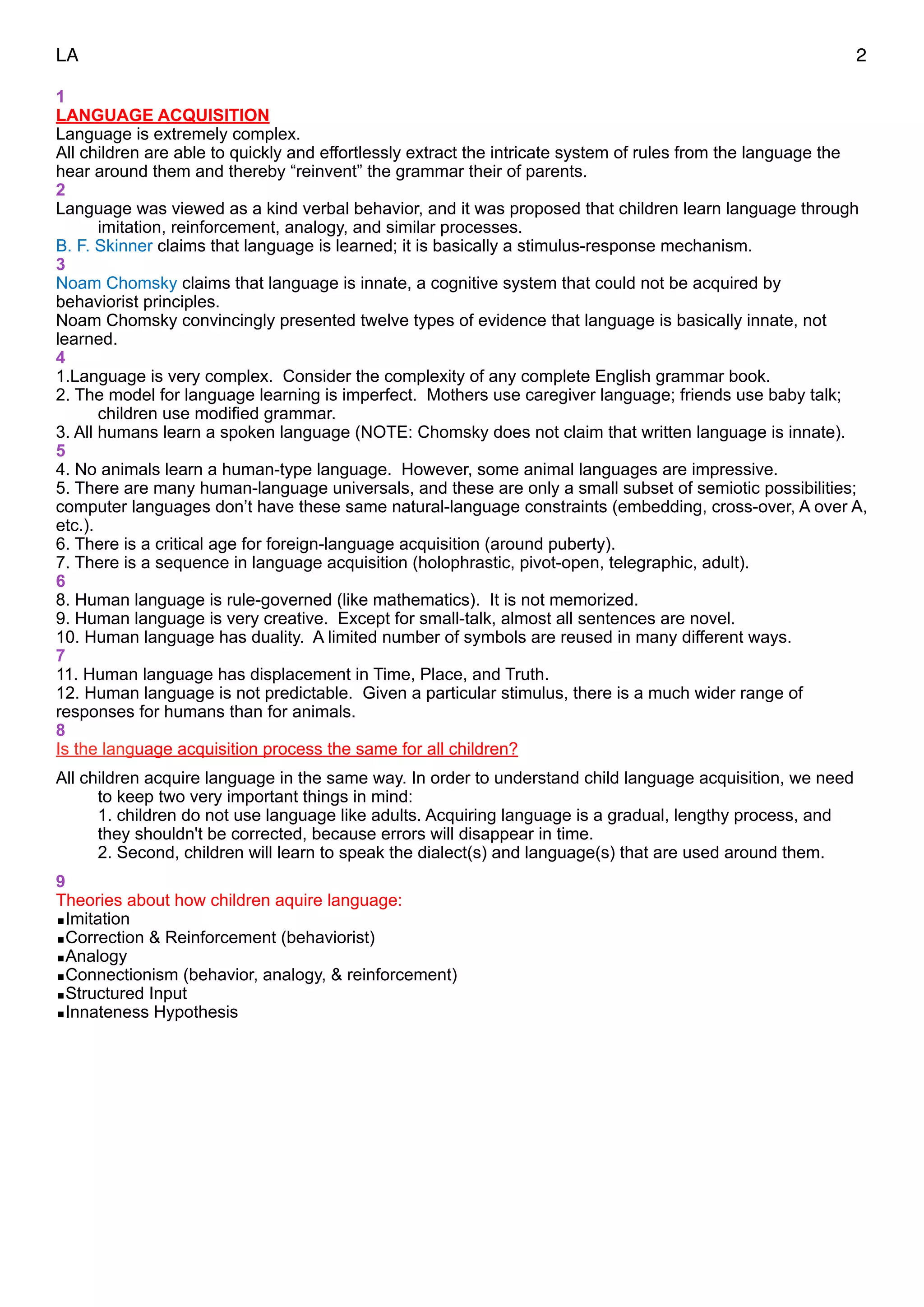
![LA 5
o 2 word phrases
• 3 years - 5 years
o Pretend play
o longer dialogue
19
Sixteen month-old JP’s Vocabulary
[/aw] not [s:] aerosol spray
[bÃ/]/[mÃ/] up [sju:] shoe
[da] dog [haj] hi
[i/o]/[si/o] Cheerios [sr] shirt / sweater
[sa] sock [sQ:]/[«sQ:] what’s
that?/hey, look
[aj]/[Ãj] light [ma] mommy
[baw]/[daw] down [dQ] daddy
"20
Acquisition Order of Sounds
Manner Place
of Articulation of Articulation
Nasals Labials
Glides Velars
Stops Alveolars
Liquids Palatals
Fricatives
Affricates
21
Perception and Production
Linguist Neil Smith and his 2-year-old son
Father: What does [maws] mean?
Amahl: Like a cat.
Father: Yes, what else?
Amahl: Nothing else
Father: It’s part of your head.
Amahl: [fascinated]
Father: [touching Amahl’s mouth] What’s this?
Amahl: [maws]
22
Simplifying the Sounds of a Language
[ pun ] spoon
[ peyn ] plane
[ tIs ] kiss
[ taw ] cow
[ tin ] clean
[ pol«r ] stroller
[ majtl ] Michael
[ dajt«r ] diaper
[ pati ] Papi
[ mani ] Mommy
[ b«rt ] Bert
[ b«rt ] (big) Bird](https://image.slidesharecdn.com/laslidesofthe1stbook-140723172657-phpapp01/75/Language-Acquisition-5-2048.jpg)
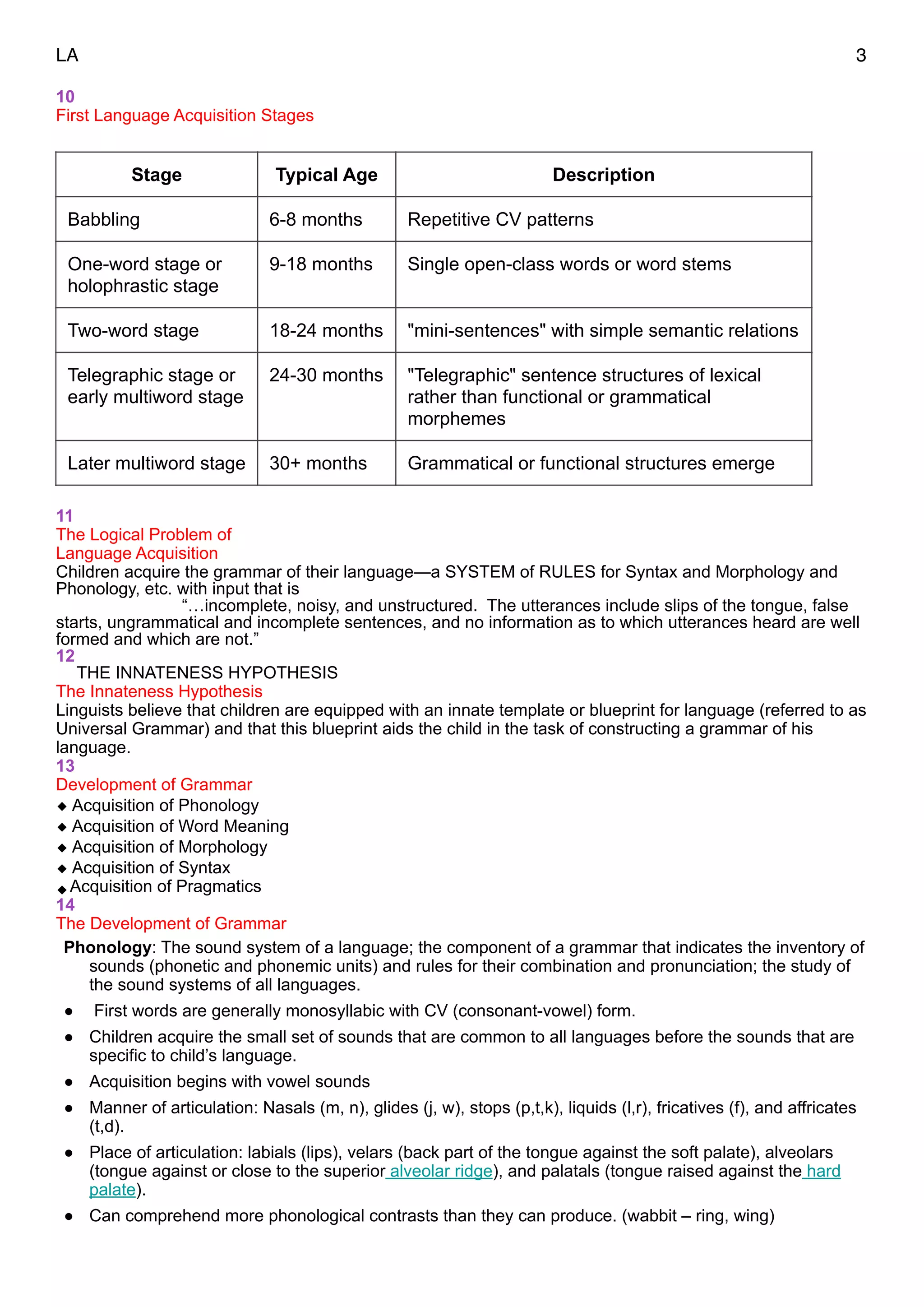
![LA 6
23
The Problem of Acquiring Meaning
“A child who observes a cat sitting on a mat also observes…a mat supporting a cat, a mat under a cat,
a floor supporting a mat and a cat, and so on. If the adult now says. ‘The cat is on the mat’ even while
pointing to the cat on the mat, how is the child to choose among these interpretations of the
situation?”
24
Innate Bias in Acquiring Word Meaning
1. Whole object principle
2. Form over color principle
3. Everything has a name
4. Each thing has only one name
25
Stages of Irregular Verb Acquisition
Phase 1 Phase 2 Phase 3
broke breaked broke
brought bringed brought
went goed went
26
Acquisition of Morphology
TOM: Where’s Mommy?
CHILD: Mommy goed to the store.
TOM: Mommy goed to the store?
CHILD: NO! (annoyed) Daddy, I say it that way, not you.
CHILD: You readed some of it too…she readed all the rest.
DAN: She read the whole thing to you, huh?
CHILD: Nu-uh, you read some.
DAN: Oh, that’s right, yeah. I readed the beginning of it.
CHILD: Readed? (annoyed surprise) Read!
(pronounced / rEd /)
DAN: Oh, yeah, read.
CHILD: Will you stop that, Papa?
"27
Morpheme Acquisition Order
-ing
in, on
-s (REGULAR PLURAL)
-s (1st PERS SINGULAR PRESENT)
’s (POSSESSIVE)
28
Two-Word Sentences
allgone sock hi Mommy
bye bye boat allgone sticky
more wet it ball
Katherine sock dirty sock
29
Chapter 7 Homework (Exercise 5, pp. 370-371)
1. don’t [ dot ] simplification: ConCl
2. skip [ kHIp ] simplify: ConsClust
3. shoe [ su ] substitute
4. that [ dQt ] substitute
5. play [ pHe ] simplify: ConsClust
6. thump [ dÃp ] substitute & simplify
7. bath [ bQt ] substitute
8. chop [ tHap ] substitute/simplify](https://image.slidesharecdn.com/laslidesofthe1stbook-140723172657-phpapp01/75/Language-Acquisition-6-2048.jpg)
![LA 7
9. kitty [ kIdi ] ??
10. light [ wajt ] substitute
11. dolly [ dawi ] substitute
12. grow [ go ] simplify: ConsClust
"
30
Chapter 7 Homework (Exercise 7, p. 371)
Adult Form Child form
a. children childs
b. went goed
c. better gooder
d. best goodest
e. brought bringed
f. sang singed
g. geese gooses
h. worst baddest
i. knives knifes
j. worse badder
"Assignment
Exercise 3: Chapter 7 in Fromkin, V., Rodman, R., & Hyams, N. (2011). An Introduction to Language.
Wadsworth, Cengage Learning, p. 369
Resources
Crain, S. & Pietroski, P. (2001). Nature, Nurture and Universal
Grammar. Linguistics And Philosophy, 24(2), 139-186.
"
Fromkin, V., Rodman, R., & Hyams, N. (2007). An Introduction to
Language. Boston, MA: Wadsworth Publishing.
"
Hill, J. D. & Flynn, K. M. (2006). Classroom Instruction That Works
with English Language Learners. [Retrieved] 5/28/2012, [from]
http://www.ascd.org/publications/books/106009/chapters/The-Stag
es-of-Second-Language-Acquisition.aspx.
"
Stages of Language Acquisition in Children. (n.d).
[Retrieved]5/28/2012 [from] http://www.ling.upenn/edu/courses/
Fall_2003/ling001/acquisition.html
"
L.R. Gleitman and E. Wanner. 1982. Language Acquisition: The State of the State of the Art. Cambridge:
Cambridge University Press, p. 10.] [Reference not given in 2009, 9th ed.; given in 2003.]
"
Steven Pinker. Words and Rules. New York: Basic Books, 1999, pp. 199-200.
"](https://image.slidesharecdn.com/laslidesofthe1stbook-140723172657-phpapp01/75/Language-Acquisition-7-2048.jpg)
![LA 8
1
The
Human
Mind
at
Work:
Human
Language
Processing
Psycholinguistics
is
concerned
with
linguistic
performance
or
processing,
which
is
the
use
of
linguistic
knowledge
(competence)
in
speech
production
and
comprehension.
2
Comprehension
Comprehension,
the
process
of
understanding
an
utterance,
requires
the
ability
to
access
the
mental
lexicon
to
match
the
words
in
the
utterance
to
their
meanings.
Comprehension
begins
with
the
perception
of
the
acoustic
speech
signal.
3
The
speech
signal
can
be
described
in
terms
of
the
fundamental
frequency
of
the
sounds,
perceived
as
pitch;
the
intensity,
perceived
as
loudness;
and
the
quality,
perceived
as
differences
in
speech
sounds,
such
as
between
an
[i]
and
an
[a].
The
speech
wave
can
be
displayed
visually
as
a
spectrogram,
sometimes
called
a
voiceprint.
In
a
spectrogram,
vowels
exhibit
dark
bands
where
frequency
intensity
is
greatest.
4
Speech
Perception
and
Comprehension
The
speech
signal
is
a
continuous
stream
of
sounds.
Listeners
have
the
ability
to
segment
the
stream
into
linguistic
units
and
to
recognize
acoustically
distinct
sounds
as
the
same
linguistic
unit.
5
If
you
heard
someone
say
The
cat
chased
the
rat
and
you
perceived
the
sounds
as
[ð
ə
kʰ
æ
ʔ
tʃʰ
e
s
t
ð
ə
r
æ
t]
a
lexical
look-‐up
process
would
lead
you
to
conclude
that
an
event
concerning
a
cat,
a
rat,
and
the
activity
of
chasing
had
occurred.
You
could
know
this
only
by
segmenting
the
words
in
the
continuous
speech
signal,
analyzing
them
into
their
phonological
word
units,
and
matching
these
units
to
similar
strings
stored
in
your
lexicon.
6
Bottom-‐up
and
Top-‐down
Models
The
perception
of
the
speech
signal
is
necessary
but
not
sufficient
for
the
comprehension
of
speech.
To
get
the
full
meaning
of
an
utterance,
we
must
parse
the
string
into
syntactic
structures,
because
meaning
depends
on
word
order
and
constituent
structure
in
addition
to
the
meaning
of
words.
Some
psycholinguists
believe
we
use
both
top-‐
down
processing
and
bottom-‐up
processing
during
comprehension.
7
Top-‐down
processing
uses
semantic
and
syntactic
information
in
addition
to
the
lexical
information
drawn
from
the
sensory
input
For
example,
upon
hearing
the
determiner
the,
the
speaker
begins
constructing
an
NP
and
expects
that
the
next
word
could
be
a
noun,
as
in
the
boy.
In
this
instance
the
knowledge
of
phrase
structure
would
be
the
source
of
information.
bottom-‐up
processing
uses
only
information
contained
in
the
sensory
input.
According
to
this
model
the
speaker
waits
until
hearing
the
and
boy
before
constructing
an
NP,
and
then
waits
for
the
next
word,
and
so
on.
8
Lexical
Access
and
Word
Recognition
➢
Semantic
Priming
➢
Naming
Task
➢
Shadowing
Task
9
Psycholinguistic
experimental
studies
are
aimed
at
uncovering
the
units,
stages,
and
processes
involved
in
linguistic
performance.
Several
experimental
techniques
have
proven
to
be
very
helpful.
In
a
lexical
decision
task,
subjects
are
asked
to
respond
to
spoken
or
written
stimuli
by
pressing
a
button
if
they
consider
the
stimulus
to
be
a
word.
In
naming
tasks,
subjects
read
from
printed
stimuli.
10
The
measurement
of
response
times,
RTs,
in
naming
and
other
tasks
shows
that
it
takes
longer
to
process
less
frequent
words
compared
to
more
frequent
words,
longer
to
produce
irregularly
spelled
versus
regularly
spelled](https://image.slidesharecdn.com/laslidesofthe1stbook-140723172657-phpapp01/75/Language-Acquisition-8-2048.jpg)
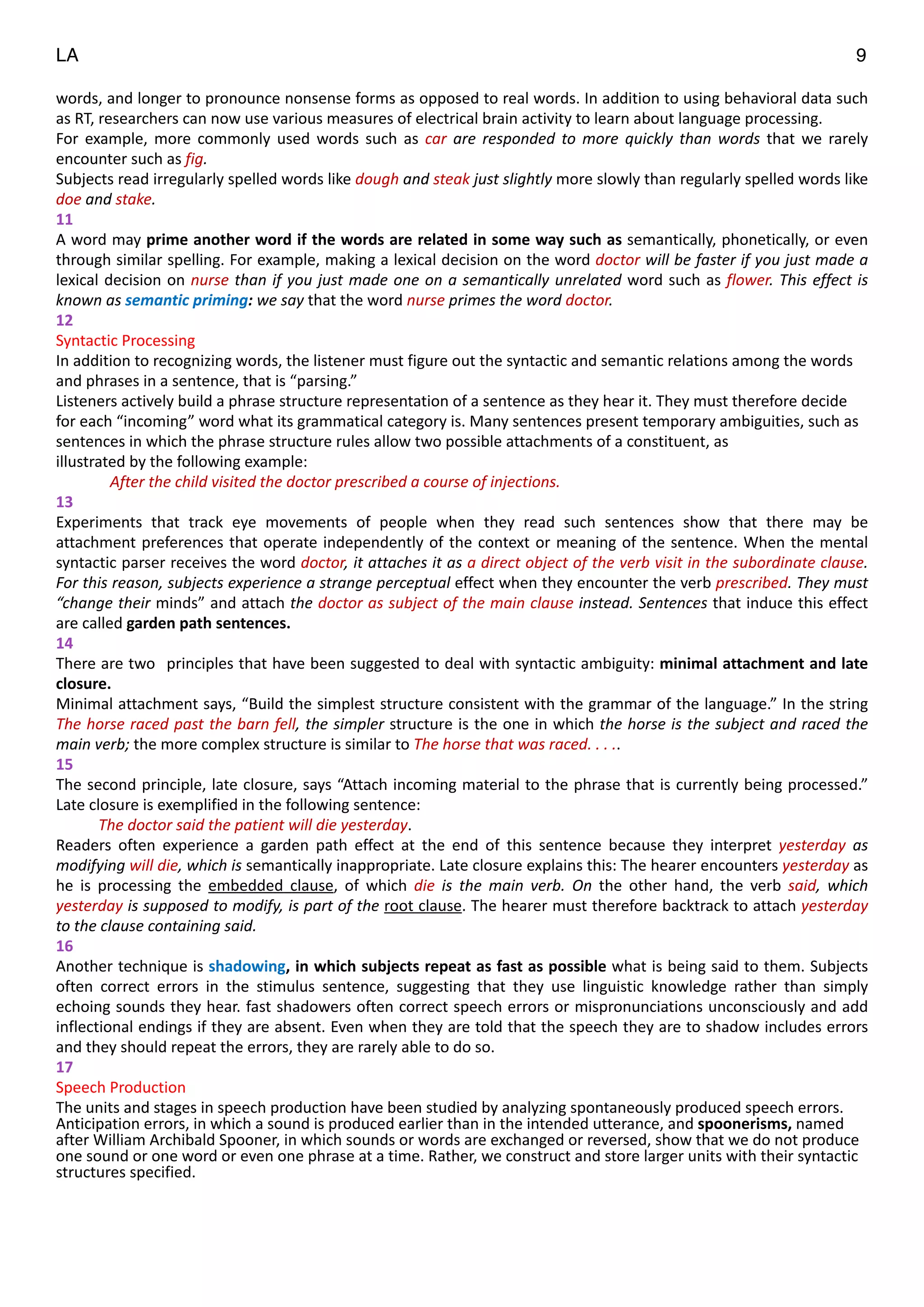
![LA 10
18
Indeed,
speech
errors
show
that
features,
segments,
words,
and
phrases
may
be
conceptualized
well
before
they
are
uttered.
This
point
is
illustrated
in
the
following
examples
of
speech
errors
(the
intended
utterance
is
to
the
left
of
the
arrow;
the
actual
utterance,
including
the
error,
is
to
the
right
of
the
arrow):
1.
The
hiring
of
minority
faculty.
→
The
firing
of
minority
faculty.
(The
intended
h
is
replaced
by
the
f
of
faculty,
which
occurs
later
in
the
intended
utterance.)
2.
ad
hoc
→
odd
hack
(The
vowels
/æ/
of
the
first
word
and
/a/
of
the
second
are
exchanged
or
reversed.)
3.
big
and
fat
→
pig
and
vat
(The
values
of
a
single
feature
are
switched:
in
big
[+voiced]
becomes
[–voiced]
and
in
fat
[–voiced]
becomes
[+voiced].)
19
Lexical
Selection
Word
substitutions
and
blends
show
that
words
are
connected
to
other
words
phonologically
and
semantically.
The
production
of
ungrammatical
utterances
also
shows
that
morphological,
inflectional,
and
syntactic
rules
may
be
wrongly
applied
or
fail
to
apply
when
we
speak,
but
at
the
same
time
shows
that
such
rules
are
actually
involved
in
speech
production.
20
Such
blends
are
illustrated
in
the
following
errors:
1.
splinters/blisters
→
splisters
2.
edited/annotated
→
editated
3.
a
swinging/hip
chick
→
a
swip
chick
4.
frown/scowl
→
frowl
These
blend
errors
are
typical
in
that
the
segments
stay
in
the
same
position
within
the
syllable
as
they
were
in
the
target
words.
21
Brain
and
Language
The
attempt
to
understand
what
makes
the
acquisition
and
use
of
language
possible
has
led
to
research
on
the
brain-‐
mind-‐language
relationship.
Neurolinguistics
is
the
study
of
the
brain
mechanisms
and
anatomical
structures
that
underlie
linguistic
competence
and
performance.
22
The
Human
Brain
The
nerve
cells
that
form
the
surface
of
the
brain
are
called
the
cortex,
which
serves
as
the
intellectual
decision
maker,
receiving
messages
from
the
sensory
organs
and
initiating
all
voluntary
actions.
The
brain
of
all
higher
animals
is
divided
into
two
parts
called
the
cerebral
hemispheres,
which
are
connected
by
the
corpus
callosum,
a
network
that
permits
the
left
and
right
hemispheres
to
communicate.
23
Each
hemisphere
exhibits
contralateral
control
of
functions.
The
left
hemisphere
controls
the
right
side
of
the
body,
and
the
right
hemisphere
controls
the
left
side.
Despite
the
general
symmetry
of
the
human
body,
much
evidence
suggests
that
the
brain
is
asymmetric,
with
the
left
and
right
hemispheres
lateralized
for
different
functions.
24
The
Localization
of
Language
in
the
Brain
An
issue
of
central
concern
has
been
to
determine
which
parts
of
the
brain
are
responsible
for
human
linguistic
abilities.
In
the
early
nineteenth
century,
Franz
Joseph
Gall
proposed
the
theory
of
localization,
which
is
the
idea
that
different
human
cognitive
abilities
and
behaviors
are
localized
in
specific
parts
of
the
brain.
25
Aphasia
The
study
of
aphasia
has
been
an
important
area
of
research
in
understanding
the
relationship
between
brain
and
language.
Aphasia
is
the
neurological
term
for
any
language
disorder
that
results
from
brain
damage
caused
by
disease
or
trauma.
In
the
second
half
of
the
nineteenth
century,
significant
scientific
advances
were
made
in
localizing
language
in
the
brain
based
on
the
study
of
people
with
aphasia.
In
the
1860s
the
French
surgeon
Paul
Broca
proposed
that
language
is
localized
to
the
left
hemisphere
of
the
brain,
and
more
specifically
to
the
front
part
of
the
left
hemisphere
(now
called
Broca’s
area).
26
A
decade
later
Carl
Wernicke,
a
German
neurologist,
described
another
variety
of
aphasia
that
occurred
in
patients
with
lesions
in
areas
of
the
left
hemisphere
temporal
lobe,
now
known
as
Wernicke’s
area.](https://image.slidesharecdn.com/laslidesofthe1stbook-140723172657-phpapp01/75/Language-Acquisition-10-2048.jpg)


This document discusses theories of language acquisition in children. It covers: - Theories of first and second language acquisition, including behaviorist vs. innateness views. - Stages of first language acquisition from babbling to telegraphic to multi-word stages. - The logical problem of how children acquire language from incomplete input. - The innateness hypothesis that children have an innate blueprint or Universal Grammar that aids language acquisition. - Development of grammar includes acquisition of phonology, word meanings, morphology and syntax. Children intuitively learn language rules from contextual cues in the environment.


