Stages of second language acquisition
L. Aisha Maashi
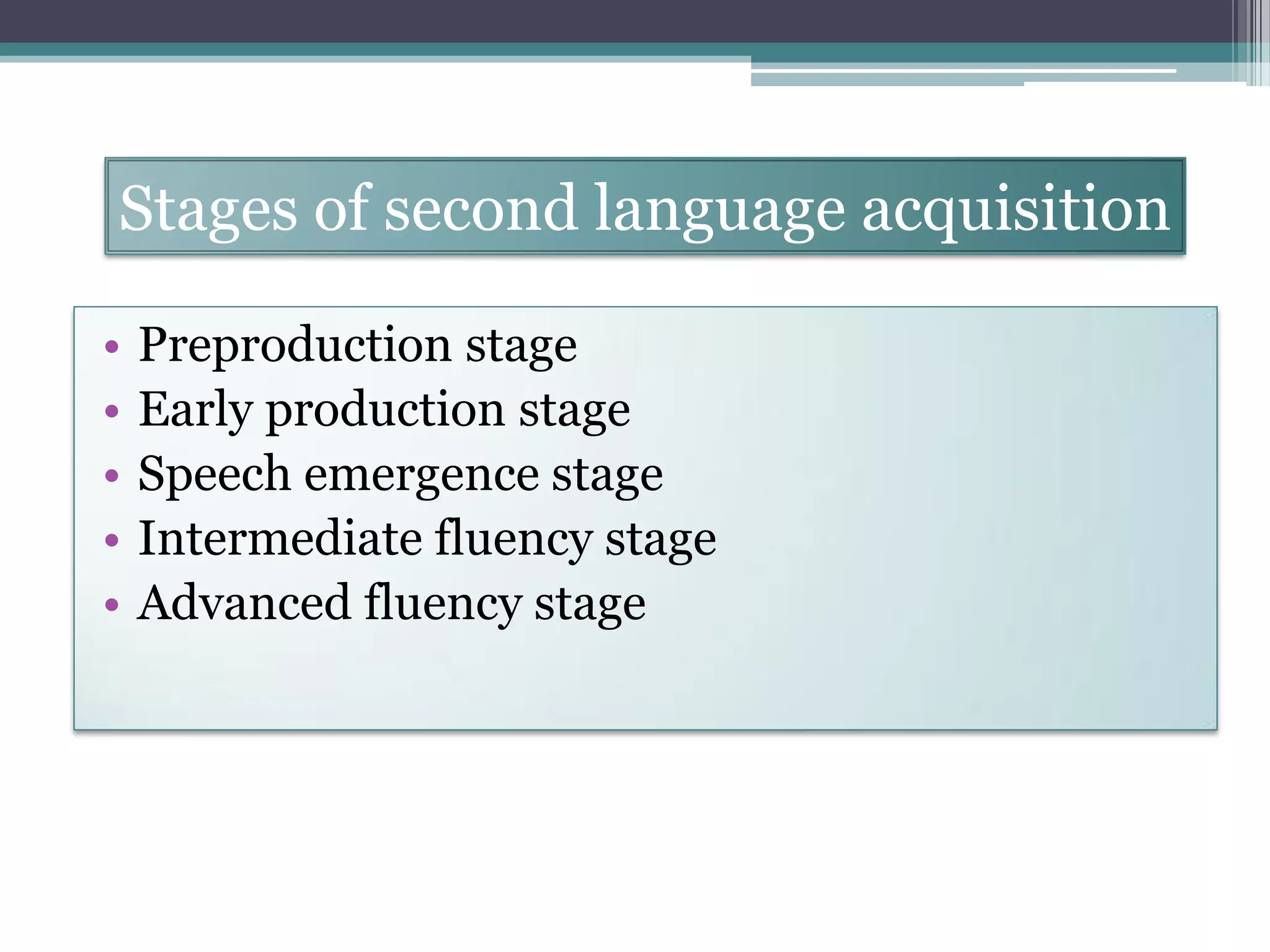
Stages of second language acquisition
• Preproduction stage
• Early production stage
• Speech emergence stage
• Intermediate fluency stage
• Advanced fluency stage
1. Preproduction stage
• This stage is also called the ‘silent period’.
• It lasts for about six weeks or longer.
• At this stage learners do not speak they just
listen to second language and observe what is
going on around them.
• Learners have hundreds of words and can repeat
words and expressions, and forms of the target
language. However, they lack the ability to
produce the target language.
What teachers should do:
• Push learners to listen to different authentic
materials.
• Push learners to search for different words and
expressions.
• Use communicative activities that help learners
use and share the new acquired words and
expressions.
• Use total physical response method of teaching
through which learners are asked to respond
physically to some pictures or visuals?
2. Early production stage
• This stage may last up to six months.
• Second language learners begin to speak using
short words, simple phrases of two-words, and
sentences. However, there will be many errors in
their utterances.
• Most of the new words they can use relate to the
classroom (e.g., ‘open the door’, ‘bring the chalk’,
‘what is the date?’, ‘write on the board’, etc).
What teachers should do:
• Simplify the content materials to be used and
focus on vocabulary.
• Give learners the chance to participate in some
whole class activities, group work, and pair
work.
• Provide different listening activities to improve
the ability to listen and to enrich their
vocabulary.
• Provide different activities which depend on
vocabulary like cross-word puzzle.
3. Speech emergence stage:
• Learners can communicate with simple phrases
and sentences using longer words and more
complicated structures. However, they still rely
heavily on context clues and familiar topics.
• Their errors begin to decrease specifically in
repeated contexts.
• They can start simple conversations with
classmates.
• Can understand different topics and stories read
in classes.
What teachers should do:
• Push learners to read short texts in different
topics.
• Push learners to write brief stories and topics.
• Use different communicative activities like
story-telling activities. Learners listen to or read
a story and then retell the story using their own
words.
• Give learners the chance to explain their own
thoughts and ideas.
•
4. Intermediate fluency stage
• Learners have a large body of active vocabulary.
• They start to use more complex sentences in
writing and speaking.
• They can express opinion and share their
thoughts.
• They can speak fluently with minimal errors
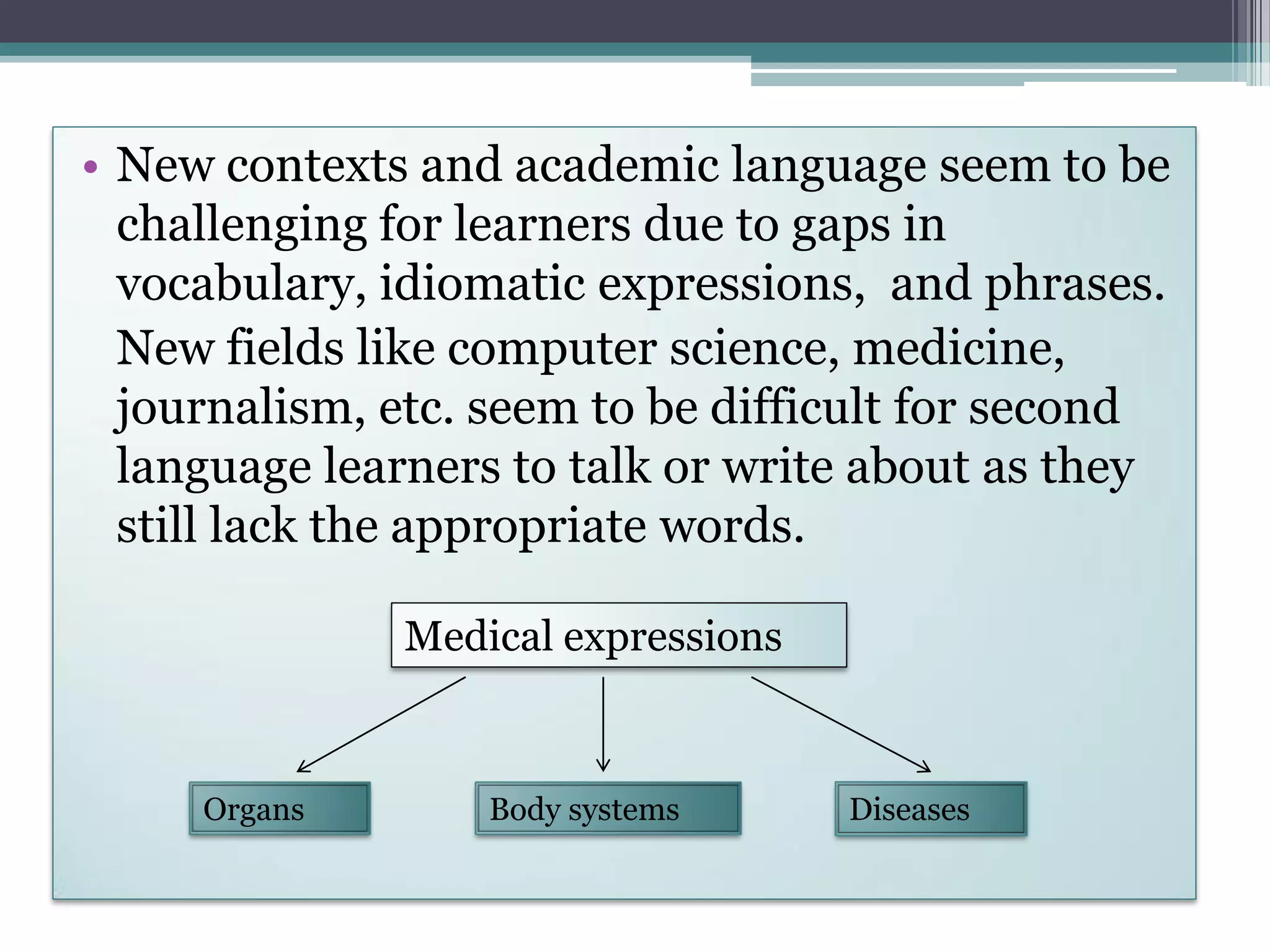
• New contexts and academic language seem to be
challenging for learners due to gaps in
vocabulary, idiomatic expressions, and phrases.
New fields like computer science, medicine,
journalism, etc. seem to be difficult for second
language learners to talk or write about as they
still lack the appropriate words.
Body systemsOrgans Diseases
Medical expressions
How to improve:
• By asking teacher questions to clarify what they
are learning in class.
• By gathering new vocabulary and expressions
related to the field. This can be done by
consulting the dictionary or via internet.
• By reading more about the field.
• Learners, at this stage, produce many errors when
writing in target language.
1. due to the complexity of the target language
grammar and structures.
2. The use of the native language knowledge.
Learners transfer the structures of their native
language (first language) to the second language.
How to improve:
• Check structures of second language.
• Stop thinking in native language structures when
writing or speaking.
• Read more in target language to see how
language is written, and how to form correct
grammatical sentences.
• Write more in target language.
5. Advanced fluency stage
• It takes from 4-10 years to achieve cognitive
language proficiency in second language.
• at this stage, learners are close to native
language fluency and can interact well in variety
of situations.
• They show a high level of language oral and
written production.
• Learners communicate fluently in all contexts
and have the ability to maneuver when exposed
to new information.
• Still they may have some accent problems and
may use some idioms incorrectly. However, they
are fluent and communicate comfortably in
second language.
What acquirers need at this stage:
• Read newspapers and magazines in target language.
• Watch different TV channels (like BBC or CNN)
which keep you updated with new expressions and
idioms related to current issues.
• Use internet to read about different topics and to
listen to podcasts and videos in target language.

Stages of second language acquisition

  • 1.
    Stages of secondlanguage acquisition L. Aisha Maashi
  • 2.
    Stages of secondlanguage acquisition • Preproduction stage • Early production stage • Speech emergence stage • Intermediate fluency stage • Advanced fluency stage
  • 3.
    1. Preproduction stage •This stage is also called the ‘silent period’. • It lasts for about six weeks or longer. • At this stage learners do not speak they just listen to second language and observe what is going on around them. • Learners have hundreds of words and can repeat words and expressions, and forms of the target language. However, they lack the ability to produce the target language.
  • 4.
    What teachers shoulddo: • Push learners to listen to different authentic materials. • Push learners to search for different words and expressions. • Use communicative activities that help learners use and share the new acquired words and expressions. • Use total physical response method of teaching through which learners are asked to respond physically to some pictures or visuals?
  • 5.
    2. Early productionstage • This stage may last up to six months. • Second language learners begin to speak using short words, simple phrases of two-words, and sentences. However, there will be many errors in their utterances. • Most of the new words they can use relate to the classroom (e.g., ‘open the door’, ‘bring the chalk’, ‘what is the date?’, ‘write on the board’, etc).
  • 6.
    What teachers shoulddo: • Simplify the content materials to be used and focus on vocabulary. • Give learners the chance to participate in some whole class activities, group work, and pair work. • Provide different listening activities to improve the ability to listen and to enrich their vocabulary. • Provide different activities which depend on vocabulary like cross-word puzzle.
  • 7.
    3. Speech emergencestage: • Learners can communicate with simple phrases and sentences using longer words and more complicated structures. However, they still rely heavily on context clues and familiar topics. • Their errors begin to decrease specifically in repeated contexts. • They can start simple conversations with classmates. • Can understand different topics and stories read in classes.
  • 8.
    What teachers shoulddo: • Push learners to read short texts in different topics. • Push learners to write brief stories and topics. • Use different communicative activities like story-telling activities. Learners listen to or read a story and then retell the story using their own words. • Give learners the chance to explain their own thoughts and ideas. •
  • 9.
    4. Intermediate fluencystage • Learners have a large body of active vocabulary. • They start to use more complex sentences in writing and speaking. • They can express opinion and share their thoughts. • They can speak fluently with minimal errors
  • 10.
    • New contextsand academic language seem to be challenging for learners due to gaps in vocabulary, idiomatic expressions, and phrases. New fields like computer science, medicine, journalism, etc. seem to be difficult for second language learners to talk or write about as they still lack the appropriate words. Body systemsOrgans Diseases Medical expressions
  • 11.
    How to improve: •By asking teacher questions to clarify what they are learning in class. • By gathering new vocabulary and expressions related to the field. This can be done by consulting the dictionary or via internet. • By reading more about the field.
  • 12.
    • Learners, atthis stage, produce many errors when writing in target language. 1. due to the complexity of the target language grammar and structures. 2. The use of the native language knowledge. Learners transfer the structures of their native language (first language) to the second language.
  • 13.
    How to improve: •Check structures of second language. • Stop thinking in native language structures when writing or speaking. • Read more in target language to see how language is written, and how to form correct grammatical sentences. • Write more in target language.
  • 14.
    5. Advanced fluencystage • It takes from 4-10 years to achieve cognitive language proficiency in second language. • at this stage, learners are close to native language fluency and can interact well in variety of situations. • They show a high level of language oral and written production.
  • 15.
    • Learners communicatefluently in all contexts and have the ability to maneuver when exposed to new information. • Still they may have some accent problems and may use some idioms incorrectly. However, they are fluent and communicate comfortably in second language.
  • 16.
    What acquirers needat this stage: • Read newspapers and magazines in target language. • Watch different TV channels (like BBC or CNN) which keep you updated with new expressions and idioms related to current issues. • Use internet to read about different topics and to listen to podcasts and videos in target language.