LANGUAGE ACQUISITION We are designed to walk… That we are taught to walk is impossible. And  pretty much the same is true of language. Nobody is taught language. In fact you can’t prevent the child from learning it. Noam Chomsky,  The Human Language Serie 2 (1994)
LANGUAGE ACQUISITION Language is extremely complex Children before 5 already know the complex system that make up the grammar of a language: Syntactic  Phonological Morphological Semantic and pragmatic rules of grammar Children acquire a system of rules that enables them to construct and understand sentences, most of them have never produced or heard before. Children are creative in the use of language Nobody teach grammatical rules to the children
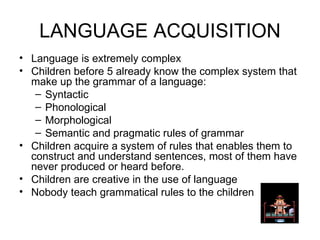
Mechanism of language acquisition REINFORCE MENT ANALOGY IMITATION BEHAVIOURISM
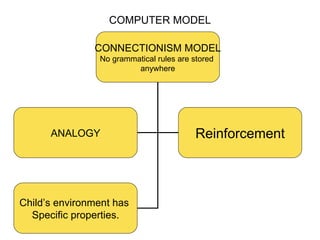
COMPUTER MODEL CONNECTIONISM MODEL No grammatical rules are stored  anywhere ANALOGY Child’s environment has  Specific properties. Reinforcement
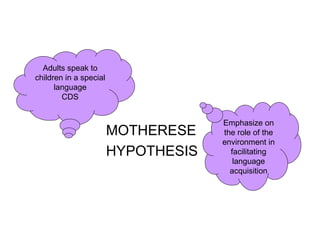
MOTHERESE HYPOTHESIS Emphasize on the role of the environment in facilitating language acquisition Adults speak to children in a special language CDS
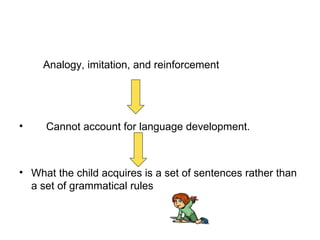
Analogy, imitation, and reinforcement Cannot account for language development. What the child acquires is a set of sentences rather than a set of grammatical rules
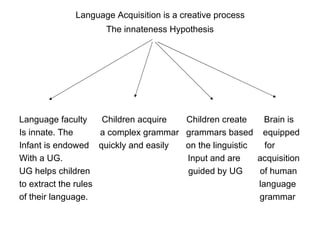
Language Acquisition is a creative process The innateness Hypothesis Language faculty  Children acquire  Children create  Brain is Is innate. The  a complex grammar  grammars based  equipped Infant is endowed  quickly and easily  on the linguistic  for With a UG.  Input and are  acquisition UG helps children  guided by UG  of human to extract the rules  language of their language.  grammar
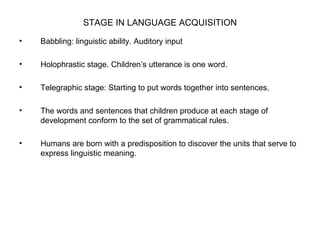
STAGE IN LANGUAGE ACQUISITION Babbling: linguistic ability. Auditory input Holophrastic stage. Children’s utterance is one word.  Telegraphic stage: Starting to put words together into sentences. The words and sentences that children produce at each stage of development conform to the set of grammatical rules. Humans are born with a predisposition to discover the units that serve to express linguistic meaning.
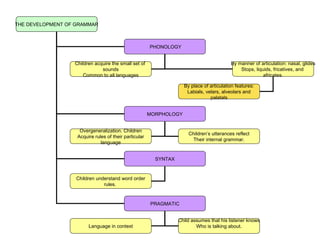
THE DEVELOPMENT OF GRAMMAR PHONOLOGY SYNTAX PRAGMATIC MORPHOLOGY Children acquire the small set of  sounds Common to all languages Overgeneralization. Children Acquire rules of their particular language Children understand word order rules.  Language in context By manner of articulation: nasal, glides Stops, liquids, fricatives, and  africates. Children’s utterances reflect Their internal grammar. Child assumes that his listener knows Who is talking about. By place of articulation features: Labials, velars, alveolars and palatals
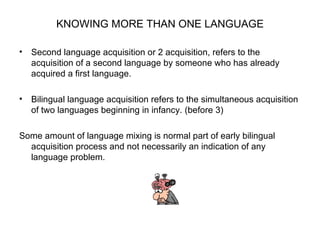
KNOWING MORE THAN ONE LANGUAGE Second language acquisition or 2 acquisition, refers to the acquisition of a second language by someone who has already acquired a first language. Bilingual language acquisition refers to the simultaneous acquisition of two languages beginning in infancy. (before 3) Some amount of language mixing is normal part of early bilingual acquisition process and not necessarily an indication of any language problem.
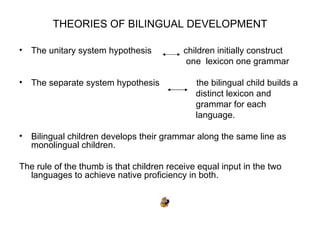
THEORIES OF BILINGUAL DEVELOPMENT The unitary system hypothesis  children initially construct  one  lexicon one grammar The separate system hypothesis  the bilingual child builds a  distinct lexicon and  grammar for each  language. Bilingual children develops their grammar along the same line as monolingual children. The rule of the thumb is that children receive equal input in the two languages to achieve native proficiency in both.
Second Language Acquisition L2 learners construct grammars of the target language. Fundamental difference hypothesis: L2 acquisition is different from L1 Interlanguage grammar- stages Transfer of grammatical rules from L1 to L2 Age is a significant factor in L2 acquisition
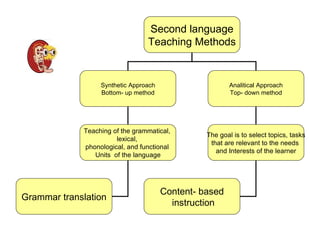
Second language Teaching Methods Synthetic Approach Bottom- up method Analitical Approach Top- down method Teaching of the grammatical,  lexical,  phonological, and functional  Units  of the language The goal is to select topics, tasks that are relevant to the needs  and Interests of the learner Grammar translation Content- based instruction

Language Acquisition

  • 1.
    LANGUAGE ACQUISITION Weare designed to walk… That we are taught to walk is impossible. And pretty much the same is true of language. Nobody is taught language. In fact you can’t prevent the child from learning it. Noam Chomsky, The Human Language Serie 2 (1994)
  • 2.
    LANGUAGE ACQUISITION Languageis extremely complex Children before 5 already know the complex system that make up the grammar of a language: Syntactic Phonological Morphological Semantic and pragmatic rules of grammar Children acquire a system of rules that enables them to construct and understand sentences, most of them have never produced or heard before. Children are creative in the use of language Nobody teach grammatical rules to the children
  • 3.
    Mechanism of languageacquisition REINFORCE MENT ANALOGY IMITATION BEHAVIOURISM
  • 4.
    COMPUTER MODEL CONNECTIONISMMODEL No grammatical rules are stored anywhere ANALOGY Child’s environment has Specific properties. Reinforcement
  • 5.
    MOTHERESE HYPOTHESIS Emphasizeon the role of the environment in facilitating language acquisition Adults speak to children in a special language CDS
  • 6.
    Analogy, imitation, andreinforcement Cannot account for language development. What the child acquires is a set of sentences rather than a set of grammatical rules
  • 7.
    Language Acquisition isa creative process The innateness Hypothesis Language faculty Children acquire Children create Brain is Is innate. The a complex grammar grammars based equipped Infant is endowed quickly and easily on the linguistic for With a UG. Input and are acquisition UG helps children guided by UG of human to extract the rules language of their language. grammar
  • 8.
    STAGE IN LANGUAGEACQUISITION Babbling: linguistic ability. Auditory input Holophrastic stage. Children’s utterance is one word. Telegraphic stage: Starting to put words together into sentences. The words and sentences that children produce at each stage of development conform to the set of grammatical rules. Humans are born with a predisposition to discover the units that serve to express linguistic meaning.
  • 9.
    THE DEVELOPMENT OFGRAMMAR PHONOLOGY SYNTAX PRAGMATIC MORPHOLOGY Children acquire the small set of sounds Common to all languages Overgeneralization. Children Acquire rules of their particular language Children understand word order rules. Language in context By manner of articulation: nasal, glides Stops, liquids, fricatives, and africates. Children’s utterances reflect Their internal grammar. Child assumes that his listener knows Who is talking about. By place of articulation features: Labials, velars, alveolars and palatals
  • 10.
    KNOWING MORE THANONE LANGUAGE Second language acquisition or 2 acquisition, refers to the acquisition of a second language by someone who has already acquired a first language. Bilingual language acquisition refers to the simultaneous acquisition of two languages beginning in infancy. (before 3) Some amount of language mixing is normal part of early bilingual acquisition process and not necessarily an indication of any language problem.
  • 11.
    THEORIES OF BILINGUALDEVELOPMENT The unitary system hypothesis children initially construct one lexicon one grammar The separate system hypothesis the bilingual child builds a distinct lexicon and grammar for each language. Bilingual children develops their grammar along the same line as monolingual children. The rule of the thumb is that children receive equal input in the two languages to achieve native proficiency in both.
  • 12.
    Second Language AcquisitionL2 learners construct grammars of the target language. Fundamental difference hypothesis: L2 acquisition is different from L1 Interlanguage grammar- stages Transfer of grammatical rules from L1 to L2 Age is a significant factor in L2 acquisition
  • 13.
    Second language TeachingMethods Synthetic Approach Bottom- up method Analitical Approach Top- down method Teaching of the grammatical, lexical, phonological, and functional Units of the language The goal is to select topics, tasks that are relevant to the needs and Interests of the learner Grammar translation Content- based instruction