
By:
Abolfazl Ghanbari
 To know differences between Learning and Acquisition
 To know the role of Electronic Devices in language
acquisition (LA)
 To know the first three years of LA
 To know developmental sequence in LA
 To know “WUG Test”
 To know theories of first language acquisition:
Behaviorism, Innatism, Interactionist
 To know Zone of proximal development (ZPD)
 Bilingualism and Additive & Subtractive Bilingualism
 To know Connectionism
First language acquisition is the process
by which humans acquire the capacity
to perceive and comprehend language,
as well as to produce and use words
and sentences to communicate.
Children go through a number of
different stages as language acquirers,
from the earliest stage of producing
cooing sounds (repetition) until being
able to produce complex, multi-word
sentences.
 Is it adequate for babies to hear
language sounds from electronic
devices in order to acquire the
language?
 In order to be able to
distinguish between the sounds
and acquire a language, they
need to interact with human
speaker (Conboy & Kuhl 2001)
Milestones and
developmental sequences
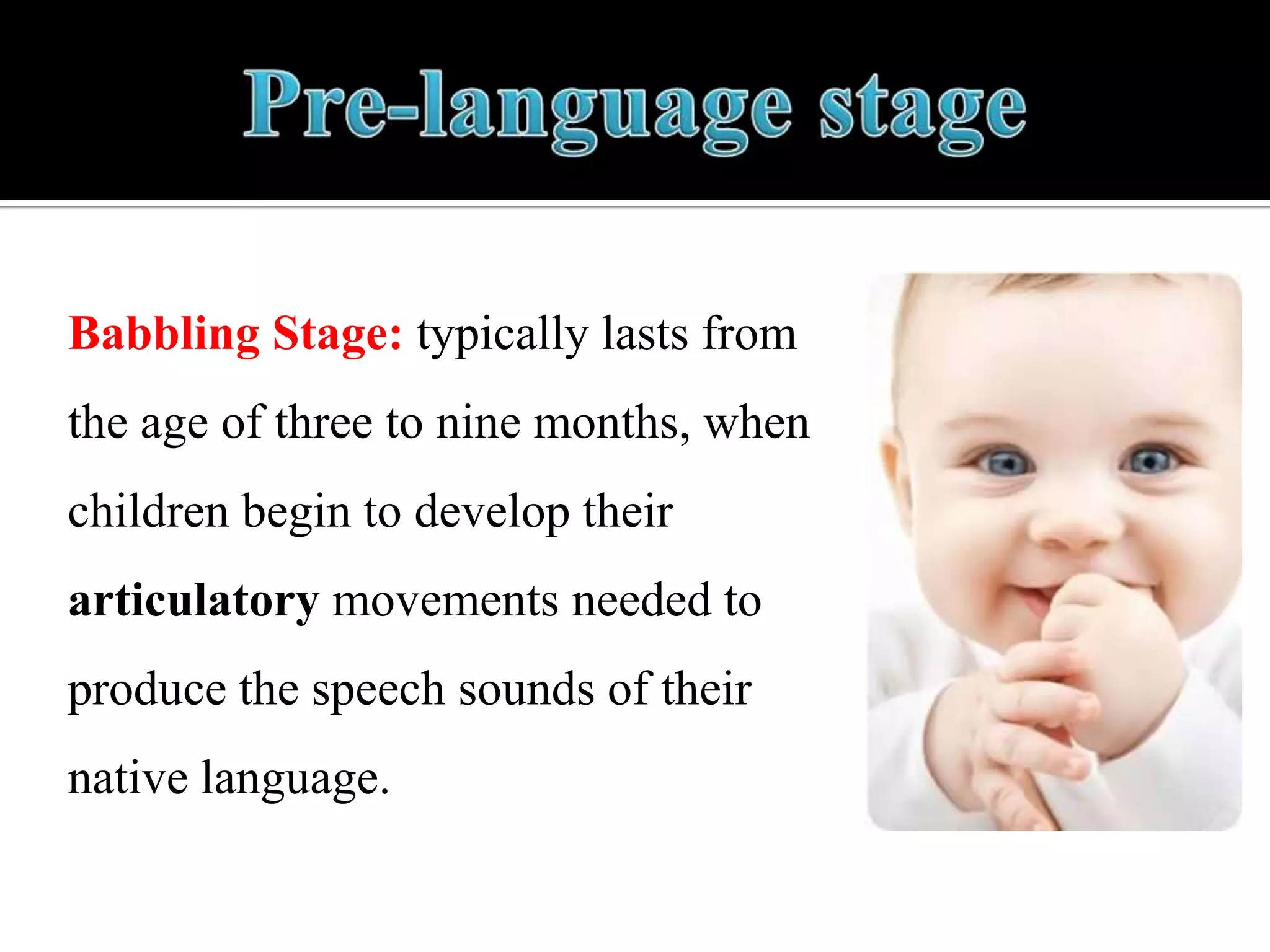
Babbling Stage: typically lasts from
the age of three to nine months, when
children begin to develop their
articulatory movements needed to
produce the speech sounds of their
native language.
Holophrasis is the prelinguistic use of a
single word to express a complex idea.
Around the age of 10 to 13 months, children will
begin to produce their first real words.
It is important to realize that they are able to
understand more than what they are capable to
produce. Infants begin to comprehend language
about twice as fast as they are able to produce it.
Two words: It begins around the age of 18
months, when children begin to use two word sentences.
These sentences usually consist of just nouns and verbs,
such as "Where daddy?" and "Puppy big!"
Note: in this stage since
utterances are so reduced,
context & situation are
determinant for understanding
the message.
As children age, they continue to learn more new words
every day. By the time they enter school around the age
of five, children typically have a vocabulary of 10,000
words or more
Around the age of two, children begin
to produce short, multi-word sentences
that have a subject and predicate.
child who had mastered the
grammatical morphemes at the
bottom of the list had also
mastered those at the top, but the
reverse was not true.
Thus, there was evidence for a
“developmental sequence” or
order of acquisition. (Brown)
Researchers found that grammatical
morphemes were acquired by
children in a similar sequence.
WUG Test
 Jean Berko Gleason is the mother of the “wug test"
 The test demonstrated that children as young as three or
four can internalize complex grammatical codes no one
has necessarily ever tried to teach them — like forming
plurals — and apply these rules broadly, even to made-
up words
Plural
Simple Past
WUG Test
 Jean Berko Gleason is the mother of the “wug test"
 The test demonstrated that children as young as three or
four can internalize complex grammatical codes no one has
necessarily ever tried to teach them — like forming plurals
— and apply these rules broadly, even to made-up words
 By completing these sentences , children demonstrate that
they know the patterns for plural and simple past in
English. By generalizing these patterns to words they have
never heard before, they show that their language is more
than just a list of memorized word.
they can express them in sentences, using
the appropriate words and word order.
The following stages in the development
of negation have been observed in the
acquisition of English.
Even though children understand the functions
of negation and express them with single words
and gestures, it takes some time before
Negation is usually expressed
by the word ‘no’, either all
alone or as the first word in
the utterance.
No. No cookie. No comb hair.
The negative word appears just
before the verb. Sentences
expressing rejection or
prohibition often use don’t.
Daddy no comb hair. Don’t touch that!
Children may add forms of
negative other than ‘no’
including words like can’t and
don’t. However, children do
not yet vary these forms for
different persons or tenses.
I can’t do it. He don’t want it.
Children begin to attach the
negative element to the correct
form of auxiliary verbs such as
‘do’ and ‘be’:
You didn’t have supper.
She doesn’t want it.
They may still have difficulty
with some other features related
to negatives.
I don’t have no more candies.
There is a predictable order in which the wh-
words emerge. “What” is generally the first wh-
question to be used. Then they use “Where”
and “Who”, after that around the end of the
second year “Why” emerges, and finally
“When” and “How”.
Children use single words or
simple two- or three-word
sentences with rising
intonation.
Cookie? Mummy, book?
Children begin to use
declarative sentence with
'yes/no' questions, with rising
intonation.
You like this? I have some?
Gradually, children notice that the
structure of questions is different
and begin to produce questions
such as:
Can I go? Are you happy?
Children begin to use subject-
auxiliary inversion and can even
add 'do'.
Do dogs like ice-cream?
However, children tend to
generalize that all questions are
formed by putting a verb at the
beginning of a sentence.
Is the teddy is tired?
Do I can have a cookie?
Why you don’t have one?
Why you watched it?
Children eventually combine
inversion in yes/no question and
wh-questions.
Are these your boots?
Why did you do that?
Does daddy have a car?
Finally, wh- words appear in
subordinate clauses or
embedded questions.
Do you know where the ball is?
Why the teddy bear can’t go outside?
Negative question may still be
a bit too difficult.
 By the age of four, most
children can ask questions,
give commands, report real
events, create an imaginary
story, use correct word and
grammar.
 They have acquired the
basic structure of the
language that they have
heard.
 Also they begin to
develop metalinguistic
awareness, the ability to
treat language as an
object separate from the
meaning it conveys.
 Writing is one aspect of
language is growing at
school.
 Language register is another
development.
 Learning to read gives a major boot to metalinguistic
awareness.
 Vocabulary grows at a rate of between several hundred
and more than a thousand words a year.
1) Behaviorism: Say what I say
2) Innatism: It’s all in your mind
3) Interactionist/Developmental perspectives:
1. The Behaviorist Perspective
1940s, US
Best-known its proponent: B. F. Skinner
Learning is by imitation & practice
The children receive “positive reinforcement” like
praise or just successful communication
Quality, quantity, consistency of the
reinforcement, and environment would shape the
child’s language behavior.
Language learning is the result of:
 imitation (word-for-word repetition),
 practice (repetitive manipulation of form),
feedback on success (positive
reinforcement)
 habit formation.
The quality and
quantity of the
language that the child
hears
as well as the
consistency of the
reinforcement offered
by others in the
environment
would shape the
child’s language
behaviour.
 Thus, Children learn language step by step
Imitation
Repetition
Memorization
Controlled drilling
Reinforcement
Reinforcement can either be positive or negative
Limitations in the Behaviorist Perspective
The children are using language creatively, for
example:
 Overgeneralizing patterns in language
 Focus on meaning rather than form and structure
 Questions formation in different situation
 Mentioning the events in the order of their
occurrences
These limitation led researchers to look for different
explanations for language acquisition.
Chomsky (1959)
argues that behaviorism
cannot provide
sufficient explanations
for children’s language
acquisition for the
following reasons:
Children come to know more about
the structure of their language than
they could be expected to learn on the
basis of the samples of language they
hear.
The language children are exposed to
includes false starts, incomplete sentences
and slips of the tongue, and yet they learn to
distinguish between grammatical and
ungrammatical sentences.
Children are by no means systematically
corrected or instructed on language by
parents.
Children are
biologically
programmed for
language
Language
develops in the
child
In the same way
of other
biological
functions
So:
 It contains all and only the
principles and parameters which are
universal to all human languages
(i.e.. Universal Grammar – UG).
children need
access only to
samples of a
natural
language
which serve
as a trigger to
activate the
device.
Once the
LAD is
activated
They discover
the structure
of the
language to
be learned
By matching the
innate
knowledge of
basic
grammatical
principles (UG)
to the structures
of the particular
language in the
environment.
• Children’s acquisition of grammatical rules is
guided by principles of an innate UG which
could apply to all languages.
• Children “know” certain things of the language
just by being exposed to a limited number of
samples.
 Virtually all children successfully learn their
native language at a time in life when they
would not be expected to learn anything else so
complicated (i.e. biologically programmed).
 Language is separate from other aspects of
cognitive developments (e.g., creativity and
social grace) and may be located in a different
“module" of the brain.
 The language children are exposed to does not
contain examples of all the linguistic rules and
patterns.
 Animals cannot learn to manipulate a symbol
system as complicated as the natural language of a
3- or 4-year-old child.
 Children acquire grammatical rules without getting
explicit instruction.
The Innatist perspective is often linked to
The Critical Period Hypothesis (CPH) (Lenneberg)
 There is a specific and limited time period (i.e.,
“critical period”) for the LAD to work
successfully.
 The lateralization of brain function refers to how
some neural functions, or cognitive processes tend
to be more dominant in one hemisphere than the
other. The medial longitudinal fissure separates
the human brain into two distinct cerebral
hemispheres, connected by the corpus callosum.
Two versions
Strong Only by puberty
Weak
After puberty it will
be more difficult and
incomplete
Too much emphasis on the “final state”
(the competence of adult native speakers )
but not enough on the developmental
aspects of language acquisition.
 Language was ONE manifestation of the
cognitive and affective ability to deal with the
world
 Innatist dealt with FORMS of the language,
not with the FUNCTIONAL levels of
meaning constructed from SOCIAL
INTERACTION
 Language acquisition is an example of
children’s ability to learn from experience.
 What children need to know is essentially
available in the language they are exposed
to.
the innate learning
ability of children
the environment
in which they
develop
LANGUAGE
DEVELOPMENT
Jean Piaget was a proponents of
view that the children’s
language is built on their
cognitive development.
Vygotsky
Sociocultural theory of human
mental processing.
 He argued that language develops
primarily from
social interaction.
• A level that a child is able to do when there is
support from interaction with a more advanced
interlocutor.
• A supportive interactive environment enables
children to advance to a higher level of
knowledge and performance than s/he would
be able to do independently. (Vygotsky)
 Wood, Bruner and Ross (1976) – adults particularly parents,
support children's cognitive development through everyday play
interactions.
 Scaffolding is a temporary support structure around that child’s
attempts to understand new ideas and complete new tasks.
 The purpose of the support is to allow the child to achieve higher
levels of development by:
 1. simplifying the task or idea
 2. motivating and encouraging the child
 Highlighting important task elements or errors
 Giving models that can be imitated.
 There is no direct pressure to learn
 There is no time limit for learning.
 There is no way of escaping into a different
language (no vacations).
 The language is not sequenced by grammar
or vocabulary (no textbook).
 There is lots of repetition
 Both the language and the world are new.
 All the language is spoken in the context of
the surrounding world.
 The language is all around.
 The child has many opportunities for using
the language to communicate to those
around him.
 Much of the language is simplified to the
level of understanding of the child.
The interaction between a language-learning
child and a speaker who responds in some way
to the child is important.
 Exposure to impersonal sources of language
such as television or radio alone are not
sufficient for children to learn the structure of
a particular language.
 One-on-one interaction gives children access
to language that is adjusted to their level of
comprehension. Once children have acquired
some language, however, television can be a
source of language and cultural information.
 Research show that language acquisition is
usage-based
 The children have this opportunities to make
connection between the language they heard
and what they experience in their
environment.
Though both innatism and connectionism look
at the cognitive aspect of language acquisition,
yet they differ in the following:
 Connectionists hypothesize that language
acquisition does not require a separate
“module of the mind” but can be explained in
terms of learning in general.
 Connectionists argue that what children need to know is
essentially available in the language they are exposed to.
 They attribute greater importance to the role of the
environment than to any innate knowledge in the learner.
 Language acquisition is not just a process of associating
words with elements of external reality. It is also a process
of associating words and phrases with the other words and
phrases that occur with them, or words with grammatical
morphemes that occur with them
 Children who learn more than one language from earliest
childhood are referred to as “simultaneous bilingual”.
 Children who learn more than one language later is called
“sequential bilingual”
 There is no evidence that learning two languages
substantially slow down their linguistic development or
interferes with cognitive development
 One aspect of bilingual language use is
referred to as “code switching”, the use of
words or phrases from more than one
language within a conversation.
 Manu children attain high level of proficiency in both
languages, but when they have the opportunity to use
them and interact with others.
 As you acquire your second language, you
continue to develop cognitively in your first
language. You develop age-appropriate
proficiency in both L1 and L2.
 The result: Positive cognitive effects.
Proficient bilinguals outscore monolinguals on
school tests.
 As you acquire your second language, you
gradually lose your first language.
 The result: Negative cognitive effects.
 Subtractive bilinguals do less well in school as
cognitive complexity increases in the school
curriculum.
Issues in first
language
acquisition
 Competence refers to
one’s underlying of a
system, event, or fact; non
observable ability to do
something.
 Performance is the overtly
observable and concrete
manifestation or
realization of competence.
It is the actual doing of
something.
Competence and
performance
They both can be aspects of
performance and competence. It is
thought that comprehension (listening
and reading) can be associated with
competence, while production
(speaking, writing) are associated with
performance.
Comprehension
and production
Nature or nurture
Nativists contend that a child
is born with an innate
knowledge of a language, and
that this innate property is
universal.
However, it hasn’t been
proven that there are
“language genes” in our
genetic information.
Environmental factors cannot
be ignored.
Language and thought
The issue at stake is to determine
how thought affects language,
how language affects thought,
and how linguists can best
describe and explain the
interaction of the two.
There have been some positions
on this such as that of Piaget,
who claimed that cognitive
development is at the center of
human organisms and that
language depends on cognitive
development.
Imitation
 Research has shown that
echoing is a particularly
salient strategy in early
language learning and an
important aspect of early
phonological acquisition.
 Children imitate the
surface structure of the
language.
Practice
Children like to play
with language.
Practicing a language
involves speaking and
comprehension
practice.
Input
The speech that young
children hear is primarily
the speech heard in home.
Also, children acquire the
language from
overhearing the
conversations of others,
from listening to the radio,
watching TV or work with
some objects.
Discourse
The child will learn how
to initiate a conversation
and give responses.
The child will identify
whether he is being
requested for information,
for an action, or for help.
Second language learning theories

Second language learning theories

  • 1.
  • 2.
     To knowdifferences between Learning and Acquisition  To know the role of Electronic Devices in language acquisition (LA)  To know the first three years of LA  To know developmental sequence in LA  To know “WUG Test”  To know theories of first language acquisition: Behaviorism, Innatism, Interactionist  To know Zone of proximal development (ZPD)  Bilingualism and Additive & Subtractive Bilingualism  To know Connectionism
  • 4.
    First language acquisitionis the process by which humans acquire the capacity to perceive and comprehend language, as well as to produce and use words and sentences to communicate.
  • 5.
    Children go througha number of different stages as language acquirers, from the earliest stage of producing cooing sounds (repetition) until being able to produce complex, multi-word sentences.
  • 6.
     Is itadequate for babies to hear language sounds from electronic devices in order to acquire the language?  In order to be able to distinguish between the sounds and acquire a language, they need to interact with human speaker (Conboy & Kuhl 2001)
  • 7.
  • 8.
    Babbling Stage: typicallylasts from the age of three to nine months, when children begin to develop their articulatory movements needed to produce the speech sounds of their native language.
  • 9.
    Holophrasis is theprelinguistic use of a single word to express a complex idea. Around the age of 10 to 13 months, children will begin to produce their first real words. It is important to realize that they are able to understand more than what they are capable to produce. Infants begin to comprehend language about twice as fast as they are able to produce it.
  • 10.
    Two words: Itbegins around the age of 18 months, when children begin to use two word sentences. These sentences usually consist of just nouns and verbs, such as "Where daddy?" and "Puppy big!" Note: in this stage since utterances are so reduced, context & situation are determinant for understanding the message.
  • 11.
    As children age,they continue to learn more new words every day. By the time they enter school around the age of five, children typically have a vocabulary of 10,000 words or more Around the age of two, children begin to produce short, multi-word sentences that have a subject and predicate.
  • 12.
    child who hadmastered the grammatical morphemes at the bottom of the list had also mastered those at the top, but the reverse was not true. Thus, there was evidence for a “developmental sequence” or order of acquisition. (Brown) Researchers found that grammatical morphemes were acquired by children in a similar sequence.
  • 13.
    WUG Test  JeanBerko Gleason is the mother of the “wug test"  The test demonstrated that children as young as three or four can internalize complex grammatical codes no one has necessarily ever tried to teach them — like forming plurals — and apply these rules broadly, even to made- up words
  • 14.
  • 15.
  • 16.
    WUG Test  JeanBerko Gleason is the mother of the “wug test"  The test demonstrated that children as young as three or four can internalize complex grammatical codes no one has necessarily ever tried to teach them — like forming plurals — and apply these rules broadly, even to made-up words  By completing these sentences , children demonstrate that they know the patterns for plural and simple past in English. By generalizing these patterns to words they have never heard before, they show that their language is more than just a list of memorized word.
  • 17.
    they can expressthem in sentences, using the appropriate words and word order. The following stages in the development of negation have been observed in the acquisition of English. Even though children understand the functions of negation and express them with single words and gestures, it takes some time before
  • 18.
    Negation is usuallyexpressed by the word ‘no’, either all alone or as the first word in the utterance. No. No cookie. No comb hair. The negative word appears just before the verb. Sentences expressing rejection or prohibition often use don’t. Daddy no comb hair. Don’t touch that!
  • 19.
    Children may addforms of negative other than ‘no’ including words like can’t and don’t. However, children do not yet vary these forms for different persons or tenses. I can’t do it. He don’t want it. Children begin to attach the negative element to the correct form of auxiliary verbs such as ‘do’ and ‘be’: You didn’t have supper. She doesn’t want it. They may still have difficulty with some other features related to negatives. I don’t have no more candies.
  • 20.
    There is apredictable order in which the wh- words emerge. “What” is generally the first wh- question to be used. Then they use “Where” and “Who”, after that around the end of the second year “Why” emerges, and finally “When” and “How”.
  • 21.
    Children use singlewords or simple two- or three-word sentences with rising intonation. Cookie? Mummy, book? Children begin to use declarative sentence with 'yes/no' questions, with rising intonation. You like this? I have some?
  • 22.
    Gradually, children noticethat the structure of questions is different and begin to produce questions such as: Can I go? Are you happy? Children begin to use subject- auxiliary inversion and can even add 'do'. Do dogs like ice-cream? However, children tend to generalize that all questions are formed by putting a verb at the beginning of a sentence. Is the teddy is tired? Do I can have a cookie? Why you don’t have one? Why you watched it?
  • 23.
    Children eventually combine inversionin yes/no question and wh-questions. Are these your boots? Why did you do that? Does daddy have a car? Finally, wh- words appear in subordinate clauses or embedded questions. Do you know where the ball is? Why the teddy bear can’t go outside? Negative question may still be a bit too difficult.
  • 24.
     By theage of four, most children can ask questions, give commands, report real events, create an imaginary story, use correct word and grammar.  They have acquired the basic structure of the language that they have heard.
  • 25.
     Also theybegin to develop metalinguistic awareness, the ability to treat language as an object separate from the meaning it conveys.
  • 26.
     Writing isone aspect of language is growing at school.  Language register is another development.  Learning to read gives a major boot to metalinguistic awareness.  Vocabulary grows at a rate of between several hundred and more than a thousand words a year.
  • 27.
    1) Behaviorism: Saywhat I say 2) Innatism: It’s all in your mind 3) Interactionist/Developmental perspectives:
  • 28.
    1. The BehavioristPerspective 1940s, US Best-known its proponent: B. F. Skinner Learning is by imitation & practice The children receive “positive reinforcement” like praise or just successful communication Quality, quantity, consistency of the reinforcement, and environment would shape the child’s language behavior.
  • 29.
    Language learning isthe result of:  imitation (word-for-word repetition),  practice (repetitive manipulation of form), feedback on success (positive reinforcement)  habit formation.
  • 30.
    The quality and quantityof the language that the child hears as well as the consistency of the reinforcement offered by others in the environment would shape the child’s language behaviour.
  • 31.
     Thus, Childrenlearn language step by step Imitation Repetition Memorization Controlled drilling Reinforcement Reinforcement can either be positive or negative
  • 32.
    Limitations in theBehaviorist Perspective The children are using language creatively, for example:  Overgeneralizing patterns in language  Focus on meaning rather than form and structure  Questions formation in different situation  Mentioning the events in the order of their occurrences These limitation led researchers to look for different explanations for language acquisition.
  • 34.
    Chomsky (1959) argues thatbehaviorism cannot provide sufficient explanations for children’s language acquisition for the following reasons:
  • 35.
    Children come toknow more about the structure of their language than they could be expected to learn on the basis of the samples of language they hear.
  • 36.
    The language childrenare exposed to includes false starts, incomplete sentences and slips of the tongue, and yet they learn to distinguish between grammatical and ungrammatical sentences. Children are by no means systematically corrected or instructed on language by parents.
  • 37.
    Children are biologically programmed for language Language developsin the child In the same way of other biological functions So:
  • 38.
     It containsall and only the principles and parameters which are universal to all human languages (i.e.. Universal Grammar – UG).
  • 39.
    children need access onlyto samples of a natural language which serve as a trigger to activate the device. Once the LAD is activated They discover the structure of the language to be learned By matching the innate knowledge of basic grammatical principles (UG) to the structures of the particular language in the environment.
  • 40.
    • Children’s acquisitionof grammatical rules is guided by principles of an innate UG which could apply to all languages. • Children “know” certain things of the language just by being exposed to a limited number of samples.
  • 41.
     Virtually allchildren successfully learn their native language at a time in life when they would not be expected to learn anything else so complicated (i.e. biologically programmed).  Language is separate from other aspects of cognitive developments (e.g., creativity and social grace) and may be located in a different “module" of the brain.
  • 42.
     The languagechildren are exposed to does not contain examples of all the linguistic rules and patterns.  Animals cannot learn to manipulate a symbol system as complicated as the natural language of a 3- or 4-year-old child.  Children acquire grammatical rules without getting explicit instruction.
  • 43.
    The Innatist perspectiveis often linked to The Critical Period Hypothesis (CPH) (Lenneberg)  There is a specific and limited time period (i.e., “critical period”) for the LAD to work successfully.  The lateralization of brain function refers to how some neural functions, or cognitive processes tend to be more dominant in one hemisphere than the other. The medial longitudinal fissure separates the human brain into two distinct cerebral hemispheres, connected by the corpus callosum.
  • 45.
    Two versions Strong Onlyby puberty Weak After puberty it will be more difficult and incomplete
  • 47.
    Too much emphasison the “final state” (the competence of adult native speakers ) but not enough on the developmental aspects of language acquisition.
  • 48.
     Language wasONE manifestation of the cognitive and affective ability to deal with the world  Innatist dealt with FORMS of the language, not with the FUNCTIONAL levels of meaning constructed from SOCIAL INTERACTION
  • 49.
     Language acquisitionis an example of children’s ability to learn from experience.  What children need to know is essentially available in the language they are exposed to.
  • 50.
    the innate learning abilityof children the environment in which they develop LANGUAGE DEVELOPMENT
  • 51.
    Jean Piaget wasa proponents of view that the children’s language is built on their cognitive development.
  • 52.
    Vygotsky Sociocultural theory ofhuman mental processing.  He argued that language develops primarily from social interaction.
  • 54.
    • A levelthat a child is able to do when there is support from interaction with a more advanced interlocutor. • A supportive interactive environment enables children to advance to a higher level of knowledge and performance than s/he would be able to do independently. (Vygotsky)
  • 55.
     Wood, Brunerand Ross (1976) – adults particularly parents, support children's cognitive development through everyday play interactions.  Scaffolding is a temporary support structure around that child’s attempts to understand new ideas and complete new tasks.  The purpose of the support is to allow the child to achieve higher levels of development by:  1. simplifying the task or idea  2. motivating and encouraging the child  Highlighting important task elements or errors  Giving models that can be imitated.
  • 56.
     There isno direct pressure to learn  There is no time limit for learning.  There is no way of escaping into a different language (no vacations).  The language is not sequenced by grammar or vocabulary (no textbook).
  • 57.
     There islots of repetition  Both the language and the world are new.  All the language is spoken in the context of the surrounding world.  The language is all around.
  • 58.
     The childhas many opportunities for using the language to communicate to those around him.  Much of the language is simplified to the level of understanding of the child.
  • 59.
    The interaction betweena language-learning child and a speaker who responds in some way to the child is important.  Exposure to impersonal sources of language such as television or radio alone are not sufficient for children to learn the structure of a particular language.
  • 60.
     One-on-one interactiongives children access to language that is adjusted to their level of comprehension. Once children have acquired some language, however, television can be a source of language and cultural information.
  • 61.
     Research showthat language acquisition is usage-based  The children have this opportunities to make connection between the language they heard and what they experience in their environment.
  • 62.
    Though both innatismand connectionism look at the cognitive aspect of language acquisition, yet they differ in the following:  Connectionists hypothesize that language acquisition does not require a separate “module of the mind” but can be explained in terms of learning in general.
  • 63.
     Connectionists arguethat what children need to know is essentially available in the language they are exposed to.  They attribute greater importance to the role of the environment than to any innate knowledge in the learner.  Language acquisition is not just a process of associating words with elements of external reality. It is also a process of associating words and phrases with the other words and phrases that occur with them, or words with grammatical morphemes that occur with them
  • 64.
     Children wholearn more than one language from earliest childhood are referred to as “simultaneous bilingual”.  Children who learn more than one language later is called “sequential bilingual”  There is no evidence that learning two languages substantially slow down their linguistic development or interferes with cognitive development
  • 65.
     One aspectof bilingual language use is referred to as “code switching”, the use of words or phrases from more than one language within a conversation.  Manu children attain high level of proficiency in both languages, but when they have the opportunity to use them and interact with others.
  • 66.
     As youacquire your second language, you continue to develop cognitively in your first language. You develop age-appropriate proficiency in both L1 and L2.  The result: Positive cognitive effects. Proficient bilinguals outscore monolinguals on school tests.
  • 67.
     As youacquire your second language, you gradually lose your first language.  The result: Negative cognitive effects.  Subtractive bilinguals do less well in school as cognitive complexity increases in the school curriculum.
  • 68.
  • 69.
     Competence refersto one’s underlying of a system, event, or fact; non observable ability to do something.  Performance is the overtly observable and concrete manifestation or realization of competence. It is the actual doing of something. Competence and performance
  • 70.
    They both canbe aspects of performance and competence. It is thought that comprehension (listening and reading) can be associated with competence, while production (speaking, writing) are associated with performance. Comprehension and production
  • 71.
    Nature or nurture Nativistscontend that a child is born with an innate knowledge of a language, and that this innate property is universal. However, it hasn’t been proven that there are “language genes” in our genetic information. Environmental factors cannot be ignored.
  • 72.
    Language and thought Theissue at stake is to determine how thought affects language, how language affects thought, and how linguists can best describe and explain the interaction of the two. There have been some positions on this such as that of Piaget, who claimed that cognitive development is at the center of human organisms and that language depends on cognitive development.
  • 73.
    Imitation  Research hasshown that echoing is a particularly salient strategy in early language learning and an important aspect of early phonological acquisition.  Children imitate the surface structure of the language.
  • 74.
    Practice Children like toplay with language. Practicing a language involves speaking and comprehension practice.
  • 75.
    Input The speech thatyoung children hear is primarily the speech heard in home. Also, children acquire the language from overhearing the conversations of others, from listening to the radio, watching TV or work with some objects.
  • 76.
    Discourse The child willlearn how to initiate a conversation and give responses. The child will identify whether he is being requested for information, for an action, or for help.