FIRST LANGUAGE ACQUISITION
Applied Linguistics
Isabel Matos
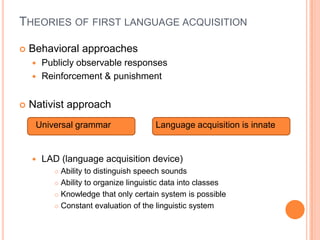
THEORIES OF FIRST LANGUAGE ACQUISITION

   Behavioral approaches
     Publicly observable responses
     Reinforcement & punishment


   Nativist approach
     Universal grammar                 Language acquisition is innate


       LAD (language acquisition device)
           Ability to distinguish speech sounds
           Ability to organize linguistic data into classes

           Knowledge that only certain system is possible

           Constant evaluation of the linguistic system
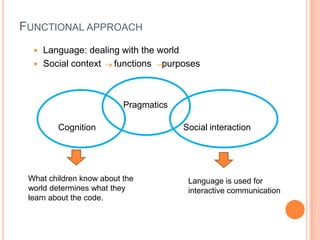
FUNCTIONAL APPROACH
   Language: dealing with the world
   Social context  functions purposes


                          Pragmatics

        Cognition                      Social interaction


 What children know about the           Language is used for
 world determines what they             interactive communication
 learn about the code.
ISSUES IN FIRST LANGUAGE ACQUISITION
   Competence: ability to do something

   Performance: manifestation of competence

  Comprehension & production
(listening , reading)(speaking, writing)

   Nature or Nurture?
       Problems with the nativist approach
         Genetic transmission?
         What are the behaviors given by nature ? And by teaching?
   Universals: language is universally acquired in the
    same manner and the deepest structure is the same in
    all languages.
                                    Word order

                                        Negation
       Principles: are universal      Question Formation

                                     Agreement


       Parameters : vary across languages
   Systematicity and Variability
     The   acquisition process is systematic but it is not clear where the
      limit of its stages is (variability)


   Language and thought
                                Piaget: Language
                                depends on cognition


Behaviorist: cognition      Each language imposes on          Jerome Bruner:
is too mentalistic to be      Its speaker a particular        Language influences
studied                              worldview                cognition


                           Benjamin Whorf & Edward Sapir:
                           Linguistics relativity
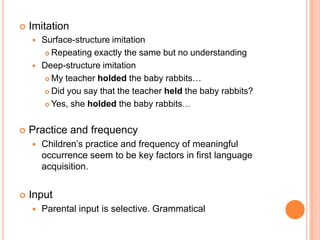
   Imitation
       Surface-structure imitation
          Repeating exactly the same but no understanding

       Deep-structure imitation
          My teacher holded the baby rabbits…

          Did you say that the teacher held the baby rabbits?

          Yes, she holded the baby rabbits…


   Practice and frequency
       Children’s practice and frequency of meaningful
        occurrence seem to be key factors in first language
        acquisition.


   Input
       Parental input is selective. Grammatical
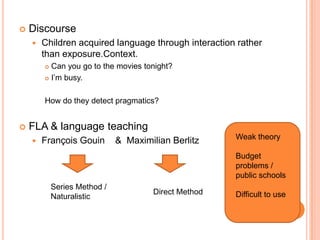
   Discourse
       Children acquired language through interaction rather
        than exposure.Context.
         Can you go to the movies tonight?
         I’m busy.


        How do they detect pragmatics?


   FLA & language teaching
                                                       Weak theory
       François Gouin        & Maximilian Berlitz
                                                       Budget
                                                       problems /
                                                       public schools
            Series Method /
                                       Direct Method   Difficult to use
            Naturalistic
“The second time around on something is always
    easier. In the case of language, this is not
                 necessarily true.”
                 Douglas Brown

First language acquisition

  • 1.
    FIRST LANGUAGE ACQUISITION AppliedLinguistics Isabel Matos
  • 2.
    THEORIES OF FIRSTLANGUAGE ACQUISITION  Behavioral approaches  Publicly observable responses  Reinforcement & punishment  Nativist approach Universal grammar Language acquisition is innate  LAD (language acquisition device)  Ability to distinguish speech sounds  Ability to organize linguistic data into classes  Knowledge that only certain system is possible  Constant evaluation of the linguistic system
  • 3.
    FUNCTIONAL APPROACH  Language: dealing with the world  Social context functions purposes Pragmatics Cognition Social interaction What children know about the Language is used for world determines what they interactive communication learn about the code.
  • 4.
    ISSUES IN FIRSTLANGUAGE ACQUISITION  Competence: ability to do something  Performance: manifestation of competence  Comprehension & production (listening , reading)(speaking, writing)  Nature or Nurture?  Problems with the nativist approach  Genetic transmission?  What are the behaviors given by nature ? And by teaching?
  • 5.
    Universals: language is universally acquired in the same manner and the deepest structure is the same in all languages. Word order Negation  Principles: are universal Question Formation Agreement  Parameters : vary across languages
  • 6.
    Systematicity and Variability  The acquisition process is systematic but it is not clear where the limit of its stages is (variability)  Language and thought Piaget: Language depends on cognition Behaviorist: cognition Each language imposes on Jerome Bruner: is too mentalistic to be Its speaker a particular Language influences studied worldview cognition Benjamin Whorf & Edward Sapir: Linguistics relativity
  • 7.
    Imitation  Surface-structure imitation  Repeating exactly the same but no understanding  Deep-structure imitation  My teacher holded the baby rabbits…  Did you say that the teacher held the baby rabbits?  Yes, she holded the baby rabbits…  Practice and frequency  Children’s practice and frequency of meaningful occurrence seem to be key factors in first language acquisition.  Input  Parental input is selective. Grammatical
  • 8.
    Discourse  Children acquired language through interaction rather than exposure.Context.  Can you go to the movies tonight?  I’m busy. How do they detect pragmatics?  FLA & language teaching Weak theory  François Gouin & Maximilian Berlitz Budget problems / public schools Series Method / Direct Method Difficult to use Naturalistic
  • 9.
    “The second timearound on something is always easier. In the case of language, this is not necessarily true.” Douglas Brown