Language
A means of communication.
Broca's Area Wernicke's Area
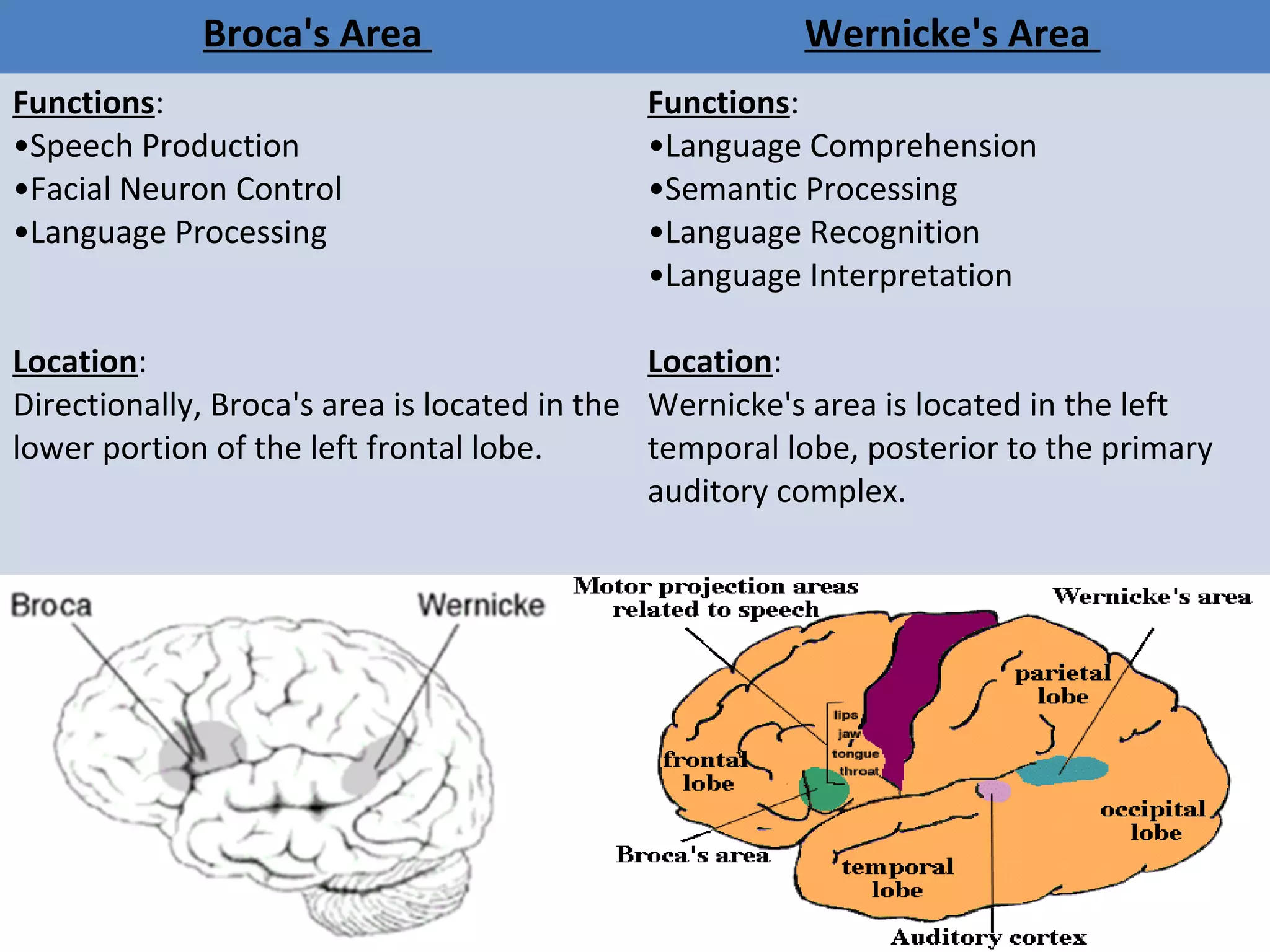
Functions:
•Speech Production
•Facial Neuron Control
•Language Processing
‍Location:
Directionally, Broca's area is located in the
lower portion of the left frontal lobe.
Functions:
•Language Comprehension
•Semantic Processing
•Language Recognition
•Language Interpretation
‍Location:
Wernicke's area is located in the left
temporal lobe, posterior to the primary
auditory complex.
Language
A means of communication.
Language can be…..
auditory, visual, or tactile
All languages contain….
Phonemes
• The smallest units of
sound in a language.
• English has about 44
phonemes.
Morphemes
• The smallest unit of
meaningful sound.
• Can be words like a or
but.
• Can also be parts of
words like prefixes or
suffixes…”ed” at the
end of a word means
past tense.
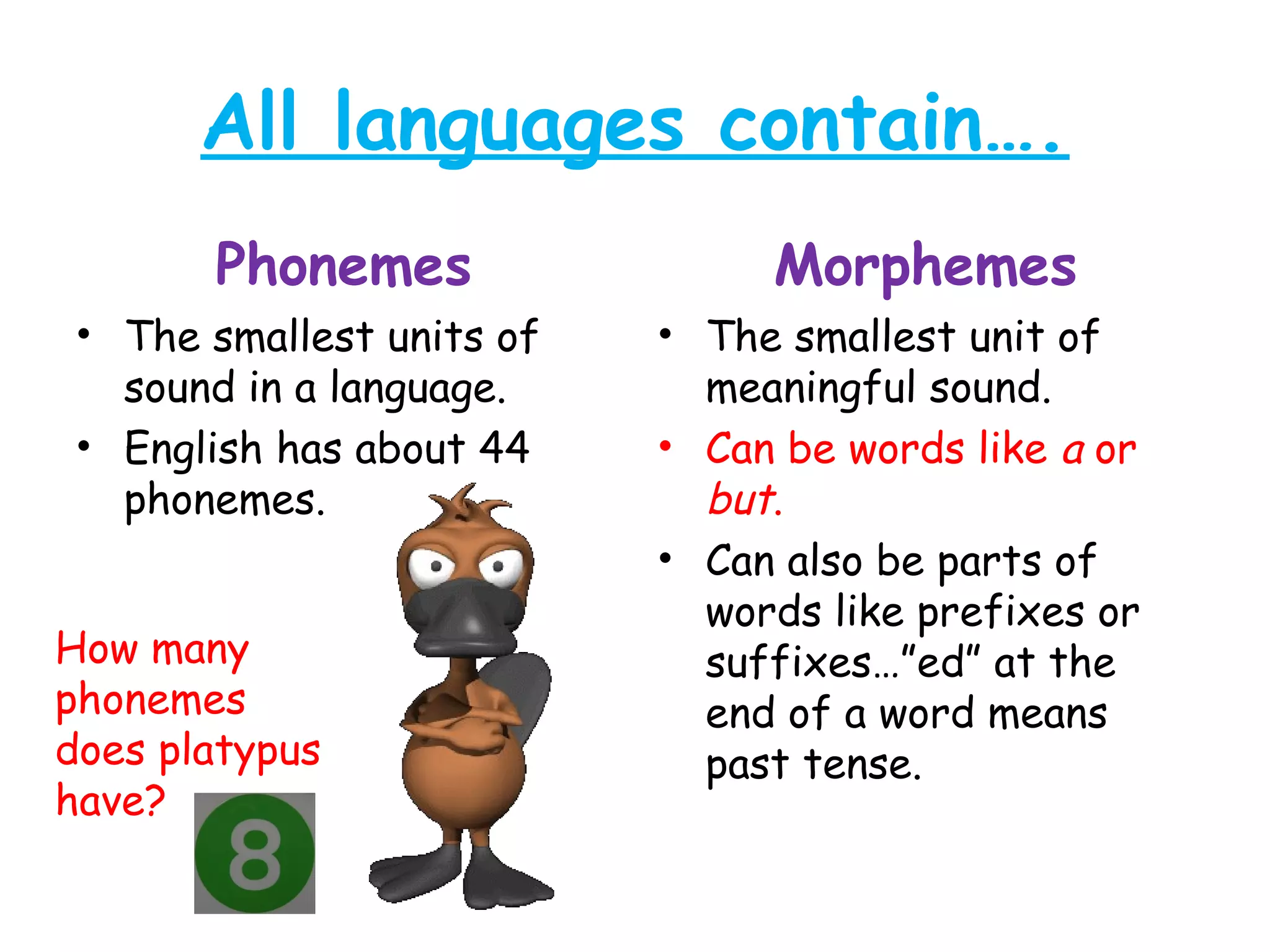
How many
phonemes
does platypus
have?
Grammar
• The rules of a
language.
• Syntax: the order
of words in a
language.
Language Acquisition
Stages that we learn
language…
1. Babbling Stage
2. Holophrastic Stage (one
word stage)
3. Telegraphic Speech
Stage
• After the telegraphic
stage we get
overgeneralization.
https://www.youtube.com/watch?v=wxtLhgzntg8
How do we learn language?
Social Learning Theory
• B.F. Skinner from the
Behaviorist School
• Baby may imitate a
parent.
 If they are reinforced
they keep saying the
word.
 If they are punished,
they stop saying the
word.
Chomsky’s Theory
(Nativist Theory)
• We learn language
too quickly for it to
be through
reinforcement and
punishment.
• Inborn universal
language acquisition
device
https://www.youtube.com/watch?
v=3gU-B0-
DCKI&index=20&list=PLfoJWSBAwZA
xpXAHjV6blIEBJWNSuvZv5
https://www.youtube.com/watch?v=uSFPgDuyv6E
Whorf’s Linguistic Relativity
• The idea that
language determines
the way we think.
• The Hopi tribe has
no past tense in
their language.
• Whorf says they
rarely think of the
past.
Do animals use language?

Language

  • 1.
    Language A means ofcommunication.
  • 3.
    Broca's Area Wernicke'sArea Functions: •Speech Production •Facial Neuron Control •Language Processing ‍Location: Directionally, Broca's area is located in the lower portion of the left frontal lobe. Functions: •Language Comprehension •Semantic Processing •Language Recognition •Language Interpretation ‍Location: Wernicke's area is located in the left temporal lobe, posterior to the primary auditory complex.
  • 4.
    Language A means ofcommunication.
  • 5.
  • 6.
    All languages contain…. Phonemes •The smallest units of sound in a language. • English has about 44 phonemes. Morphemes • The smallest unit of meaningful sound. • Can be words like a or but. • Can also be parts of words like prefixes or suffixes…”ed” at the end of a word means past tense. How many phonemes does platypus have?
  • 7.
    Grammar • The rulesof a language. • Syntax: the order of words in a language.
  • 8.
    Language Acquisition Stages thatwe learn language… 1. Babbling Stage 2. Holophrastic Stage (one word stage) 3. Telegraphic Speech Stage • After the telegraphic stage we get overgeneralization. https://www.youtube.com/watch?v=wxtLhgzntg8
  • 9.
    How do welearn language?
  • 12.
    Social Learning Theory •B.F. Skinner from the Behaviorist School • Baby may imitate a parent.  If they are reinforced they keep saying the word.  If they are punished, they stop saying the word.
  • 13.
    Chomsky’s Theory (Nativist Theory) •We learn language too quickly for it to be through reinforcement and punishment. • Inborn universal language acquisition device https://www.youtube.com/watch? v=3gU-B0- DCKI&index=20&list=PLfoJWSBAwZA xpXAHjV6blIEBJWNSuvZv5
  • 14.
  • 15.
    Whorf’s Linguistic Relativity •The idea that language determines the way we think. • The Hopi tribe has no past tense in their language. • Whorf says they rarely think of the past.
  • 16.
    Do animals uselanguage?