http://www.youtube.com/watch?v=
KyJDeF2RHMw
Content Objectives
• Our mission for this week will be:
  – To explore the properties of language.
  – To understand the key concepts regarding
    first language acquisition.
  – To learn about the brain and language
    processing.
  – To learn how to use context clues to
    understand meanings.
Language Objectives
• We will accomplish our mission by:
  – Discussing the properties of language using “What is
    language in Pictures & Words”.
   – Individually writing responses to opening discussion
     cases associated with key concepts.
   – Discussing in a group our understanding of brain areas
     used for language processing
   – After reading a passage, complete exercises on using
     definitions, details, and examples to understand
     meanings.
Opening Discussion Case 1
• How do you pronounce this made-up word:
  “wug”? - /wʌg/

• How about “nghalmax”? Why do you have a
  problem pronouncing this non-word
  compared to the first one?
Opening Discussion Case 2
• When making a singular verb into a plural
  form, how do you know whether to add
an /s/ sound as in “pits” and “sinks”,
a /z/ sound as in “lids” and “pens”, or
an /əz/ sound as in “watches” and “lodges”?
Opening Discussion Case 3
• Why do we say „happier” and
  “prettiest”, but “more upset” and
  “most excited?”
Opening Discussion Case 4
• Why would a child say each of the
  following “errors?” What does this tell
  you about first language acquisition?
  (1) Child: “Daddy bringed me my shoes for
  my foots.”*
  (2) Adult: Who broke the window?”
   Child: Well, perhaps it was John, but
  perhapser it was Mary.”*
COURSE SYLLABUS

• Overview
• Assignments
• Due Dates
• Questions???
What are the properties of
         language?
• Communicative: Language = primary form of
  communication
• Arbitrary relationship to referents (e.g., dog - perro)
• Systematic (patterns based on rules)
• Generative/productive – We can generate an infinite
  # of sentences out of a finite set of rules (Chomsky)
• Evolutionary – language changes over time; new
  words are coined every year (e.g., blog)
• Cultural/conventional - symbols and their meanings
  represent shared values among a group of people
What are the properties of
         language?
• All of the Above!
• Linguists are interested in the
  communicative, arbitrary, systematic,
  generative, evolutionary, and culturally
  specific nature of human language and
  communication.
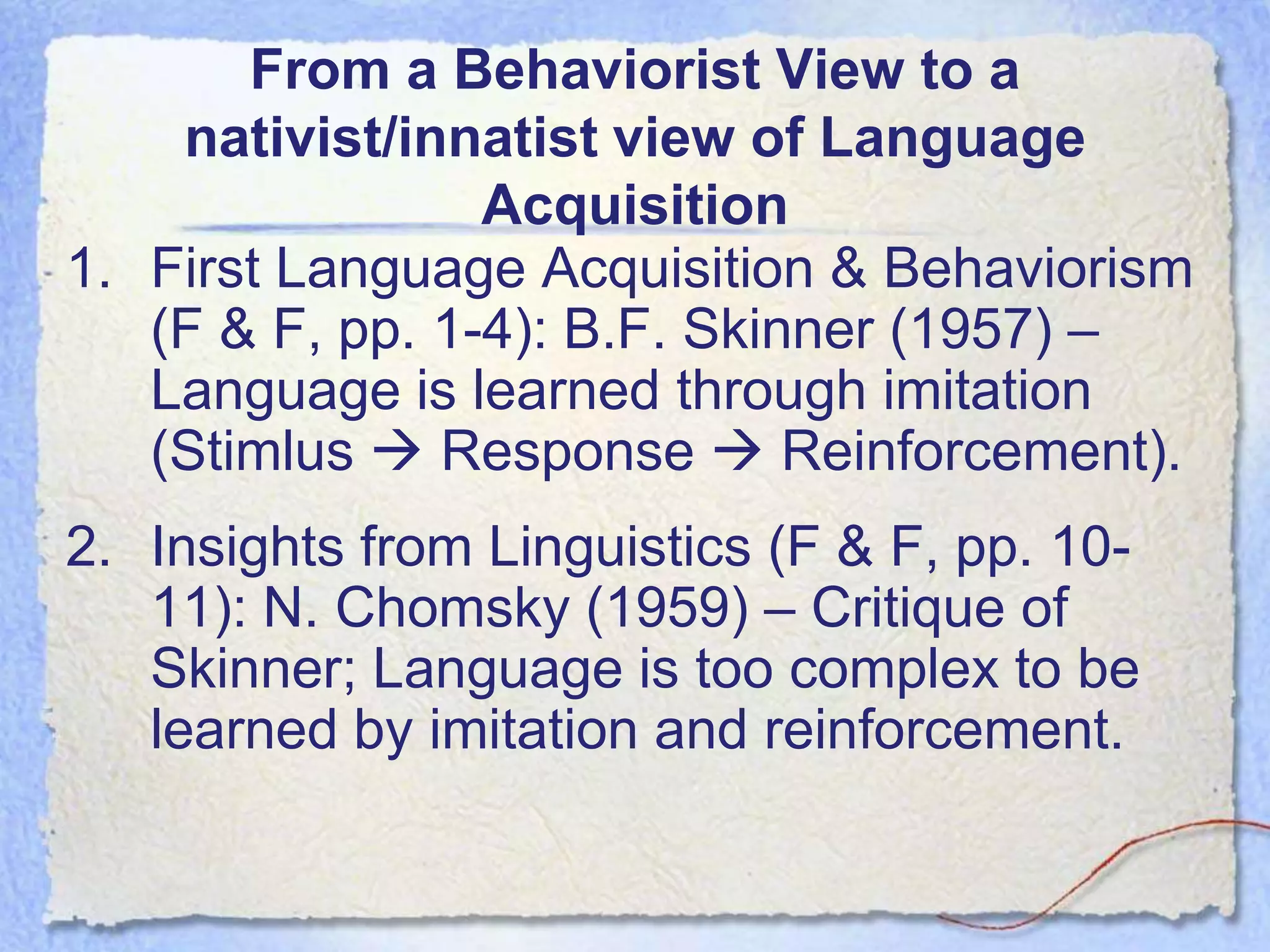
From a Behaviorist View to a
    nativist/innatist view of Language
                 Acquisition
1. First Language Acquisition & Behaviorism
   (F & F, pp. 1-4): B.F. Skinner (1957) –
   Language is learned through imitation
   (Stimlus  Response  Reinforcement).
2. Insights from Linguistics (F & F, pp. 10-
   11): N. Chomsky (1959) – Critique of
   Skinner; Language is too complex to be
   learned by imitation and reinforcement.
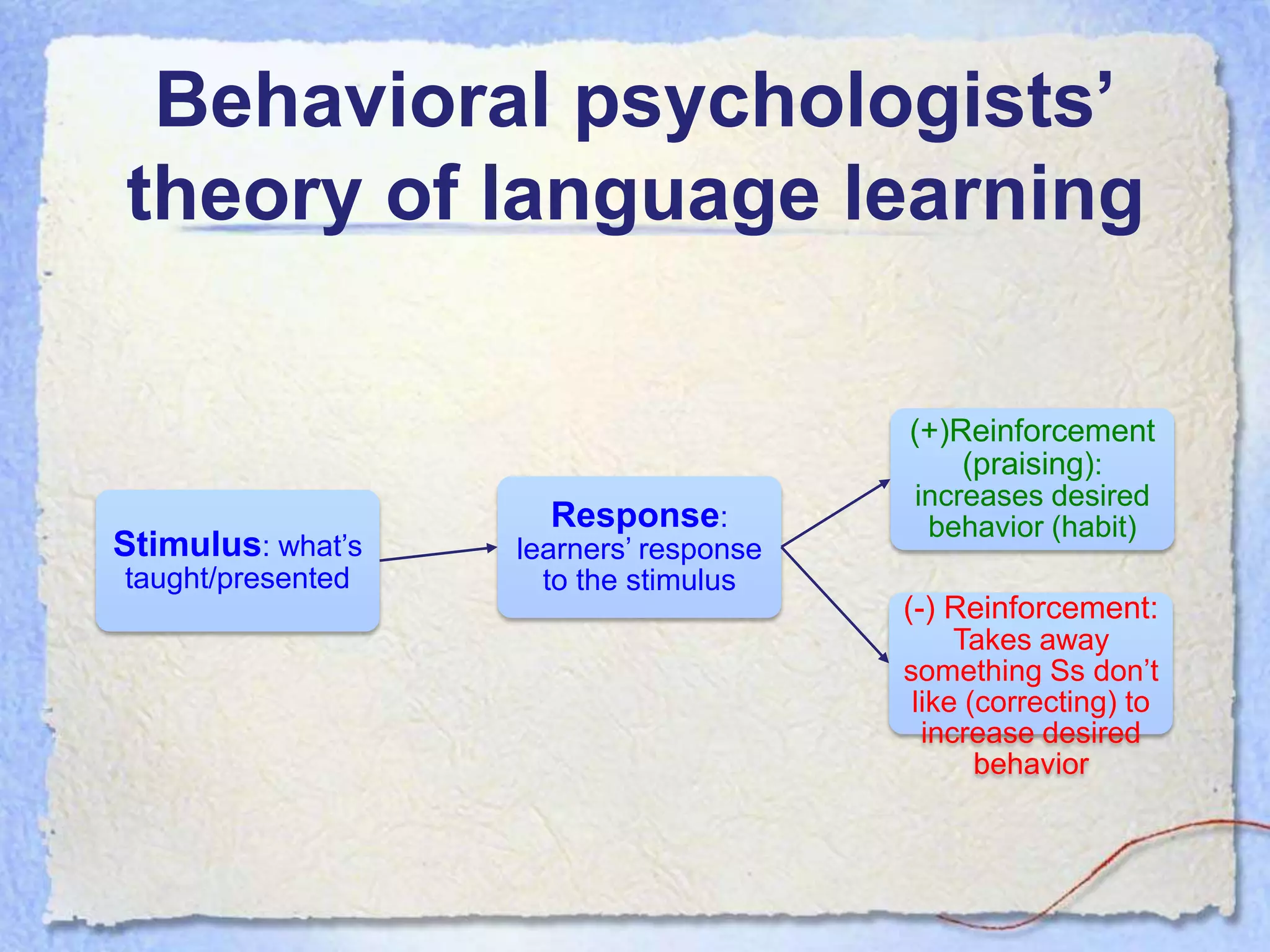
Behavioral psychologists‟
theory of language learning

                                        (+)Reinforcement
                                            (praising):
                                        increases desired
                     Response:           behavior (habit)
Stimulus: what’s   learners’ response
taught/presented     to the stimulus
                                        (-) Reinforcement:
                                             Takes away
                                        something Ss don’t
                                         like (correcting) to
                                          increase desired
                                               behavior
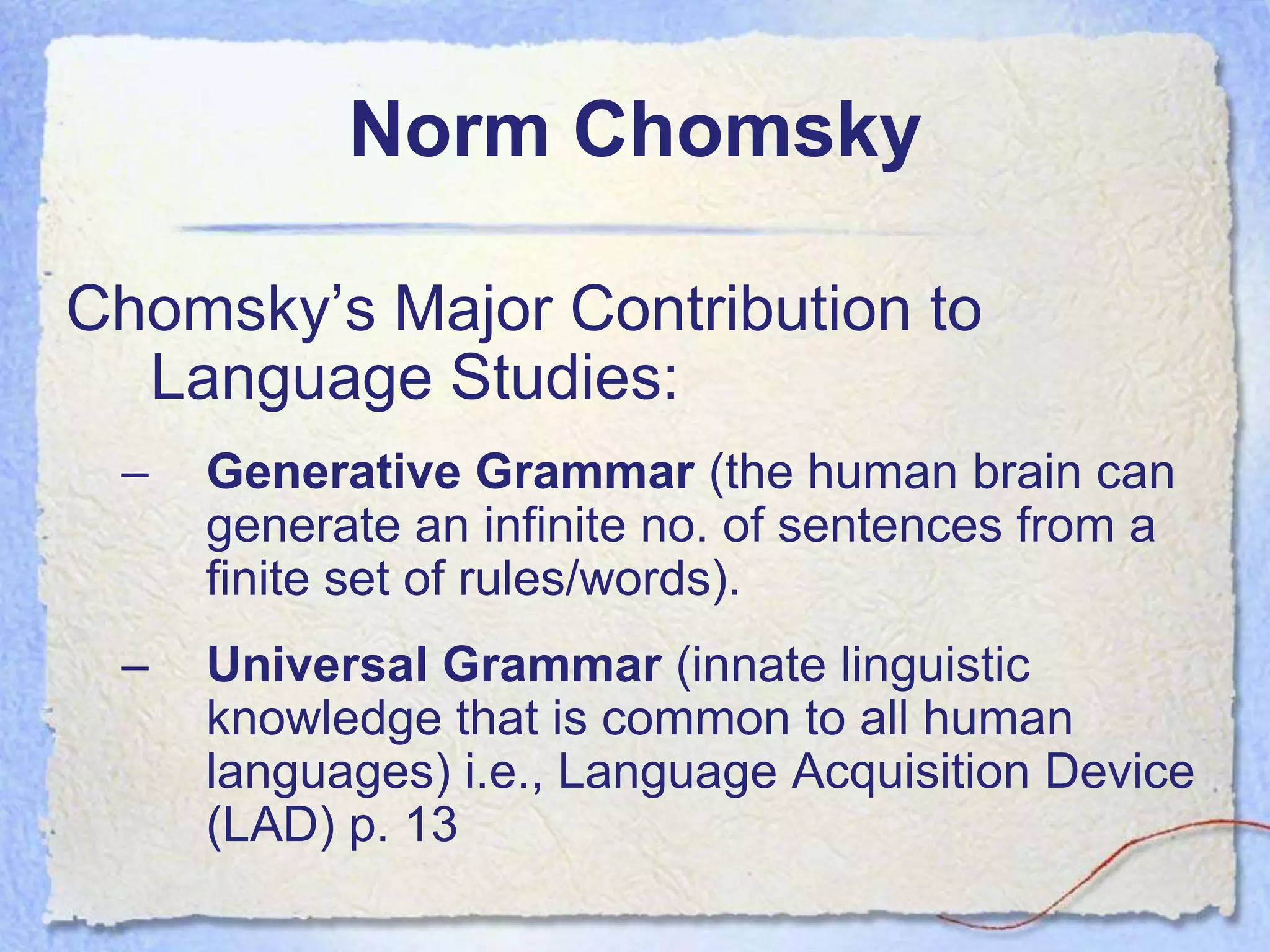
Norm Chomsky

Chomsky’s Major Contribution to
  Language Studies:
 –   Generative Grammar (the human brain can
     generate an infinite no. of sentences from a
     finite set of rules/words).
 –   Universal Grammar (innate linguistic
     knowledge that is common to all human
     languages) i.e., Language Acquisition Device
     (LAD) p. 13
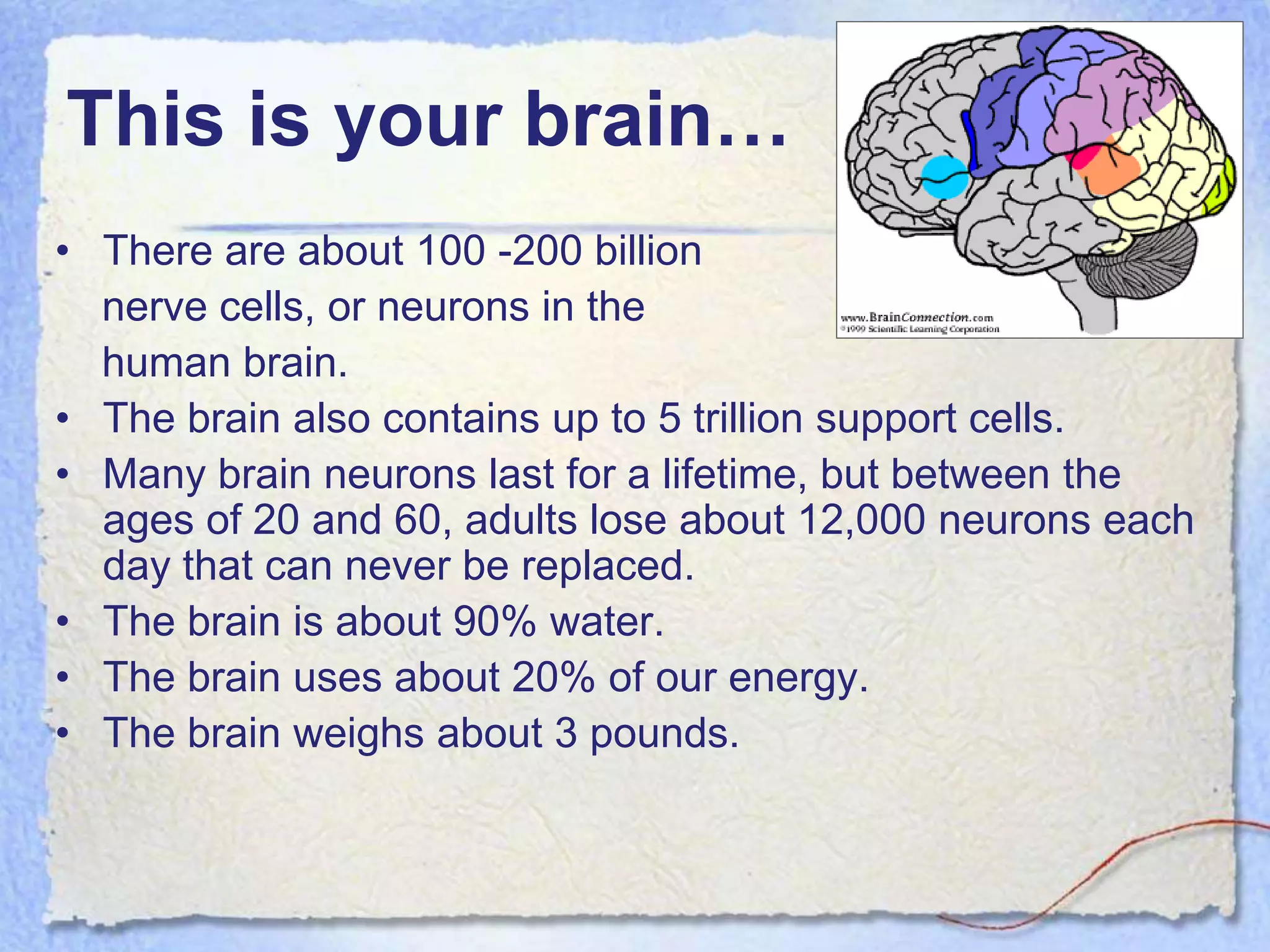
This is your brain…
• There are about 100 -200 billion
  nerve cells, or neurons in the
  human brain.
• The brain also contains up to 5 trillion support cells.
• Many brain neurons last for a lifetime, but between the
  ages of 20 and 60, adults lose about 12,000 neurons each
  day that can never be replaced.
• The brain is about 90% water.
• The brain uses about 20% of our energy.
• The brain weighs about 3 pounds.
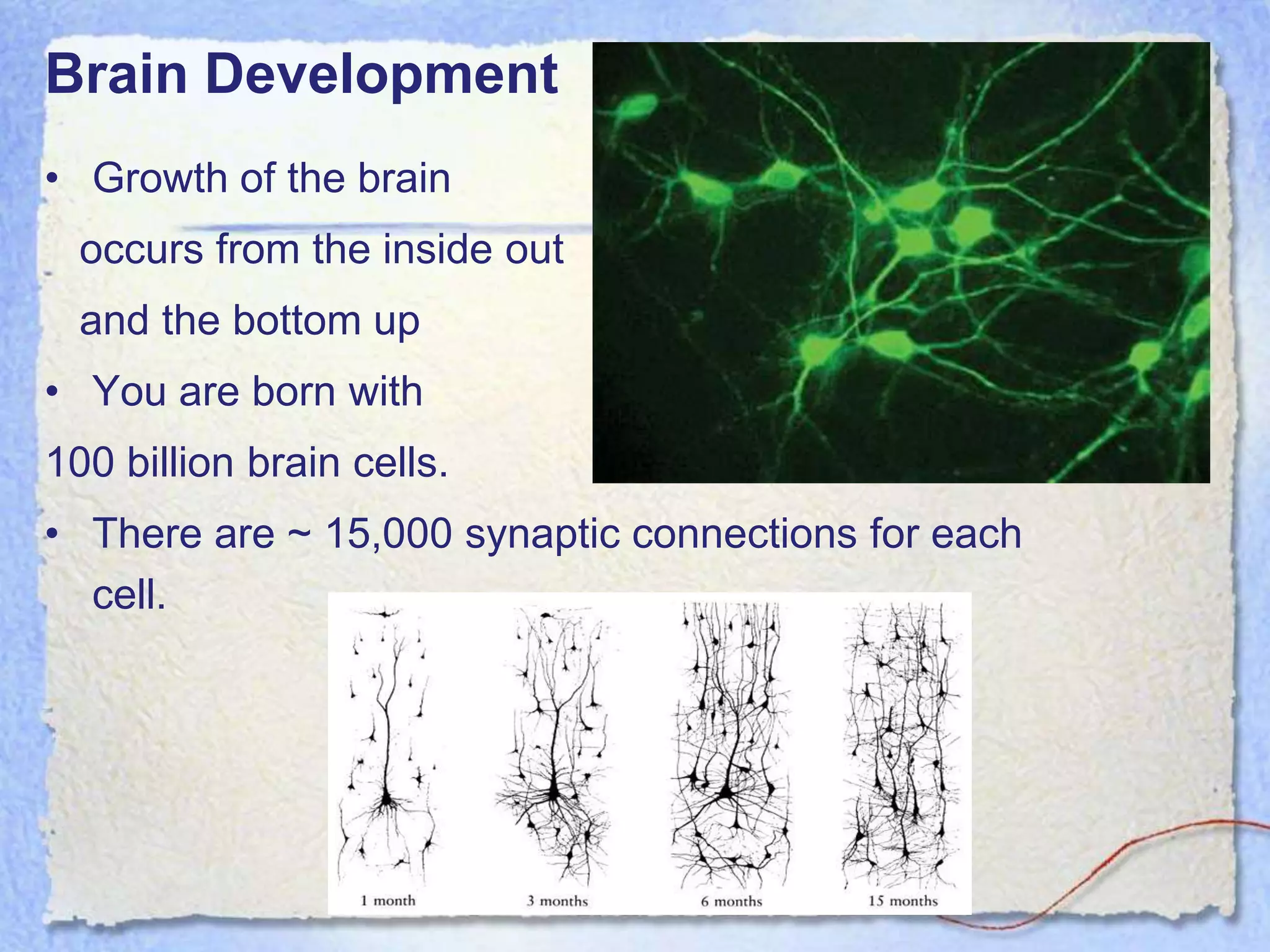
Brain Development
• Growth of the brain
  occurs from the inside out
  and the bottom up
• You are born with
100 billion brain cells.
• There are ~ 15,000 synaptic connections for each
  cell.
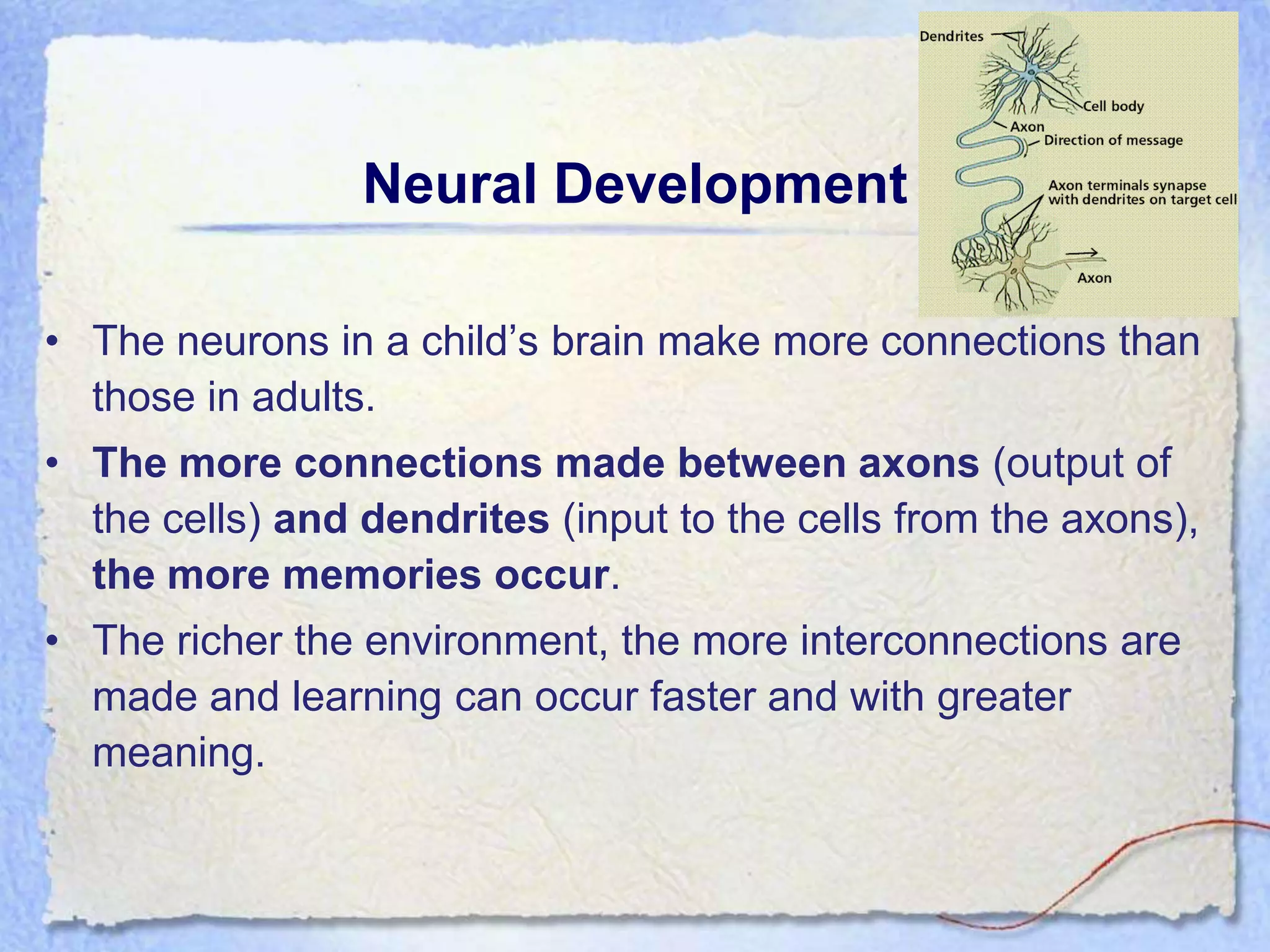
Neural Development

• The neurons in a child’s brain make more connections than
  those in adults.
• The more connections made between axons (output of
  the cells) and dendrites (input to the cells from the axons),
  the more memories occur.
• The richer the environment, the more interconnections are
  made and learning can occur faster and with greater
  meaning.
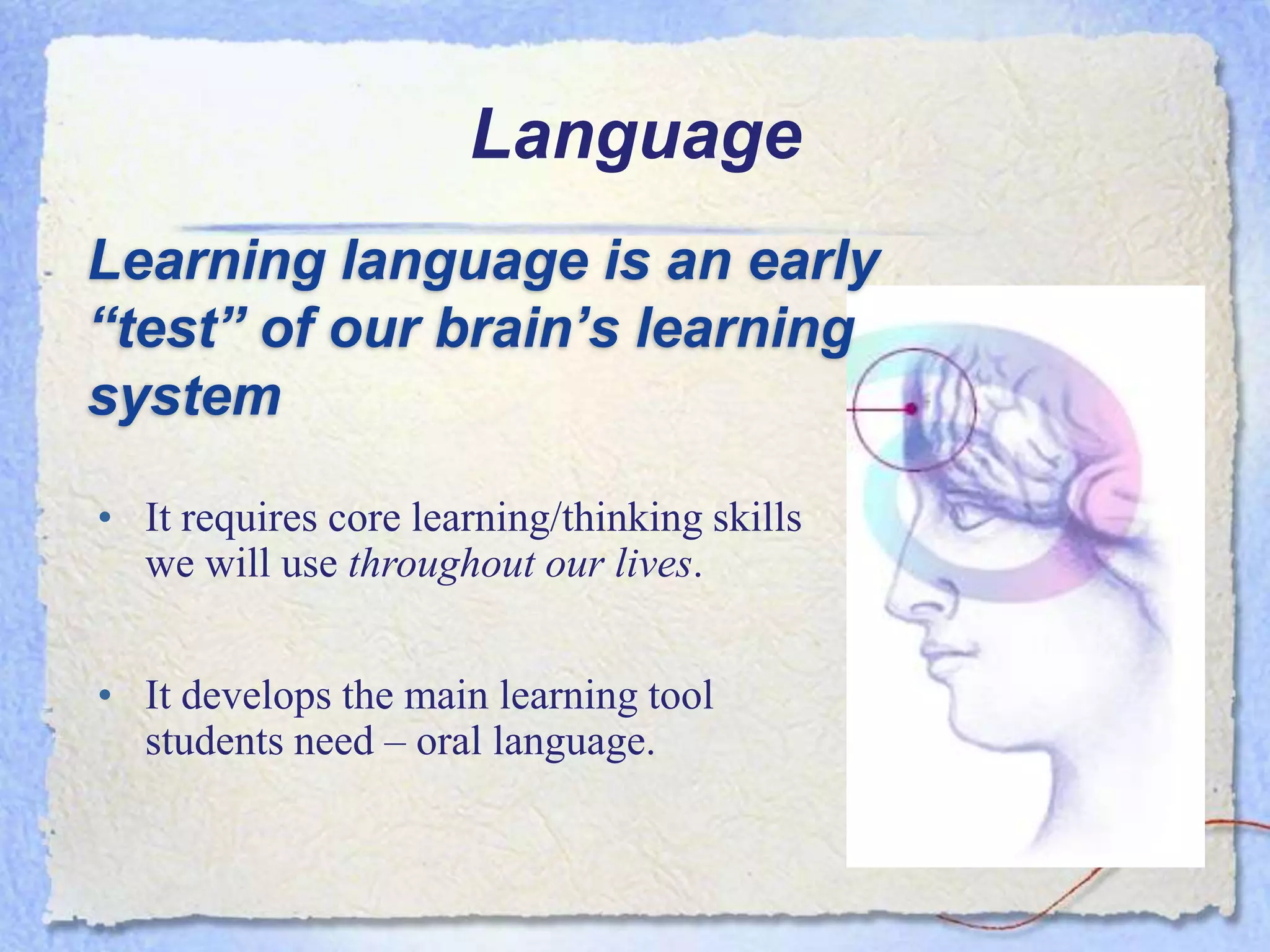
Language
Learning language is an early
“test” of our brain’s learning
system

• It requires core learning/thinking skills
  we will use throughout our lives.


• It develops the main learning tool
  students need – oral language.
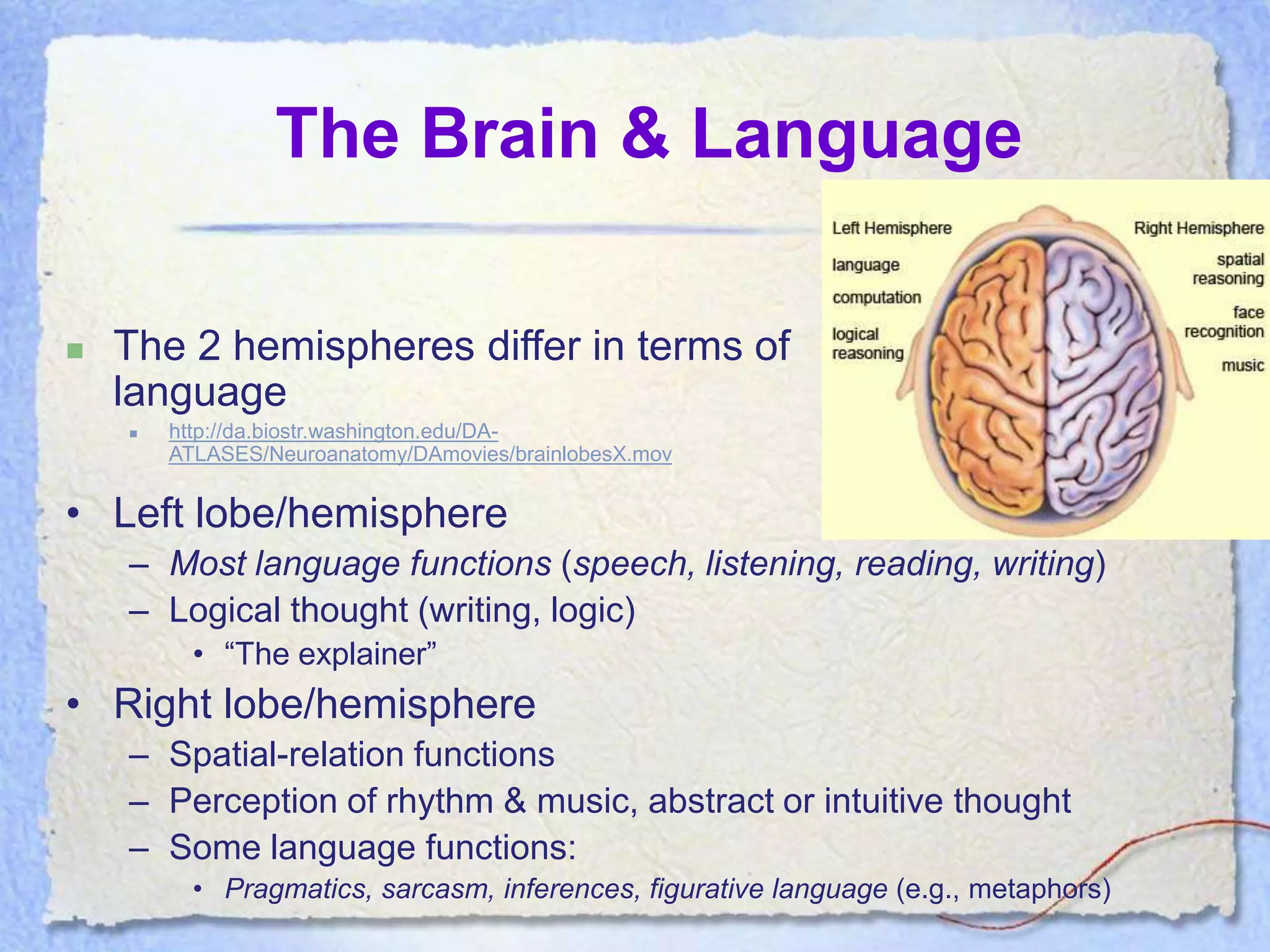
The Brain & Language

   The 2 hemispheres differ in terms of
    language
       http://da.biostr.washington.edu/DA-
        ATLASES/Neuroanatomy/DAmovies/brainlobesX.mov


• Left lobe/hemisphere
    – Most language functions (speech, listening, reading, writing)
    – Logical thought (writing, logic)
          • “The explainer”
• Right lobe/hemisphere
    – Spatial-relation functions
    – Perception of rhythm & music, abstract or intuitive thought
    – Some language functions:
          • Pragmatics, sarcasm, inferences, figurative language (e.g., metaphors)
The Brain & Language

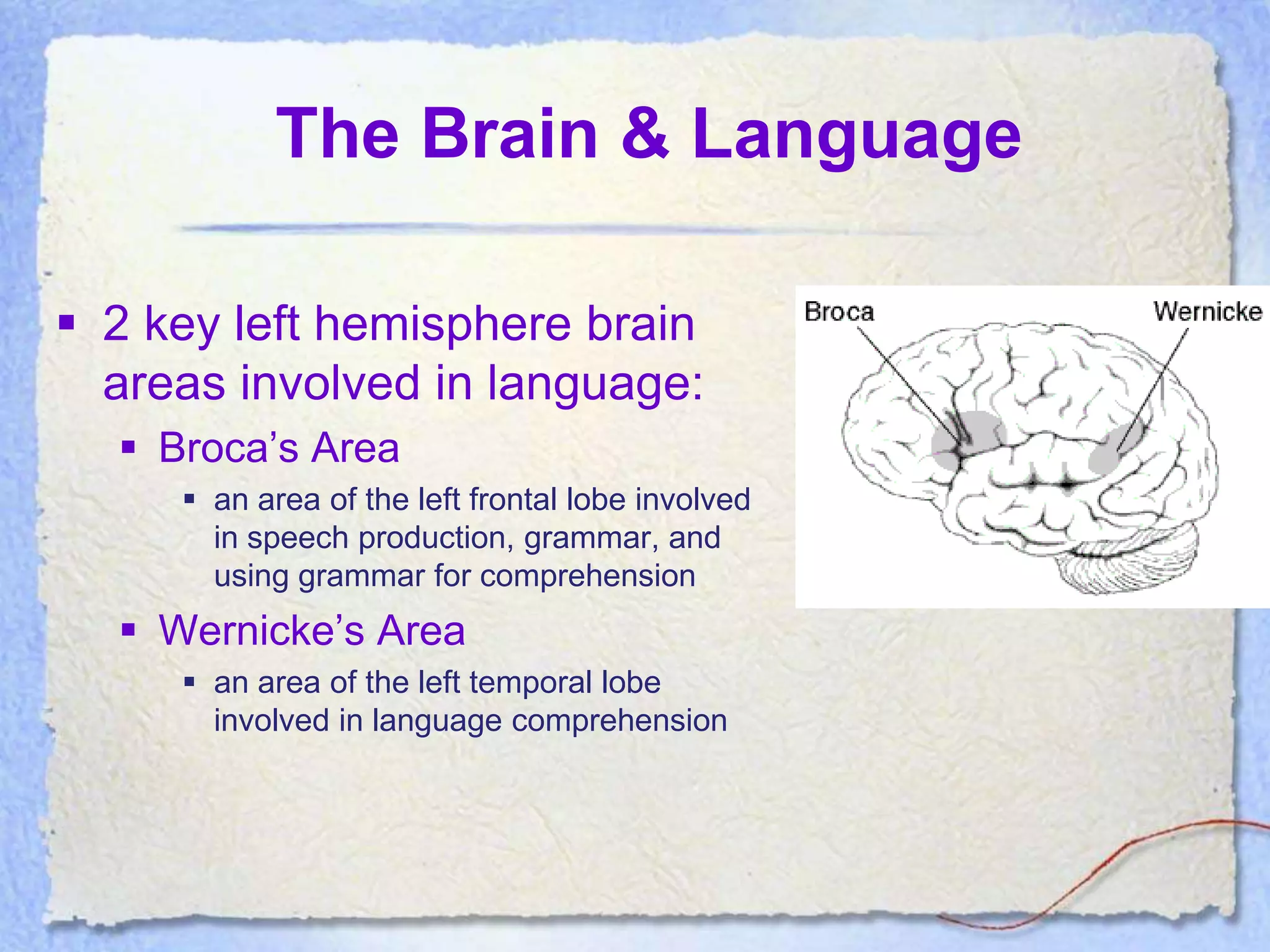
 2 key left hemisphere brain
  areas involved in language:
   Broca’s Area
      an area of the left frontal lobe involved
       in speech production, grammar, and
       using grammar for comprehension
   Wernicke’s Area
      an area of the left temporal lobe
       involved in language comprehension
The Brain & Language

   Broca’s Area and Wernicke’s Area:
       2 of the first brain areas discovered to have
        specific functions (Broca, 1861; Wernicke,
        1874)
       Discovered through working with patients
        having severe language difficulties.
       After death, these patients were found to have
        brain damage in consistent areas.
The Brain & Language

 Aphasia
   Language impairment, usually caused by left
    hemisphere damage either to Broca’s area
    (impairing speech & grammar) or to Wernicke’s
    area (impairing speech planning & language
    comprehension)
The Brain & Language

 Aphasia
   Language impairment, usually caused by left
    hemisphere damage either to Broca’s area (impairing
    speech & grammar) or to Wernicke’s area (impairing
    speech planning & language comprehension)
 Broca’s aphasia
 Wernicke’s aphasia
   http://www.youtube.com/watch?v=aVhYN7NTIKU&feature=related
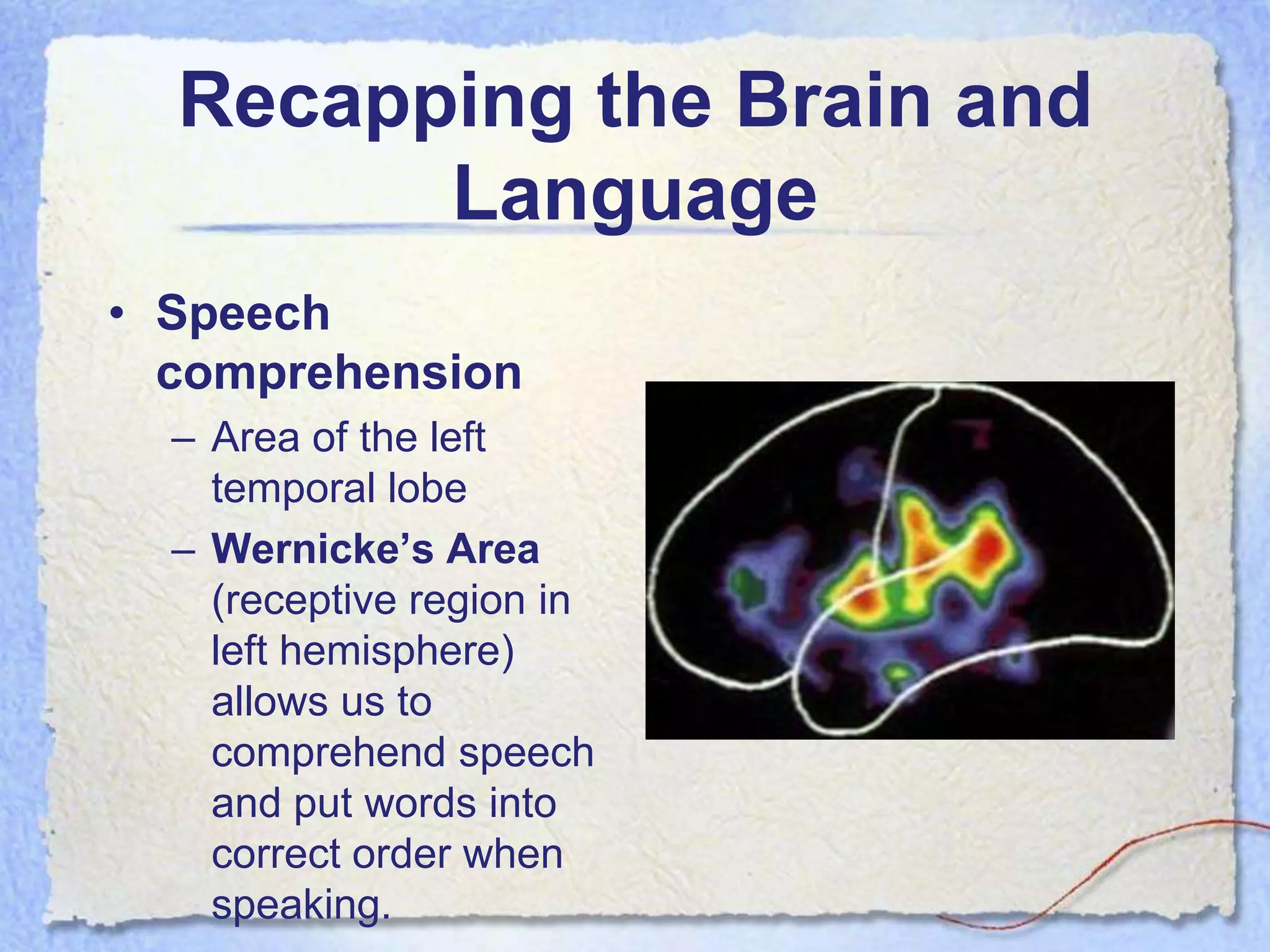
Recapping the Brain and
        Language
• Speech
  comprehension
  – Area of the left
    temporal lobe
  – Wernicke‟s Area
    (receptive region in
    left hemisphere)
    allows us to
    comprehend speech
    and put words into
    correct order when
    speaking.
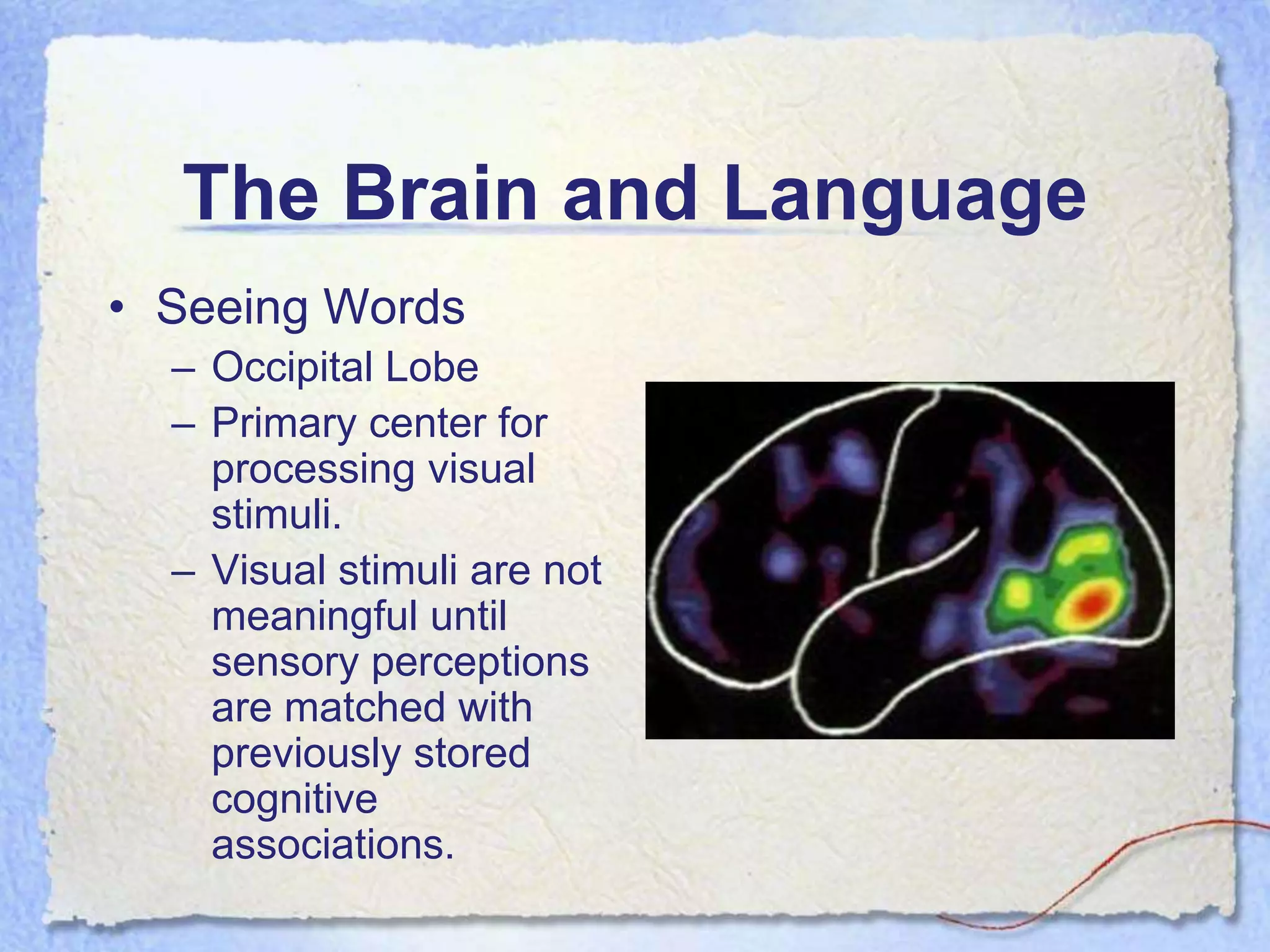
The Brain and Language
• Seeing Words
  – Occipital Lobe
  – Primary center for
    processing visual
    stimuli.
  – Visual stimuli are not
    meaningful until
    sensory perceptions
    are matched with
    previously stored
    cognitive
    associations.
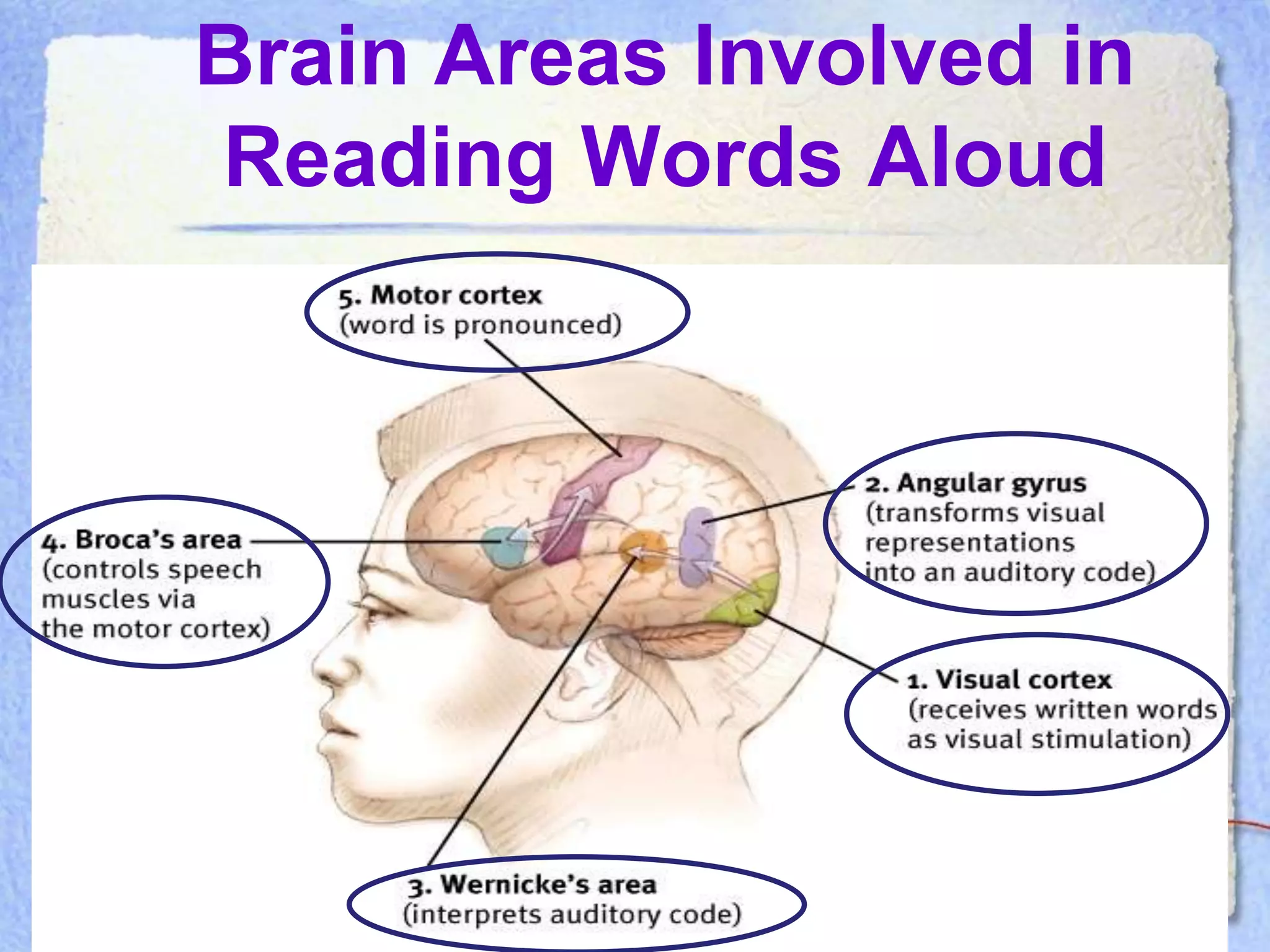
Brain Areas Involved in
Reading Words Aloud
The Bilingual Brain

   Bilinguals’ brain activations for L1 & L2:
       Are L1 and L2 represented together (same
        areas) or separately in the brain?
       Does this differ for comprehension vs. speech
        production & grammar?
       Does this differ between early or late L2
        learners?
The Bilingual Brain
• Let’s watch “The Bilingual Brain” to
  learn how language helps us to
  understand more about our brains.
The Bilingual Brain
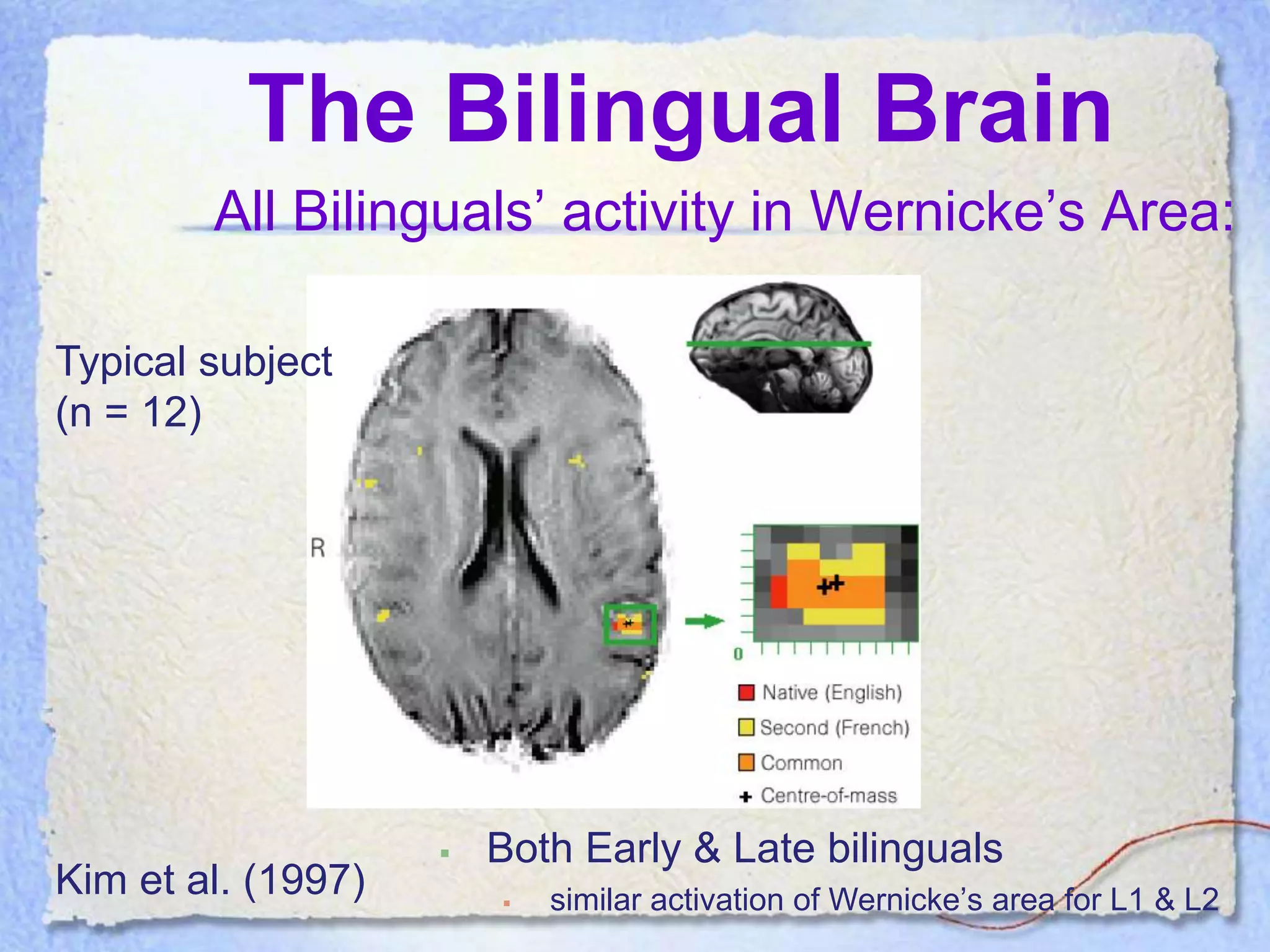
        All Bilinguals’ activity in Wernicke’s Area:

Typical subject
(n = 12)


                       Both Early & Late bilinguals
Kim et al. (1997)          similar activation of Wernicke’s area for L1 & L2
The Bilingual Brain
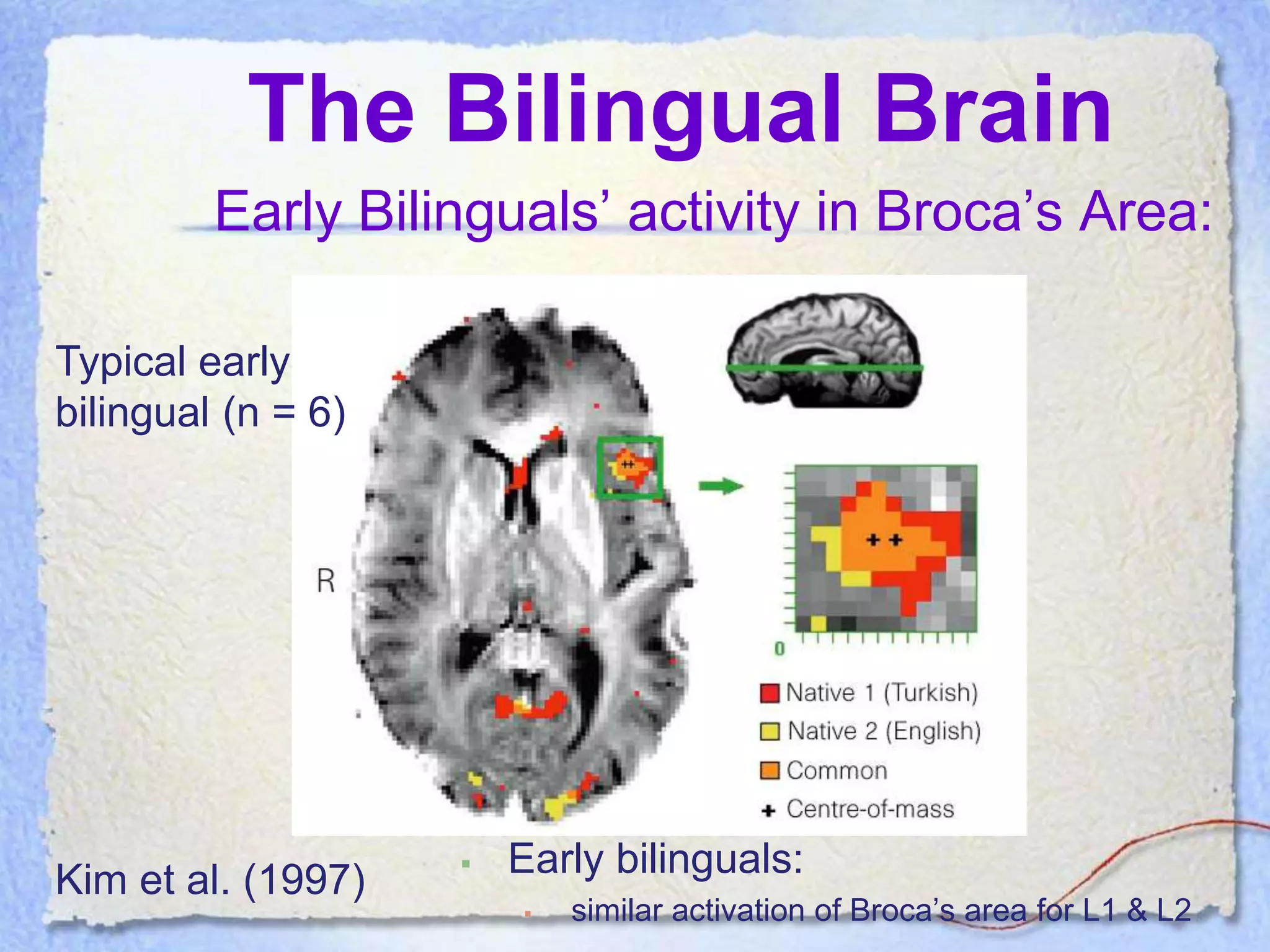
         Early Bilinguals’ activity in Broca’s Area:

Typical early
bilingual (n = 6)


                       Early bilinguals:
Kim et al. (1997)
                           similar activation of Broca’s area for L1 & L2
The Bilingual Brain
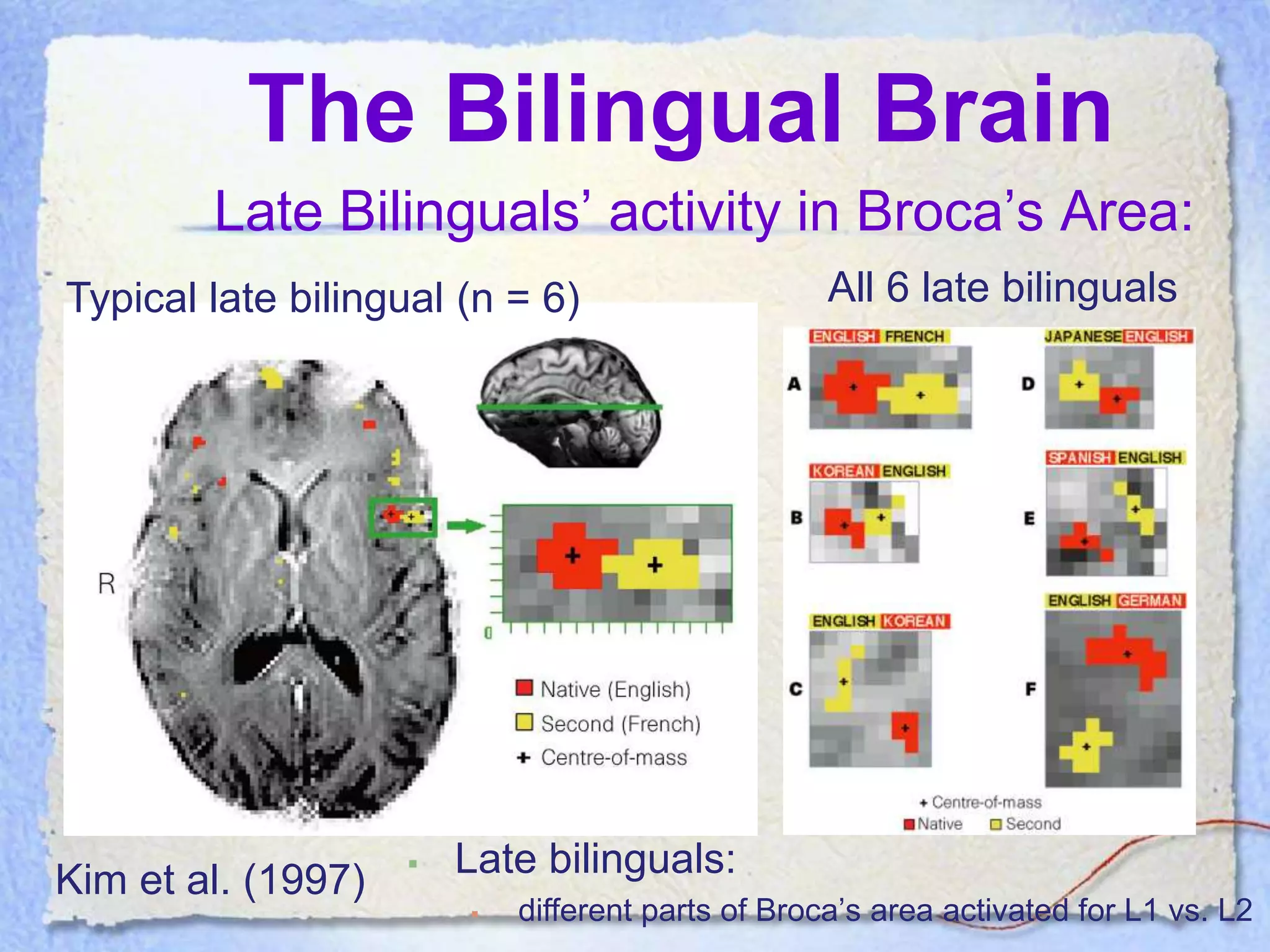
        Late Bilinguals’ activity in Broca’s Area:
Typical late bilingual (n = 6)                     All 6 late bilinguals


                       Late bilinguals:
Kim et al. (1997)
                           different parts of Broca’s area activated for L1 vs. L2
The Bilingual Brain

   Fluent bilinguals’ brain activations for L1 & L2:
    Comprehension area may be the same for both L1 &
     L2, but speech production area (e.g., pronunciation)
     may differ if L2 is acquired late (Kim et al., 1997).
   Similar findings of shared vs. separate areas for early
     vs. late L2 learners in many studies (Fabbro, 2001).
• What does the brain imaging tell you about bilingual
  processing?
• How would you incorporate this information into bilingual
  education?
The Brain and Language
• Among early bilinguals, L1 and L2 are in the
  same brain region and processed by the
  same neural devices.
• For later bilinguals, some brain areas (within
  Broca’s area) are different for L1 & L2.
Language, Thinking and
          Learning
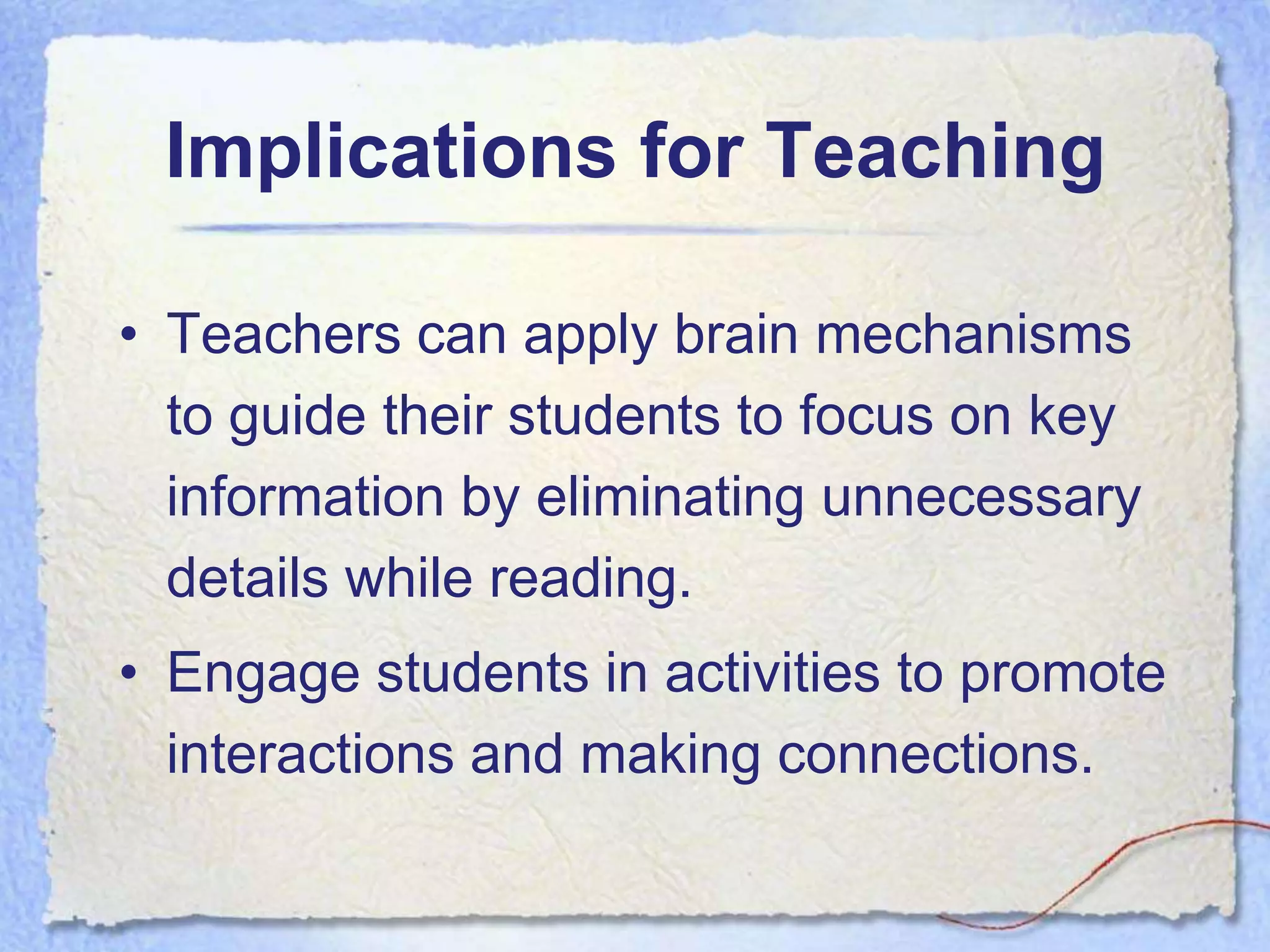
• Language shapes cognitive (thinking)
  process and vice versa.
The Brain Mechanism and
        Language Processing
• Eliminate Irrelevant Information
  – Skilled learners eliminate irrelevant information for
    better comprehension– Gernsbacker (1993, 1995)
  – Bilinguals’ ability to inhibit L1 to allow L2
    production to proceed (Kroll, 2010).
• Enrich the Environment
  – The more enriched the environment is, the more
    dendritic branching occurs for better performance
    (Greenough et al., 1992)
Implications for Teaching

• Teachers can apply brain mechanisms
  to guide their students to focus on key
  information by eliminating unnecessary
  details while reading.
• Engage students in activities to promote
  interactions and making connections.
In Review…
Complete one of the following prompts using one
  word:
  – Language is…
  – Language can be…
  – Language leads to…
  – Language is composed of…
  – Language promotes…
  – Language processing is …
Using top-down information
  to predict text content
• Rely on top-down information (e.g.,
  titles, headings, and illustrations) to
  predict the content of the text
• Activating their knowledge of the world.
• What is your prediction about chapter
  three of the course text?
Using context clues to
    understand meanings
• Context clues = learn new words by
  paying attention to the other words in
  the sentence (Yaworski, 2006, pp. 78-87).
  1) Definitions
  2) Details
  3) Examples
1) Definitions
• Authors define new terms with in the
  context of a sentence by setting the
  definition apart with the verbs (is/are,
  is/are called, is/are known as).
Ex. A professional portfolio is a
collection of work that documents an
individual’s accomplishments in an area
of professional practice.
Exercise1-a: Definitions
• Identify the key term being defined with its
  definition.
• A practicum is a short-term field-based
  experience that allows teacher education
  students to spend time observing and
  assisting in classrooms.
• What is the term being defined: ________
• Underline its definition.
Exercise1-b: Definitions
• According to many psychologists
  phobias are irrational fears represent
  symbolic repressed anxiety. The most
  useful treatment has been behavior-
  modification therapy.
• A phobia is: (a) a psychologist, (b) fear,
  (c) symbol, (d) treatment
2) Details
• The term rhythmic is often used to
  describe music that features simple
  patterns, such as ONE two ONE two,
  repeating over and over again, but that
  is not really correct. Such patterns
  should be described as metrical, or
  strongly metrical, not rhythmic.
Exercise 2-a: Details
• Identify the key term being defined and create
  a definition from the details.
• The basic unit for measuring time in music is
  the beat. When listening to a marching band,
  to take a clear example, we surely sense a
  regular recurrence of short durational units.
• What is the term being defined?: ________
• What is its definition?:___________________
  ____________________________________
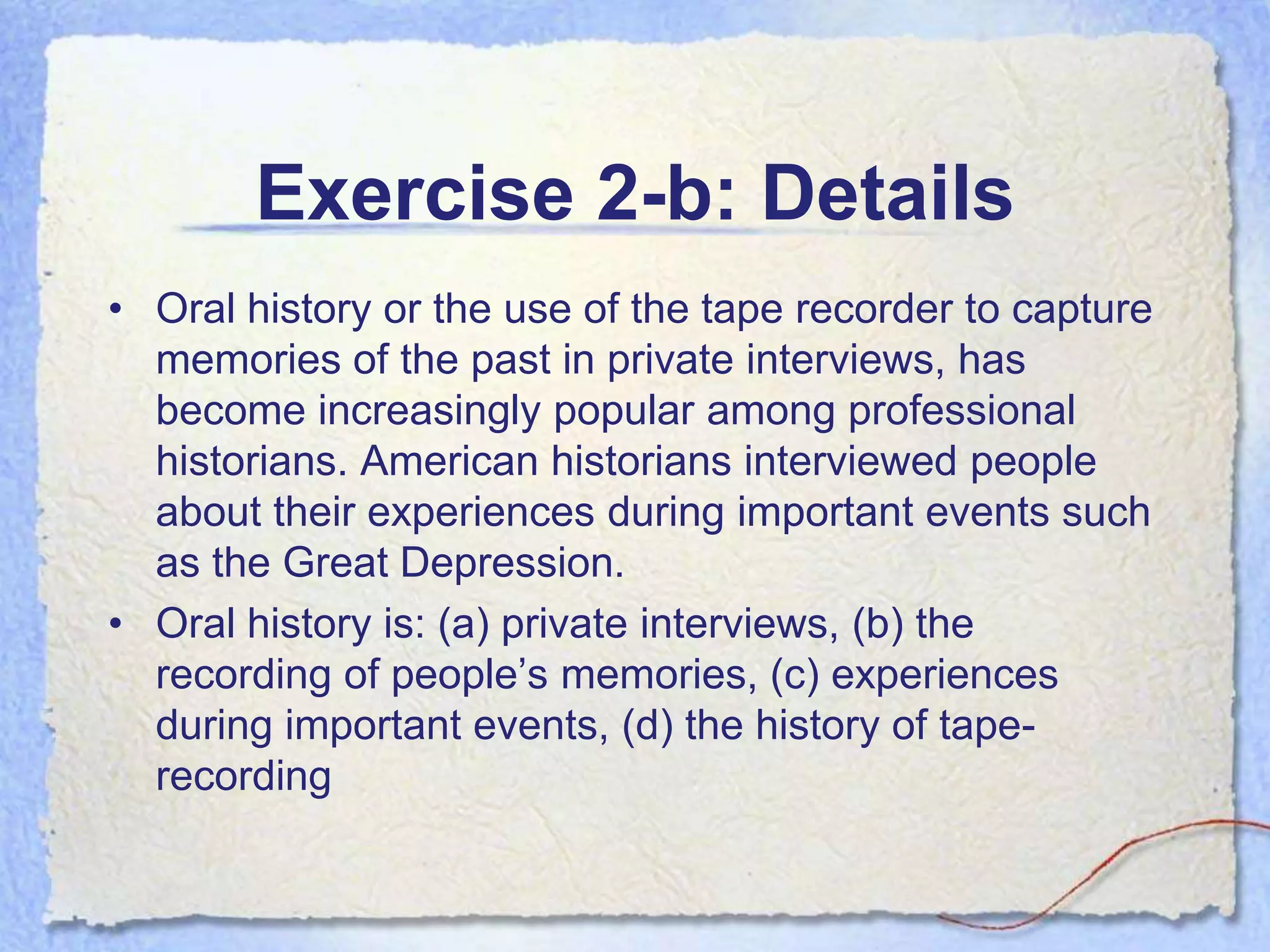
Exercise 2-b: Details
• Oral history or the use of the tape recorder to capture
  memories of the past in private interviews, has
  become increasingly popular among professional
  historians. American historians interviewed people
  about their experiences during important events such
  as the Great Depression.
• Oral history is: (a) private interviews, (b) the
  recording of people’s memories, (c) experiences
  during important events, (d) the history of tape-
  recording
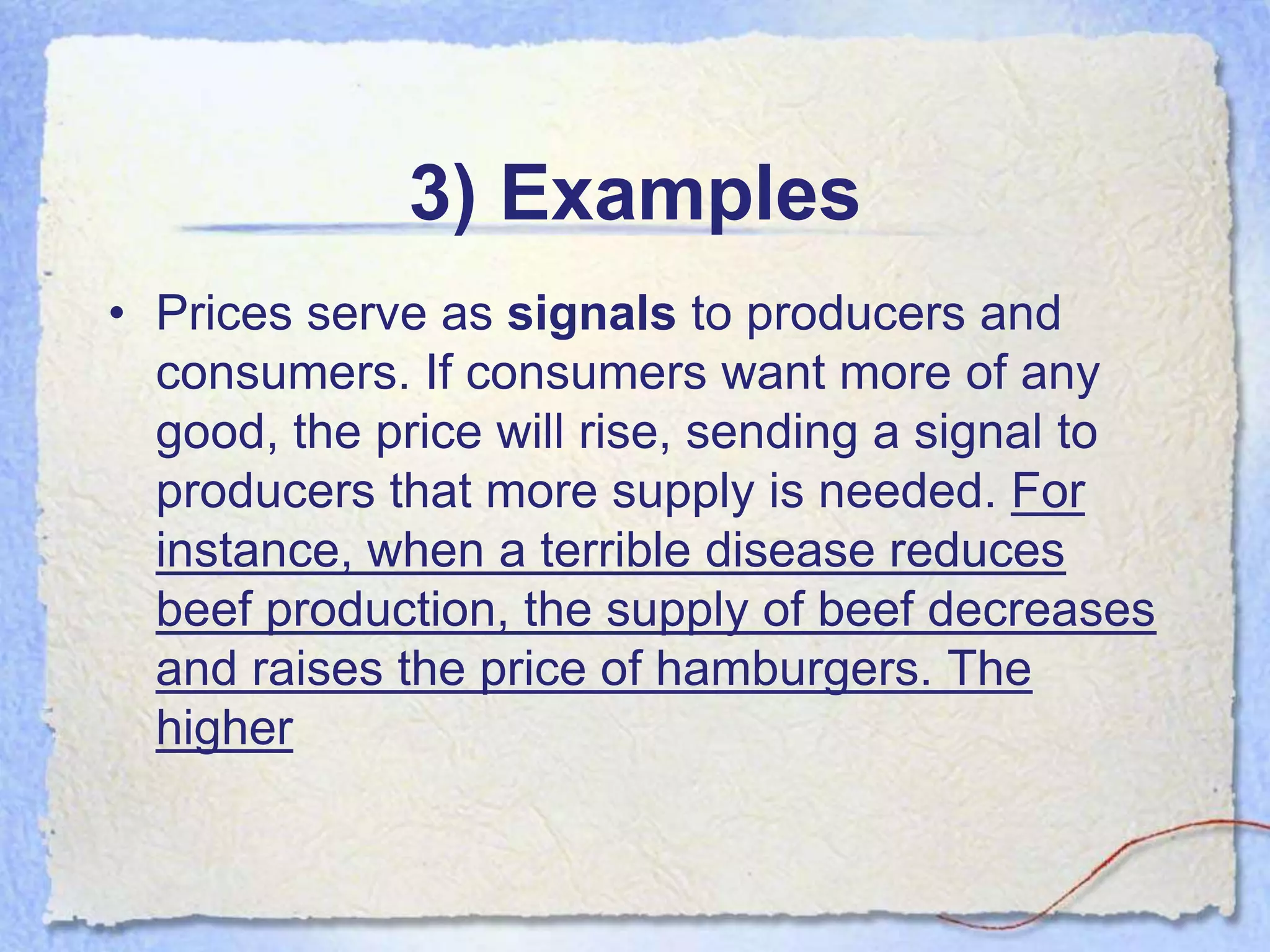
3) Examples
• Prices serve as signals to producers and
  consumers. If consumers want more of any
  good, the price will rise, sending a signal to
  producers that more supply is needed. For
  instance, when a terrible disease reduces
  beef production, the supply of beef decreases
  and raises the price of hamburgers. The
  higher
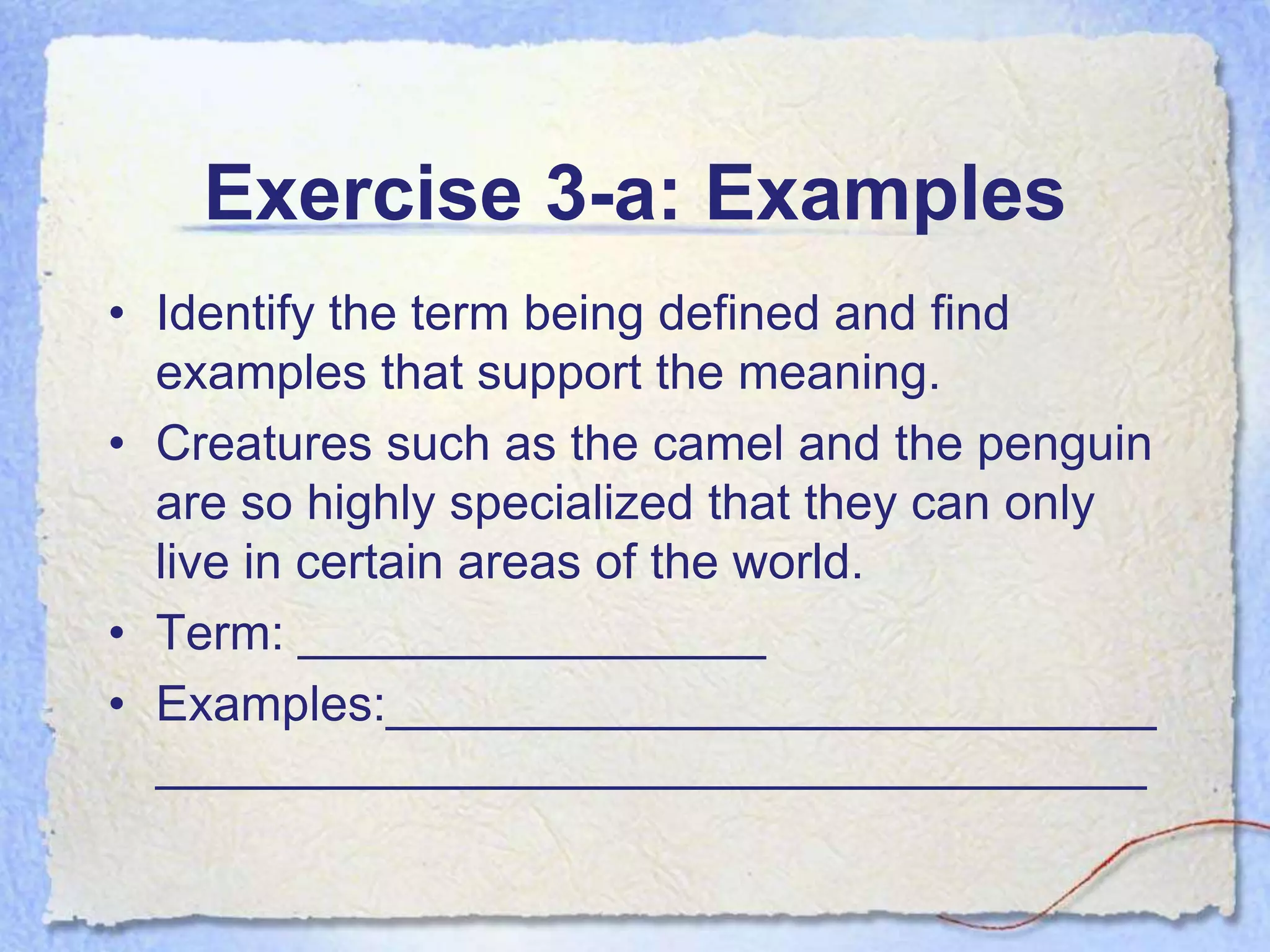
Exercise 3-a: Examples
• Identify the term being defined and find
  examples that support the meaning.
• Creatures such as the camel and the penguin
  are so highly specialized that they can only
  live in certain areas of the world.
• Term: _________________
• Examples:____________________________
  ____________________________________
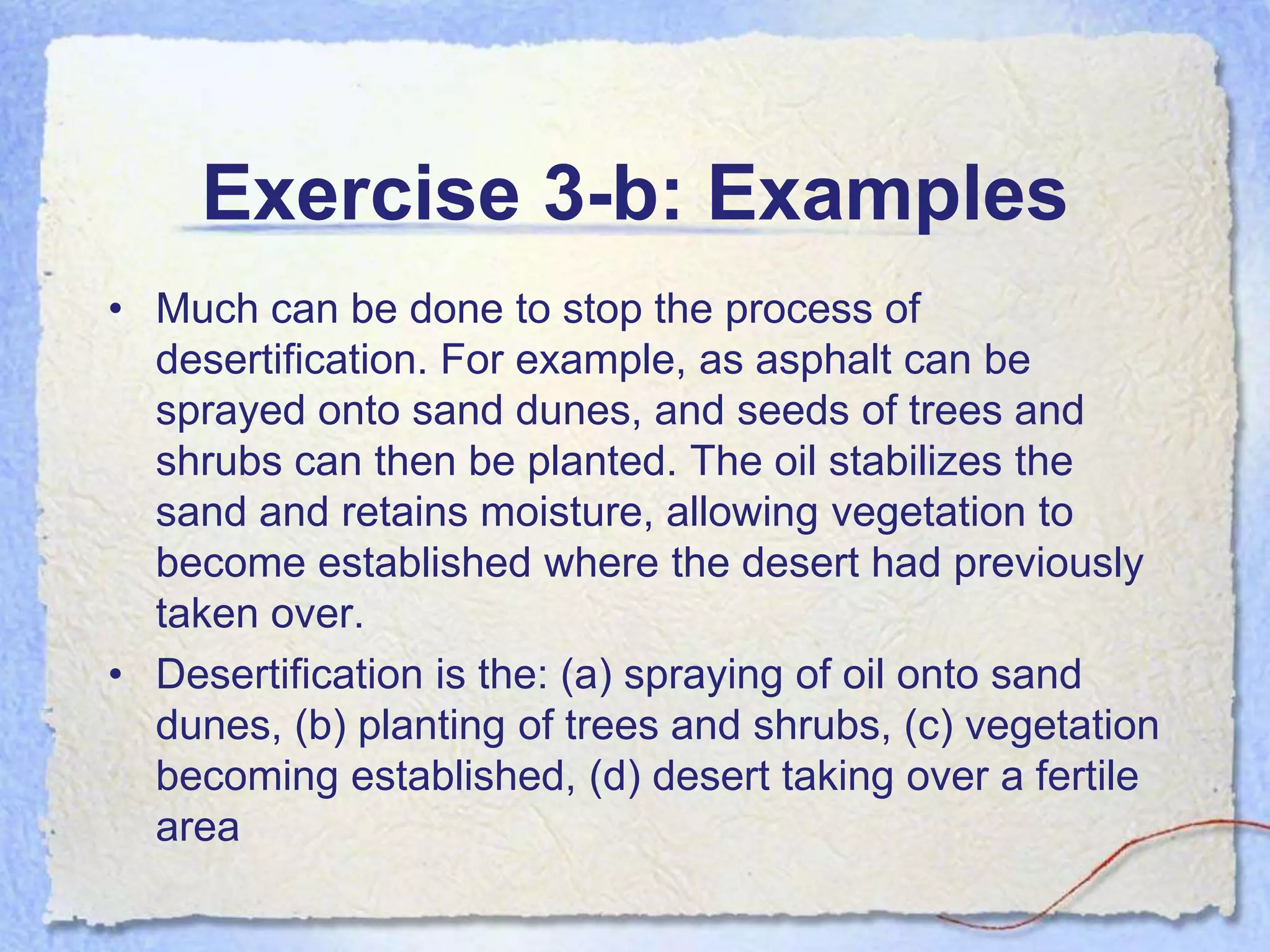
Exercise 3-b: Examples
• Much can be done to stop the process of
  desertification. For example, as asphalt can be
  sprayed onto sand dunes, and seeds of trees and
  shrubs can then be planted. The oil stabilizes the
  sand and retains moisture, allowing vegetation to
  become established where the desert had previously
  taken over.
• Desertification is the: (a) spraying of oil onto sand
  dunes, (b) planting of trees and shrubs, (c) vegetation
  becoming established, (d) desert taking over a fertile
  area

Su2012 ss lg week one full pp

  • 2.
  • 3.
    Content Objectives • Ourmission for this week will be: – To explore the properties of language. – To understand the key concepts regarding first language acquisition. – To learn about the brain and language processing. – To learn how to use context clues to understand meanings.
  • 4.
    Language Objectives • Wewill accomplish our mission by: – Discussing the properties of language using “What is language in Pictures & Words”. – Individually writing responses to opening discussion cases associated with key concepts. – Discussing in a group our understanding of brain areas used for language processing – After reading a passage, complete exercises on using definitions, details, and examples to understand meanings.
  • 5.
    Opening Discussion Case1 • How do you pronounce this made-up word: “wug”? - /wʌg/ • How about “nghalmax”? Why do you have a problem pronouncing this non-word compared to the first one?
  • 6.
    Opening Discussion Case2 • When making a singular verb into a plural form, how do you know whether to add an /s/ sound as in “pits” and “sinks”, a /z/ sound as in “lids” and “pens”, or an /əz/ sound as in “watches” and “lodges”?
  • 7.
    Opening Discussion Case3 • Why do we say „happier” and “prettiest”, but “more upset” and “most excited?”
  • 8.
    Opening Discussion Case4 • Why would a child say each of the following “errors?” What does this tell you about first language acquisition? (1) Child: “Daddy bringed me my shoes for my foots.”* (2) Adult: Who broke the window?” Child: Well, perhaps it was John, but perhapser it was Mary.”*
  • 9.
    COURSE SYLLABUS • Overview •Assignments • Due Dates • Questions???
  • 10.
    What are theproperties of language? • Communicative: Language = primary form of communication • Arbitrary relationship to referents (e.g., dog - perro) • Systematic (patterns based on rules) • Generative/productive – We can generate an infinite # of sentences out of a finite set of rules (Chomsky) • Evolutionary – language changes over time; new words are coined every year (e.g., blog) • Cultural/conventional - symbols and their meanings represent shared values among a group of people
  • 11.
    What are theproperties of language? • All of the Above! • Linguists are interested in the communicative, arbitrary, systematic, generative, evolutionary, and culturally specific nature of human language and communication.
  • 12.
    From a BehavioristView to a nativist/innatist view of Language Acquisition 1. First Language Acquisition & Behaviorism (F & F, pp. 1-4): B.F. Skinner (1957) – Language is learned through imitation (Stimlus  Response  Reinforcement). 2. Insights from Linguistics (F & F, pp. 10- 11): N. Chomsky (1959) – Critique of Skinner; Language is too complex to be learned by imitation and reinforcement.
  • 13.
    Behavioral psychologists‟ theory oflanguage learning (+)Reinforcement (praising): increases desired Response: behavior (habit) Stimulus: what’s learners’ response taught/presented to the stimulus (-) Reinforcement: Takes away something Ss don’t like (correcting) to increase desired behavior
  • 14.
    Norm Chomsky Chomsky’s MajorContribution to Language Studies: – Generative Grammar (the human brain can generate an infinite no. of sentences from a finite set of rules/words). – Universal Grammar (innate linguistic knowledge that is common to all human languages) i.e., Language Acquisition Device (LAD) p. 13
  • 15.
    This is yourbrain… • There are about 100 -200 billion nerve cells, or neurons in the human brain. • The brain also contains up to 5 trillion support cells. • Many brain neurons last for a lifetime, but between the ages of 20 and 60, adults lose about 12,000 neurons each day that can never be replaced. • The brain is about 90% water. • The brain uses about 20% of our energy. • The brain weighs about 3 pounds.
  • 16.
    Brain Development • Growthof the brain occurs from the inside out and the bottom up • You are born with 100 billion brain cells. • There are ~ 15,000 synaptic connections for each cell.
  • 17.
    Neural Development • Theneurons in a child’s brain make more connections than those in adults. • The more connections made between axons (output of the cells) and dendrites (input to the cells from the axons), the more memories occur. • The richer the environment, the more interconnections are made and learning can occur faster and with greater meaning.
  • 18.
    Language Learning language isan early “test” of our brain’s learning system • It requires core learning/thinking skills we will use throughout our lives. • It develops the main learning tool students need – oral language.
  • 19.
    The Brain &Language  The 2 hemispheres differ in terms of language  http://da.biostr.washington.edu/DA- ATLASES/Neuroanatomy/DAmovies/brainlobesX.mov • Left lobe/hemisphere – Most language functions (speech, listening, reading, writing) – Logical thought (writing, logic) • “The explainer” • Right lobe/hemisphere – Spatial-relation functions – Perception of rhythm & music, abstract or intuitive thought – Some language functions: • Pragmatics, sarcasm, inferences, figurative language (e.g., metaphors)
  • 20.
    The Brain &Language  2 key left hemisphere brain areas involved in language:  Broca’s Area  an area of the left frontal lobe involved in speech production, grammar, and using grammar for comprehension  Wernicke’s Area  an area of the left temporal lobe involved in language comprehension
  • 21.
    The Brain &Language  Broca’s Area and Wernicke’s Area:  2 of the first brain areas discovered to have specific functions (Broca, 1861; Wernicke, 1874)  Discovered through working with patients having severe language difficulties.  After death, these patients were found to have brain damage in consistent areas.
  • 22.
    The Brain &Language  Aphasia  Language impairment, usually caused by left hemisphere damage either to Broca’s area (impairing speech & grammar) or to Wernicke’s area (impairing speech planning & language comprehension)
  • 25.
    The Brain &Language  Aphasia  Language impairment, usually caused by left hemisphere damage either to Broca’s area (impairing speech & grammar) or to Wernicke’s area (impairing speech planning & language comprehension)  Broca’s aphasia  Wernicke’s aphasia  http://www.youtube.com/watch?v=aVhYN7NTIKU&feature=related
  • 26.
    Recapping the Brainand Language • Speech comprehension – Area of the left temporal lobe – Wernicke‟s Area (receptive region in left hemisphere) allows us to comprehend speech and put words into correct order when speaking.
  • 28.
    The Brain andLanguage • Seeing Words – Occipital Lobe – Primary center for processing visual stimuli. – Visual stimuli are not meaningful until sensory perceptions are matched with previously stored cognitive associations.
  • 29.
    Brain Areas Involvedin Reading Words Aloud
  • 30.
    The Bilingual Brain  Bilinguals’ brain activations for L1 & L2:  Are L1 and L2 represented together (same areas) or separately in the brain?  Does this differ for comprehension vs. speech production & grammar?  Does this differ between early or late L2 learners?
  • 31.
    The Bilingual Brain •Let’s watch “The Bilingual Brain” to learn how language helps us to understand more about our brains.
  • 32.
    The Bilingual Brain All Bilinguals’ activity in Wernicke’s Area: Typical subject (n = 12)  Both Early & Late bilinguals Kim et al. (1997)  similar activation of Wernicke’s area for L1 & L2
  • 33.
    The Bilingual Brain Early Bilinguals’ activity in Broca’s Area: Typical early bilingual (n = 6)  Early bilinguals: Kim et al. (1997)  similar activation of Broca’s area for L1 & L2
  • 34.
    The Bilingual Brain Late Bilinguals’ activity in Broca’s Area: Typical late bilingual (n = 6) All 6 late bilinguals  Late bilinguals: Kim et al. (1997)  different parts of Broca’s area activated for L1 vs. L2
  • 35.
    The Bilingual Brain  Fluent bilinguals’ brain activations for L1 & L2: Comprehension area may be the same for both L1 & L2, but speech production area (e.g., pronunciation) may differ if L2 is acquired late (Kim et al., 1997).  Similar findings of shared vs. separate areas for early vs. late L2 learners in many studies (Fabbro, 2001). • What does the brain imaging tell you about bilingual processing? • How would you incorporate this information into bilingual education?
  • 36.
    The Brain andLanguage • Among early bilinguals, L1 and L2 are in the same brain region and processed by the same neural devices. • For later bilinguals, some brain areas (within Broca’s area) are different for L1 & L2.
  • 37.
    Language, Thinking and Learning • Language shapes cognitive (thinking) process and vice versa.
  • 38.
    The Brain Mechanismand Language Processing • Eliminate Irrelevant Information – Skilled learners eliminate irrelevant information for better comprehension– Gernsbacker (1993, 1995) – Bilinguals’ ability to inhibit L1 to allow L2 production to proceed (Kroll, 2010). • Enrich the Environment – The more enriched the environment is, the more dendritic branching occurs for better performance (Greenough et al., 1992)
  • 39.
    Implications for Teaching •Teachers can apply brain mechanisms to guide their students to focus on key information by eliminating unnecessary details while reading. • Engage students in activities to promote interactions and making connections.
  • 40.
    In Review… Complete oneof the following prompts using one word: – Language is… – Language can be… – Language leads to… – Language is composed of… – Language promotes… – Language processing is …
  • 41.
    Using top-down information to predict text content • Rely on top-down information (e.g., titles, headings, and illustrations) to predict the content of the text • Activating their knowledge of the world. • What is your prediction about chapter three of the course text?
  • 42.
    Using context cluesto understand meanings • Context clues = learn new words by paying attention to the other words in the sentence (Yaworski, 2006, pp. 78-87). 1) Definitions 2) Details 3) Examples
  • 43.
    1) Definitions • Authorsdefine new terms with in the context of a sentence by setting the definition apart with the verbs (is/are, is/are called, is/are known as). Ex. A professional portfolio is a collection of work that documents an individual’s accomplishments in an area of professional practice.
  • 44.
    Exercise1-a: Definitions • Identifythe key term being defined with its definition. • A practicum is a short-term field-based experience that allows teacher education students to spend time observing and assisting in classrooms. • What is the term being defined: ________ • Underline its definition.
  • 45.
    Exercise1-b: Definitions • Accordingto many psychologists phobias are irrational fears represent symbolic repressed anxiety. The most useful treatment has been behavior- modification therapy. • A phobia is: (a) a psychologist, (b) fear, (c) symbol, (d) treatment
  • 46.
    2) Details • Theterm rhythmic is often used to describe music that features simple patterns, such as ONE two ONE two, repeating over and over again, but that is not really correct. Such patterns should be described as metrical, or strongly metrical, not rhythmic.
  • 47.
    Exercise 2-a: Details •Identify the key term being defined and create a definition from the details. • The basic unit for measuring time in music is the beat. When listening to a marching band, to take a clear example, we surely sense a regular recurrence of short durational units. • What is the term being defined?: ________ • What is its definition?:___________________ ____________________________________
  • 48.
    Exercise 2-b: Details •Oral history or the use of the tape recorder to capture memories of the past in private interviews, has become increasingly popular among professional historians. American historians interviewed people about their experiences during important events such as the Great Depression. • Oral history is: (a) private interviews, (b) the recording of people’s memories, (c) experiences during important events, (d) the history of tape- recording
  • 49.
    3) Examples • Pricesserve as signals to producers and consumers. If consumers want more of any good, the price will rise, sending a signal to producers that more supply is needed. For instance, when a terrible disease reduces beef production, the supply of beef decreases and raises the price of hamburgers. The higher
  • 50.
    Exercise 3-a: Examples •Identify the term being defined and find examples that support the meaning. • Creatures such as the camel and the penguin are so highly specialized that they can only live in certain areas of the world. • Term: _________________ • Examples:____________________________ ____________________________________
  • 51.
    Exercise 3-b: Examples •Much can be done to stop the process of desertification. For example, as asphalt can be sprayed onto sand dunes, and seeds of trees and shrubs can then be planted. The oil stabilizes the sand and retains moisture, allowing vegetation to become established where the desert had previously taken over. • Desertification is the: (a) spraying of oil onto sand dunes, (b) planting of trees and shrubs, (c) vegetation becoming established, (d) desert taking over a fertile area