Bilinguals and Bilingualism
1
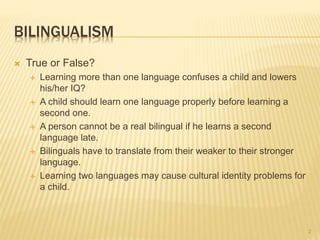
BILINGUALISM
 True or False?
 Learning more than one language confuses a child and lowers
his/her IQ?
 A child should learn one language properly before learning a
second one.
 A person cannot be a real bilingual if he learns a second
language late.
 Bilinguals have to translate from their weaker to their stronger
language.
 Learning two languages may cause cultural identity problems for
a child.
2
BILINGUALISM
 Why do we study bilingualism?
 A large proportion of the world’s population knows and uses more than one
language on a regular basis. Multilingualism is the norm. More than 140
languages are spoken in Manchester. Language planning (social and
educational policy) is a political issue often based on academic research.
 Topics in bilingualism
 Who is bilingual? What is a native language?
 How does a child acquire two languages?
 How does bilingualism influence a human being’s intellectual and mental
growth?
 When and how should we learn a second language?
 Does a bilingual’s brain function differently from a monolingual’s brain?
 How and when do bilinguals switch from one language to the other?
3
BILINGUALISM
 Approaches
 Linguistics – studies the structure and development of the two
languages
 Psycholinguistics – studies the psychological basis of bilingual’s
language competence and performance
 Sociolinguistics – looks at how cultures/social groups affect
language performance and language choice
 Neurolinguistics – studies the relationship between language and
the brain
4
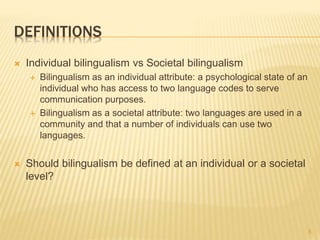
DEFINITIONS
 Individual bilingualism vs Societal bilingualism
 Bilingualism as an individual attribute: a psychological state of an
individual who has access to two language codes to serve
communication purposes.
 Bilingualism as a societal attribute: two languages are used in a
community and that a number of individuals can use two
languages.
 Should bilingualism be defined at an individual or a societal
level?
5
DEFINITIONS
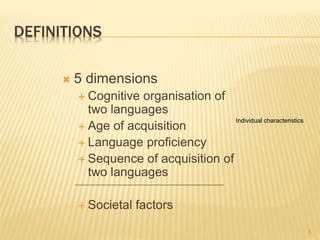
 5 dimensions
 Cognitive organisation of
two languages
 Age of acquisition
 Language proficiency
 Sequence of acquisition of
two languages
 Societal factors
6
Individual characteristics
COMPOUND VS. COORDINATE BILINGUALS
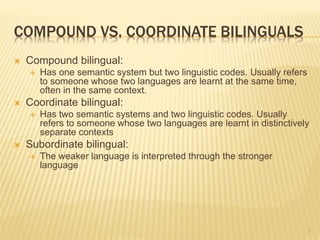
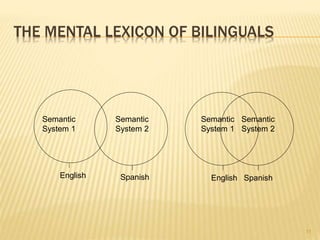
 Compound bilingual:
 Has one semantic system but two linguistic codes. Usually refers
to someone whose two languages are learnt at the same time,
often in the same context.
 Coordinate bilingual:
 Has two semantic systems and two linguistic codes. Usually
refers to someone whose two languages are learnt in distinctively
separate contexts
 Subordinate bilingual:
 The weaker language is interpreted through the stronger
language
7
THE MENTAL LEXICON OF
MONOLINGUALS
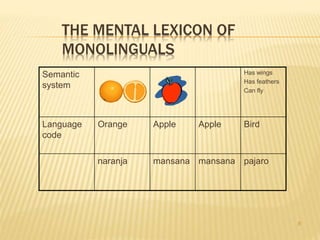
Semantic
system
Has wings
Has feathers
Can fly
Language
code
Orange Apple Apple Bird
naranja mansana mansana pajaro
8
THE MENTAL LEXICON OF BILINGUALS
9
Semantic system Semantic
System 1
Semantic
System 2
English Spanish English Spanish
Compound bilingual Coordinate bilingual
THE MENTAL LEXICON OF BILINGUALS
10
Semantic system
English Spanish
Subordinate bilingual
THE MENTAL LEXICON OF BILINGUALS
11
Semantic
System 1
English Spanish
Semantic
System 2
English Spanish
Semantic
System 2
Semantic
System 1
THE MENTAL LEXICON OF BILINGUALS
 Whether there are two or more systems
depends on:
 Age of acquisition
 Learning/teaching method
 Similarities and differences between the two
languages
12
EARLY VS. LATE BILINGUALS
 Early bilingual:
 someone who has acquired two languages early
in childhood (usually received systematic
training/learning of a second language before
age 6).
 Late bilingual:
 someone who has become a bilingual later than
childhood (after age 12).
 Discussion: Is there a “critical period” for
second language learning?
13
EARLY VS. LATE BILINGUALS
14
How do we determine the age of acquisition?
BALANCED VS. DOMINANT BILINGUALS
 Balanced bilingual:
 someone whose mastery of two languages is
roughly equivalent.
 Dominant bilingual:
 someone with greater proficiency in one of his or
her languages and uses it significantly more than
the other language.
 Semilingual:
 someone with insufficient knowledge of either
language.
15
SUCCESSIVE VS. SIMULTANEOUS BILINGUALS
 Successive bilingualism:
 Learning one language after already knowing another. This is the situation for all
those who become bilingual as adults, as well as for many who became bilingual
earlier in life. Sometimes also called consecutive bilingualism.
 Simultaneous bilingualism:
 Learning two languages as "first languages". That is, a person who is a
simultaneous bilingual goes from speaking no languages at all directly to
speaking two languages. Infants who are exposed to two languages from birth
will become simultaneous bilinguals.
 Receptive bilingualism:
 Being able to understand two languages but express oneself in only one. This is
generally not considered "true" bilingualism but is a fairly common situation.
16
ADDITIVE VS. SUBTRACTIVE BILINGUALS
 Additive bilingual:
 The learning of a second language does not interfere with the
learning of a first language. Both languages are well developed.
 Subtractive bilingual:
 The learning a second language interferes with the learning of a
first language. The second language replaces the first language.
 Additive or subtractive bilingualism is related to the different
status associated with the two languages in a society.
17
ELITE VS. FOLK BILINGUALS
 Elite bilingual:
 Individuals who choose to have a bilingual home,
often in order to enhance social status.
 Folk bilingual:
 Individuals who develop second language
capacity under circumstances that are not often
of their own choosing, and in conditions where
the society does not value their native language.
18
SUMMARY: DEFINITIONS
 Coordinate vs. Compound bilingualism
 Early vs. Late bilingualism
 Balanced vs. Dominant bilingualism
 Simultaneous vs. Successive bilingualism
 Additive vs. Subtractive bilingualism
 Elite vs. Folk bilingualism
19
LANGUAGE ACQUISITION OF BILINGUAL
CHILDREN
 Bilingual acquisition is a complex phenomenon.
 Monolingual children usually learn language from parents.
But bilingual children may learn languages not only from
parents but also from grandparents, playmates, babysitters,
childcare, school teachers and TV.
 Their exposure to languages fluctuate over time and
situation/environment.
 Childhood bilingualism is poorly understood by many and
regarded with scepticism by others.
20
LANGUAGE ACQUISITION OF BILINGUAL
CHILDREN
 Compared to monolingual children, bilingual children have
less exposure to each of their languages and, therefore,
they never master either language fully and never become
as proficient as monolingual children.
 How do we measure language proficiency?
 How do we determine if bilingual children’s language
development is normal?
21
LANGUAGE ACQUISITION OF BILINGUAL
CHILDREN
 Compared to monolingual children, bilingual children have
less exposure to each of their languages and, therefore,
they never master either language fully and never become
as proficient as monolingual children.
 How do we measure language proficiency?
 How do we determine if bilingual children’s language
development is normal?
22
LANGUAGE ACQUISITION OF BILINGUAL
CHILDREN
 Young bilingual children may know fewer words in one or
both of their languages in comparison with monolingual
children of the same age.
 This is understandable because young children have limited
cognitive / memory capacities, and bilingual children must
store words from two languages, not just one.
 Also, because bilingual children learn words in each
language from different people, they sometimes know
certain words in one language but not in the other.
23
LANGUAGE ACQUISITION OF BILINGUAL
CHILDREN
 When adding the vocabulary that bilingual children know in
both languages, they generally know the same number of or
even more words as their monolingual peers.
 Even when differences like these occur, they are short term
and are likely to disappear by the time the children begin
school.
 Bilingual children's overall proficiency in each language
reflects the amount of time they spend in each.
24
WILL LEARNING TWO LANGUAGES CONFUSE
CHILDREN/
 Young bilingual children often mix the two languages and
cannot keep them separate.
 Language mixing is taken as evidence that learning two
languages confuses children.
 Mixing: a fusion of two languages with the inability to
differentiate one language from the other.
 Mixing happens most frequently during early phase of
language development, before or around age 2;0 (years;
months), whereas later on, bilingual children can easily
separate the two linguistic systems.
25
WILL LEARNING TWO LANGUAGES CONFUSE
CHILDREN
 Phonological mixing
 Kats – Katt (swedish) & Kass (Estonia)
 [both katt and kass mean ‘cat’ in English]
 Lexical mixing
 I want mansana
 [I want apple]
 Semantic mixing
 I lost the bus
 [lost = missed in Spanish]
 Syntactic mixing
 A house red
 [colour adjectives follow the noun in Spanish]
26
WILL LEARNING TWO LANGUAGES CONFUSE
CHILDREN
 Children mix because they are confused by
learning two languages? or,
 Because they lack the appropriate items in
one language but have them in the other
language?
Unitary language system hypothesis
Vs.
Separate language system hypothesis
27
UNITARY LANGUAGE SYSTEM HYPOTHESIS
 A 3-stage model for early bilingual development proposed
by Volterra & Taeschner, 1978:
 I. the bilingual child has only one lexical system comprising words
from both languages [1.6-2.1]
 II. development of two distinct lexical systems although the child
applies “the same syntactic rules to both languages” [2.5-3.3]
 III. differentiation of two linguistic systems, lexical as well as
syntactic [2.9-311]
28
UNITARY LANGUAGE SYSTEM HYPOTHESIS
 Bilingual children first have a single fused linguistic representation.
 They begin to differentiate their two native languages by age
 3;0.
 Implication: Young bilinguals have language delay relative to monolinguals.
 Support for this hypothesis: Volterra & Taeschner (1978)
 Young bilinguals in the one-word stage acquire words mostly in one but not
both languages. e.g., if the word ` bird ' is acquired one language, it is not
acquired in the other language.
 This suggests that young bilinguals do not initially differentiate between their
two native vocabularies.
29
UNITARY LANGUAGE SYSTEM HYPOTHESIS
 Challenges to this hypothesis
 Bilingual children mix because they lack appropriate lexical items
in one language but have them in the other language. Thus, they
borrow vocabularies from the other language.
 Mixing declines as a child comes to recognize adult-imposed
standards of behaviour and shows awareness of his own ability to
meet them.
 Slobin (1972, 1973) argues that bilingual children mix because of
acquisitional strategies that are independent of language
30
SEPARATE LANGUAGE SYSTEM HYPOTHESIS
 Genesee F. (1989, Journal of Child Language) argued that:
 “...contrary to most extant interpretations, bilingual children
develop differentiated language systems from the beginning
and are able to use their developing languages in
contextually sensitive ways. A call for more serious attention
to the possible role of parental input in the form of mixed
utterances is made.”
31
SEPARATE LANGUAGE SYSTEM HYPOTHESIS
 According to Genesee:
 “The most proficient bilinguals mix the most and in the most
sophisticated ways without violating the rules of either language. It is
normal for children growing up in these communities to mix their
languages extensively because they are simply learning the patterns of
communication that are common in their community. It can be difficult
and unnatural, if not impossible, to keep the languages completely
separate. If most people in the children's wider community use only one
language, the children will eventual learn the monolingual patterns.”
32
SEPARATE LANGUAGE SYSTEM HYPOTHESIS
 The language mixing seen in bilingual
children is constrained by grammatical rules.
 Influenced by sociolinguistic factors such as
language mixing pattern of parents.
 Language mixing is not a consequence of
confusion but instead demonstrates the
bilingual child's distinct representations of the
two languages from an early age.
33

Bilingualism.ppt

  • 1.
  • 2.
    BILINGUALISM  True orFalse?  Learning more than one language confuses a child and lowers his/her IQ?  A child should learn one language properly before learning a second one.  A person cannot be a real bilingual if he learns a second language late.  Bilinguals have to translate from their weaker to their stronger language.  Learning two languages may cause cultural identity problems for a child. 2
  • 3.
    BILINGUALISM  Why dowe study bilingualism?  A large proportion of the world’s population knows and uses more than one language on a regular basis. Multilingualism is the norm. More than 140 languages are spoken in Manchester. Language planning (social and educational policy) is a political issue often based on academic research.  Topics in bilingualism  Who is bilingual? What is a native language?  How does a child acquire two languages?  How does bilingualism influence a human being’s intellectual and mental growth?  When and how should we learn a second language?  Does a bilingual’s brain function differently from a monolingual’s brain?  How and when do bilinguals switch from one language to the other? 3
  • 4.
    BILINGUALISM  Approaches  Linguistics– studies the structure and development of the two languages  Psycholinguistics – studies the psychological basis of bilingual’s language competence and performance  Sociolinguistics – looks at how cultures/social groups affect language performance and language choice  Neurolinguistics – studies the relationship between language and the brain 4
  • 5.
    DEFINITIONS  Individual bilingualismvs Societal bilingualism  Bilingualism as an individual attribute: a psychological state of an individual who has access to two language codes to serve communication purposes.  Bilingualism as a societal attribute: two languages are used in a community and that a number of individuals can use two languages.  Should bilingualism be defined at an individual or a societal level? 5
  • 6.
    DEFINITIONS  5 dimensions Cognitive organisation of two languages  Age of acquisition  Language proficiency  Sequence of acquisition of two languages  Societal factors 6 Individual characteristics
  • 7.
    COMPOUND VS. COORDINATEBILINGUALS  Compound bilingual:  Has one semantic system but two linguistic codes. Usually refers to someone whose two languages are learnt at the same time, often in the same context.  Coordinate bilingual:  Has two semantic systems and two linguistic codes. Usually refers to someone whose two languages are learnt in distinctively separate contexts  Subordinate bilingual:  The weaker language is interpreted through the stronger language 7
  • 8.
    THE MENTAL LEXICONOF MONOLINGUALS Semantic system Has wings Has feathers Can fly Language code Orange Apple Apple Bird naranja mansana mansana pajaro 8
  • 9.
    THE MENTAL LEXICONOF BILINGUALS 9 Semantic system Semantic System 1 Semantic System 2 English Spanish English Spanish Compound bilingual Coordinate bilingual
  • 10.
    THE MENTAL LEXICONOF BILINGUALS 10 Semantic system English Spanish Subordinate bilingual
  • 11.
    THE MENTAL LEXICONOF BILINGUALS 11 Semantic System 1 English Spanish Semantic System 2 English Spanish Semantic System 2 Semantic System 1
  • 12.
    THE MENTAL LEXICONOF BILINGUALS  Whether there are two or more systems depends on:  Age of acquisition  Learning/teaching method  Similarities and differences between the two languages 12
  • 13.
    EARLY VS. LATEBILINGUALS  Early bilingual:  someone who has acquired two languages early in childhood (usually received systematic training/learning of a second language before age 6).  Late bilingual:  someone who has become a bilingual later than childhood (after age 12).  Discussion: Is there a “critical period” for second language learning? 13
  • 14.
    EARLY VS. LATEBILINGUALS 14 How do we determine the age of acquisition?
  • 15.
    BALANCED VS. DOMINANTBILINGUALS  Balanced bilingual:  someone whose mastery of two languages is roughly equivalent.  Dominant bilingual:  someone with greater proficiency in one of his or her languages and uses it significantly more than the other language.  Semilingual:  someone with insufficient knowledge of either language. 15
  • 16.
    SUCCESSIVE VS. SIMULTANEOUSBILINGUALS  Successive bilingualism:  Learning one language after already knowing another. This is the situation for all those who become bilingual as adults, as well as for many who became bilingual earlier in life. Sometimes also called consecutive bilingualism.  Simultaneous bilingualism:  Learning two languages as "first languages". That is, a person who is a simultaneous bilingual goes from speaking no languages at all directly to speaking two languages. Infants who are exposed to two languages from birth will become simultaneous bilinguals.  Receptive bilingualism:  Being able to understand two languages but express oneself in only one. This is generally not considered "true" bilingualism but is a fairly common situation. 16
  • 17.
    ADDITIVE VS. SUBTRACTIVEBILINGUALS  Additive bilingual:  The learning of a second language does not interfere with the learning of a first language. Both languages are well developed.  Subtractive bilingual:  The learning a second language interferes with the learning of a first language. The second language replaces the first language.  Additive or subtractive bilingualism is related to the different status associated with the two languages in a society. 17
  • 18.
    ELITE VS. FOLKBILINGUALS  Elite bilingual:  Individuals who choose to have a bilingual home, often in order to enhance social status.  Folk bilingual:  Individuals who develop second language capacity under circumstances that are not often of their own choosing, and in conditions where the society does not value their native language. 18
  • 19.
    SUMMARY: DEFINITIONS  Coordinatevs. Compound bilingualism  Early vs. Late bilingualism  Balanced vs. Dominant bilingualism  Simultaneous vs. Successive bilingualism  Additive vs. Subtractive bilingualism  Elite vs. Folk bilingualism 19
  • 20.
    LANGUAGE ACQUISITION OFBILINGUAL CHILDREN  Bilingual acquisition is a complex phenomenon.  Monolingual children usually learn language from parents. But bilingual children may learn languages not only from parents but also from grandparents, playmates, babysitters, childcare, school teachers and TV.  Their exposure to languages fluctuate over time and situation/environment.  Childhood bilingualism is poorly understood by many and regarded with scepticism by others. 20
  • 21.
    LANGUAGE ACQUISITION OFBILINGUAL CHILDREN  Compared to monolingual children, bilingual children have less exposure to each of their languages and, therefore, they never master either language fully and never become as proficient as monolingual children.  How do we measure language proficiency?  How do we determine if bilingual children’s language development is normal? 21
  • 22.
    LANGUAGE ACQUISITION OFBILINGUAL CHILDREN  Compared to monolingual children, bilingual children have less exposure to each of their languages and, therefore, they never master either language fully and never become as proficient as monolingual children.  How do we measure language proficiency?  How do we determine if bilingual children’s language development is normal? 22
  • 23.
    LANGUAGE ACQUISITION OFBILINGUAL CHILDREN  Young bilingual children may know fewer words in one or both of their languages in comparison with monolingual children of the same age.  This is understandable because young children have limited cognitive / memory capacities, and bilingual children must store words from two languages, not just one.  Also, because bilingual children learn words in each language from different people, they sometimes know certain words in one language but not in the other. 23
  • 24.
    LANGUAGE ACQUISITION OFBILINGUAL CHILDREN  When adding the vocabulary that bilingual children know in both languages, they generally know the same number of or even more words as their monolingual peers.  Even when differences like these occur, they are short term and are likely to disappear by the time the children begin school.  Bilingual children's overall proficiency in each language reflects the amount of time they spend in each. 24
  • 25.
    WILL LEARNING TWOLANGUAGES CONFUSE CHILDREN/  Young bilingual children often mix the two languages and cannot keep them separate.  Language mixing is taken as evidence that learning two languages confuses children.  Mixing: a fusion of two languages with the inability to differentiate one language from the other.  Mixing happens most frequently during early phase of language development, before or around age 2;0 (years; months), whereas later on, bilingual children can easily separate the two linguistic systems. 25
  • 26.
    WILL LEARNING TWOLANGUAGES CONFUSE CHILDREN  Phonological mixing  Kats – Katt (swedish) & Kass (Estonia)  [both katt and kass mean ‘cat’ in English]  Lexical mixing  I want mansana  [I want apple]  Semantic mixing  I lost the bus  [lost = missed in Spanish]  Syntactic mixing  A house red  [colour adjectives follow the noun in Spanish] 26
  • 27.
    WILL LEARNING TWOLANGUAGES CONFUSE CHILDREN  Children mix because they are confused by learning two languages? or,  Because they lack the appropriate items in one language but have them in the other language? Unitary language system hypothesis Vs. Separate language system hypothesis 27
  • 28.
    UNITARY LANGUAGE SYSTEMHYPOTHESIS  A 3-stage model for early bilingual development proposed by Volterra & Taeschner, 1978:  I. the bilingual child has only one lexical system comprising words from both languages [1.6-2.1]  II. development of two distinct lexical systems although the child applies “the same syntactic rules to both languages” [2.5-3.3]  III. differentiation of two linguistic systems, lexical as well as syntactic [2.9-311] 28
  • 29.
    UNITARY LANGUAGE SYSTEMHYPOTHESIS  Bilingual children first have a single fused linguistic representation.  They begin to differentiate their two native languages by age  3;0.  Implication: Young bilinguals have language delay relative to monolinguals.  Support for this hypothesis: Volterra & Taeschner (1978)  Young bilinguals in the one-word stage acquire words mostly in one but not both languages. e.g., if the word ` bird ' is acquired one language, it is not acquired in the other language.  This suggests that young bilinguals do not initially differentiate between their two native vocabularies. 29
  • 30.
    UNITARY LANGUAGE SYSTEMHYPOTHESIS  Challenges to this hypothesis  Bilingual children mix because they lack appropriate lexical items in one language but have them in the other language. Thus, they borrow vocabularies from the other language.  Mixing declines as a child comes to recognize adult-imposed standards of behaviour and shows awareness of his own ability to meet them.  Slobin (1972, 1973) argues that bilingual children mix because of acquisitional strategies that are independent of language 30
  • 31.
    SEPARATE LANGUAGE SYSTEMHYPOTHESIS  Genesee F. (1989, Journal of Child Language) argued that:  “...contrary to most extant interpretations, bilingual children develop differentiated language systems from the beginning and are able to use their developing languages in contextually sensitive ways. A call for more serious attention to the possible role of parental input in the form of mixed utterances is made.” 31
  • 32.
    SEPARATE LANGUAGE SYSTEMHYPOTHESIS  According to Genesee:  “The most proficient bilinguals mix the most and in the most sophisticated ways without violating the rules of either language. It is normal for children growing up in these communities to mix their languages extensively because they are simply learning the patterns of communication that are common in their community. It can be difficult and unnatural, if not impossible, to keep the languages completely separate. If most people in the children's wider community use only one language, the children will eventual learn the monolingual patterns.” 32
  • 33.
    SEPARATE LANGUAGE SYSTEMHYPOTHESIS  The language mixing seen in bilingual children is constrained by grammatical rules.  Influenced by sociolinguistic factors such as language mixing pattern of parents.  Language mixing is not a consequence of confusion but instead demonstrates the bilingual child's distinct representations of the two languages from an early age. 33

Editor's Notes