LANGUAGE AND 
HUMAN BRAIN 
Psycholinguistic
LANGBRAIN 
GROUP
Introduction 
Era & Yuni 
The Expert 
Jana & Julaisa 
Language and 
the Brain 
Irma & Syarifah
Introduction 
Era & Yuni
How the human acquire and 
use language? 
Research on the brain in humans and nonhuman primates, 
anatomically, psychologically, and behaviorally is helping 
to answer the questions connecting the neurological 
basis for language. 
Neurolinguistics is the study of how language is represented and 
processed in the brain. 
We will discuss the language and the brain such as the definition, the reason 
why only human can speak the language, the process/ mechanism, the 
theories, the contribution, and the examples.
The Definition 
The brain is one of the important organs that located in human’s 
head that composed of neurons, nerve cells that are the 
basic information processing units of the nervous 
system 
The language is the human ability to acquire and use 
complex systems of communication, the scientific study of 
language is called linguistics.
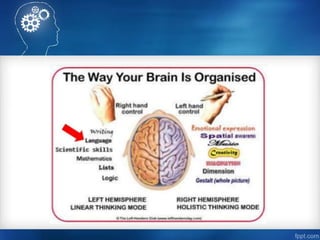
THE HUMAN BRAIN 
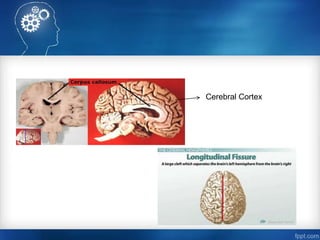
 The cerebral cortex is the gray wrinkled mass that sits over the 
rest of the brain and accounts for language representation and 
processing. 
 The longitudinal fissure separates the left and right 
hemispheres of the brain. 
 The corpus callosum is the bundle of nerve fibers that connects 
the two hemispheres.
Cerebral Cortex
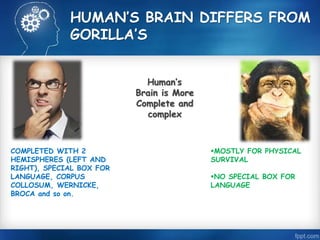
HUMAN’S BRAIN DIFFERS FROM 
GORILLA’S 
Human’s 
Brain is More 
Complete and 
complex 
MOSTLY FOR PHYSICAL 
SURVIVAL 
NO SPECIAL BOX FOR 
LANGUAGE 
COMPLETED WITH 2 
HEMISPHERES (LEFT AND 
RIGHT), SPECIAL BOX FOR 
LANGUAGE, CORPUS 
COLLOSUM, WERNICKE, 
BROCA and so on.
Language ability as a difference in degree 
between humans and other primates 
Nonhuman primates could 
not develop speech because 
their vocal tracts couldn’t 
produce a large enough 
inventory of speech sounds. 
Mynah birds and parrots 
have the ability to imitate 
human speech, but not the 
ability to acquire language 
The development of a vocal tract 
capable of producing the wide 
variety of sounds can only utilized 
by human.
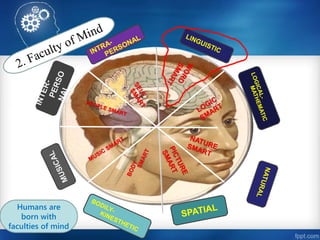
Humans are 
born with 
faculties of mind
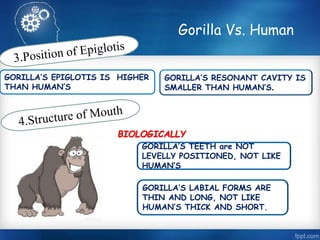
GORILLA’S EPIGLOTIS IS HIGHER 
THAN HUMAN’S 
Gorilla Vs. Human 
GORILLA’S RESONANT CAVITY IS 
SMALLER THAN HUMAN’S. 
BIOLOGICALLY 
GORILLA’S TEETH are NOT 
LEVELLY POSITIONED, NOT LIKE 
HUMAN’S 
GORILLA’S LABIAL FORMS ARE 
THIN AND LONG, NOT LIKE 
HUMAN’S THICK AND SHORT.
Why is the brain so well suited to 
learning language? 
The structure of human language 
is inevitably shaped around human 
learning and processing biases 
deriving from the structure of our 
thought processes (brain). 
Language is easy for us to learn 
and use, not because our brains 
embody knowledge of language, but 
because language has adapted to our 
brains.
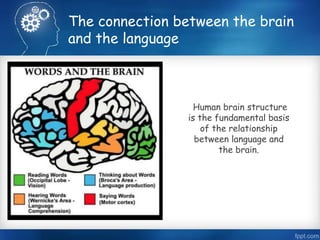
The connection between the brain 
and the language 
Human brain structure 
is the fundamental basis 
of the relationship 
between language and 
the brain.
The Experts 
Jana & Julaisa
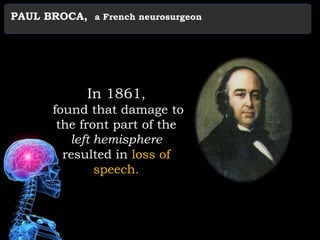
PAUL BROCA, a French neurosurgeon 
In 1861, 
found that damage to 
the front part of the 
left hemisphere 
resulted in loss of 
speech.
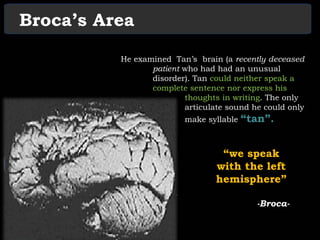
Broca’s Area 
He examined Tan’s brain (a recently deceased 
patient who had had an unusual 
disorder). Tan could neither speak a 
complete sentence nor express his 
thoughts in writing. The only 
articulate sound he could only 
make syllable “tan”. 
“we speak 
with the left 
hemisphere” 
-Broca-
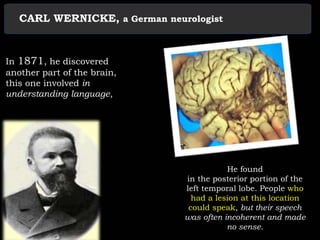
CARL WERNICKE, a German neurologist 
In 1871, he discovered 
another part of the brain, 
this one involved in 
understanding language, 
He found 
in the posterior portion of the 
left temporal lobe. People who 
had a lesion at this location 
could speak, but their speech 
was often incoherent and made 
no sense.
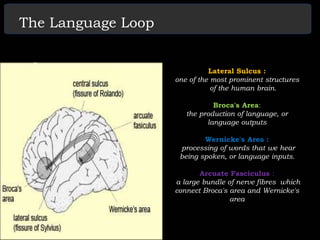
The Language Loop 
Lateral Sulcus : 
one of the most prominent structures 
of the human brain. 
Broca's Area: 
the production of language, or 
language outputs 
Wernicke's Area : 
processing of words that we hear 
being spoken, or language inputs. 
Arcuate Fasciculus : 
a large bundle of nerve fibres which 
connect Broca's area and Wernicke's 
area
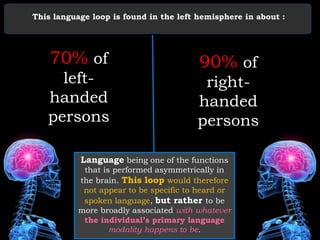
This language loop is found in the left hemisphere in about : 
90% of 
right-handed 
persons 
70% of 
left-handed 
persons 
Language being one of the functions 
that is performed asymmetrically in 
the brain. This loop would therefore 
not appear to be specific to heard or 
spoken language, but rather to be 
more broadly associated with whatever 
the individual’s primary language 
modality happens to be.
Language and the Brain 
Irma & Syarifah
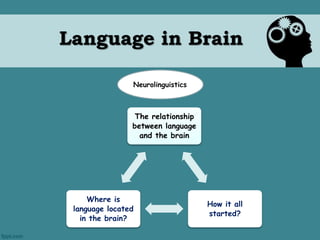
Language in Brain 
Neurolinguistics 
. 
The relationship 
between language 
and the brain 
How it all 
started? 
Where is 
language located 
in the brain?
Parts of the brain 
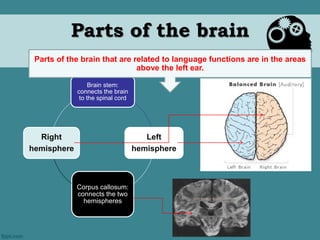
Parts of the brain that are related to language functions are in the areas 
Brain stem: 
connects the brain 
to the spinal cord 
Left 
hemisphere 
Corpus callosum: 
connects the two 
hemispheres 
Right 
hemisphere 
above the left ear.
Parts of the brain 
• Anterior speech cortex 
• Controls Syntax 
(1) 
Broca’s 
area 
• Posterior speech cortex 
• controls Semantics 
(2) 
Wernicke’s 
area
Parts of the brain 
• Controls the movement of 
the muscles (for moving 
hands, feet, arms, etc. as 
well as muscles of the face, 
jaw, tongue, and larynx. 
• Involved in the physical 
articulation of speech 
• Two neurosurgeons: Penfield 
and Roberts (1959) 
(3) 
Motor 
cortex:
Parts of the brain 
• A bundle of nerve fiber 
• Wernicke’s discovery 
• Connection between 
Broac’s area and 
Wernicke’s area 
(4) 
Arcuate 
Fasciculus
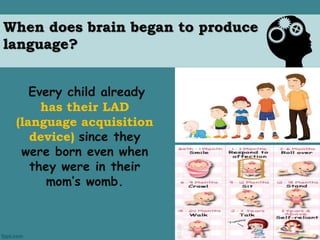
When does brain began to produce 
language? 
Every child already 
has their LAD 
(language acquisition 
device) since they 
were born even when 
they were in their 
mom’s womb.
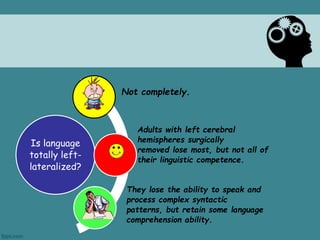
Is language 
totally left-lateralized? 
Not completely. 
Adults with left cerebral 
hemispheres surgically 
removed lose most, but not all of 
their linguistic competence. 
They lose the ability to speak and 
process complex syntactic 
patterns, but retain some language 
comprehension ability.
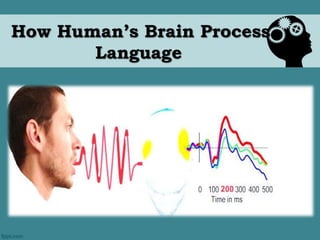
How Human’s Brain Process 
Language
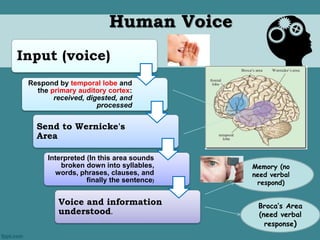
Human Voice 
Input (voice) 
Respond by temporal lobe and 
the primary auditory cortex: 
received, digested, and 
processed 
Send to Wernicke's 
Area 
Interpreted (In this area sounds 
broken down into syllables, 
words, phrases, clauses, and 
finally the sentence) 
Voice and information 
understood. 
Memory (no 
need verbal 
respond) 
Broca’s Area 
(need verbal 
response)
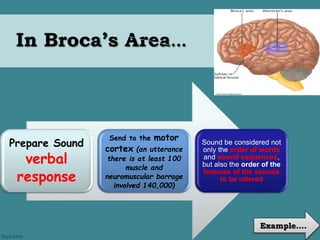
In Broca’s Area… 
Prepare Sound 
verbal 
response 
Send to the motor 
cortex (an utterance 
there is at least 100 
muscle and 
neuromuscular barrage 
involved 140,000) 
Sound be considered not 
only the order of words 
and sound sequences, 
but also the order of the 
features of the sounds 
to be uttered 
Example….
Example… 
Consist of / 
d / / i /, / e 
“die” “tie” 
/ 
Consist of / t 
/, / i/, / e / 
1. Deciding the features of the 
phoneme: Phoneme / d / has a feature 
[+ voice], [+ consonant], [+ anterior], 
[-bilabial], [+ alveolar], [-nasal] -> 
2. motor cortex -> 3. vocal cords 30 
milliseconds -> 4. attached to the tip 
of the tongue in the mouth of 
Regional alveolar to the sound / d / 
coordinated with all so neat & 
accurate coordination 
In contrast, 
/ t / -> 25 milliseconds 
after the sound 
To : ensure that the 
billabial sound that comes 
out it really / d /, and not / 
t / 
Without this accuracy then the 
conversation would sound like a 
stranger
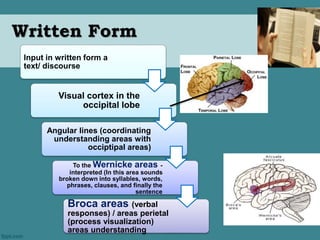
Written Form 
Input in written form a 
text/ discourse 
Visual cortex in the 
occipital lobe 
Angular lines (coordinating 
understanding areas with 
occiptipal areas) 
To the Wernicke areas - 
interpreted (In this area sounds 
broken down into syllables, words, 
phrases, clauses, and finally the 
sentence 
Broca areas (verbal 
responses) / areas perietal 
(process visualization) 
areas understanding
Language Disorders
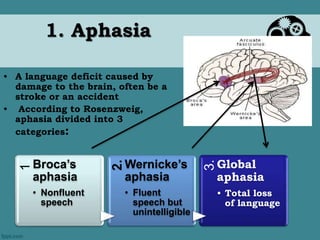
1. Aphasia 
• A language deficit caused by 
damage to the brain, often be a 
stroke or an accident 
• According to Rosenzweig, 
aphasia divided into 3 
categories: 
1. 
Broca’s 
aphasia 
• Nonfluent 
speech 
2. 
Wernicke’s 
aphasia 
• Fluent 
speech but 
unintelligible 
3. 
Global 
aphasia 
• Total loss 
of language
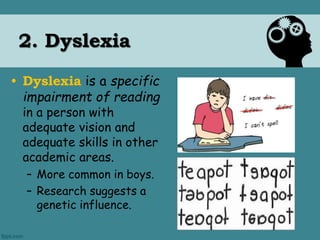
2. Dyslexia 
• Dyslexia is a specific 
impairment of reading 
in a person with 
adequate vision and 
adequate skills in other 
academic areas. 
– More common in boys. 
– Research suggests a 
genetic influence.

Language and Human's Brain

  • 1.
    LANGUAGE AND HUMANBRAIN Psycholinguistic
  • 2.
  • 3.
    Introduction Era &Yuni The Expert Jana & Julaisa Language and the Brain Irma & Syarifah
  • 4.
  • 5.
    How the humanacquire and use language? Research on the brain in humans and nonhuman primates, anatomically, psychologically, and behaviorally is helping to answer the questions connecting the neurological basis for language. Neurolinguistics is the study of how language is represented and processed in the brain. We will discuss the language and the brain such as the definition, the reason why only human can speak the language, the process/ mechanism, the theories, the contribution, and the examples.
  • 6.
    The Definition Thebrain is one of the important organs that located in human’s head that composed of neurons, nerve cells that are the basic information processing units of the nervous system The language is the human ability to acquire and use complex systems of communication, the scientific study of language is called linguistics.
  • 8.
    THE HUMAN BRAIN  The cerebral cortex is the gray wrinkled mass that sits over the rest of the brain and accounts for language representation and processing.  The longitudinal fissure separates the left and right hemispheres of the brain.  The corpus callosum is the bundle of nerve fibers that connects the two hemispheres.
  • 9.
  • 10.
    HUMAN’S BRAIN DIFFERSFROM GORILLA’S Human’s Brain is More Complete and complex MOSTLY FOR PHYSICAL SURVIVAL NO SPECIAL BOX FOR LANGUAGE COMPLETED WITH 2 HEMISPHERES (LEFT AND RIGHT), SPECIAL BOX FOR LANGUAGE, CORPUS COLLOSUM, WERNICKE, BROCA and so on.
  • 11.
    Language ability asa difference in degree between humans and other primates Nonhuman primates could not develop speech because their vocal tracts couldn’t produce a large enough inventory of speech sounds. Mynah birds and parrots have the ability to imitate human speech, but not the ability to acquire language The development of a vocal tract capable of producing the wide variety of sounds can only utilized by human.
  • 12.
    Humans are bornwith faculties of mind
  • 13.
    GORILLA’S EPIGLOTIS ISHIGHER THAN HUMAN’S Gorilla Vs. Human GORILLA’S RESONANT CAVITY IS SMALLER THAN HUMAN’S. BIOLOGICALLY GORILLA’S TEETH are NOT LEVELLY POSITIONED, NOT LIKE HUMAN’S GORILLA’S LABIAL FORMS ARE THIN AND LONG, NOT LIKE HUMAN’S THICK AND SHORT.
  • 14.
    Why is thebrain so well suited to learning language? The structure of human language is inevitably shaped around human learning and processing biases deriving from the structure of our thought processes (brain). Language is easy for us to learn and use, not because our brains embody knowledge of language, but because language has adapted to our brains.
  • 15.
    The connection betweenthe brain and the language Human brain structure is the fundamental basis of the relationship between language and the brain.
  • 16.
  • 17.
    PAUL BROCA, aFrench neurosurgeon In 1861, found that damage to the front part of the left hemisphere resulted in loss of speech.
  • 18.
    Broca’s Area Heexamined Tan’s brain (a recently deceased patient who had had an unusual disorder). Tan could neither speak a complete sentence nor express his thoughts in writing. The only articulate sound he could only make syllable “tan”. “we speak with the left hemisphere” -Broca-
  • 19.
    CARL WERNICKE, aGerman neurologist In 1871, he discovered another part of the brain, this one involved in understanding language, He found in the posterior portion of the left temporal lobe. People who had a lesion at this location could speak, but their speech was often incoherent and made no sense.
  • 20.
    The Language Loop Lateral Sulcus : one of the most prominent structures of the human brain. Broca's Area: the production of language, or language outputs Wernicke's Area : processing of words that we hear being spoken, or language inputs. Arcuate Fasciculus : a large bundle of nerve fibres which connect Broca's area and Wernicke's area
  • 21.
    This language loopis found in the left hemisphere in about : 90% of right-handed persons 70% of left-handed persons Language being one of the functions that is performed asymmetrically in the brain. This loop would therefore not appear to be specific to heard or spoken language, but rather to be more broadly associated with whatever the individual’s primary language modality happens to be.
  • 22.
    Language and theBrain Irma & Syarifah
  • 23.
    Language in Brain Neurolinguistics . The relationship between language and the brain How it all started? Where is language located in the brain?
  • 24.
    Parts of thebrain Parts of the brain that are related to language functions are in the areas Brain stem: connects the brain to the spinal cord Left hemisphere Corpus callosum: connects the two hemispheres Right hemisphere above the left ear.
  • 25.
    Parts of thebrain • Anterior speech cortex • Controls Syntax (1) Broca’s area • Posterior speech cortex • controls Semantics (2) Wernicke’s area
  • 26.
    Parts of thebrain • Controls the movement of the muscles (for moving hands, feet, arms, etc. as well as muscles of the face, jaw, tongue, and larynx. • Involved in the physical articulation of speech • Two neurosurgeons: Penfield and Roberts (1959) (3) Motor cortex:
  • 27.
    Parts of thebrain • A bundle of nerve fiber • Wernicke’s discovery • Connection between Broac’s area and Wernicke’s area (4) Arcuate Fasciculus
  • 28.
    When does brainbegan to produce language? Every child already has their LAD (language acquisition device) since they were born even when they were in their mom’s womb.
  • 29.
    Is language totallyleft-lateralized? Not completely. Adults with left cerebral hemispheres surgically removed lose most, but not all of their linguistic competence. They lose the ability to speak and process complex syntactic patterns, but retain some language comprehension ability.
  • 30.
    How Human’s BrainProcess Language
  • 31.
    Human Voice Input(voice) Respond by temporal lobe and the primary auditory cortex: received, digested, and processed Send to Wernicke's Area Interpreted (In this area sounds broken down into syllables, words, phrases, clauses, and finally the sentence) Voice and information understood. Memory (no need verbal respond) Broca’s Area (need verbal response)
  • 32.
    In Broca’s Area… Prepare Sound verbal response Send to the motor cortex (an utterance there is at least 100 muscle and neuromuscular barrage involved 140,000) Sound be considered not only the order of words and sound sequences, but also the order of the features of the sounds to be uttered Example….
  • 33.
    Example… Consist of/ d / / i /, / e “die” “tie” / Consist of / t /, / i/, / e / 1. Deciding the features of the phoneme: Phoneme / d / has a feature [+ voice], [+ consonant], [+ anterior], [-bilabial], [+ alveolar], [-nasal] -> 2. motor cortex -> 3. vocal cords 30 milliseconds -> 4. attached to the tip of the tongue in the mouth of Regional alveolar to the sound / d / coordinated with all so neat & accurate coordination In contrast, / t / -> 25 milliseconds after the sound To : ensure that the billabial sound that comes out it really / d /, and not / t / Without this accuracy then the conversation would sound like a stranger
  • 34.
    Written Form Inputin written form a text/ discourse Visual cortex in the occipital lobe Angular lines (coordinating understanding areas with occiptipal areas) To the Wernicke areas - interpreted (In this area sounds broken down into syllables, words, phrases, clauses, and finally the sentence Broca areas (verbal responses) / areas perietal (process visualization) areas understanding
  • 35.
  • 36.
    1. Aphasia •A language deficit caused by damage to the brain, often be a stroke or an accident • According to Rosenzweig, aphasia divided into 3 categories: 1. Broca’s aphasia • Nonfluent speech 2. Wernicke’s aphasia • Fluent speech but unintelligible 3. Global aphasia • Total loss of language
  • 37.
    2. Dyslexia •Dyslexia is a specific impairment of reading in a person with adequate vision and adequate skills in other academic areas. – More common in boys. – Research suggests a genetic influence.