Chilmie BOZATZI
Chava PETSENIK
Tuğba KARATEPE
Ezgi KARAMAN
 Neurolinguistics studies the relation of
language
and communication to different aspects of brain
function, i.e. it tries to explore how the brain
understands and produces language and
communication.
 This involves attempting to combine theory
from
neurology/neurophysiology (how the brain is
structured and how it functions) with linguistic
theory (how language is structured and how it
functions).
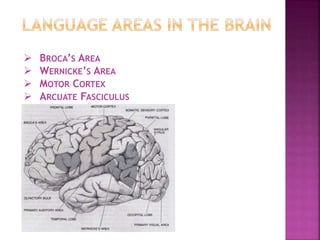
 BROCA’S AREA
 WERNICKE’S AREA
 MOTOR CORTEX
 ARCUATE FASCICULUS
Broca’s area is used to produce production of
speech. It was possible to localize
psychological
functions to brain convolutions. Linguistic
symptoms were caused by lesions in the left
hemisphere and that language, thus, was
lateralized, which was totally unexpected.
And also Broca’s area is said to have a “motor
representation” of speech.
 Wernicke’s area is the posterior part of the first
or superior temporal gyrus and adjacent areas
(parts of the angular gyrus, the supramarginal
gyrus and the second temporal gyrus are
included) first temporal convolution.
 Language comprehension disturbed
 Important parts of Wernicke’s theory are:
1. The identification of symptom complexes.
2. The idea about flow of information (a sort of high
level “reflex arc”).
3. The idea of representation. Wernicke’s area is said
to have an “auditory sound representation” of
speech.
Motor cortex is an area that generally
controls movement of the muscles (for
moving hands, feet, arms, etc.). Close to
Broca’s area is the part of the motor cortex
that controls the articulatory muscles of the
face, jaw, tongue and larynx. Evidence that
this area is involved in the physical
articulation of speech.
A white matter tract that connects Broca’s
Area and Wernicke’s Area through the
Temporal, Parietal and Frontal Lobes. Allows
for coordinated, comprehensible speech.
The localization view is having identified
these four components, it is tempting to
conclude that specific
aspects of language ability can be accorded
specific locations in the brain. And it has been
used to suggest that the brain activity involved
in hearing a word, understanding it, then
saying it, would follow a definite pattern. This
is certainly an oversimplified version of what
may actually take place, but it is consistent
with much of what we understand about
simple language processing in the brain.
 The tip of the tongue phenomenon
It is in which we feel that some word is just
eluding us, that we know the word. It also
showing speakers generally have an accurate
phonological outline of the word, can get the
initial sound correct and mostly know the
number of syllables in the word. When we make
mistakes in this retrieval process, there are
often strong phonological similarities between
the target word we’re trying to say and the
mistake we actually produce.
For example, speakers produced secant, sextet
and sexton when asked to name a particular
type of navigational instrument (sextant).
Other examples are fire distinguisher (for
“extinguisher”) and transcendental medication
(instead of "meditation”). Mistakes of this type
are sometimes referred to as malapropisms
after a character called Mrs. Malaprop (in a play
by Sheridan) who consistently produced “near-
misses” for words, with great comic effect.
 Slips of the tongue
Slips of the tongue are sometimes called
spoonerisms after William Spooner, an
Anglican clergyman at Oxford University,
who was renowned for his tongue slips.
They are often simply the result of a sound
being carried over from one word to the next,
as in black boxes (for “black boxes”), or a
sound used in one word in anticipation of its
occurrence in the next word, as in no man
numeral (for “roman numeral”), or a top of tea
(“cup”).
 Slips of the ear
Slips of the ear provide some clues to
how the brain tries to make sense of the
auditory signal it receives.
For example; in our hearing great ape
and wondering why someone should be
looking for one in his office. (The
speaker actually said “gray tape.”)
 Aphasia is one kind of language disorder
that results from damage to the parts of
the brain that contain language.
 Aphasia causes problems in the ability
to perceive, process, or produce
language.
 Aphasia occurs in various forms and
degrees, depending upon the situation,
extent, and severity of the cerebral
lesions which is responsible.
 This is caused by the damage to Brorca's area,
located at the base of the motor cortex.
 Speak haltingly and have a hard time forming
complete words when they attempt to
produce language.
 Understand the speech of others fairly well.
 May have some difficulty matching the correct
semantic interpretation to the syntactic order
of the sentence.
 If writing to be tested, this must be attempted
with the unaffected hand (usually the left).
 This handwriting is usually defective and
there is poverty and lack of precision of
written language, though copying is relatively
impaired.
 This is caused by the damage of Wernicke’s
area, located near the back section of the
auditory cortex.
 It is very difficult for people with
Wernicke’s aphasia to understand the
speech of others.
 May speak in long sentences that have no
meaning, add unnecessary words, and even
create made-up words.
 The syntactic order of words is also
altered.
 Often cannot follow simple instructions.
 Paraphasias (incorrect word usage).
 Literal (the use of incorrect vowels or
consonants within a word).
 Verbal (the use of incorrect words).
 Requires extra time to understand spoken
message.
 Finds if very hard to follow fast.
 This results from damage to the arcuate
fasciculus which results in severing the
connection between the Broca’s and Wernicke’s
areas.
 Object naming, spontaneous writing and
comprehension of both oral and written language
are impaired.
 Repetition of words spoken by the examiner is
normal and the patient may show parrot-like
repetition of a word or phrase (‘echolalia’).
 Fluent but meaningless speech but the patient
shows signs of being able to comprehend the
speech of others.
 Will be able to understand utterances but will
not be able to repeat them.
 Dichotic listening is an experimental
technique that has demonstrated a left
hemisphere dominance for syllable and
word processing.
 This technique uses the generally
established fact that anything
experienced on the right-hand side of
the body is processed in the left
hemisphere, and anything on the left
side is processed in the right
hemisphere.
 For example, through one earphone
comes the syllable ga or the word dog,
and through the other earphone at
exactly the same time comes da or cat.
When asked to say what was heard, the
subject more often correctly identifies
the sound that came via the right ear.
This is known as the right ear advantage
for linguistic sounds.
 The critical period hypothesis assumes that
language is biologically based and states that the
ability to learn a native language develops
within a fixed period, from birth to middle
childhood.
 During childhood, there is a period when the
human brain is most ready to receive input and
learn a particular language.
 For human babies, the brain is very flexible, and
the left hemisphere is not dominant. By the
Critical Age, the left hemisphere is dominant
and Broca’s area and Wernicke’s area become
less adaptable to new language stimuli.
 Genie was discovered in 1970 at the age of
thirteen and seven months in a Los Angeles
suburb.
 She was confined up until that point by her
controlling father, who abused her
regularly.
 Because she had not acquired language up
until that point, linguists used her to test
the critical period theory.
 When Genie was first found, they
couldn’t tell at first whether or not she
had already acquired language and
simply wasn’t using it or if she indeed
had not acquired language.
 Because she did not respond to simple
commands but did respond to words that
were clearly out of the context of their
environment, it was determined that
Genie truly had not yet acquired
language.
 Genie’s first basic ‘words’ were
monosyllabic consonant-vowel
sequences.
 After five months, she began to use
single words spontaneously.
 Her early vocabulary was different from
the first words of regular children which
are typically nouns, plus particles like
up and down.
 When she was first discovered, most of
the sounds that came out of her mouth
were voiceless.
 Normal people learn very early in life
how to speak and breathe at the same
time. Genie, however, never learned how
to do so.
Lang. and brain

Lang. and brain

  • 1.
  • 2.
     Neurolinguistics studiesthe relation of language and communication to different aspects of brain function, i.e. it tries to explore how the brain understands and produces language and communication.  This involves attempting to combine theory from neurology/neurophysiology (how the brain is structured and how it functions) with linguistic theory (how language is structured and how it functions).
  • 3.
     BROCA’S AREA WERNICKE’S AREA  MOTOR CORTEX  ARCUATE FASCICULUS
  • 4.
    Broca’s area isused to produce production of speech. It was possible to localize psychological functions to brain convolutions. Linguistic symptoms were caused by lesions in the left hemisphere and that language, thus, was lateralized, which was totally unexpected. And also Broca’s area is said to have a “motor representation” of speech.
  • 5.
     Wernicke’s areais the posterior part of the first or superior temporal gyrus and adjacent areas (parts of the angular gyrus, the supramarginal gyrus and the second temporal gyrus are included) first temporal convolution.  Language comprehension disturbed  Important parts of Wernicke’s theory are: 1. The identification of symptom complexes. 2. The idea about flow of information (a sort of high level “reflex arc”). 3. The idea of representation. Wernicke’s area is said to have an “auditory sound representation” of speech.
  • 6.
    Motor cortex isan area that generally controls movement of the muscles (for moving hands, feet, arms, etc.). Close to Broca’s area is the part of the motor cortex that controls the articulatory muscles of the face, jaw, tongue and larynx. Evidence that this area is involved in the physical articulation of speech.
  • 7.
    A white mattertract that connects Broca’s Area and Wernicke’s Area through the Temporal, Parietal and Frontal Lobes. Allows for coordinated, comprehensible speech.
  • 8.
    The localization viewis having identified these four components, it is tempting to conclude that specific aspects of language ability can be accorded specific locations in the brain. And it has been used to suggest that the brain activity involved in hearing a word, understanding it, then saying it, would follow a definite pattern. This is certainly an oversimplified version of what may actually take place, but it is consistent with much of what we understand about simple language processing in the brain.
  • 9.
     The tipof the tongue phenomenon It is in which we feel that some word is just eluding us, that we know the word. It also showing speakers generally have an accurate phonological outline of the word, can get the initial sound correct and mostly know the number of syllables in the word. When we make mistakes in this retrieval process, there are often strong phonological similarities between the target word we’re trying to say and the mistake we actually produce.
  • 10.
    For example, speakersproduced secant, sextet and sexton when asked to name a particular type of navigational instrument (sextant). Other examples are fire distinguisher (for “extinguisher”) and transcendental medication (instead of "meditation”). Mistakes of this type are sometimes referred to as malapropisms after a character called Mrs. Malaprop (in a play by Sheridan) who consistently produced “near- misses” for words, with great comic effect.
  • 11.
     Slips ofthe tongue Slips of the tongue are sometimes called spoonerisms after William Spooner, an Anglican clergyman at Oxford University, who was renowned for his tongue slips.
  • 12.
    They are oftensimply the result of a sound being carried over from one word to the next, as in black boxes (for “black boxes”), or a sound used in one word in anticipation of its occurrence in the next word, as in no man numeral (for “roman numeral”), or a top of tea (“cup”).
  • 13.
     Slips ofthe ear Slips of the ear provide some clues to how the brain tries to make sense of the auditory signal it receives.
  • 14.
    For example; inour hearing great ape and wondering why someone should be looking for one in his office. (The speaker actually said “gray tape.”)
  • 15.
     Aphasia isone kind of language disorder that results from damage to the parts of the brain that contain language.  Aphasia causes problems in the ability to perceive, process, or produce language.  Aphasia occurs in various forms and degrees, depending upon the situation, extent, and severity of the cerebral lesions which is responsible.
  • 16.
     This iscaused by the damage to Brorca's area, located at the base of the motor cortex.  Speak haltingly and have a hard time forming complete words when they attempt to produce language.  Understand the speech of others fairly well.
  • 17.
     May havesome difficulty matching the correct semantic interpretation to the syntactic order of the sentence.  If writing to be tested, this must be attempted with the unaffected hand (usually the left).  This handwriting is usually defective and there is poverty and lack of precision of written language, though copying is relatively impaired.
  • 18.
     This iscaused by the damage of Wernicke’s area, located near the back section of the auditory cortex.  It is very difficult for people with Wernicke’s aphasia to understand the speech of others.  May speak in long sentences that have no meaning, add unnecessary words, and even create made-up words.
  • 19.
     The syntacticorder of words is also altered.  Often cannot follow simple instructions.  Paraphasias (incorrect word usage).  Literal (the use of incorrect vowels or consonants within a word).  Verbal (the use of incorrect words).  Requires extra time to understand spoken message.  Finds if very hard to follow fast.
  • 20.
     This resultsfrom damage to the arcuate fasciculus which results in severing the connection between the Broca’s and Wernicke’s areas.  Object naming, spontaneous writing and comprehension of both oral and written language are impaired.  Repetition of words spoken by the examiner is normal and the patient may show parrot-like repetition of a word or phrase (‘echolalia’).
  • 21.
     Fluent butmeaningless speech but the patient shows signs of being able to comprehend the speech of others.  Will be able to understand utterances but will not be able to repeat them.
  • 22.
     Dichotic listeningis an experimental technique that has demonstrated a left hemisphere dominance for syllable and word processing.  This technique uses the generally established fact that anything experienced on the right-hand side of the body is processed in the left hemisphere, and anything on the left side is processed in the right hemisphere.
  • 23.
     For example,through one earphone comes the syllable ga or the word dog, and through the other earphone at exactly the same time comes da or cat. When asked to say what was heard, the subject more often correctly identifies the sound that came via the right ear. This is known as the right ear advantage for linguistic sounds.
  • 24.
     The criticalperiod hypothesis assumes that language is biologically based and states that the ability to learn a native language develops within a fixed period, from birth to middle childhood.  During childhood, there is a period when the human brain is most ready to receive input and learn a particular language.  For human babies, the brain is very flexible, and the left hemisphere is not dominant. By the Critical Age, the left hemisphere is dominant and Broca’s area and Wernicke’s area become less adaptable to new language stimuli.
  • 25.
     Genie wasdiscovered in 1970 at the age of thirteen and seven months in a Los Angeles suburb.  She was confined up until that point by her controlling father, who abused her regularly.  Because she had not acquired language up until that point, linguists used her to test the critical period theory.
  • 26.
     When Geniewas first found, they couldn’t tell at first whether or not she had already acquired language and simply wasn’t using it or if she indeed had not acquired language.  Because she did not respond to simple commands but did respond to words that were clearly out of the context of their environment, it was determined that Genie truly had not yet acquired language.
  • 27.
     Genie’s firstbasic ‘words’ were monosyllabic consonant-vowel sequences.  After five months, she began to use single words spontaneously.  Her early vocabulary was different from the first words of regular children which are typically nouns, plus particles like up and down.
  • 28.
     When shewas first discovered, most of the sounds that came out of her mouth were voiceless.  Normal people learn very early in life how to speak and breathe at the same time. Genie, however, never learned how to do so.