SOCIOLINGUISTICS
SIR IRFAN ABBAS
IQRA MUSHTAQ
UMAR FAROOQ
TO P I C S :
• L A N G U A G E S H I F T
• L A N G U A G E D E AT H
• M A R K E R
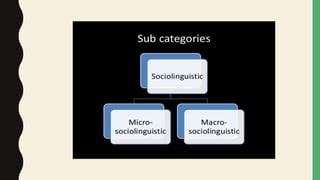
• M I C R O / M A C R O S O C I O L I N G U I S T I C S
LANGUAGE SHIFT
LANGUAGE SHIFT
• Language Shift also known as language Transfer or Language Replacement or
Language Assimilation.
• The process whereby a community gradually abandons its original language and via a
stage of bilingualism, shift to another language.

• A change from the use of one language to the use of another language.
• Gradually shifting may take three or four generations.
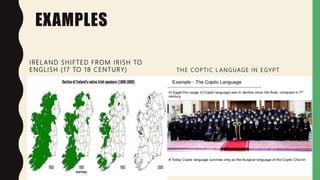
EXAMPLES
IREL AND SHIFTED FROM IRISH TO
ENGLISH (17 TO 18 CENTURY) THE COPTIC L ANGUAGE IN EGYPT
REASONS FOR LANGUAGE SHIFT
• Often occurs when people migrate from one country to another country where the
main language is different.
• The speaker of the lesser-used language, gradually shifts from his/her native language
to the dominant language.

• In order to restricting the number of languages used as media of instruction, language
shift may be actively encouraged by government policy
• May also occur when the main language of a country is needed for employment
opportunities and wider communication.
WHAT FACTORS LEAD TO LANGUAGE
SHIFT?
• Social Factor
The dominant language is associated with social
status and prestige.
• Economical Factor
Obtaining work is the obvious reason for
learning another language.
• Political Factor
The pressure of institutional domains such as
schools and the media.
• Demographic factors
i. Language shift is faster in urban areas than
rural
ii. The size of the group is sometimes a
critical factor
iii. Intermarriage between groups can
accelerate language shift
• Attitudes and values
Language shift is slower among communities
where the minority language is highly valued,
therefore when the language is seen as an
important symbol of ethnic identity its generally
maintained longer.
CHARACTERISTICS
• Shift take place gradually
• Shift take place domain by domain
• Original language being retained longest in formal family
type contexts
• The ultimate end point of language shift is language death
• Abandon language often a minority language
• Sometime its lengthy or sometime short
LANGUAGE DEATH
LANGUAGE DEATH
• Language death also known language extinction and language loss.
• If the entire community shift totally to a new language, the original language will
eventually have no speakers left in the community in question, and the end point of
the process of language shift will be language death.
• When all the people who speak a language die, the language dies with them.
EXAMPLES
CORNISH (TO ENGLISH) MANCHU (TO CHINESE)
ACCORDING TO SOME WRITERS….
L ANGUAGE LOSS
• Definition
Where total shift occurs in only one of
the communities speaking the
language.
• Example
The loss of Dutch (language) in
immigrant communities in Australia.
L ANGUAGE DEATH
• Definition
Which is the total loss of a language from
the world, when all the speakers of a
language shift.
• Example
The loss of Manx (language) on the Isle of
Man.
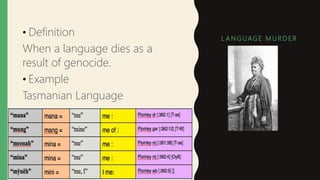
L A N G UAG E M U R D E R
• Definition
When a language dies as a
result of genocide.
• Example
Tasmanian Language
Last speaker
REASON FOR LANGUAGE DEATH
• Language death occurs in unstable bilingual or multilingual speech communities as a
result of language shift from a regressive minority language to a dominant majority
language
WHY DO LANGUAGE DIE(FACTOR)
FACTORS WHICH PUT PEOPLE IN
PHYSICAL DANGER
• Natural disasters leading to death or
destruction of habitat
• Disease
• Economic exploitation
• Political conflict leading to civil war,
ethnic murder, or genocide
FACTORS WHICH CHANGE THE
PEOPLE’S CULTURE
– Cultural assimilation
– Military dominance
– Urbanization
– Media
– Bilingualism
CHARACTERISTICS
• Its occurs in the situation of multilingualism and language contact.
• Language shift maybe take place before it.
• Language loss can be occur on two levels. Personal level or familial level
MARKER
MARKER, ACCORDING TO WILLIAM LABOV’S
SECULAR LINGUISTICS (A VIEW)
• Definition:
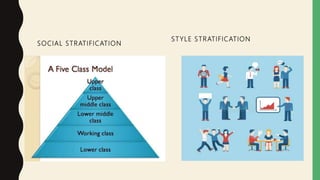
Marker is a linguistic variable which shows social stratification and style stratification.
• Importance:
William Labov emphasizes the important role of sociolinguistic markers in identifying
the speaker and the speech style.
• Purpose:
Marker as “A linguistic feature whose usage correlates both with social group and with
speech style”.
SOCIAL STRATIFICATION
STYLE STRATIFICATION
EXAMPLES
Example:
• variation in use of –in’/-ing in speech.
• r-dropping in the speech of New York City (Labov 1966)
MICRO/MACRO SOCIOLINGUISTICS
SOCIOLINGUISTICS?
• Use of language in society.
• The study of the relationship between language and society.
• Sociolinguistic examines the relationship between language use and the social world,
particularly how language operates within and created social structures.
MIC-SOCIOLINGUISTIC
• Mic-sociolinguistic refer to research with a linguistic slat on dialect
and stylistic/variation.
• According to Coulmas (Sociolinguistic) as “social dimensions of
language.
• Sociolinguistics or microsociolinguistics: “The study of language in
relation to society…” Hudson (1996)
SUB-FIELDS OF MICRO SOCIOLINGUISTICS
• Anthropological Linguistics,
• Dialectology
• Discourse Analysis
• Ethnography Of Speaking
• Geolinguistics
• Language Contact Studies
• Secular Linguistics,
• The Social Psychology Of Language
• The Sociology Of Language
MACRO-SOCIOLINGUISTIC
• Macro-linguistics looks at the behaviors of entire speech
communication exploring issues such as why immigrant
communities retain their native languages in some contexts
but not in other.
• According to Coulmas “linguistic dimensions of society”
• the study of society in relation to language. (Hudson, 1996)
SUB-FIELDS OF MACRO SOCIOLINGUISTICS
• Macro sociolinguistics covers many sub-fields which are given several different names.
Among the most known ones there are (Trudgill, 2003):
• Language Variation and Change
• Pidgin and Creole Languages
• Language Attitude Studies
DIFFERENCE BETWEEN MICRO AND MACRO
SOCIOLINGUISTICS
• In this distinction, sociolinguistics or
micro-sociolinguistics is concerned
with investigating the relationships
between language and society with
the goal being a better understanding
of the structure of language and of
how languages function in
communication;
• It’s main focus is
“Society on Language”
• the equivalent goal in the macro
sociolinguistics or sociology of
language is trying to discover how
social structure can be better
understood through the study of
language, e.g., how certain linguistic
features serve to characterize
particular social arrangements.
• It’s main focus is
“Languages effects on society”
ANY QUESTION
TIME TO QUIZ
I. Give any two examples of language shift from the society of Pakistan.
II. How can we secure a language from death especially Punjabi Language.
III. Are there some ways to identify the social status of a person (any two).
IV. What is the focus of microsociolinguistics?
V. What is the focus of macrosociolinguistics?
THANK YOU

Language deth, language shift, marker, micro/macro sociolinguistics

  • 1.
  • 2.
    IQRA MUSHTAQ UMAR FAROOQ TOP I C S : • L A N G U A G E S H I F T • L A N G U A G E D E AT H • M A R K E R • M I C R O / M A C R O S O C I O L I N G U I S T I C S
  • 3.
  • 4.
    LANGUAGE SHIFT • LanguageShift also known as language Transfer or Language Replacement or Language Assimilation. • The process whereby a community gradually abandons its original language and via a stage of bilingualism, shift to another language. • A change from the use of one language to the use of another language. • Gradually shifting may take three or four generations.
  • 5.
    EXAMPLES IREL AND SHIFTEDFROM IRISH TO ENGLISH (17 TO 18 CENTURY) THE COPTIC L ANGUAGE IN EGYPT
  • 6.
    REASONS FOR LANGUAGESHIFT • Often occurs when people migrate from one country to another country where the main language is different. • The speaker of the lesser-used language, gradually shifts from his/her native language to the dominant language. • In order to restricting the number of languages used as media of instruction, language shift may be actively encouraged by government policy • May also occur when the main language of a country is needed for employment opportunities and wider communication.
  • 7.
    WHAT FACTORS LEADTO LANGUAGE SHIFT? • Social Factor The dominant language is associated with social status and prestige. • Economical Factor Obtaining work is the obvious reason for learning another language. • Political Factor The pressure of institutional domains such as schools and the media. • Demographic factors i. Language shift is faster in urban areas than rural ii. The size of the group is sometimes a critical factor iii. Intermarriage between groups can accelerate language shift • Attitudes and values Language shift is slower among communities where the minority language is highly valued, therefore when the language is seen as an important symbol of ethnic identity its generally maintained longer.
  • 8.
    CHARACTERISTICS • Shift takeplace gradually • Shift take place domain by domain • Original language being retained longest in formal family type contexts • The ultimate end point of language shift is language death • Abandon language often a minority language • Sometime its lengthy or sometime short
  • 9.
  • 10.
    LANGUAGE DEATH • Languagedeath also known language extinction and language loss. • If the entire community shift totally to a new language, the original language will eventually have no speakers left in the community in question, and the end point of the process of language shift will be language death. • When all the people who speak a language die, the language dies with them.
  • 11.
    EXAMPLES CORNISH (TO ENGLISH)MANCHU (TO CHINESE)
  • 12.
    ACCORDING TO SOMEWRITERS…. L ANGUAGE LOSS • Definition Where total shift occurs in only one of the communities speaking the language. • Example The loss of Dutch (language) in immigrant communities in Australia. L ANGUAGE DEATH • Definition Which is the total loss of a language from the world, when all the speakers of a language shift. • Example The loss of Manx (language) on the Isle of Man.
  • 13.
    L A NG UAG E M U R D E R • Definition When a language dies as a result of genocide. • Example Tasmanian Language Last speaker
  • 14.
    REASON FOR LANGUAGEDEATH • Language death occurs in unstable bilingual or multilingual speech communities as a result of language shift from a regressive minority language to a dominant majority language
  • 15.
    WHY DO LANGUAGEDIE(FACTOR) FACTORS WHICH PUT PEOPLE IN PHYSICAL DANGER • Natural disasters leading to death or destruction of habitat • Disease • Economic exploitation • Political conflict leading to civil war, ethnic murder, or genocide FACTORS WHICH CHANGE THE PEOPLE’S CULTURE – Cultural assimilation – Military dominance – Urbanization – Media – Bilingualism
  • 16.
    CHARACTERISTICS • Its occursin the situation of multilingualism and language contact. • Language shift maybe take place before it. • Language loss can be occur on two levels. Personal level or familial level
  • 17.
  • 18.
    MARKER, ACCORDING TOWILLIAM LABOV’S SECULAR LINGUISTICS (A VIEW) • Definition: Marker is a linguistic variable which shows social stratification and style stratification. • Importance: William Labov emphasizes the important role of sociolinguistic markers in identifying the speaker and the speech style. • Purpose: Marker as “A linguistic feature whose usage correlates both with social group and with speech style”.
  • 19.
  • 20.
    EXAMPLES Example: • variation inuse of –in’/-ing in speech. • r-dropping in the speech of New York City (Labov 1966)
  • 21.
  • 22.
    SOCIOLINGUISTICS? • Use oflanguage in society. • The study of the relationship between language and society. • Sociolinguistic examines the relationship between language use and the social world, particularly how language operates within and created social structures.
  • 24.
    MIC-SOCIOLINGUISTIC • Mic-sociolinguistic referto research with a linguistic slat on dialect and stylistic/variation. • According to Coulmas (Sociolinguistic) as “social dimensions of language. • Sociolinguistics or microsociolinguistics: “The study of language in relation to society…” Hudson (1996)
  • 25.
    SUB-FIELDS OF MICROSOCIOLINGUISTICS • Anthropological Linguistics, • Dialectology • Discourse Analysis • Ethnography Of Speaking • Geolinguistics • Language Contact Studies • Secular Linguistics, • The Social Psychology Of Language • The Sociology Of Language
  • 26.
    MACRO-SOCIOLINGUISTIC • Macro-linguistics looksat the behaviors of entire speech communication exploring issues such as why immigrant communities retain their native languages in some contexts but not in other. • According to Coulmas “linguistic dimensions of society” • the study of society in relation to language. (Hudson, 1996)
  • 27.
    SUB-FIELDS OF MACROSOCIOLINGUISTICS • Macro sociolinguistics covers many sub-fields which are given several different names. Among the most known ones there are (Trudgill, 2003): • Language Variation and Change • Pidgin and Creole Languages • Language Attitude Studies
  • 28.
    DIFFERENCE BETWEEN MICROAND MACRO SOCIOLINGUISTICS • In this distinction, sociolinguistics or micro-sociolinguistics is concerned with investigating the relationships between language and society with the goal being a better understanding of the structure of language and of how languages function in communication; • It’s main focus is “Society on Language” • the equivalent goal in the macro sociolinguistics or sociology of language is trying to discover how social structure can be better understood through the study of language, e.g., how certain linguistic features serve to characterize particular social arrangements. • It’s main focus is “Languages effects on society”
  • 29.
  • 30.
    TIME TO QUIZ I.Give any two examples of language shift from the society of Pakistan. II. How can we secure a language from death especially Punjabi Language. III. Are there some ways to identify the social status of a person (any two). IV. What is the focus of microsociolinguistics? V. What is the focus of macrosociolinguistics?
  • 31.