BRAIN AND ITSRELATIONSHIP WITH
LANGUAGE
Introduction
Language Definition
Brain Structure
Language and Brain
Language Processing
Parts and function of Brain
Biological basis of Language Learning
3.
INTRODUCTION:
The sciencethat deals with the relationship
between language and brain is called
neurolinguistics.
Although the study of the relationship between
language and brain is still in its infancy, much
has been learned about which parts of the brain
are involved in various aspects of language
production and comprehension.
4.
• LANGUAGE: THESYSTEM OF WORDS OR SIGNS THAT PEOPLE USE TO EXPRESS THOUGHTS AND FEELINGS TO
EACH OTHER.
6.
Brain structure:• The brain is composed of
nerve cells called neurons.
1,400 grammes. Although the brain accounts for
only about 2 percent of total body weight, it
consumes about 20 percent of the oxygen the
body uses while at rest.
The most complex 1,400 grammes in the galaxy.
The Greek philosopher Aristotle.
10 billion neurons
Different regions of the brain are specialized:
hearing, sight, bodily sensations, etc.
8.
87–92% isright-handed
95% of right-handers, the left side of the brain is
dominant for language.
10% is left-handed
60-70% of left-handers, the left side of brain is
used for language.
In the 1860s and 1870s, Paul Broca and Karl
Wernicke observed that people who had damage
to a particular area on the left side of the brain
had speech and language problems.
9.
The twolanguage areas of the brain that are
important for language now bear their names:
Broca's area and Wernicke's area Each
hemisphere of the brain is dominant for other
behaviors.
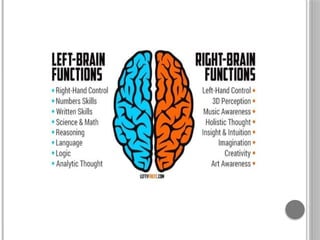
For example, it appears that the right brain is
dominant for spatial abilities, face recognition,
visual imagery and music. The left brain may be
more dominant for calculations, math and logical
abilities.
10.
Imagine thatyou could open the top of a living
human being’s skull and observe the brain while
the individual is engaged in activities such as
reading, writing, watching a hockey game, or
having a heated argument. What would you see?
The answer is – nothing.
To the outside observer, the working brain shows
no evidence of its activity. This is clearly a
problem for the field of neurolinguistics, which
requires the use of special investigative
techniques to uncover the secrets of where and
how language is processed in the brain.
what is going on in the brain when people
are engaged in language behavior?
11.
Autopsy studiesUntil recently the only way to
study the brain was through Autopsy studies.
This this technique was most often carried out
with patients who were admitted to hospitals
displaying a neurological disorder. Subsequent to
his or her death, the brain was examined to
determine which areas were damaged. By
comparing the area of brain damage and the type
of disorder the patient displayed while alive,
neurologists could develop theories about the role
of the damaged brain parts in normal brain
functioning.
12.
THE PARTS &FUNCTION OF THE
BRAIN
Brain is the one of the largest and the most
complex organs in human body.
The human brain is the powerhouse and
control center for all physiological and
cognitive functions.
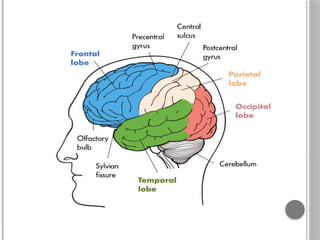
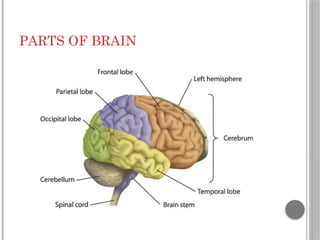
The brain can be divided into four sections ,
which are known as lobes. The frontal lobe,
parietal lobe, occipital lobe and temporal lobe
have been associated with different functions
ranging from reasoning to auditory perception.
THE FOUR LOBESOF THE BRAIN
The Frontal Lobe: It is located at the front of
the brain and is associated with reasoning, motor
skills , higher level cognition , and expressive
language. At the back of the frontal lobe lies the
motor cortex. This area of the brain receives
information from various lobes of the brain and
utilizes this information to carry out body
movements.
The Parietal Lobe: It is located in the middle
section of the brain and is associated with
processing tactile sensory information such as
pressure, touch, and pain. It is essential to the
processing of the body’s sense.
15.
The Temporallobe: It is located on the bottom
section of the brain. This lobe is also the location
of the primary auditory cortex, which is
important for interpreting sounds and the
language we hear. This portion of the brain is
also heavily associated with the formation of
memories.
The Occipital Lobe: It is located at the back
portion of the brain and is associated with
interpreting visual stimuli and information.The
primary visual cortex, which receives and
interprets information from the retinas of the
eyes, is located in the occipital lobe.
16.
BIOLOGICAL BASIS OFLANGUAGE
LEARNING
“If you talk to a man in a language he
understand, that goes to his head. If you talk to
him in his language, that goes to his heart” -
Nelson Mandela.
Language: The system of words or signs that
people used to express thoughts and feelings to
each other.
The Biological Base, Humans: Language in
humans is clearly dependent on their society in
which they could learn it with other people, other
humans to speak to, to be motivated emotionally
and to be intelligence.
17.
LANGUAGE AND PROCESSING:
Broca's area, located in the left hemisphere, is
associated with speech production and
articulation. Our ability to articulate ideas, as
well as use words accurately in spoken and
written language, has been attributed to this
crucial area.
The Broca area is in the frontal lobe of the brain
and is responsible for language processing. ...
Through extensive research, neuroscientist say
that the Broca area is able to understand
language through memories, meanings, and
emotions. It is a complex process!
18.
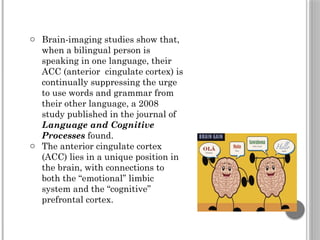
o Brain-imaging studiesshow that,
when a bilingual person is
speaking in one language, their
ACC (anterior cingulate cortex) is
continually suppressing the urge
to use words and grammar from
their other language, a 2008
study published in the journal of
Language and Cognitive
Processes found.
o The anterior cingulate cortex
(ACC) lies in a unique position in
the brain, with connections to
both the “emotional” limbic
system and the “cognitive”
prefrontal cortex.
19.
CONDUCTING APHASIA
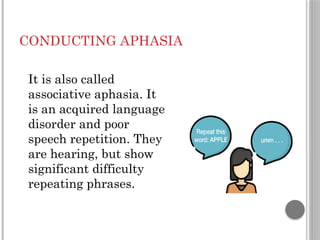
It isalso called
associative aphasia. It
is an acquired language
disorder and poor
speech repetition. They
are hearing, but show
significant difficulty
repeating phrases.
20.
LANGUAGE AREAS INTHE BRAIN
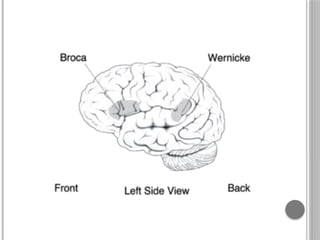
BROCA’S AREA - is very near to that part of the
motor strip which controls the tongue and lips.
Damage to Broca’s area will results in a typical
aphasic syndrome called Broca’s aphasia in
which the patient has good comprehension but
much difficult with pronunciation and producing
the little words of the language, such as articles
and prepositions.
For Example, Hey bro, what’s your plan in
spending your weekened at home? Boston college.
Football. Saturday.
22.
WERNICKE’S AREA:It is located in posterior
left temporal lobe, near the auditory association
areas of the brain.
Damage to Wernicke’s area produces an aphasia
that is characterized by fluent speech with many
neologisms (non-sense words) and poor
comprehension.
One aphasic, when asked to name an ashtray,
said “ That’s a book” When he was later asked to
point to the book, however, he had no idea what
the examiner meant.
23.
ARCUATE FASCICULUS
Itis a band of subcortical fiber that connects
Wernicke’s area with BROCA’S area.
If you ask someone to repeat what you say, the
incoming message is processed in Wernicke’s
area and then sent out over the arcuate
fasciculus to Broca’s area, where it is
programmed for production.
Patients with lesions in the arcuate fasciculus
are unable to repeat; their disorder is called
conduction aphasia.