What is
Language?
University of the Punjab , Department
of English Language & Literature.
Lahore, Pakistan
LANGUAGE
A Skill
• Something we do
– He speaks well but
writes badly.
KNOWLEDGE
• Something we know
– I don’t know much
Italian.
LANGUAGE
A Possession
• Something we
have/possess
– I haven’t much French.
A Tool
• Something we use
– What words can I use to
describe her?
LANGUAGE
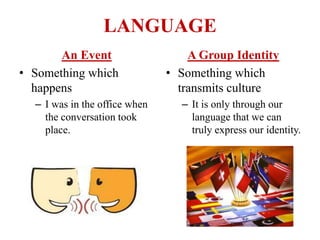
An Event
• Something which
happens
– I was in the office when
the conversation took
place.
A Group Identity
• Something which
transmits culture
– It is only through our
language that we can
truly express our identity.
LANGUAGE
An Object
• Something which we
can describe
– This language has a
complex structure.
A Living Organism
• Something which is
born, lives and dies
– Gradually a new
language was born.
– The 18th century saw a
flowering of the
language.
– That’s a dead language
LANGUAGE
• The most valuable
possession of man
• Difficult to think of a
society without
Language
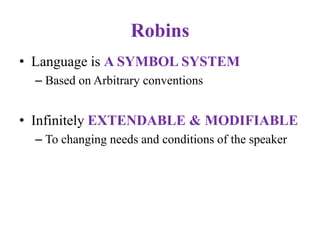
Robins
• Language is A SYMBOL SYSTEM
– Based on Arbitrary conventions
• Infinitely EXTENDABLE & MODIFIABLE
– To changing needs and conditions of the speaker
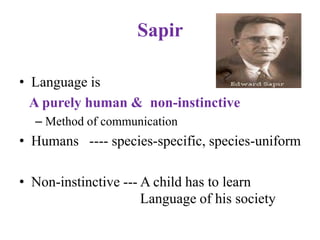
Sapir
• Language is
A purely human & non-instinctive
– Method of communication
• Humans ---- species-specific, species-uniform
• Non-instinctive --- A child has to learn
Language of his society
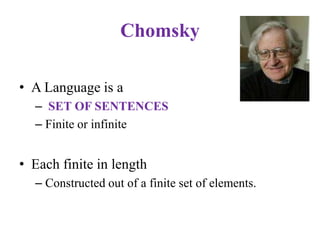
Chomsky
• A Language is a
– SET OF SENTENCES
– Finite or infinite
• Each finite in length
– Constructed out of a finite set of elements.
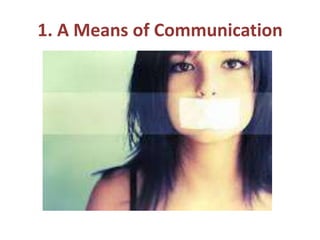
1. A Means of Communication
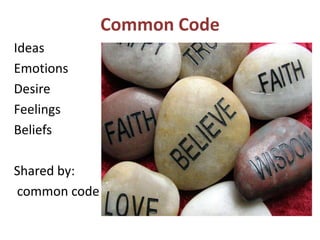
Common Code
Ideas
Emotions
Desire
Feelings
Beliefs
Shared by:
common code
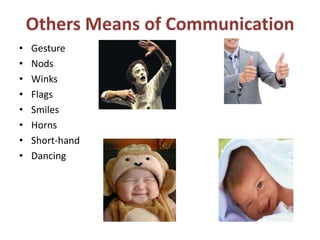
Others Means of Communication
• Gesture
• Nods
• Winks
• Flags
• Smiles
• Horns
• Short-hand
• Dancing
Others Means of Communication
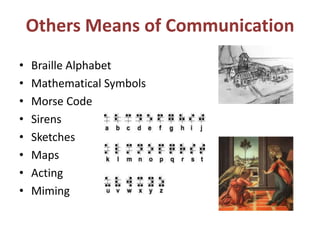
• Braille Alphabet
• Mathematical Symbols
• Morse Code
• Sirens
• Sketches
• Maps
• Acting
• Miming
Other System Vs. Language
• Extremely Limited
• Not Flexible
• Not Comprehensive
• Not Perfect
• Not Extensive
Language A Carrier
• It conveys/carries
»Human thoughts
»Philosophy
»Culture
»Civilization
• Shapes
»people’s thought
• Guides/control
»activities
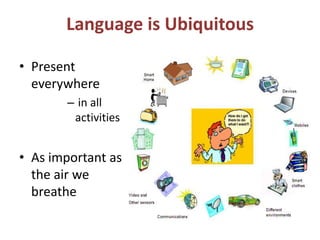
Language is Ubiquitous
• Present
everywhere
– in all
activities
• As important as
the air we
breathe
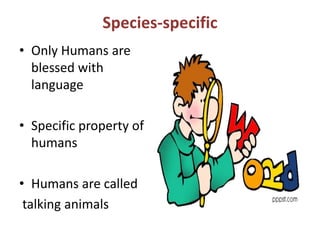
Species-specific
• Only Humans are
blessed with
language
• Specific property of
humans
• Humans are called
talking animals
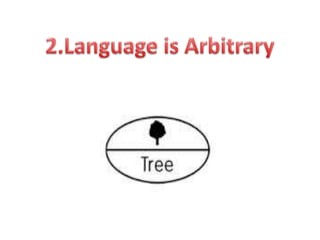
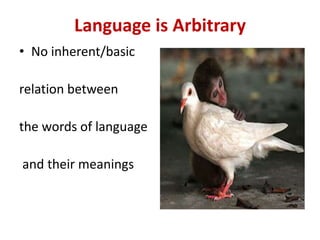
Language is Arbitrary
• No inherent/basic
relation between
the words of language
and their meanings
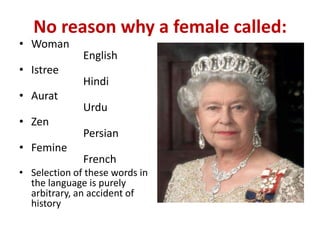
No reason why a female called:
• Woman
English
• Istree
Hindi
• Aurat
Urdu
• Zen
Persian
• Femine
French
• Selection of these words in
the language is purely
arbitrary, an accident of
history
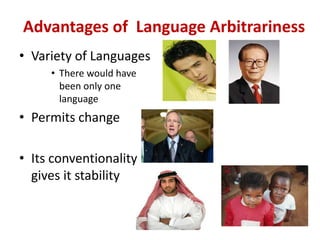
Advantages of Language Arbitrariness
• Variety of Languages
• There would have
been only one
language
• Permits change
• Its conventionality
gives it stability
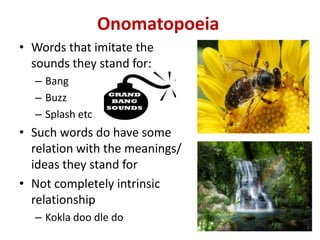
Onomatopoeia
• Words that imitate the
sounds they stand for:
– Bang
– Buzz
– Splash etc
• Such words do have some
relation with the meanings/
ideas they stand for
• Not completely intrinsic
relationship
– Kokla doo dle do
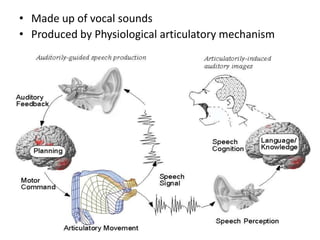
• Made up of vocal sounds
• Produced by Physiological articulatory mechanism
Speech Primary, Writing Secondary
• A child learns to speak first
– Writing comes much later
• A man speaks much more
– than he writes
• Writing
– Graphic representation of vocal sounds
– Letters K , Q /k/
• Total quantum of speech is > T.Q. written
material
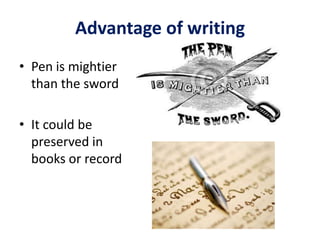
Advantage of writing
• Pen is mightier
than the sword
• It could be
preserved in
books or record
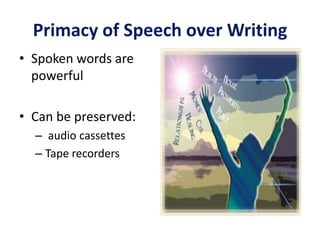
Primacy of Speech over Writing
• Spoken words are
powerful
• Can be preserved:
– audio cassettes
– Tape recorders
Language
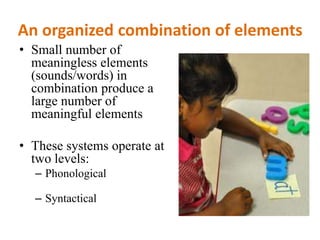
An organized combination of elements
• Small number of
meaningless elements
(sounds/words) in
combination produce a
large number of
meaningful elements
• These systems operate at
two levels:
– Phonological
– Syntactical
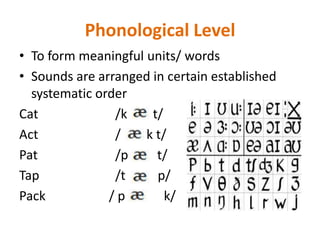
Phonological Level
• To form meaningful units/ words
• Sounds are arranged in certain established
systematic order
Cat /k t/
Act / k t/
Pat /p t/
Tap /t p/
Pack / p k/
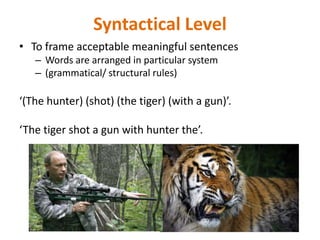
Syntactical Level
• To frame acceptable meaningful sentences
– Words are arranged in particular system
– (grammatical/ structural rules)
‘(The hunter) (shot) (the tiger) (with a gun)’.
‘The tiger shot a gun with hunter the’.
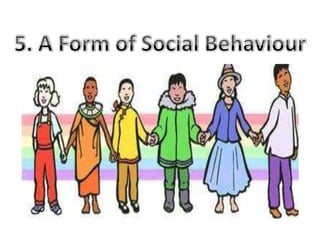
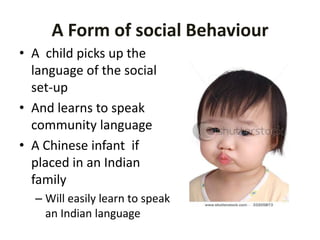
A Form of social Behaviour
• A child picks up the
language of the social
set-up
• And learns to speak
community language
• A Chinese infant if
placed in an Indian
family
– Will easily learn to speak
an Indian language
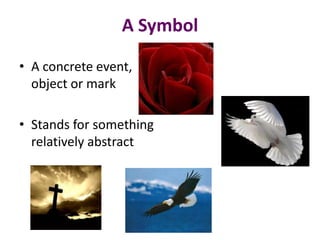
A Symbol
• A concrete event,
object or mark
• Stands for something
relatively abstract
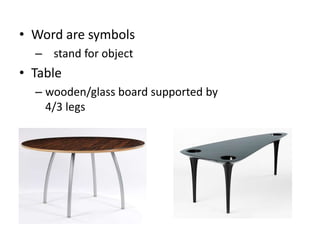
• Word are symbols
– stand for object
• Table
– wooden/glass board supported by
4/3 legs
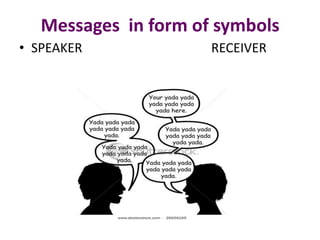
Messages in form of symbols
• SPEAKER RECEIVER
7. The Uniqueness of Human
Language
Human Language Vs.
Animal Communication
1. Displacement
• To talk about things, places
• To create fiction
• To yoke future, past, present
( far away in space and time )
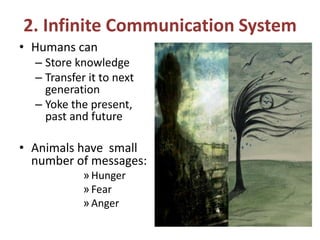
2. Infinite Communication System
• Humans can
– Store knowledge
– Transfer it to next
generation
– Yoke the present,
past and future
• Animals have small
number of messages:
»Hunger
»Fear
»Anger
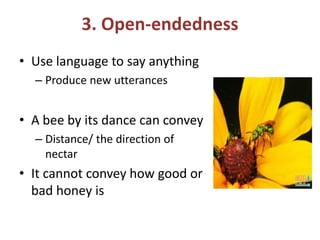
3. Open-endedness
• Use language to say anything
– Produce new utterances
• A bee by its dance can convey
– Distance/ the direction of
nectar
• It cannot convey how good or
bad honey is
4. Language is Flexible/OPEN-ENDED
– It is modifiable, Extendable
• It changes , grow
– New words’ addition
• Downloading, software, laser etc
• Animal communication system is closed
system
– A bee’s dance
– cock’s crow
– AS the same as that were 200 years ago
5. Discreteness
• Clear
• Distinguishable
• Separate
• Identifiable symbols
6. Structural Complexity
• English (RP variety) has 44 sounds
– Form thousands of words (475000)
• Millions of sentences
• Internal structure of sentence
• No complexity in monkey’s cry etc
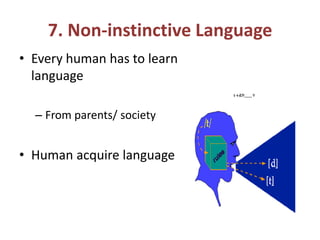
7. Non-instinctive Language
• Every human has to learn
language
– From parents/ society
• Human acquire language
What is Language

What is Language

  • 1.
    What is Language? University ofthe Punjab , Department of English Language & Literature. Lahore, Pakistan
  • 2.
    LANGUAGE A Skill • Somethingwe do – He speaks well but writes badly. KNOWLEDGE • Something we know – I don’t know much Italian.
  • 3.
    LANGUAGE A Possession • Somethingwe have/possess – I haven’t much French. A Tool • Something we use – What words can I use to describe her?
  • 4.
    LANGUAGE An Event • Somethingwhich happens – I was in the office when the conversation took place. A Group Identity • Something which transmits culture – It is only through our language that we can truly express our identity.
  • 5.
    LANGUAGE An Object • Somethingwhich we can describe – This language has a complex structure. A Living Organism • Something which is born, lives and dies – Gradually a new language was born. – The 18th century saw a flowering of the language. – That’s a dead language
  • 6.
    LANGUAGE • The mostvaluable possession of man • Difficult to think of a society without Language
  • 8.
    Robins • Language isA SYMBOL SYSTEM – Based on Arbitrary conventions • Infinitely EXTENDABLE & MODIFIABLE – To changing needs and conditions of the speaker
  • 9.
    Sapir • Language is Apurely human & non-instinctive – Method of communication • Humans ---- species-specific, species-uniform • Non-instinctive --- A child has to learn Language of his society
  • 10.
    Chomsky • A Languageis a – SET OF SENTENCES – Finite or infinite • Each finite in length – Constructed out of a finite set of elements.
  • 12.
    1. A Meansof Communication
  • 14.
  • 15.
    Others Means ofCommunication • Gesture • Nods • Winks • Flags • Smiles • Horns • Short-hand • Dancing
  • 16.
    Others Means ofCommunication • Braille Alphabet • Mathematical Symbols • Morse Code • Sirens • Sketches • Maps • Acting • Miming
  • 17.
    Other System Vs.Language • Extremely Limited • Not Flexible • Not Comprehensive • Not Perfect • Not Extensive
  • 18.
    Language A Carrier •It conveys/carries »Human thoughts »Philosophy »Culture »Civilization • Shapes »people’s thought • Guides/control »activities
  • 19.
    Language is Ubiquitous •Present everywhere – in all activities • As important as the air we breathe
  • 20.
    Species-specific • Only Humansare blessed with language • Specific property of humans • Humans are called talking animals
  • 22.
    Language is Arbitrary •No inherent/basic relation between the words of language and their meanings
  • 23.
    No reason whya female called: • Woman English • Istree Hindi • Aurat Urdu • Zen Persian • Femine French • Selection of these words in the language is purely arbitrary, an accident of history
  • 24.
    Advantages of LanguageArbitrariness • Variety of Languages • There would have been only one language • Permits change • Its conventionality gives it stability
  • 25.
    Onomatopoeia • Words thatimitate the sounds they stand for: – Bang – Buzz – Splash etc • Such words do have some relation with the meanings/ ideas they stand for • Not completely intrinsic relationship – Kokla doo dle do
  • 27.
    • Made upof vocal sounds • Produced by Physiological articulatory mechanism
  • 28.
    Speech Primary, WritingSecondary • A child learns to speak first – Writing comes much later • A man speaks much more – than he writes • Writing – Graphic representation of vocal sounds – Letters K , Q /k/ • Total quantum of speech is > T.Q. written material
  • 29.
    Advantage of writing •Pen is mightier than the sword • It could be preserved in books or record
  • 30.
    Primacy of Speechover Writing • Spoken words are powerful • Can be preserved: – audio cassettes – Tape recorders
  • 31.
  • 32.
    An organized combinationof elements • Small number of meaningless elements (sounds/words) in combination produce a large number of meaningful elements • These systems operate at two levels: – Phonological – Syntactical
  • 33.
    Phonological Level • Toform meaningful units/ words • Sounds are arranged in certain established systematic order Cat /k t/ Act / k t/ Pat /p t/ Tap /t p/ Pack / p k/
  • 34.
    Syntactical Level • Toframe acceptable meaningful sentences – Words are arranged in particular system – (grammatical/ structural rules) ‘(The hunter) (shot) (the tiger) (with a gun)’. ‘The tiger shot a gun with hunter the’.
  • 36.
    A Form ofsocial Behaviour • A child picks up the language of the social set-up • And learns to speak community language • A Chinese infant if placed in an Indian family – Will easily learn to speak an Indian language
  • 38.
    A Symbol • Aconcrete event, object or mark • Stands for something relatively abstract
  • 39.
    • Word aresymbols – stand for object • Table – wooden/glass board supported by 4/3 legs
  • 40.
    Messages in formof symbols • SPEAKER RECEIVER
  • 41.
    7. The Uniquenessof Human Language Human Language Vs. Animal Communication
  • 42.
    1. Displacement • Totalk about things, places • To create fiction • To yoke future, past, present ( far away in space and time )
  • 43.
    2. Infinite CommunicationSystem • Humans can – Store knowledge – Transfer it to next generation – Yoke the present, past and future • Animals have small number of messages: »Hunger »Fear »Anger
  • 44.
    3. Open-endedness • Uselanguage to say anything – Produce new utterances • A bee by its dance can convey – Distance/ the direction of nectar • It cannot convey how good or bad honey is
  • 45.
    4. Language isFlexible/OPEN-ENDED – It is modifiable, Extendable • It changes , grow – New words’ addition • Downloading, software, laser etc • Animal communication system is closed system – A bee’s dance – cock’s crow – AS the same as that were 200 years ago
  • 46.
    5. Discreteness • Clear •Distinguishable • Separate • Identifiable symbols
  • 47.
    6. Structural Complexity •English (RP variety) has 44 sounds – Form thousands of words (475000) • Millions of sentences • Internal structure of sentence • No complexity in monkey’s cry etc
  • 48.
    7. Non-instinctive Language •Every human has to learn language – From parents/ society • Human acquire language